
In the pursuit of higher performance in power transmission systems, gear design continuously evolves. This analysis focuses on a comparative study of the structural strength under load for three types of gear pairs: the standard involute spur gear, the common involute helical gear, and a specialized variant known as the double-helical bevel gear. The double-helical bevel gear presents a unique design where the left and right flanks of the tooth are manufactured with different helix angles. This configuration introduces a slight conical shape to the gear tooth along its axis. The primary advantage of this design is the ability to precisely adjust the backlash of the meshing pair by axially shifting one gear relative to its mate, making it exceptionally suitable for applications requiring精密传动 (precision transmission). Furthermore, as its teeth are essentially composed of two helical gear flanks, it inherits favorable characteristics from standard helical gears, such as smoother engagement and higher potential contact ratio. This work employs a rigorous finite element analysis (FEA) methodology to evaluate and compare the contact and bending stresses in these three gear types under identical operating conditions, providing a foundational understanding of the double-helical bevel gear’s mechanical behavior.
Methodology: Finite Element Model Development
The foundation of an accurate FEA lies in the creation of a precise geometric model. For this study, all three-dimensional solid models of the gear pairs were parametrically generated. The core of the tooth profile generation lies in the mathematical definition of the involute curve and the trochoidal fillet.
Gear Geometry and Mathematical Foundation
For the helical gear and the double-helical bevel gear, the tooth profile is defined on the transverse (cross-sectional) plane. The coordinates for the transverse involute curve are given by:
$$
\begin{cases}
x = r_b \sin(\lambda) – r_b \lambda \cos(\lambda) \\
y = r_b \cos(\lambda) + r_b \lambda \sin(\lambda)
\end{cases}
$$
where \( r_b \) is the base circle radius and \( \lambda \) is the roll angle on the base circle. The pressure angle \( \alpha_t \) in the transverse plane is related to the normal pressure angle \( \alpha_n \) and the helix angle \( \beta \) by \( \tan(\alpha_t) = \tan(\alpha_n) / \cos(\beta) \).
The transition from the involute to the root circle, often a trochoid generated by the tip of the cutting tool, is described by:
$$
\begin{cases}
x = (r_p’ + h_a^{*}m_n – \rho_a^{*}) \sin(\theta) + \rho_a^{*} \cos(\pi/2 – \psi + \theta) \\
y = (r_p’ + h_a^{*}m_n – \rho_a^{*}) \cos(\theta) – \rho_a^{*} \sin(\pi/2 – \psi + \theta)
\end{cases}
$$
where:
\( r_p’ \) is the pitch radius of the generating rack relative to the gear.
\( h_a^{*}m_n \) is the addendum of the tool.
\( \rho_a^{*} \) is the tip radius of the cutting tool.
\( \theta \) and \( \psi \) are angular parameters derived from the gear geometry and tool positioning.
For the standard spur gear, the profile is simply the planar involute, defined by the parametric equations where the parameter \( u \) is the involute roll angle:
$$
\begin{cases}
x = \frac{m_n z}{2} \cos(\alpha_n) (\sin(u) – u \cos(u)) \\
y = \frac{m_n z}{2} \cos(\alpha_n) (\cos(u) + u \sin(u))
\end{cases}
$$
Here, \( m_n \) is the normal module and \( z \) is the number of teeth. The double-helical bevel gear model was constructed by creating two separate helical gear segments with equal but opposite-signed helix angles for their respective flanks and merging them into a single gear body, resulting in a tooth whose thickness varies linearly along the face width.
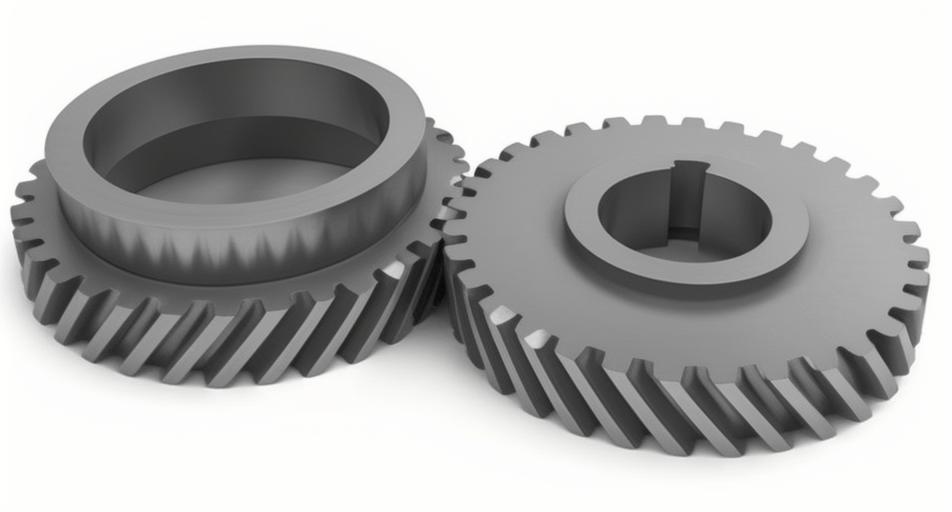
The common design parameters for all analyzed gear pairs are summarized in Table 1, ensuring a consistent basis for comparison. A key distinction is that for the double-helical bevel gear, the helix angle \( \beta \) takes two values (e.g., +2° and -2°) for the two flanks.
| Parameter | Pinion | Gear |
|---|---|---|
| Number of Teeth, \( z \) | 20 | 20 |
| Normal Module, \( m_n \) (mm) | 3 | 3 |
| Face Width, \( b \) (mm) | 15 | 15 |
| Helix Angle, \( \beta \) (°) (for helical/double-helical) |
+2 / ±2* | +2 / ±2* |
| Normal Pressure Angle, \( \alpha_n \) (°) | 20 | 20 |
| Addendum Coefficient, \( h_a^* \) | 1 | 1 |
| Dedendum Coefficient, \( c^* \) | 0.25 | 0.25 |
| Profile Shift Coefficient, \( x \) | 0 | 0 |
*Double-helical bevel gear uses two values for opposite flanks.
Finite Element Model Setup and Loading
The generated solid models were discretized into finite element meshes. The material was defined as 40Cr alloy steel with an elastic modulus \( E = 2.06 \times 10^5 \) MPa and a Poisson’s ratio \( \nu = 0.3 \). SOLID185 elements were used for the gear bodies. To accurately capture contact stresses, surface-to-surface contact pairs were defined using CONTA174 and TARGE170 elements on the potentially contacting tooth flanks.
A three-tooth segment model was used for efficiency while maintaining accuracy near the loaded tooth. The mesh was refined in the contact region and at the tooth root fillet, where high stress gradients are expected. A mapped meshing technique was applied to the teeth, while a free mesh was used for the gear core.
The boundary conditions and loading were applied to simulate a static torque transmission event. The driven gear’s inner bore surface was fully constrained. A driving torque \( T = 50 \) N·m was applied to the pinion. This torque was converted into a tangential force \( F_t \) distributed as nodal forces on the pinion’s inner bore nodes in the cylindrical coordinate system:
$$
F_{node} = \frac{T}{r_{bore} \cdot N_{node}}
$$
where \( r_{bore} \) is the bore radius and \( N_{node} \) is the total number of nodes on the bore surface where the force is applied.
Analysis Results and Discussion
The finite element analysis was performed for several key meshing positions within one mesh cycle. The meshing position is characterized by the angle of rotation \( \theta \) of the pinion, where \( \theta = 0^\circ \) corresponds to the pitch point contact at the mid-face width. Negative angles indicate contact moving towards the pinion’s dedendum.
Contact Stress Comparison
The maximum contact (Hertzian) stress on the pinion tooth surface was extracted for each gear type at various meshing positions. The results are consolidated in Table 2.
| Pinion Rotation Angle, \( \theta \) (°) | Spur Gear (MPa) | Helical Gear (MPa) | Double-Helical Bevel Gear (MPa) |
|---|---|---|---|
| +9 | 223.4 | 219.0 | 220.0 |
| +6 | 218.1 | 212.7 | 210.0 |
| +3 | 300.0 | 270.2 | 279.0 |
| 0 | 337.6 | 317.5 | 321.9 |
| -3 | 289.6 | 278.0 | 279.0 |
| -6 | 210.0 | 194.7 | 203.8 |
| -9 | 216.0 | 206.0 | 210.0 |
The analysis reveals a consistent trend: the standard helical gear exhibits the lowest contact stresses across most meshing positions. This is attributed to the longer line of contact characteristic of a helical gear, which distributes the load over a larger area compared to the point contact of a spur gear. The double-helical bevel gear shows contact stress values that lie between those of the spur gear and the standard helical gear. While it benefits from the inclined contact line of a helical gear flank, the varying tooth thickness slightly modifies the local contact geometry and compliance, leading to stresses marginally higher than in a symmetric helical gear. The peak stress for all types occurs near the pitch point ( \( \theta = 0^\circ \) ), which aligns with theoretical expectations for single-tooth-pair contact regions.
Bending Stress Analysis
In gear strength evaluation, the tensile bending stress at the tooth root fillet on the loaded side is critical, as cracks initiating in tension tend to propagate more rapidly. The stress distribution along the face width from the thin end (0 mm) to the thick end (15 mm) of the double-helical bevel gear tooth was examined and compared with the uniform stress across the face of the spur and standard helical gear.
The results indicate a significant effect of the tapered tooth geometry. At the thinner end of the double-helical bevel gear tooth, the bending tensile stress is notably higher than the constant stress level found in the spur and standard helical gear. This is a direct consequence of the reduced sectional modulus at that cross-section. Towards the central and thicker regions of the face width, the bending stress in the double-helical bevel gear decreases and becomes comparable to, or even slightly lower than, that of the other two gear types. This non-uniform stress distribution is a key design consideration for the double-helical bevel gear, suggesting that the thin end could be a potential failure initiation point under high cyclic bending loads. The magnitude of this stress concentration can be controlled by the choice of the two helix angles; smaller differential angles result in less taper and a more uniform stress distribution.
Load Sharing Between Multiple Tooth Pairs
An advantage of helical gear designs is their typically higher contact ratio, leading to multiple tooth pairs sharing the load simultaneously. The load-sharing ratio \( \gamma_i \) for a given tooth pair \( i \) is defined as the fraction of the total transmitted load it carries:
$$
\gamma_i = \frac{P_i}{P_{total}}
$$
where \( P_i \) is the load carried by the \( i \)-th tooth pair and \( P_{total} \) is the total tangential load derived from the applied torque. By extracting reaction forces from the finite element model, the load distribution among consecutive tooth pairs was determined for the double-helical bevel gear at various engagement phases, as shown in Table 3. For example, at \( \theta = -3^\circ \), the first pair carries about 12% of the load while the second carries nearly 88%, demonstrating effective load sharing. This multi-pair contact contributes to the smoother operation and higher load capacity associated with helical gear configurations, a benefit retained by the double-helical bevel design.
| Pinion Angle, \( \theta \) (°) | Load on 1st Pair (%) | Load on 2nd Pair (%) | Load on 3rd Pair (%) |
|---|---|---|---|
| -9 | 35.32 | 64.68 | – |
| -6 | 25.20 | 74.80 | – |
| -3 | 12.02 | 87.98 | – |
| +3 | 85.74 | 14.26 | – |
| +6 | 62.50 | 37.50 | – |
| +9 | 53.46 | 46.54 | – |
Conclusion
This detailed finite element-based investigation provides a quantitative comparison of the mechanical performance of spur, helical, and double-helical bevel gears under identical operational parameters. The standard helical gear consistently demonstrates superior contact stress characteristics due to its favorable line contact. The double-helical bevel gear, while offering the unique functional advantage of adjustable backlash, exhibits contact stress levels that are intermediate between spur and helical gears. Its most distinctive feature is the non-uniform bending stress distribution along the face width, with the thinner end of the tooth being critically loaded. This stress pattern is a direct design consequence of the dual-helix-angle architecture. However, this characteristic can be managed by optimizing the selected helix angles to minimize the taper. Furthermore, the analysis confirms that the double-helical bevel gear maintains the beneficial load-sharing behavior of a conventional helical gear, contributing to its potential for smooth and reliable operation in precision transmission systems. The findings establish a fundamental theoretical framework for the strength assessment and practical application of the double-helical bevel gear.