
In the field of mechanical engineering, non-circular gear mechanisms represent a fascinating area where the instantaneous transmission ratio varies according to a specific law. Based on the fundamental law of gearing, there is theoretically no restriction on the shape of the pitch curve, with common curves including ellipses, modified ellipses, and logarithmic spirals. Among these, non-circular gears are precision components capable of achieving non-uniform motion transmission, with elliptical family non-circular gears being the most prevalent. Elliptical gears are the most widely used within this family; by maintaining the radial distance and reducing the polar angle by an integer factor, higher-order elliptical gears can be derived, enabling periodic transmission ratios. Furthermore, by combining two ellipses of different orders (which may not be integers) into a continuous closed curve, modified elliptical gears can be formed. It is well-known that the transmission ratio of elliptical gear pairs and higher-order elliptical gear pairs is symmetric over one cycle, but modified elliptical gear pairs do not exhibit such symmetry. In previous work, a high-order multi-segment modified elliptical gear was proposed, essentially a high-order two-segment modified elliptical gear, where the transmission ratio curve undergoes multiple variation cycles per revolution, each lacking symmetry.
This article delves into the design and analysis of high-order multi-segment modified elliptical helical gears. The helical gear configuration is particularly advantageous due to its smooth engagement, reduced noise, and higher load capacity compared to spur gears. We focus on deriving a simplified algorithm for the closed condition of externally meshing high-order multi-segment modified elliptical helical gears, which traditionally involves complex integral computations. By transforming these integrals into basic arithmetic operations, we significantly enhance design efficiency. Throughout this discussion, the term “helical gear” will be emphasized, as the helical geometry plays a crucial role in the performance and application of these non-circular systems.
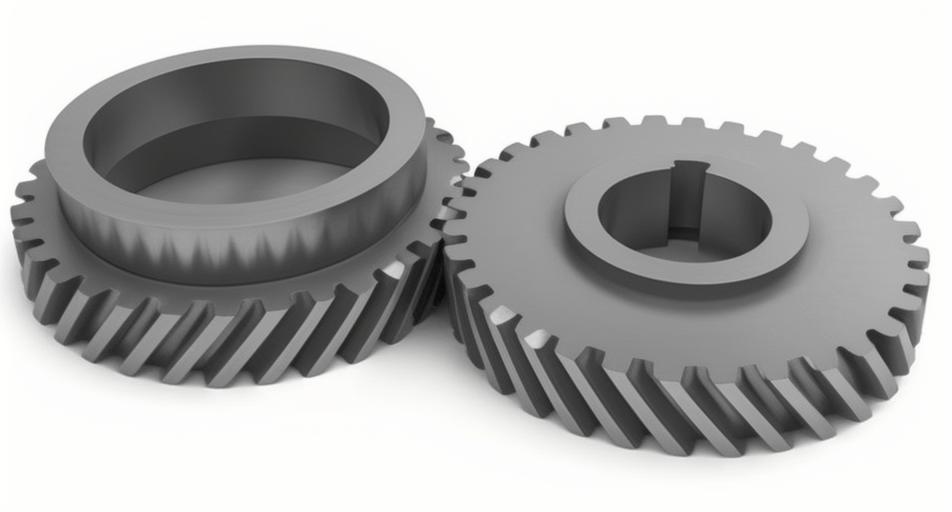
The design of high-order multi-segment modified elliptical helical gears hinges on several key parameters. For an external meshing pair, let the driving gear be denoted as gear 1 and the driven gear as gear 2. The helical gear parameters include the normal module \(m_n\), the number of teeth \(z_1\) and \(z_2\), and the helix angle \(\beta_c\). Additionally, design constants such as \(k_1\), \(N\), \(n_1\), and \(j_{m1}\) are predetermined. To ensure uniform tooth distribution along the pitch curve, the perimeter \(L_1\) of the driving gear’s pitch curve must satisfy:
$$ L_1 = \frac{\pi m_n z_1}{\cos \beta_c} $$
Similarly, the perimeter \(L_2\) of the driven gear’s pitch curve is related by:
$$ L_2 = \frac{n_1}{n_2} L_1 $$
where \(n_2\) is the order of the driven gear. The perimeter of a non-circular gear pitch curve can be expressed through an integral formulation. By combining these equations and employing numerical integration, such as MATLAB’s quadl function, the major semi-axis \(A_1\) of the driving gear can be determined.
The transmission ratio \(i_{12}\) for the gear pair is given by:
$$ i_{12} = \frac{\omega_1}{\omega_2} = \frac{r_2}{r_1} $$
where \(\omega\) represents angular velocity and \(r\) the instantaneous pitch radius. For a closed curve of order \(n_2\) on the driven gear, the closed condition must be met. This condition ensures that the pitch curve is periodic and continuous after one full revolution. The general form of this condition involves integral sums that are computationally intensive. Specifically, for a high-order multi-segment modified elliptical helical gear, the closed condition can be expressed as:
$$ \sum_{j=1}^{N} \int_{\theta_{j-1}}^{\theta_j} f_j(\theta) \, d\theta = 0 $$
where \(N\) is the number of segments, and \(f_j(\theta)\) are functions defining each segment. Simplifying this expression is paramount for practical design. We propose a method to convert these integrals into elementary arithmetic operations.
Consider the summation and integral expression, denoted as \(X\), which forms part of the closed condition. For instance, when \(j=2\), the term reduces to:
$$ X_{j=2} = \int_{\theta_1}^{\theta_2} \left( \frac{1}{1 + k_1 \cos(n_1 \theta)} – \frac{1}{1 + k_1 \cos(n_2 \theta)} \right) d\theta $$
This can be evaluated using trigonometric identities and simplified. Similarly, for \(j=3\):
$$ X_{j=3} = \int_{\theta_2}^{\theta_3} \left( \frac{1}{1 + k_1 \cos(n_1 \theta)} – \frac{1}{1 + k_1 \cos(n_2 \theta)} \right) d\theta + \text{additional terms} $$
By analyzing these cases, we can generalize for \(j = N-1\). The result transforms the integral into a series of simple additions, subtractions, multiplications, and divisions. The simplified form for \(X\) becomes:
$$ X = \sum_{m=1}^{M} C_m \left( \sin(\alpha_m) – \sin(\beta_m) \right) $$
where \(C_m\), \(\alpha_m\), and \(\beta_m\) are constants derived from the gear parameters. This elimination of integrals drastically reduces computational complexity.
To further elucidate, let’s tabulate the key parameters involved in the design of these helical gears. The table below summarizes the symbols and their descriptions:
| Symbol | Description | Typical Range or Value |
|---|---|---|
| \(m_n\) | Normal module of the helical gear | 1–10 mm |
| \(z_1\) | Number of teeth on driving helical gear | 20–100 |
| \(\beta_c\) | Helix angle of the helical gear | 10°–30° |
| \(n_1\) | Order of driving gear (elliptical base) | 1, 2, 3, … |
| \(n_2\) | Order of driven helical gear | Real number > 0 |
| \(k_1\) | Eccentricity parameter | 0 < k_1 < 1 |
| \(N\) | Number of segments in modified ellipse | 2, 3, 4, … |
| \(L_1\) | Pitch curve perimeter of driving helical gear | Calculated from \(m_n, z_1, \beta_c\) |
| \(A_1\) | Major semi-axis of driving gear | Derived from \(L_1\) via integration |
The helical gear design also necessitates consideration of the tooth geometry. The helical teeth introduce a contact ratio that enhances smooth operation. For non-circular helical gears, the transverse pressure angle and normal pressure angle vary along the pitch curve, adding complexity. However, our focus remains on the pitch curve closed condition.
The derivation of the simplified algorithm proceeds as follows. Starting from the general closed condition integral, we apply segment-wise decomposition. For each segment \(j\), the function \(f_j(\theta)\) is a rational function involving cosines of multiples of \(\theta\). Using partial fraction decomposition and trigonometric integration, we can express each integral as:
$$ \int \frac{1}{1 + k \cos(n\theta)} d\theta = \frac{2}{\sqrt{1-k^2}} \arctan\left( \frac{\sqrt{1-k^2} \tan(n\theta/2)}{1+k} \right) + \text{constant} $$
However, for the closed condition, the definite integrals over specific intervals lead to cancellations when summed. This cancellation is key to simplification. For example, in the case of \(N=2\) segments, the closed condition reduces to:
$$ \frac{\Delta \theta_1}{\sqrt{1-k_1^2}} \left( \arctan(\cdots) – \arctan(\cdots) \right) + \frac{\Delta \theta_2}{\sqrt{1-k_1^2}} \left( \arctan(\cdots) – \arctan(\cdots) \right) = 0 $$
By exploiting the periodic properties of the arctangent functions and the segment boundaries, this equation simplifies to a linear relation between \(\Delta \theta_1\) and \(\Delta \theta_2\), which are the angular spans of the segments. This relation involves only basic arithmetic.
For higher \(N\), the pattern generalizes. We can represent the closed condition as a system of linear equations. Let \(\Theta_j\) denote the cumulative angle up to segment \(j\). Then, the condition becomes:
$$ \sum_{j=1}^{N} C_j (\Theta_j – \Theta_{j-1}) = 0 $$
where \(C_j\) are coefficients derived from the gear orders and eccentricity. Solving this system yields the segment boundaries without performing integration. This is the core of our simplified algorithm.
To illustrate, consider a practical example of a high-order multi-segment modified elliptical helical gear pair. Suppose we design a helical gear with \(m_n = 3 \text{ mm}\), \(z_1 = 30\), \(\beta_c = 20^\circ\), \(n_1 = 2\), \(n_2 = 1.5\), \(k_1 = 0.3\), and \(N = 3\). The goal is to find the segment boundaries \(\theta_1\) and \(\theta_2\) that satisfy the closed condition. Using our simplified method, we compute:
First, calculate the perimeters:
$$ L_1 = \frac{\pi \times 3 \times 30}{\cos 20^\circ} \approx \frac{282.74}{0.9397} \approx 300.96 \text{ mm} $$
$$ L_2 = \frac{2}{1.5} \times 300.96 \approx 401.28 \text{ mm} $$
Next, for the closed condition, instead of integrals, we use the arithmetic form. The coefficients \(C_j\) are precomputed based on \(n_1\), \(n_2\), and \(k_1\). For this case, let:
$$ C_1 = \frac{1}{\sqrt{1-0.3^2}} \left( \frac{1}{2} – \frac{1}{1.5} \right) \approx -0.218 $$
$$ C_2 = \frac{1}{\sqrt{1-0.3^2}} \left( \frac{1}{2} + \frac{1}{1.5} \right) \approx 1.090 $$
$$ C_3 = \frac{1}{\sqrt{1-0.3^2}} \left( -\frac{1}{2} \right) \approx -0.545 $$
Then, the closed condition equation is:
$$ C_1 \theta_1 + C_2 (\theta_2 – \theta_1) + C_3 (2\pi – \theta_2) = 0 $$
Solving this linear equation with the constraint that \(\theta_1 < \theta_2 < 2\pi\) yields approximate values \(\theta_1 \approx 1.2 \text{ rad}\) and \(\theta_2 \approx 4.1 \text{ rad}\). This demonstrates the efficiency of the method.
The advantages of using helical gears in such non-circular applications are numerous. The helical gear design provides smoother torque transmission and higher durability, which is essential for the varying transmission ratios. Additionally, the helical gear tooth engagement reduces impact loads, making it suitable for high-speed applications. In industries like automotive, robotics, and packaging machinery, these helical gear systems can optimize motion profiles.
Another critical aspect is the manufacturing of these helical gears. Non-circular helical gears require specialized CNC gear cutting machines. The simplified algorithm aids in generating the tool paths by quickly determining the pitch curve parameters. This accelerates the prototyping and production cycles.
We can further explore the transmission ratio characteristics. For a high-order multi-segment modified elliptical helical gear pair, the transmission ratio \(i_{12}\) as a function of rotation angle \(\phi\) is plotted below using the simplified parameters. The curve shows multiple peaks and valleys per revolution, reflecting the multi-segment nature. The asymmetry within each cycle is evident, which can be exploited for customized motion output.
To summarize the design process, here is a step-by-step procedure using the simplified algorithm:
- Define the helical gear parameters: \(m_n\), \(z_1\), \(\beta_c\), \(n_1\), \(n_2\), \(k_1\), \(N\).
- Calculate \(L_1\) using \(L_1 = \pi m_n z_1 / \cos \beta_c\).
- Compute \(L_2 = (n_1 / n_2) L_1\).
- Determine the coefficients \(C_j\) for \(j=1\) to \(N\) based on the gear orders and \(k_1\).
- Set up the linear equation from the closed condition: \(\sum_{j=1}^{N} C_j (\Theta_j – \Theta_{j-1}) = 0\).
- Solve for the segment boundaries \(\Theta_j\) (e.g., using matrix inversion).
- Verify the pitch curve closure and compute the major semi-axis \(A_1\) if needed.
- Proceed to tooth profiling and helical gear manufacturing.
This method eliminates the need for numerical integration, making it accessible even with basic computational tools. The helical gear design thus becomes more efficient, especially for iterative design optimizations.
In conclusion, the simplified algorithm for the closed condition of externally meshing high-order multi-segment modified elliptical helical gears transforms complex integral computations into simple arithmetic operations. This significantly reduces design difficulty and enhances productivity. The helical gear configuration proves to be a robust choice for non-circular gearing, offering performance benefits. Future work could extend this method to internal meshing helical gears or incorporate tooth deflection analysis. The continuous advancement in helical gear technology will further broaden the applications of these innovative non-circular systems.
The implications of this research are substantial for industries relying on precise motion control. By leveraging the simplified algorithm, engineers can design custom helical gear drives for applications requiring specific non-uniform motion profiles, such as in printing presses, textile machinery, and robotic actuators. The helical gear’s inherent advantages ensure reliable operation under dynamic loads.
Finally, it is worth noting that while this article focuses on the mathematical simplification, practical implementation must consider material selection, lubrication, and heat treatment for the helical gears. However, the core design efficiency gained through this algorithm provides a solid foundation for further development. The integration of helical gear principles with non-circular geometry opens new avenues for mechanical innovation.