
The reliable operation of power transmission systems in heavy industries, such as metallurgy and rolling mills, is paramount for productivity and safety. Central to these systems are gear drives, with helical gear pairs being a prevalent choice for their smooth engagement, high load capacity, and reduced noise compared to spur gears. However, under severe operating conditions involving high torque and dynamic shocks, these components are susceptible to failure. A common and catastrophic failure mode is the bending fatigue fracture originating at the tooth root fillet. This paper presents a detailed finite element analysis (FEA) case study investigating the bending and contact stress states in a failing industrial helical gear set, focusing on the critical influence of the contact path along the face width.
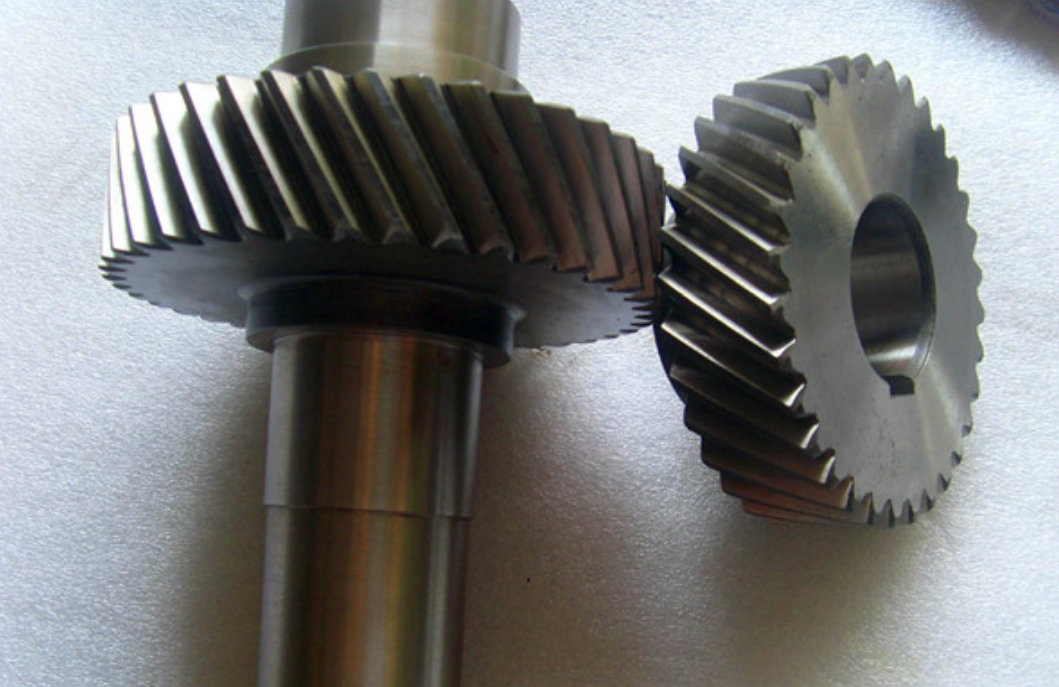
The inherent complexity of a helical gear mesh lies in the progressive and simultaneous engagement of teeth along a diagonal contact line. Unlike spur gears, the contact on a single tooth pair does not occur instantaneously across the entire face width. It begins at one end of the tooth and moves diagonally across the face as the gears rotate. Consequently, the location of the maximum load application, or the “contact center,” shifts continuously during operation. This dynamic loading condition, combined with potential misalignments, makes the stress analysis of helical gear teeth particularly challenging and necessitates advanced computational methods like FEA for accurate prediction.
Theoretical Background and Stress Calculation
The fundamental stresses governing gear design are the contact (Hertzian) stress and the bending stress. For a helical gear, the nominal formulas account for the helical angle.
The contact stress at the pitch point can be estimated using a modified Hertzian contact formula, as often referenced in standards like ISO 6336 or AGMA 2001:
$$ \sigma_H = Z_E \cdot Z_H \cdot Z_\epsilon \cdot Z_\beta \cdot \sqrt{ \frac{F_t}{b \cdot d_1} \cdot \frac{u \pm 1}{u} \cdot K_A \cdot K_V \cdot K_{H\beta} \cdot K_{H\alpha} } $$
Where:
- $\sigma_H$ is the calculated contact stress.
- $Z_E$ is the elasticity factor.
- $Z_H$ is the zone factor.
- $Z_\epsilon$ is the contact ratio factor.
- $Z_\beta$ is the helix angle factor.
- $F_t$ is the nominal tangential load at the reference cylinder.
- $b$ is the face width.
- $d_1$ is the pinion reference diameter.
- $u$ is the gear ratio.
- $K_A$, $K_V$, $K_{H\beta}$, $K_{H\alpha}$ are application, dynamic, face load distribution, and transverse load distribution factors, respectively.
The bending stress at the tooth root is calculated using the Lewis formula extended for helical gears:
$$ \sigma_F = \frac{F_t}{b \cdot m_n} \cdot Y_F \cdot Y_S \cdot Y_\beta \cdot Y_B \cdot K_A \cdot K_V \cdot K_{F\beta} \cdot K_{F\alpha} $$
Where:
- $\sigma_F$ is the calculated bending stress.
- $m_n$ is the normal module.
- $Y_F$ is the form factor.
- $Y_S$ is the stress correction factor.
- $Y_\beta$ is the helix angle factor for bending.
- $Y_B$ is the rim thickness factor.
- $K_{F\beta}$ and $K_{F\alpha}$ are the face and transverse load distribution factors for bending.
These formulas provide nominal values but assume perfect alignment and uniform load distribution. In practice, especially in wide-face helical gears, edge loading due to deflection and misalignment can lead to severe stress concentrations not captured by these simple formulas. This is where FEA becomes indispensable.
Finite Element Modeling of the Helical Gear Pair
The case study involves a primary reduction helical gear set from a rolling mill drive. The failure involved tooth root breakage on the pinion. The first step was to establish an accurate three-dimensional model.
Gear Geometry and Material Properties
The helical gear geometry was defined by its basic parameters. A parametric modeling approach was used to generate the precise involute tooth profile with the specified helix angle.
| Parameter | Symbol | Pinion Value | Gear Value |
|---|---|---|---|
| Normal Module | $m_n$ | 28 mm | 28 mm |
| Number of Teeth | $z$ | 23 | 85 |
| Normal Pressure Angle | $\alpha_n$ | 20° | 20° |
| Helix Angle | $\beta$ | 10° | 10° |
| Face Width | $b$ | 700 mm | 700 mm |
| Profile Shift Coefficient | $x$ | +0.337 | -0.337 |
| Center Distance | $a$ | 1540 mm | |
The material properties for the FEA model were assigned based on the specified grades and heat treatments.
| Component | Material | Heat Treatment | Young’s Modulus, $E$ | Poisson’s Ratio, $\nu$ |
|---|---|---|---|---|
| Pinion | 17Cr2Ni2Mo | Case Carburized | 2.10e5 MPa | 0.30 |
| Gear | 42CrMo | Case Carburized | 2.06e5 MPa | 0.28 |
Mesh Generation and Contact Definition
A critical aspect of FEA for gear contact is mesh refinement. A coarse global mesh was used for the gear bodies to reduce computational cost, while a localized, finely discretized region was created around the potential contact zones on several tooth flanks. This “submodeling” or local refinement technique ensures accurate stress resolution where it matters most. High-order 3D solid elements (e.g., 10-node tetrahedral or 20-node hexahedral elements) were employed.
The contact between the pinion and gear teeth was modeled as a surface-to-surface contact pair. A finite sliding formulation was used to account for the relative motion. A Coulomb friction model with a conservative coefficient was applied to simulate the sliding friction component present in the gear mesh.
Boundary Conditions and Loading
Boundary conditions were applied to simulate the actual mounting and loading in the gearbox:
- The gear shaft ends were constrained in all translational degrees of freedom (DOF). The rotational DOF about the gear’s axis was left free for the driven member and constrained for the driver, depending on the analysis step.
- The pinion shaft ends were constrained radially and axially but were free to rotate about their axis.
- A pure torque, $T$, was applied to the pinion’s input shaft. The torque magnitude was calculated from the drive motor’s rated power and speed:
$$ T = 9550 \cdot \frac{P}{n} = 9550 \cdot \frac{8000 \text{ kW}}{180 \text{ rpm}} \approx 4.244 \times 10^5 \text{ Nm} $$
Analysis of Stress Under Different Contact Centers
To capture the worst-case stress scenario during the mesh cycle, analyses were performed with the contact center positioned at three critical locations along the face width: at the very end of the tooth ($Z=0$), at the quarter-face position ($Z=b/4=175$ mm), and at the mid-face position ($Z=b/2=350$ mm). The end-of-tooth contact represents a condition of potential edge loading or misalignment, which is often the most severe.
The FEA solved for the complete stress tensor at each node. Key results extracted were:
- Maximum Bending Stress ($\sigma_{Fmax}$): Typically the first principal stress ($\sigma_1$) found in the tension-side root fillet region.
- Maximum Contact Stress ($\sigma_{Hmax}$): The von Mises or Hertzian contact pressure on the tooth flank surface.
The following table summarizes the peak stress values obtained from the three analyses:
| Contact Center Position (Z) | Max. Bending Stress, $\sigma_{Fmax}$ (MPa) | Max. Contact Stress, $\sigma_{Hmax}$ (MPa) |
|---|---|---|
| 0 mm (End of Tooth) | 388.73 | 832.79 |
| 175 mm (Quarter Face) | 289.54 | 555.34 |
| 350 mm (Mid Face) | 252.22 | 449.34 |
The results clearly demonstrate a profound gradient. When the load is applied at the tooth end, both bending and contact stresses are significantly higher—over 50% greater in bending and 85% greater in contact compared to the mid-face loading condition. This vividly illustrates the detrimental effect of non-uniform load distribution across the face of a helical gear. The stress contours showed the bending stress concentration precisely at the root fillet on the tensile side, while the contact stress formed an elliptical patch near the pitch line, skewed towards the loaded end.
Strength Evaluation and Failure Root Cause Analysis
The FEA results, particularly from the worst-case end-loading scenario, were evaluated against the material endurance limits with appropriate safety factors according to gear rating standards.
Contact Strength Safety Factor
The contact safety factor $S_H$ is calculated as:
$$ S_H = \frac{\sigma_{Hlim} \cdot Z_{NT} \cdot Z_{LVR} \cdot Z_W \cdot Z_X}{\sigma_{H0}} $$
Where $\sigma_{H0}$ is the FEA-calculated stress (832.79 MPa) and $\sigma_{Hlim}$ is the permissible contact stress for the material. For the case-hardened pinion material, a typical $\sigma_{Hlim}$ is approximately 1121 MPa. Using standard factors for lifetime ($Z_{NT} \approx 1.0$), lubricant ($Z_{LVR} \approx 1.0$), work hardening ($Z_W \approx 1.0$), and size ($Z_X \approx 0.749$), the safety factor is:
$$ S_H = \frac{1121 \cdot 1.0 \cdot 1.0 \cdot 1.0 \cdot 0.749}{832.79} \approx 1.01 $$
This value, while above the absolute minimum of 1.0, indicates a design with very limited margin for contact fatigue (pitting), especially when considering dynamic overloads.
Bending Strength Safety Factor
The bending safety factor $S_F$ is calculated as:
$$ S_F = \frac{\sigma_{Flim} \cdot Y_{ST} \cdot Y_{NT} \cdot Y_{\delta rel} \cdot Y_{R rel} \cdot Y_X}{\sigma_{F0}} $$
Where $\sigma_{F0}$ is the FEA-calculated bending stress (388.73 MPa). The permissible bending stress $\sigma_{Flim}$ for high-grade case-hardened steel is around 500 MPa. Applying the relevant factors—stress correction ($Y_{ST}=2.0$), lifetime ($Y_{NT} \approx 1.1$), notch sensitivity ($Y_{\delta rel} \approx 0.95$), surface ($Y_{R rel} \approx 0.99$), and size ($Y_X \approx 0.75$):
$$ S_F = \frac{500 \cdot 2.0 \cdot 1.1 \cdot 0.95 \cdot 0.99 \cdot 0.75}{388.73} \approx 1.99 $$
However, a critical observation must be noted. The FEA provides the actual local stress. The factor $Y_{ST} \cdot Y_S$ is already embedded in the FEA result because the model includes the exact root fillet geometry. Therefore, for FEA-based validation, $\sigma_{Flim}$ should be compared directly to $\sigma_{F0}$ using a more fundamental fatigue limit. The endurance limit for bending fatigue of such materials, considering the stress concentration at the root, is often in the range of 350-400 MPa for high-cycle fatigue. Comparing the calculated 388.73 MPa to this range yields a safety factor very close to 1.0.
For a required minimum safety factor of $S_{Fmin} = 1.25$, the design is inadequate under the assumed end-loaded condition.
Identification of Failure Cause
The FEA-based strength evaluation points decisively to bending fatigue as the root cause of the pinion failure. Under the nominal rated torque, the localized bending stress at the tooth root, particularly if edge loading is present, approaches or exceeds the material’s endurance limit. In real-world operation, several aggravating factors come into play:
- Dynamic Loads: The rolling mill environment subjects the drive to shock loads and torque reversals, significantly increasing the peak bending stress beyond the nominal static analysis value.
- Misalignment: Any parallel misalignment of the pinion and gear shafts, or errors in helix angle, will force the load towards one end of the tooth, exactly replicating the high-stress $Z=0$ condition analyzed.
- Fatigue Crack Propagation: Once a micro-crack initiates at the root fillet (the point of maximum tensile stress), the cyclic loading from each mesh engagement causes the crack to propagate. This process continues until the remaining cross-section can no longer support the load, resulting in sudden tooth fracture.
The combination of a design with low bending margin, inevitable dynamic overloads, and probable misalignment created the perfect conditions for fatigue failure in this industrial helical gear.
Design Improvements and Preventive Measures
Based on the FEA findings, several corrective and preventive measures can be implemented to enhance the reliability of the helical gear drive:
- Gear Tooth Optimization:
- Profile and Lead Modifications: Introducing deliberate modifications to the tooth profile (tip and/or root relief) and lead (crowning or end relief) is the most effective way to mitigate edge loading. Lead crowning distributes the load more evenly across the face width by removing a small amount of material from the center of the tooth flank, ensuring contact occurs in the central region even under slight misalignment. This directly addresses the stress concentration seen in the $Z=0$ analysis.
- Optimized Root Fillet: The shape of the root fillet can be optimized using FEA to reduce the stress concentration factor ($K_f$). A smoother, larger radius fillet design, possibly generated by a full trochoidal tool path, can significantly lower the peak bending stress.
- Manufacturing and Assembly Controls:
- Precision Alignment: Implementing strict procedures and using laser alignment tools during assembly to minimize parallel and angular misalignment between the pinion and gear shafts is crucial.
- Quality Verification: Conducting metallurgical inspection (hardness testing, microstructure analysis) on new and failed gears ensures the heat treatment meets the specified case depth, hardness, and core properties required for high bending strength.
- Operational and Maintenance Strategies:
- Condition Monitoring: Implementing vibration analysis and periodic oil debris monitoring can provide early warnings of developing gear damage, such as pitting or cracking, allowing for intervention before catastrophic failure.
- Load Monitoring: Monitoring the actual torque in the drive system can help identify and potentially mitigate damaging overload events.
In the specific case study presented, the implementation of lead crowning on the gear teeth, coupled with meticulous realignment of the gearbox, successfully resolved the fracture issue. The modified helical gear set has operated reliably since, validating the conclusions drawn from the finite element stress analysis.
Conclusion
This comprehensive finite element analysis underscores the critical importance of evaluating the stress state in helical gears under realistic, non-uniform loading conditions. The study demonstrates that the location of the contact center along the tooth face width has a dramatic impact on both bending and contact stresses, with end-of-tooth contact representing a worst-case scenario that can precipitate bending fatigue failure. Traditional analytical formulas, while useful for initial design, may not capture these severe localized stress concentrations. FEA serves as an essential tool for identifying these risks, enabling root cause analysis of failures, and guiding effective design improvements such as profile and lead modifications. For critical applications involving wide-face helical gears in heavy industries, a robust design process must integrate advanced FEA simulations that account for potential misalignment and dynamic effects to ensure operational durability and prevent costly downtime.