
In modern mechanical transmission systems, helical gears are widely used due to their high load capacity, smooth operation, and reduced noise compared to spur gears. However, the complex multi-field coupling state in gear transmission, involving factors such as thermal effects, lubrication, and dynamic loads, necessitates advanced optimization techniques to enhance performance and durability. As an engineer specializing in gear design, I have extensively utilized Kisssoft software, a specialized tool for transmission system design, to analyze and optimize helical gear pairs. This software not only provides design solutions based on requirements but also considers real-world conditions like temperature and lubrication, making calculations more accurate. In this article, I will share my experience in optimizing the tooth profile of a helical gear pair from a reducer, focusing on eliminating stress concentration along the tooth width and reducing transmission error fluctuations. Through detailed analysis using Kisssoft, we explored various modification methods, including profile modification, crowning modification, and a combined approach, to improve strength, transmission performance, and meshing quality. The results demonstrate that comprehensive modification significantly enhances gear performance, aligning with practical applications.
Helical gears, characterized by their angled teeth, offer advantages in load distribution and noise reduction, but they are prone to issues like localized stress and vibration under heavy loads. The optimization of helical gear tooth profiles is crucial to mitigate these problems. Key parameters for evaluation include sliding ratio, safety factors, flash temperature, and transmission error. These metrics guide the modification process to ensure optimal performance. In this study, we based our analysis on a helical gear pair from a reducer with specific parameters, as shown in the table below. The input power was 240 kW, input speed was 1500 r/min, lubrication was oil bath (ISO-VG220), and calculations followed ISO 6336:2006 method B.
| Parameter | Pinion (Driving Gear) | Gear (Driven Gear) |
|---|---|---|
| Number of Teeth | 27 | 82 |
| Module (mm) | 5 | 5 |
| Pressure Angle (°) | 20 | 20 |
| Helix Angle (°) | 10 | 10 |
| Face Width (mm) | 100 | 100 |
| Profile Shift Coefficient | 0.3027 | 0.3842 |
| Material and Heat Treatment | 12Cr2Ni4A, carburized and hardened, surface hardness 58-62 HRC | 20CrMo, carburized and hardened, surface hardness 58-62 HRC, core hardness ≥35 HRC |
The initial design of this helical gear pair, without any modification, exhibited significant issues. Using Kisssoft, we analyzed the load distribution, and the results revealed stress concentration along the tooth width direction, with a maximum unit load of approximately 1000 N/mm. This concentration led to increased dynamic loads, vibration, and noise, ultimately reducing the lifespan of the helical gears. The transmission error curve showed sharp fluctuations, indicating poor meshing quality. To address these problems, we focused on tooth modification techniques, which involve altering the tooth profile to compensate for deformations and errors during operation. Modification can be applied through profile modification (tip or root relief), crowning modification (barreling along the tooth width), or a combination of both. The goal is to achieve uniform load distribution, minimize transmission error, and enhance safety factors.
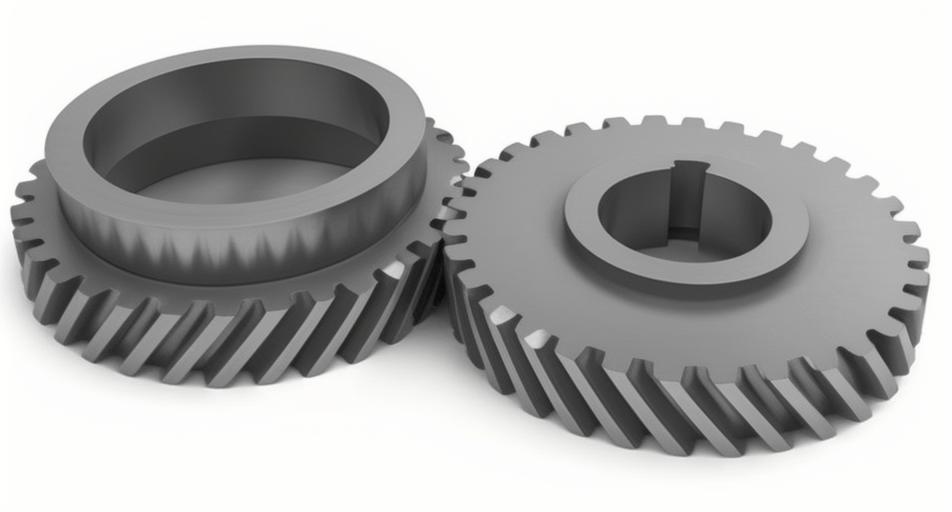
Before delving into the modification process, it is essential to understand the evaluation parameters for helical gear optimization. These parameters serve as benchmarks for assessing the effectiveness of tooth profile changes. First, the sliding ratio is a critical factor in determining wear and friction. It is defined as the relative sliding velocity between mating teeth normalized by the rolling velocity. For helical gears, a balanced sliding ratio between the pinion and gear helps minimize wear and improve longevity. Ideally, the sliding ratio should range between -1 and 1 for optimal performance, or between -2 and 2 for acceptable conditions. The sliding ratio can be expressed mathematically for a point on the tooth profile. For helical gears, the sliding ratio $\eta$ is given by:
$$ \eta = \frac{v_s}{v_r} $$
where $v_s$ is the sliding velocity and $v_r$ is the rolling velocity. In practice, Kisssoft calculates this based on gear geometry and operating conditions.
Second, safety factors are vital to prevent failures such as tooth breakage and pitting. The minimum bending fatigue safety factor $S_{Fmin}$ and the minimum contact fatigue safety factor $S_{Hmin}$ are evaluated according to standards like ISO 6336. For general reliability, $S_{Fmin} \geq 1.25$ and $S_{Hmin} \geq 1$, while for high reliability, $S_{Fmin} \geq 1.6$ and $S_{Hmin} \geq 1.25$. These factors depend on material properties, load conditions, and tooth geometry. For helical gears, the bending stress $\sigma_F$ and contact stress $\sigma_H$ are calculated using modified Lewis and Hertz equations, respectively. The safety factors are then derived as:
$$ S_F = \frac{\sigma_{F \lim}}{\sigma_F} \quad \text{and} \quad S_H = \frac{\sigma_{H \lim}}{\sigma_H} $$
where $\sigma_{F \lim}$ and $\sigma_{H \lim}$ are the allowable bending and contact stresses.
Third, flash temperature is a key concern in helical gear operation, as high temperatures can lead to thermal deformation, scuffing, and lubrication breakdown. The flash temperature theory, proposed by Block, estimates the instantaneous temperature rise at the contact point due to friction. For helical gears, the flash temperature $T_{ft}$ is calculated as:
$$ T_{ft} = T_b + \Delta T_f $$
where $T_b$ is the bulk temperature and $\Delta T_f$ is the flash temperature rise. The formula for flash temperature rise is:
$$ \Delta T_f = 0.62 \cdot c_m \cdot \mu_{my} \cdot p_n^{0.75} \left( \frac{E_r}{\rho} \right)^{0.25} \cdot \frac{|u_1 – u_2|}{B \sqrt{u_1 + u_2}} $$
with the average local friction coefficient $\mu_{my}$ given by:
$$ \mu_{my} = 0.12 \frac{(p_n \cos \alpha_0 R_a)^{0.25}}{(\eta_a \sum_{i=1}^2 u_i)^{0.25}} $$
Here, $c_m$ is a weighting coefficient (typically 1.5), $p_n$ is the normal load per unit length, $E_r$ is the composite elastic modulus, $\rho$ is the composite curvature radius, $u_1$ and $u_2$ are the tangential velocities, $B$ is the thermal contact coefficient, $\alpha_0$ is the pressure angle, $R_a$ is the surface roughness, and $\eta_a$ is the dynamic viscosity of the lubricant at bulk temperature. Controlling flash temperature is crucial for preventing scuffing failures in helical gears.
Fourth, transmission error is a primary source of vibration and noise in gear systems. It arises from deviations between the theoretical and actual meshing positions due to elastic deformations under load. For helical gears, transmission error $TE$ is defined as:
$$ TE = E_A – F_A \delta_A $$
where $E_A$ is the composite deviation, $F_A$ is the normal load, and $\delta_A$ is the compliance coefficient at the meshing point. Minimizing transmission error through modification improves the dynamic performance of helical gears.
With these parameters in mind, we proceeded to optimize the helical gear pair using Kisssoft. The initial analysis, as mentioned, showed poor load distribution and high transmission error. We then applied three modification strategies: profile modification alone, crowning modification alone, and a combined modification (both profile and crowning). Profile modification involves removing material from the tip or root of the tooth to prevent interference and reduce impact loads. The modification amount $e_n$ and length $\lambda$ are calculated as:
$$ e_n = \frac{F_n f}{b} \quad \text{and} \quad \lambda = p_b (\varepsilon_a – 1) $$
where $F_n$ is the normal force, $f$ is a tip relief factor, $b$ is the face width, $p_b$ is the base pitch, and $\varepsilon_a$ is the transverse contact ratio. For crowning modification, the amount $\delta$ is given by:
$$ \delta = 0.5 F_{\beta x} $$
where $F_{\beta x}$ is the initial alignment error. Kisssoft provides recommended values based on comprehensive analysis; in this case, we used a tip relief of 16 μm and a crowning of 12 μm for the combined modification.
The results after modification were significant. For load distribution, the combined modification achieved uniform loading across the tooth width, with the maximum unit load reduced to 900 N/mm, eliminating stress concentration. The transmission error curve became smoother, indicating reduced vibration. The sliding ratio remained largely unchanged, showing that modification does not adversely affect wear performance. Most notably, the flash temperature decreased by approximately 17%, from 118.944°C to 94.704°C, enhancing scuffing resistance. The safety factors improved, meeting high-reliability standards. The table below summarizes the comparison before and after modification for this helical gear pair.
| Parameter | Before Modification | After Combined Modification |
|---|---|---|
| Contact Safety Factor ($S_H$) – Gear | 1.902 | 2.099 |
| Bending Safety Factor ($S_F$) – Gear | 4.06 | 4.53 |
| Contact Safety Factor ($S_H$) – Pinion | 1.864 | 2.028 |
| Bending Safety Factor ($S_F$) – Pinion | 4.224 | 4.567 |
| Scuffing Safety Factor (Flash Temperature) | 6.2091 | 11.5290 |
| Transverse Contact Ratio | 1.555 | 1.555 |
| Overlap Ratio | 1.105 | 1.105 |
From the table, it is evident that the combined modification enhanced all safety factors without altering the contact ratios, which is desirable for maintaining the kinematic characteristics of the helical gears. The scuffing safety factor based on flash temperature more than doubled, highlighting the effectiveness of tip relief in reducing thermal loads. Additionally, the transmission error analysis showed that the fluctuations were minimized, leading to smoother operation. These improvements are critical for high-performance applications where reliability and noise reduction are paramount.
To further elaborate on the modification process, let’s delve into the mathematical modeling involved. For helical gears, the tooth contact analysis (TCA) in Kisssoft considers the three-dimensional nature of the contact. The load distribution along the helix is influenced by misalignments and deformations. The modified tooth profile can be described by a function that alters the involute geometry. For profile modification, the new profile coordinate $y_{mod}(x)$ is given by:
$$ y_{mod}(x) = y_{inv}(x) – \Delta y(x) $$
where $y_{inv}(x)$ is the standard involute profile and $\Delta y(x)$ is the modification function, often a parabolic or linear relief. For tip relief, it is typically applied from the start of active profile (SAP) to the tip. The amount of relief can be optimized using iterative simulations in Kisssoft to balance stress and error.
For crowning modification, the tooth surface is barreled along the face width. The modification in the lead direction $z_{mod}(z)$ is expressed as:
$$ z_{mod}(z) = z – \Delta z(z) $$
with $\Delta z(z)$ being a symmetric function, such as a parabola, centered on the tooth width. This helps distribute the load evenly even in the presence of misalignments.
The combined effect of these modifications on helical gear performance can be analyzed using the following integrated equation for contact stress $\sigma_H$ under load:
$$ \sigma_H = \sqrt{\frac{F_n E_r}{\pi \rho_{eff} b_{eff}} \cdot K_A K_V K_{H\beta} K_{H\alpha}} $$
where $K_A$ is the application factor, $K_V$ is the dynamic factor, $K_{H\beta}$ is the face load factor, and $K_{H\alpha}$ is the transverse load factor. Modification reduces $K_{H\beta}$ and $K_{H\alpha}$ by improving load distribution and reducing dynamic effects. Similarly, bending stress $\sigma_F$ is calculated as:
$$ \sigma_F = \frac{F_n}{b m_n} Y_F Y_S Y_{\beta} Y_B K_A K_V K_{F\beta} K_{F\alpha} $$
where $Y_F$ is the form factor, $Y_S$ is the stress correction factor, $Y_{\beta}$ is the helix angle factor, $Y_B$ is the rim thickness factor, $K_{F\beta}$ is the bending face load factor, and $K_{F\alpha}$ is the bending transverse load factor. Modification optimizes these factors, leading to higher safety margins.
In terms of flash temperature, the reduction after modification can be attributed to lower friction coefficients and better lubrication conditions. The modified profile reduces the sliding velocity at the tip and root regions, where friction is highest. The flash temperature safety factor $S_{S}$ is then calculated as:
$$ S_S = \frac{T_{lim} – T_b}{\Delta T_f} $$
where $T_{lim}$ is the allowable temperature for the material-lubricant combination. The increase in $S_S$ from 6.21 to 11.53 indicates a substantial improvement in scuffing resistance for the helical gears.
Moreover, the transmission error minimization is achieved by compensating for elastic deformations. The modified profile ensures that the mesh stiffness variation is reduced, which directly impacts $TE$. The root mean square (RMS) of transmission error is a common metric, and after modification, it decreased significantly, contributing to lower noise levels. For helical gears, the transmission error can be expressed in the frequency domain to analyze vibration modes, but in this study, we focused on time-domain optimization using Kisssoft.
The success of this optimization highlights the importance of using advanced software like Kisssoft for helical gear design. It allows for iterative testing of modification parameters without physical prototypes, saving time and cost. Furthermore, the software’s ability to incorporate real-world factors such as lubrication and thermal effects makes it invaluable for achieving reliable designs. In industrial applications, helical gears are often subjected to varying loads and speeds, so such optimization ensures durability and efficiency.
In conclusion, the optimization of helical gear tooth profiles based on Kisssoft software proved highly effective. By applying a combined modification of tip relief and crowning, we eliminated stress concentration along the tooth width, reduced transmission error fluctuations, and improved safety factors and scuffing resistance. The helical gears exhibited enhanced performance, with uniform load distribution and lower operating temperatures. This approach demonstrates that tooth modification is a powerful tool for improving the reliability and efficiency of helical gear transmissions. Future work could explore more complex modification shapes or multi-objective optimization considering noise and weight constraints. Nonetheless, the methodology outlined here provides a robust framework for engineers designing high-performance helical gears.
To summarize key formulas used in this analysis for helical gears, we present them below in a centralized manner:
$$ \eta = \frac{v_s}{v_r} \quad \text{(Sliding Ratio)} $$
$$ S_F = \frac{\sigma_{F \lim}}{\sigma_F} \quad \text{(Bending Safety Factor)} $$
$$ S_H = \frac{\sigma_{H \lim}}{\sigma_H} \quad \text{(Contact Safety Factor)} $$
$$ \Delta T_f = 0.62 \cdot c_m \cdot \mu_{my} \cdot p_n^{0.75} \left( \frac{E_r}{\rho} \right)^{0.25} \cdot \frac{|u_1 – u_2|}{B \sqrt{u_1 + u_2}} \quad \text{(Flash Temperature Rise)} $$
$$ TE = E_A – F_A \delta_A \quad \text{(Transmission Error)} $$
$$ e_n = \frac{F_n f}{b} \quad \text{(Profile Modification Amount)} $$
$$ \delta = 0.5 F_{\beta x} \quad \text{(Crowning Modification Amount)} $$
These equations form the foundation for evaluating and optimizing helical gear designs. Through systematic application and software-aided analysis, engineers can achieve significant improvements in gear performance, ensuring long-term reliability and efficiency in mechanical systems.