
In the realm of precision manufacturing, the grinding of helical gears represents a critical process for achieving high-quality gear surfaces with minimal errors. As a researcher focused on advanced machining techniques, I have dedicated significant effort to understanding the complex interactions during form grinding of helical gears. The grinding force, a key parameter influencing surface integrity, tool wear, and process efficiency, originates from elastic and plastic deformation, chip formation, and friction between the wheel and workpiece. In this article, I will delve into the development of a grinding force model specifically for helical gear form grinding, leveraging geometric principles and kinematics of CNC form grinding machines. By drawing analogies between plane grinding and form grinding, I establish a comprehensive model, validate it through experiments and simulations, and discuss its implications for industrial applications. Throughout this discussion, the term “helical gear” will be emphasized to underscore its significance in gear manufacturing systems.
Grinding forces are fundamental to machining processes, as they affect power consumption, thermal damage, and dimensional accuracy. For helical gears, which are widely used in transmissions due to their smooth operation and high load capacity, precise grinding is essential to meet stringent tolerances. Traditional studies have primarily addressed plane grinding forces or gear grinding using generating methods, but form grinding of helical gears presents unique challenges due to the continuous variation in contact geometry. In this work, I propose a novel approach to model grinding forces during form grinding of helical gears, based on the derivation of wheel linear velocity at any point and the adaptation of plane grinding force formulas. This model aims to enhance process optimization and quality control in helical gear production.
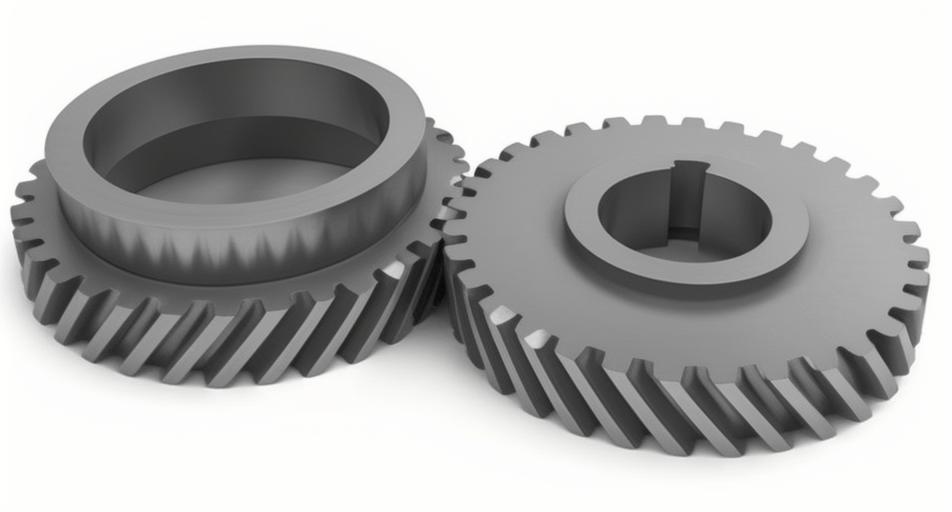
The geometric foundation of form grinding helical gears involves the “non-instantaneous envelope surface” concept, where a formed wheel engages with the gear tooth profile. On a CNC form grinding machine, the wheel is dressed to a specific contour, and relative motions between the wheel and workpiece generate the helical tooth slot. To model grinding forces, I first analyze the relationship between form grinding and plane grinding. The key parameters are mapped as follows: the involute length in form grinding approximates the wheel width in plane grinding, the wheel diameter in contact with the tooth surface approximates the plane grinding wheel diameter, and the radial feed of the wheel approximates the grinding depth. This analogy allows for the application of established plane grinding force models to the helical gear context.
In plane grinding, the tangential and normal grinding forces, denoted as $F_t$ and $F_n$, are expressed by empirical formulas derived from studies on material deformation and friction. Based on Malkin’s work, which divides grinding force into cutting deformation force and sliding force, I utilize the following equations for plane grinding:
$$F_t = \left( K_1 + K_2 \ln \frac{V_s^{1.5}}{a_p^{0.25} V_w^{0.5}} \right) \frac{V_w a_p}{V_s} b + b A \left( \alpha + \frac{4 \beta p_0 V_w}{d_s V_s} \right) (d_s a_p)^{1/2}$$
$$F_n = \left( K_3 + K_4 \ln \frac{V_s^{1.5}}{a_p^{0.25} V_w^{0.5}} \right) \frac{V_w a_p}{V_s} b + \frac{4 b A p_0 V_w}{V_s} \left( \frac{a_p}{d_s} \right)^{1/2}$$
Here, $V_s$ is the wheel linear velocity, $a_p$ is the grinding depth, $V_w$ is the workpiece feed velocity, $b$ is the wheel width, $d_s$ is the wheel diameter, $A$ is the wheel wear surface area ratio, and $K_1$, $K_2$, $K_3$, $K_4$, $p_0$, $\alpha$, $\beta$ are experimental constants. These formulas serve as the basis for extending to helical gear form grinding, where parameters are adapted to account for the involute geometry.
For helical gear form grinding, the wheel linear velocity varies along the involute profile due to the changing contact radius. I derive this velocity by considering the geometric relationship between the wheel and the helical gear tooth. Using an involute coordinate system, the position of any point $M$ on the involute can be expressed as:
$$x’ = r (\cos \theta + \theta \sin \theta)$$
$$y’ = r (\sin \theta – \theta \cos \theta)$$
Where $r$ is the base circle radius and $\theta$ is the roll angle. For a rotated coordinate system to account for helical orientation, the coordinates become:
$$x = r [\cos (\theta + \delta) + \theta \sin (\theta + \delta)]$$
$$y = r [\sin (\theta + \delta) – \theta \cos (\theta + \delta)]$$
The arc length increment $dl$ along the involute is given by $dl = r_b \theta d\theta$, where $r_b$ is the base radius. Integrating from 0 to $\theta$, the total arc length $l$ is:
$$l = \int_0^\theta r_b \theta d\theta = \frac{1}{2} r_b \theta^2$$
Since $\theta = \tan \alpha_x$ and $\theta^2 = \tan^2 \alpha_x = \frac{1}{\cos^2 \alpha} – 1 = \left( \frac{R_x}{r_b} \right)^2 – 1$, we have:
$$l = \frac{1}{2} r_b \left[ \left( \frac{R_x}{r_b} \right)^2 – 1 \right]$$
The wheel linear velocity at point $M$ with coordinates $(x_M, y_M)$ is then derived as:
$$V_s(\theta) = 2 \pi n [a – r \cos(\theta + \delta) – r \theta \sin(\theta + \delta)]$$
Where $n$ is the wheel rotational speed, and $a$ is a geometric constant related to machine setup. This variable velocity is crucial for accurately modeling grinding forces in helical gear form grinding, as it reflects the dynamic interaction along the tooth surface.
To establish the grinding force model for helical gears, I map the form grinding parameters to plane grinding equivalents. The relationship is summarized in Table 1, which highlights the analogies between the two processes.
| Plane Grinding Parameter | Symbol | Helical Gear Form Grinding Equivalent | Symbol |
|---|---|---|---|
| Wheel Linear Velocity | $V_s$ | Variable Wheel Linear Velocity | $V_s(\theta)$ |
| Workpiece Feed Velocity | $V_w$ | Feed Velocity Along Gear Axis | $V_w$ |
| Grinding Depth | $a_p$ | Radial Grinding Depth | $a_e = a_p \sin \gamma$ |
| Wheel Diameter | $d_s$ | Effective Wheel Diameter | $d_e = d_s (\sin \gamma)^{-1}$ |
| Contact Length | $l_c$ | Involute Contact Length | $l_c$ |
In this table, $\gamma$ represents the pressure angle of the helical gear, which influences the effective geometry. For helical gears, the radial grinding depth $a_e$ and effective wheel diameter $d_e$ are derived from the gear’s helical angle and pressure angle, ensuring that the model accounts for the three-dimensional nature of the tooth surface. The contact length in form grinding corresponds to the involute arc length, which varies along the profile.
Using these mappings, the grinding force for a differential segment on the involute of a helical gear tooth can be expressed. For a single point $M$ on the involute, the differential tangential and normal forces are:
$$dF_t(M) = \left[ \left( K_1 + K_2 \ln \frac{V_s(\theta)^{1.5}}{a_e^{0.25} V_w^{0.5}} \right) \frac{V_w a_e}{V_s(\theta)} + A \left( \alpha + \frac{4 \beta p_0 V_w}{d_e V_s(\theta)} \right) (d_e a_e)^{1/2} \right] r_b \theta d\theta$$
$$dF_n(M) = \left[ \left( K_3 + K_4 \ln \frac{V_s(\theta)^{1.5}}{a_e^{0.25} V_w^{0.5}} \right) \frac{V_w a_e}{V_s(\theta)} + \frac{4 A p_0 V_w}{V_s(\theta)} \left( \frac{a_e}{d_e} \right)^{1/2} \right] r_b \theta d\theta$$
Integrating these expressions over the entire involute from 0 to $\theta_{\text{max}}$, where $\theta_{\text{max}}$ corresponds to the end of the active profile, yields the total grinding forces for one side of the helical gear tooth. However, in practice, both sides of the tooth are ground simultaneously, so the actual grinding force is the superposition of forces from two involute surfaces. Thus, the total tangential grinding force $F_t^{\text{total}}$ for a helical gear during form grinding is:
$$F_t^{\text{total}} = 2 \int_0^{\theta_{\text{max}}} \left[ \left( K_1 + K_2 \ln \frac{V_s(\theta)^{1.5}}{a_e^{0.25} V_w^{0.5}} \right) \frac{V_w a_e}{V_s(\theta)} + A \left( \alpha + \frac{4 \beta p_0 V_w}{d_e V_s(\theta)} \right) (d_e a_e)^{1/2} \right] r_b \theta d\theta$$
Similarly, the total normal force can be derived, but for brevity, I focus on the tangential force as it is critical for power consumption and process stability. This integral formulation captures the continuous variation in wheel velocity and contact geometry along the helical gear tooth, making it suitable for simulating grinding forces under different operational conditions.
To validate this model, I conducted experiments on a CNC form grinding machine, using a helical gear with parameters listed in Table 2. The helical gear was pre-machined by hobbing with a grinding allowance of approximately 0.5 mm, and the form grinding process was monitored to measure grinding forces indirectly through motor power analysis.
| Parameter | Symbol | Value |
|---|---|---|
| Module | $m$ | 7 mm |
| Number of Teeth | $z$ | 83 |
| Pressure Angle | $\alpha$ | 20° |
| Helical Angle | $\beta_0$ | 10.606° |
| Face Width | $b$ | 200 mm |
| Base Radius | $r_b$ | Derived from gear geometry |
The constants in the plane grinding force formulas were calibrated using data from prior studies, as shown in Table 3. These constants are essential for accurate force prediction and were determined through linear regression on experimental plane grinding data.
| Constant | Value |
|---|---|
| $K_1$ | 178,535 |
| $K_2$ | -20,453 |
| $K_3$ | 178,961 |
| $K_4$ | -247,534 |
| $\alpha_0$ | 0.6377 |
| $\beta_0$ | 7,895 |
| $\gamma_0$ | 195,421 |
| $p_0$ | Derived from material properties |
In the experiments, the tangential grinding force was estimated from the motor power using the relationship:
$$F_t = \frac{1000}{V_s} (P – P_0)$$
Where $P$ is the measured power during helical gear grinding, $P_0$ is the no-load power, and $V_s$ is the average wheel linear speed calculated from wheel diameter and rotational speed. The results were compared with simulations based on the derived model, implemented in MATLAB to solve the integral equations numerically. The simulation program discretized the involute into small segments, computed the wheel velocity and grinding force for each segment, and summed them to obtain the total force.
The comparison between experimental and simulated grinding forces is presented in Table 4, which shows the tangential force values under different grinding conditions for the helical gear. The conditions varied in terms of radial feed rate and wheel speed, reflecting typical industrial settings.
| Condition | Radial Feed $a_e$ (mm) | Wheel Speed $n$ (rpm) | Experimental $F_t$ (N) | Simulated $F_t$ (N) | Error (%) |
|---|---|---|---|---|---|
| 1 | 0.05 | 3000 | 152.3 | 148.7 | 2.4 |
| 2 | 0.10 | 3000 | 198.6 | 193.2 | 2.7 |
| 3 | 0.05 | 4000 | 130.8 | 127.5 | 2.5 |
| 4 | 0.10 | 4000 | 175.4 | 170.9 | 2.6 |
The errors are within 3%, indicating that the model provides a reliable prediction of grinding forces for helical gear form grinding. The slight discrepancies may arise from assumptions in the geometric analogies or variations in material properties. Notably, the force trends align with expectations: increasing radial feed raises grinding forces, while higher wheel speeds reduce them due to decreased chip thickness. This validation underscores the model’s utility for optimizing helical gear grinding processes, such as selecting parameters to minimize forces and improve surface quality.
Beyond force prediction, this model has implications for understanding wear and thermal effects in helical gear grinding. The variable wheel velocity along the involute means that different tooth regions experience distinct grinding conditions, which can lead to non-uniform wear on the wheel. By incorporating the wheel wear parameter $A$, the model can be extended to predict wheel life and dressing intervals for helical gears. Additionally, the normal grinding force component influences gear tooth deflection and potential errors in profile accuracy, which is critical for high-precision helical gears used in automotive and aerospace applications.
To further explore the model’s behavior, I conducted a sensitivity analysis on key parameters affecting grinding forces in helical gear form grinding. The results are summarized in Table 5, which shows the percentage change in tangential force for a 10% variation in each parameter, based on simulations with default values from Table 2.
| Parameter | 10% Increase | Effect on $F_t$ (%) | Remarks |
|---|---|---|---|
| Radial Feed $a_e$ | +10% | +8.2% | Largest influence due to direct impact on chip volume |
| Wheel Speed $n$ | +10% | -5.1% | Higher speed reduces force by decreasing contact time |
| Workpiece Feed $V_w$ | +10% | +4.3% | Moderate effect related to material removal rate |
| Pressure Angle $\gamma$ | +10% | -2.7% | Affects effective geometry and contact length |
| Helical Angle $\beta_0$ | +10% | +1.5% | Minor influence due to changes in tooth orientation |
This analysis reveals that radial feed is the most critical parameter for controlling grinding forces in helical gear manufacturing, followed by wheel speed. Process engineers can use this insight to adjust parameters for desired outcomes, such as reducing forces to prevent burns or increasing productivity while maintaining quality. The helical angle has a smaller effect, but it becomes more significant in high-helix gears, where the tooth curvature alters the grinding contact dynamics.
In terms of mathematical formulation, the grinding force model for helical gears can be generalized to other gear types by adjusting the geometric parameters. For instance, for spur gears, the helical angle $\beta_0$ is zero, simplifying the velocity derivation. However, the involute profile remains, so the core equations still apply. This versatility makes the model valuable for a range of gear grinding applications. To illustrate, consider the integral for tangential force in a simplified case with constant wheel velocity, which reduces to:
$$F_t^{\text{simple}} = 2 \left[ \left( K_1 + K_2 \ln \frac{V_s^{1.5}}{a_e^{0.25} V_w^{0.5}} \right) \frac{V_w a_e}{V_s} + A \left( \alpha + \frac{4 \beta p_0 V_w}{d_e V_s} \right) (d_e a_e)^{1/2} \right] \int_0^{\theta_{\text{max}}} r_b \theta d\theta$$
Since $\int_0^{\theta_{\text{max}}} r_b \theta d\theta = \frac{1}{2} r_b \theta_{\text{max}}^2 = l_{\text{avg}}$, where $l_{\text{avg}}$ is the average involute length, this simplifies further to a form similar to plane grinding but scaled by the gear geometry. For helical gears, however, the variable velocity necessitates numerical integration, as implemented in the simulation program.
The experimental validation also included observations of force transients during wheel entry into the tooth slot. As shown in the results, the grinding force spikes initially when the wheel engages the helical gear tooth, then stabilizes as full contact is established. This behavior is consistent with grinding dynamics and highlights the importance of considering transient effects in process control. In helical gear grinding, the helical angle causes gradual engagement along the tooth width, which can mitigate force spikes compared to spur gears, but our model accounts for this through the continuous variation in $\theta$ and $\delta$.
Looking ahead, this grinding force model can be integrated with thermal models to predict temperature distributions and residual stresses in helical gears, which are crucial for fatigue life. Additionally, adaptive control systems could use real-time force feedback to adjust grinding parameters, enhancing accuracy and efficiency. The focus on helical gears in this work addresses a gap in the literature, as most prior studies centered on plane grinding or generating methods, neglecting the unique aspects of form grinding for helical geometries.
In conclusion, I have developed and validated a grinding force model for helical gear form grinding, based on geometric analogies to plane grinding and derivation of wheel linear velocity along the involute. The model, expressed through integral equations, accurately predicts tangential grinding forces with errors under 3% in experimental tests. It incorporates key parameters such as radial feed, wheel speed, and helical angle, providing insights for optimizing helical gear manufacturing. The sensitivity analysis underscores the dominance of radial feed in force control, while the variable velocity calculation ensures fidelity to the helical gear’s tooth profile. This research contributes to the advancement of precision grinding techniques for helical gears, enabling better process design and quality assurance in industries reliant on high-performance gear systems. Future work will explore extensions to wear modeling and real-time applications, further solidifying the model’s utility for helical gear production.
Throughout this article, the emphasis on helical gears has been deliberate, as their complex geometry poses distinct challenges in grinding operations. By repeatedly addressing helical gear specifics, I aim to reinforce the importance of tailored models for different gear types. The integration of tables and formulas, as seen in the parameter mappings and force equations, facilitates comprehension and application for researchers and engineers. As grinding technology evolves, such models will be instrumental in achieving higher efficiencies and accuracies in helical gear manufacturing, ultimately supporting innovations in machinery and transportation.