
In the mechanical manufacturing industry, helical gears are critical components widely used in various transmission systems due to their smooth operation, high load capacity, and reduced noise compared to spur gears. However, the design process for helical gears often involves significant repetitive labor, as engineers must create similar models for different specifications in series production. This not only consumes time but also increases the risk of errors. To address these challenges, I have researched and developed a parametric design system for helical gears based on CATIA/CAA, aiming to streamline the design workflow, enhance accuracy, and free up designers for innovative tasks.
Parametric design technology has emerged as a powerful solution in computer-aided design (CAD), allowing designers to define model dimensions and features through parameters and constraints. By modifying key parameters, the entire geometry can be automatically updated, enabling rapid generation of variant models. In this context, CATIA V5, a leading CAD software developed by Dassault Systèmes, offers robust parametric capabilities through its feature-based modeling environment. My work leverages these capabilities to create a specialized system for helical gears, integrating custom tools via CATIA’s Component Application Architecture (CAA) for secondary development.
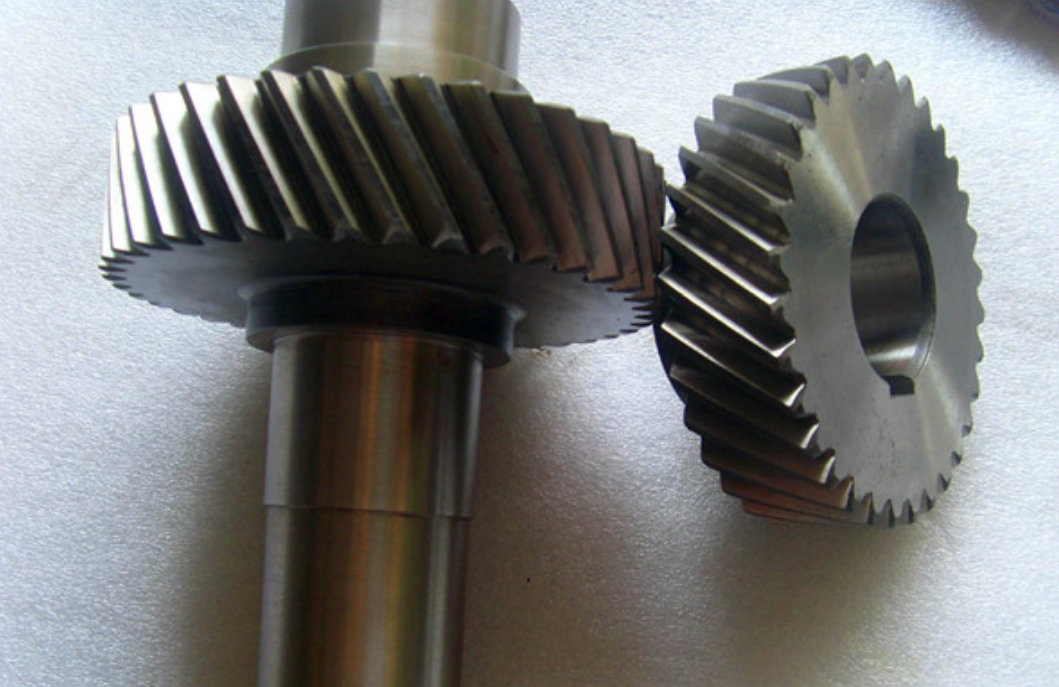
The core of my research focuses on automating the design of helical gears by encapsulating geometric relationships into a parameter-driven framework. This system allows users to input basic parameters—such as module, number of teeth, helix angle, pressure angle, and face width—through a graphical interface, after which a three-dimensional helical gear model is generated automatically in CATIA. The development environment utilizes Microsoft Visual Studio 2005 integrated with CAA-RADE (Rapid Application Development Environment), providing access to CATIA’s application programming interfaces (APIs) for seamless customization.
To understand the system’s foundation, it is essential to delve into the principles of parametric design for helical gears. A helical gear’s geometry is defined by a set of interrelated parameters, which can be expressed mathematically. For instance, the normal module $m_n$ and transverse module $m_t$ are related by the helix angle $\beta$:
$$m_t = \frac{m_n}{\cos \beta}$$
Similarly, the pitch diameter $d$ for a helical gear with $z$ teeth is given by:
$$d = \frac{m_t \cdot z}{\cos \beta}$$
Other critical formulas include the axial pitch $p_a$ and the base diameter $d_b$:
$$p_a = \frac{\pi \cdot m_n}{\sin \beta}$$
$$d_b = d \cdot \cos \alpha_t$$
where $\alpha_t$ is the transverse pressure angle. These equations form the basis for parameterizing the helical gear model, ensuring that changes in one parameter propagate correctly throughout the design. Table 1 summarizes the key parameters and their relationships for a standard helical gear.
| Parameter | Symbol | Formula/Description |
|---|---|---|
| Normal Module | $m_n$ | Basic size parameter in the normal plane |
| Transverse Module | $m_t$ | $m_t = m_n / \cos \beta$ |
| Number of Teeth | $z$ | Integer defining gear size |
| Helix Angle | $\beta$ | Angle of tooth inclination (typically 15°-45°) |
| Pressure Angle | $\alpha_n$ or $\alpha_t$ | Normal or transverse pressure angle (often 20°) |
| Face Width | $b$ | Width of gear along axis |
| Pitch Diameter | $d$ | $d = m_t \cdot z / \cos \beta$ |
| Base Diameter | $d_b$ | $d_b = d \cdot \cos \alpha_t$ |
| Axial Pitch | $p_a$ | $p_a = \pi \cdot m_n / \sin \beta$ |
Building on these mathematical foundations, the parametric design system for helical gears is architected to separate geometry from data. The helical gear model is initially created in CATIA using a template with embedded parameters, and these parameters are stored externally in an Excel spreadsheet. This separation allows for easy management and modification of design data without altering the core model. The system’s overall architecture, as illustrated in Figure 2, comprises three main layers: the user interface layer, the business logic layer, and the data storage layer. In the user interface layer, a custom dialog box is developed using CAA’s interactive mode, enabling designers to input or select parameters for the helical gear. The business logic layer handles parameter traversal and model updates via CATIA APIs, while the data storage layer maintains parameter sets in Excel files for reuse and series generation.
The development of the system menu and interface leverages CAA’s Workshop and Add-in frameworks. Specifically, I employed the Add-in approach to integrate new toolbars and commands into CATIA’s existing workbenches, ensuring a seamless user experience. Within the RADE environment, dialog resources are created by dragging and dropping controls such as text boxes, combo boxes, and buttons, resulting in a CATIA-styled interface. For example, the dialog for helical gear design includes fields for inputting the normal module, number of teeth, helix angle, and other critical parameters, along with options to choose gear type (e.g., external or internal helical gear). Upon parameter entry, the system validates inputs and triggers the modeling process.
The parametric modeling functionality is the heart of the system, enabling automatic generation of helical gear models. The process begins by loading a template CATPart document containing a parameterized helical gear. Through CATIA’s document services, the template is opened in the background, and the root container is accessed to retrieve the part features. Key code snippets involve querying interfaces for parameter publishers, which allow traversal of all parameters in the model. For instance, the CATIParmPublisher interface is used to obtain a list of parameters, which are then matched with user inputs to drive changes. The core steps include:
- Opening the template document:
CATDocumentServices::OpenDocument(pFilePath, pDocument). - Retrieving the part container:
pInitOnDoc->GetRootContainer("CATIPrtContainer"). - Accessing parameter interfaces:
spPart->QueryInterface(IID_CATIParmPublisher, (void **)&piParmPublisher). - Traversing and updating parameters:
piParmPublisher->GetAllChildren("CATICkeParm", PartParmList)followed by value assignment.
Once parameters are updated, CATIA’s parametric engine automatically regenerates the helical gear geometry, producing a new 3D model that reflects the specified dimensions. This approach eliminates manual remodeling and ensures consistency across design iterations. To illustrate the parameter-driven process, consider the generation of a helical gear with a helix angle of 25°, a normal module of 3 mm, and 24 teeth. The system calculates derived parameters like transverse module and pitch diameter using the formulas above, then updates the model accordingly. Table 2 shows a sample parameter set and its impact on gear dimensions.
| Input Parameter | Value | Calculated Parameter | Result |
|---|---|---|---|
| Normal Module ($m_n$) | 3 mm | Transverse Module ($m_t$) | 3.31 mm (for $\beta=25°$) |
| Number of Teeth ($z$) | 24 | Pitch Diameter ($d$) | 87.6 mm |
| Helix Angle ($\beta$) | 25° | Axial Pitch ($p_a$) | 22.3 mm |
| Pressure Angle ($\alpha_n$) | 20° | Base Diameter ($d_b$) | 82.1 mm |
| Face Width ($b$) | 30 mm | Gear Volume | Approx. 180 cm³ |
Beyond basic geometry, the system also incorporates design constraints and standards for helical gears, such as those from ISO or AGMA. For example, the helix angle is validated to ensure it falls within typical ranges (e.g., 15° to 45°) to avoid manufacturing issues. Additionally, parameters like tip diameter $d_a$ and root diameter $d_f$ are computed based on addendum and dedendum coefficients:
$$d_a = d + 2 \cdot m_n$$
$$d_f = d – 2.5 \cdot m_n$$
These formulas are embedded in the parametric model, allowing automatic adjustment when the module changes. The system’s flexibility extends to handling different helical gear configurations, such as single or double helical gears, by incorporating additional parameters like gap width for double helical gears. This makes the tool versatile for various mechanical applications.
The implementation of this parametric design system for helical gears demonstrates significant improvements in efficiency and accuracy. In traditional design workflows, creating a new helical gear model from scratch might take hours, involving sketch creation, extrusion, helical sweep operations, and pattern generation. With my system, designers simply input parameters into a dialog box, and a complete 3D model is generated within seconds. This reduction in repetitive labor allows engineers to focus on higher-level tasks, such as performance analysis or system integration. Moreover, the use of external Excel files for parameter storage facilitates the management of gear series, enabling quick generation of families of helical gears with incremental changes. For instance, a series of helical gears with varying tooth counts can be produced by editing a spreadsheet, and the system can batch-process these to update all models automatically.
To further enhance the system, I integrated error-checking and optimization features. For example, the system validates that the number of teeth is sufficient to avoid undercutting, which for helical gears depends on the transverse pressure angle and helix angle. The condition for no undercutting is given by:
$$z \geq \frac{2 \cdot \cos \beta}{\sin^2 \alpha_t}$$
If the input violates this, a warning message is displayed, guiding the designer to adjust parameters. Additionally, the system can compute basic performance metrics, such as contact ratio $m_c$, which for helical gears is higher than for spur gears due to the axial overlap. The contact ratio can be approximated as:
$$m_c = \frac{\sqrt{d_{a1}^2 – d_{b1}^2} + \sqrt{d_{a2}^2 – d_{b2}^2} – a \cdot \sin \alpha_t}{p_t}$$
where $a$ is the center distance and $p_t$ is the transverse pitch. By embedding such calculations, the system not only generates geometry but also aids in preliminary design validation.
In terms of software architecture, the system employs a modular approach, making it easy to extend or modify. The main components include the user interface module, parameter management module, model generation module, and data export module. Each module interacts through well-defined APIs, ensuring maintainability. For instance, the parameter management module reads and writes Excel files using COM automation, while the model generation module calls CATIA functions via CAA. This separation allows for future enhancements, such as connecting to a database for parameter storage or adding finite element analysis (FEA) integration for stress evaluation of helical gears.
The development process also involved thorough testing to ensure robustness. I created multiple test cases covering a range of helical gear specifications, from small precision gears to large industrial gears. The system successfully generated all models without errors, and the parameters were verified against manual calculations. Performance tests showed that the system can handle complex helical gear assemblies with multiple components, such as gear pairs or planetary systems, by extending the parametric approach to include assembly constraints. This aligns with advanced parametric design methodologies that use relational parameters across components, enabling full system optimization.
Looking ahead, there are several opportunities to expand this parametric design system for helical gears. One direction is to incorporate generative design algorithms, where the system can propose optimal helical gear parameters based on load, speed, and material constraints. Another is to integrate with manufacturing processes, such as generating CNC codes or 3D printing files directly from the parametric model. Additionally, cloud-based collaboration features could allow multiple designers to work on helical gear projects simultaneously, with real-time parameter synchronization. These advancements would further solidify the role of parametric design in modern mechanical engineering.
In conclusion, the research and development of this parametric design system for helical gears using CATIA/CAA have addressed the pervasive issue of repetitive labor in gear design. By leveraging parameterization, external data management, and custom interface development, the system streamlines the creation of helical gear models, enhancing both efficiency and accuracy. The helical gear, as a fundamental mechanical component, benefits greatly from such automation, allowing designers to dedicate more time to innovation and complex problem-solving. The system’s foundation on standard formulas and flexible architecture ensures its applicability across various industries, from automotive to aerospace, where helical gears are indispensable. As parametric design technologies evolve, this work serves as a stepping stone toward more intelligent and integrated CAD solutions for mechanical systems.