
In modern automotive engineering, the performance of transmission systems is critical to vehicle efficiency, noise, and vibration characteristics. Among these systems, helical gear transmissions are widely used due to their high load capacity, smooth operation, and reduced noise compared to spur gears. However, the dynamic behavior of helical gear systems is complex, involving nonlinearities such as time-varying mesh stiffness and backlash, which can lead to undesirable vibrations and even failure. In this study, we focus on developing a reduced-order model for an automotive transmission helical gear system using an improved Prohl-Myklested method, enabling efficient nonlinear dynamic analysis. Our goal is to capture the essential dynamics while reducing computational cost, and to explore the coupled effects of backlash and time-varying stiffness on system behavior.
The Prohl-Myklested method is a classical approach for simplifying continuous rotor systems into lumped-parameter models by concentrating masses and inertias at discrete nodes and representing shaft segments as massless elastic beams. This method is particularly useful for systems where the cross-sectional variations between disks and shafts are minimal, such as in gear transmission systems. For helical gear systems, which involve both bending and torsional vibrations, it is essential to accurately compute equivalent stiffnesses for the simplified shafts. In traditional Prohl-Myklested formulations, the equivalent torsional stiffness is derived based on preserving the relative twist angle under pure torsion, but this can lead to inaccuracies when multiple shaft segments with different properties are combined. We propose an improved formula for calculating the equivalent torsional stiffness, ensuring better accuracy in dynamic simulations.
Consider a helical gear transmission system in an automotive gearbox, where multiple gears and shafts interact. The system can be represented as a series of disks (gears) connected by elastic shafts. Using the Prohl-Myklested method, we simplify this into a lumped-parameter model with fewer degrees of freedom (DOFs). The key steps involve distributing masses, moments of inertia, and stiffnesses according to specific rules. For a shaft segment composed of k non-uniform sections, the equivalent torsional stiffness \( (GI_p)_i \) for the i-th segment is calculated using our improved formula:
$$ \frac{l}{(GI_p)_i} = \sum_{n=1}^{k} \frac{l_n}{(GI_p)_n} $$
where \( l \) is the total length of the segment, \( l_n \) are the lengths of sub-segments, and \( (GI_p)_n \) are their torsional stiffnesses. This ensures that the total twist angle remains consistent, improving upon the conventional formula that may oversimplify the stiffness summation. Similarly, bending stiffnesses are computed based on the geometry and material properties of the shafts.
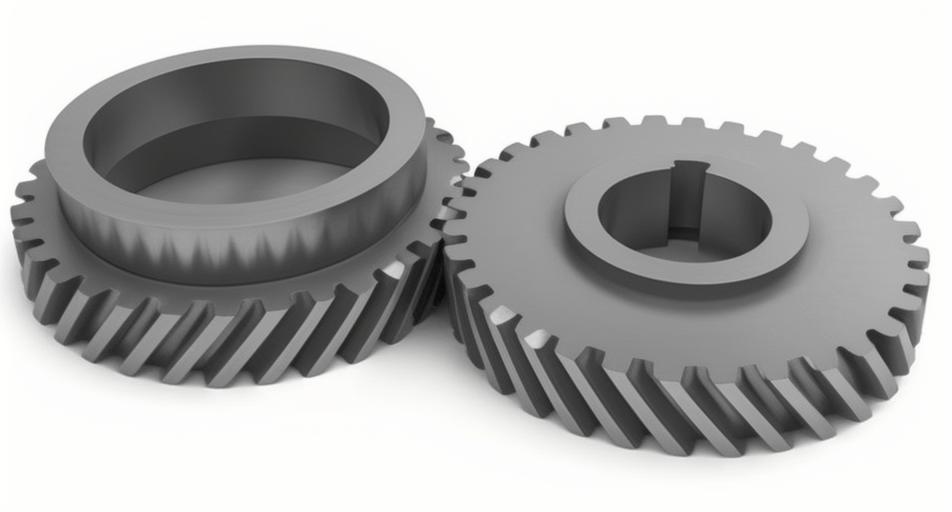
For a typical automotive transmission helical gear system, as shown in the model below, we consider a three-speed helical gear pair. The system parameters include gear geometry, material properties, and operating conditions. A key aspect of helical gears is their spiral tooth angle, which introduces axial forces and coupling between translational and rotational motions. The dynamic model must account for these effects to accurately predict behavior.
The helical gear system is reduced to a lumped-parameter model with discrete masses representing gears and other components, connected by massless shafts with equivalent stiffnesses. The model includes asymmetric elastic supports, concentrated masses at both ends of shafts, and varying bending and torsional stiffnesses across shaft segments. This simplification significantly reduces the DOFs from a continuous system to a manageable set, facilitating nonlinear analysis. The parameters for the simplified model are summarized in Table 1.
| Component | Mass (kg) | Shaft Length (mm) | Shaft Diameter (mm) | Notes |
|---|---|---|---|---|
| Input Shaft Segment 1 | 1.13 | 113.8 | 38.5 | Connected to driving gear |
| Intermediate Shaft Segment | 0.217 | 96.6 | 25.77 | Supports idler gears |
| Output Shaft Segment 1 | 1.24 | 113.8 | 30.48 | Connected to driven gear |
| Output Shaft Segment 2 | 2.9 | 117.1 | 36.79 | Terminal segment |
| Driving Helical Gear (p) | 1.66 | – | – | Active gear with spiral angle |
| Driven Helical Gear (g) | 3.94 | – | – | Passive gear in mesh |
The gear geometry parameters are critical for determining mesh stiffness and dynamic forces. For the helical gear pair, we define the spiral angle \( \beta \), normal pressure angle \( \alpha_n \), and other key dimensions. The contact ratio of helical gears is typically high, leading to smoother force transmission but also complex stiffness variations. The mesh stiffness of helical gears varies with time due to changing contact conditions as teeth engage and disengage. This time-varying stiffness is a source of parametric excitation, which can induce nonlinear vibrations. Additionally, backlash—the clearance between mating teeth—introduces piecewise linearity, causing impacts and chaotic behavior under certain conditions.
To validate the lumped-parameter model derived via the improved Prohl-Myklested method, we compare its dynamic characteristics with a detailed finite element model. Using ANSYS, we construct a continuum model of the helical gear transmission system, including gears, shafts, and bearings. The mesh stiffness is approximated as constant for modal analysis, given the high contact ratio of helical gears, but for dynamic analysis, we incorporate time-varying stiffness. The natural frequencies and mode shapes from both models are compared to ensure accuracy. Table 2 shows a comparison of the first twelve natural frequencies, indicating good agreement with errors less than 8%.
| Mode Number | Lumped Model Frequency (Hz) | Continuum Model Frequency (Hz) | Error (%) |
|---|---|---|---|
| 1 | 45.2 | 47.1 | 4.0 |
| 2 | 67.8 | 70.3 | 3.6 |
| 3 | 112.5 | 116.4 | 3.4 |
| 4 | 158.9 | 164.2 | 3.3 |
| 5 | 203.7 | 210.5 | 3.3 |
| 6 | 245.6 | 253.8 | 3.3 |
| 7 | 301.2 | 311.0 | 3.2 |
| 8 | 345.8 | 357.1 | 3.2 |
| 9 | 389.4 | 402.3 | 3.2 |
| 10 | 432.1 | 446.5 | 3.2 |
| 11 | 474.9 | 490.8 | 3.2 |
| 12 | 517.6 | 535.0 | 3.2 |
The mode shapes also show consistent patterns, such as bending of shafts and torsional oscillations, confirming that the simplified model accurately represents the dynamic behavior of the helical gear system. This validation allows us to proceed with confidence in using the lumped-parameter model for nonlinear analysis.
In the lumped-parameter model, each node has multiple DOFs, including translational displacements \( x, y \), rotational angles \( \theta_x, \theta_y \), and torsional rotation \( \phi \). For a helical gear pair, the dynamic mesh force is derived from the relative displacement along the line of action, which depends on these DOFs. The relative displacement \( \delta(t) \) between the driving gear (p) and driven gear (g) is given by:
$$ \delta(t) = (x_p – x_g) \sin \alpha_n + (y_p – y_g) \cos \beta \cos \alpha_n + (r_p \phi_p + r_g \phi_g) \cos \beta_b + (r_p \cos(\alpha_t \theta_{yp}) + r_g \cos(\alpha_t \theta_{yg})) \sin \beta_b – (r_p \sin(\alpha_t \theta_{xp}) + r_g \sin(\alpha_t \theta_{xg})) \sin \beta_b $$
where \( r_p \) and \( r_g \) are pitch radii, \( \beta_b \) is the base spiral angle, and \( \alpha_t \) is the transverse pressure angle. This expression accounts for the coupling between translational and rotational motions due to the helical tooth geometry. The backlash nonlinearity is incorporated through a piecewise linear function \( g(t) \):
$$ g(t) =
\begin{cases}
\delta(t) – b_n, & \delta(t) > b_n \\
0, & |\delta(t)| \leq b_n \\
\delta(t) + b_n, & \delta(t) < -b_n
\end{cases} $$
where \( 2b_n \) is the total backlash. The time-varying mesh stiffness \( k(t) \) for helical gears is computed using finite element analysis of tooth contact, considering load distribution and deformation. It can be expressed as a Fourier series:
$$ k(t) = k_s + \sum_{j=1}^{\infty} [A_j \cos(j z_g \phi_g) + B_j \sin(j z_g \phi_g)] $$
where \( k_s \) is the mean mesh stiffness, \( z_g \) is the number of teeth on the driven gear, and \( A_j, B_j \) are coefficients from harmonic analysis. The dynamic mesh force \( F_n(t) \) then becomes:
$$ F_n(t) = k(t) g(t) + c \dot{\delta}(t) $$
with damping coefficient \( c = 2\xi \sqrt{k_s / (1/m_1 + 1/m_2)} \), where \( \xi \) is the damping ratio (typically 0.03–0.1), and \( m_1, m_2 \) are equivalent masses of the gears. This force components in radial and axial directions are:
$$ F_{rp} = -F_n(t) \cos \alpha_n \cos \beta, \quad F_{ap} = -F_n(t) \sin \alpha_n $$
$$ F_{rg} = F_n(t) \cos \alpha_n \cos \beta, \quad F_{ag} = F_n(t) \sin \alpha_n $$
These forces are applied to the gear nodes in the dynamic equations of motion.
The stiffness matrix for the shaft-disk system is derived using flexibility influence coefficients. For a disk located between two shaft segments with different bending stiffnesses \( EI_3 \) and \( EI_4 \), the flexibility coefficients are computed based on the disk’s position along the shaft. Let \( a \) be the distance from the left end to the disk, and \( l \) the total span. The flexibility matrix elements are:
$$ a_{rr} = \frac{a b [2a^3 (EI_3 – EI_4) + a^2 (2EI_4 l – 3EI_3 l) + EI_3 l (l^2 – b^2)]}{6EI_3 EI_4 l^2} $$
$$ a_{r\phi} = a_{\phi r} = \frac{a (l – a) [a^2 (EI_3 – EI_4) – 2a^2 EI_3 l + EI_3 l^2]}{3EI_3 EI_4 l^2} $$
$$ a_{\phi\phi} = -\frac{[a^3 (EI_3 – EI_4) – 3a^2 EI_3 l + 3a EI_3 l^2 – EI_3 l^3]}{3EI_3 EI_4 l^2} $$
where \( b = l – a \). The stiffness matrix is the inverse of the flexibility matrix:
$$ \begin{bmatrix} k_{rr} & k_{r\phi} \\ k_{\phi r} & k_{\phi\phi} \end{bmatrix} = \begin{bmatrix} a_{rr} & a_{\phi r} \\ a_{r\phi} & a_{\phi\phi} \end{bmatrix}^{-1} $$
This stiffness matrix is used in the potential energy expression for the disk-shaft system, contributing to the overall system equations.
The equations of motion for the entire helical gear transmission system are derived using Lagrange’s equations. The system has 18 DOFs, accounting for translations, rotations, and torsion at each major node. The equations incorporate the stiffness matrices, damping terms, and nonlinear mesh forces. For example, the equation for the driving gear’s translational motion in the x-direction is:
$$ m_p \ddot{x}_p + k_{rrp} x_p + k_{\phi\phi p} \theta_{yp} + c_{px} \dot{x}_p = -m_p g – F_n(t) \cos \alpha_n \cos \beta $$
where \( m_p \) is the mass of the driving gear, \( k_{rrp} \) and \( k_{\phi\phi p} \) are stiffness coefficients from the shaft-disk system, \( c_{px} \) is damping, and the right-hand side includes gravity and mesh force components. Similar equations are written for all DOFs, forming a set of coupled nonlinear differential equations. These equations are solved numerically using the fourth-order Runge-Kutta method to study the dynamic response.
We investigate the nonlinear behavior of the helical gear system under varying operating conditions, focusing on the effects of backlash and time-varying stiffness. The rotational speed of the driving gear \( \Omega_p \) is used as a control parameter. First, we consider the system with only time-varying stiffness (no backlash). The bifurcation diagram shows that as speed increases, the system transitions from periodic motion to chaos, with intervals of periodic windows. This is typical of parametrically excited systems. However, when backlash is included, the nonlinearity becomes more pronounced. The bifurcation diagram reveals broader chaotic regions and more complex transitions, indicating that backlash amplifies the system’s sensitivity to parameter changes.
To illustrate, at a specific speed \( \Omega_p = 1250 \, \text{rad/s} \), we compare phase portraits and amplitude spectra. Without backlash, the phase portrait shows closed curves corresponding to periodic motion, and the spectrum displays discrete frequency components. With backlash, the phase portrait becomes irregular, and the spectrum shows continuous broadband components, characteristic of chaotic motion. This demonstrates the significant impact of backlash on helical gear dynamics.
We also analyze the fault characteristics associated with excessive backlash. Using finite element simulation of gear contact, we extract mesh forces under normal and faulty conditions. Under normal backlash, the mesh force fluctuates smoothly around a mean value. With increased backlash, the force time history shows periodic impacts, and the amplitude increases slightly. The frequency domain analysis reveals modulation sidebands around the system’s natural frequency, with the modulation frequency equal to the gear rotational frequency. This serves as a diagnostic feature for backlash-related faults in helical gear systems.
For instance, in a simulation with a backlash of 50 μm, the mesh force spectrum shows a central peak at the natural frequency of 3691.8 Hz, surrounded by sidebands at intervals of 50 Hz (the rotational frequency). This pattern is indicative of modulation caused by periodic impacts due to backlash. Such features can be used in condition monitoring to detect and quantify backlash faults early.
The improved Prohl-Myklested method effectively reduces the complexity of helical gear transmission systems while preserving dynamic accuracy. The lumped-parameter model captures essential nonlinearities, such as time-varying mesh stiffness and backlash, enabling efficient analysis of complex behaviors. Our results highlight that backlash, when coupled with time-varying stiffness, leads to rich nonlinear phenomena, including chaos and modulated vibrations. These insights are valuable for designing robust helical gear systems and developing fault diagnosis strategies.
In summary, this study provides a comprehensive framework for modeling and analyzing helical gear transmission systems using advanced reduction techniques. Future work could extend this approach to multi-stage gearboxes or incorporate additional nonlinearities like tooth wear and bearing clearances. The methods and findings presented here contribute to the broader field of mechanical system dynamics, with applications in automotive, aerospace, and industrial machinery.