
In the field of mechanical engineering, the performance and longevity of helical gears are critically influenced by their operational temperature. As a researcher focused on gear dynamics, I have observed that while steady-state thermal analyses provide valuable insights, they often overlook the transient effects that occur in real-world applications. Helical gears, due to their inclined teeth, exhibit complex contact patterns and heat generation mechanisms. This study aims to delve into the temperature field analysis of helical gears under non-steady working conditions, where parameters such as ambient temperature, rotational speed, and torque vary over time. By employing finite element methods, I seek to uncover the thermal behavior of helical gears during these unstable states, which is essential for predicting failures like scuffing, wear, and thermal deformation.
The temperature of helical gears is primarily governed by the balance between heat input from sliding friction and heat dissipation through lubrication and environmental interactions. In unstable conditions, this balance is disrupted, leading to transient temperature fields that can compromise gear integrity. Traditional analyses often assume stable parameters, but in practice, helical gears operate in environments where fluctuations are common—for instance, in automotive transmissions or industrial machinery subjected to varying loads. Therefore, understanding the dynamic thermal response of helical gears is paramount. This article presents a comprehensive investigation using simulation tools to model these effects, with an emphasis on how helical gear temperature evolves under changing operational parameters.
To begin, let’s explore the fundamental principles of heat balance in helical gears. The heat generated during gear meshing arises mainly from sliding friction between the tooth surfaces. For helical gears, the contact lines are oblique, which affects the distribution of heat sources. The average heat flux input at the meshing point can be expressed using the following formula, derived from tribological principles:
$$ q = b \omega_1 f_0 F_{av} \beta_1 \frac{v_1 – v_2}{2\pi v_1} $$
In this equation, \( q \) represents the average heat flux input for the pinion (small helical gear), \( b \) is the contact half-width at the meshing point, \( \omega_1 \) is the rotational speed of the pinion, \( f_0 \) is the sliding friction coefficient, \( F_{av} \) is the average compressive stress in the contact zone, \( \beta_1 \) is the thermal partition coefficient for the pinion, and \( v_1 \) and \( v_2 \) are the velocities of the instantaneous contact point along the tooth profile on the pinion and gear, respectively. For helical gears, these velocities are influenced by the helix angle, which introduces additional complexity in calculating sliding friction. The relationship between absolute, relative, and牵连 velocities at the contact point is given by:
$$ \frac{d\mathbf{r}}{dt} = \boldsymbol{\omega}_1 \times \mathbf{r}_1 + \frac{d_1 \mathbf{r}}{dt} $$
and
$$ \frac{d\mathbf{r}}{dt} = \boldsymbol{\omega}_2 \times \mathbf{r}_2 + \frac{d_2 \mathbf{r}}{dt} $$
where \( \frac{d\mathbf{r}}{dt} \) is the absolute velocity along the line of action, \( \boldsymbol{\omega}_i \times \mathbf{r}_i \) are the tangential velocities (牵连 velocities) for the helical gears, and \( \frac{d_i \mathbf{r}}{dt} \) are the relative velocities on each gear surface. These equations highlight how the sliding friction heat in helical gears depends on the velocity differences, which are affected by gear geometry and operational parameters.
On the heat dissipation side, the cooling effect of lubricant is quantified by the convective heat transfer coefficient. For helical gears, this coefficient is derived from the properties of the lubricant and the gear kinematics:
$$ \alpha_t = 1.418 \left( \frac{\nu}{\alpha z} \right)^{\frac{1}{4}} \sqrt{\frac{\lambda c \rho \omega}{2\pi}} $$
Here, \( \alpha_t \) is the convective heat transfer coefficient, \( \nu \) is the kinematic viscosity of the lubricant, \( \alpha \) is the thermal diffusivity of the lubricant, \( z \) is the number of teeth on the helical gear, \( \lambda \) is the thermal conductivity of the lubricant, \( c \) is the specific heat capacity, \( \rho \) is the density, and \( \omega \) is the angular velocity of the helical gear. This formula underscores the dependency of cooling efficiency on gear design and operating conditions, which is crucial for helical gears due to their continuous engagement and heat accumulation.
To analyze these thermal interactions, I developed a finite element model using ANSYS software. The model focuses on a modified helical gear pair, as helical gears are often used in high-performance applications for their smooth operation and high load capacity. For computational efficiency, I simplified the geometry to four teeth of the helical gear, which captures the essential thermal behavior without excessive resource usage. The element type selected was Thermal Solid 20node 90, with material properties typical for steel gears: density \( \rho = 7800 \, \text{kg/m}^3 \), elastic modulus \( E = 2 \times 10^{11} \, \text{Pa} \), Poisson’s ratio \( \mu = 0.3 \), specific heat \( C = 480 \, \text{J/(kg·K)} \), and thermal conductivity \( \lambda = 50 \, \text{W/(m·K)} \). The mesh was generated using free meshing techniques to ensure accuracy in temperature predictions.
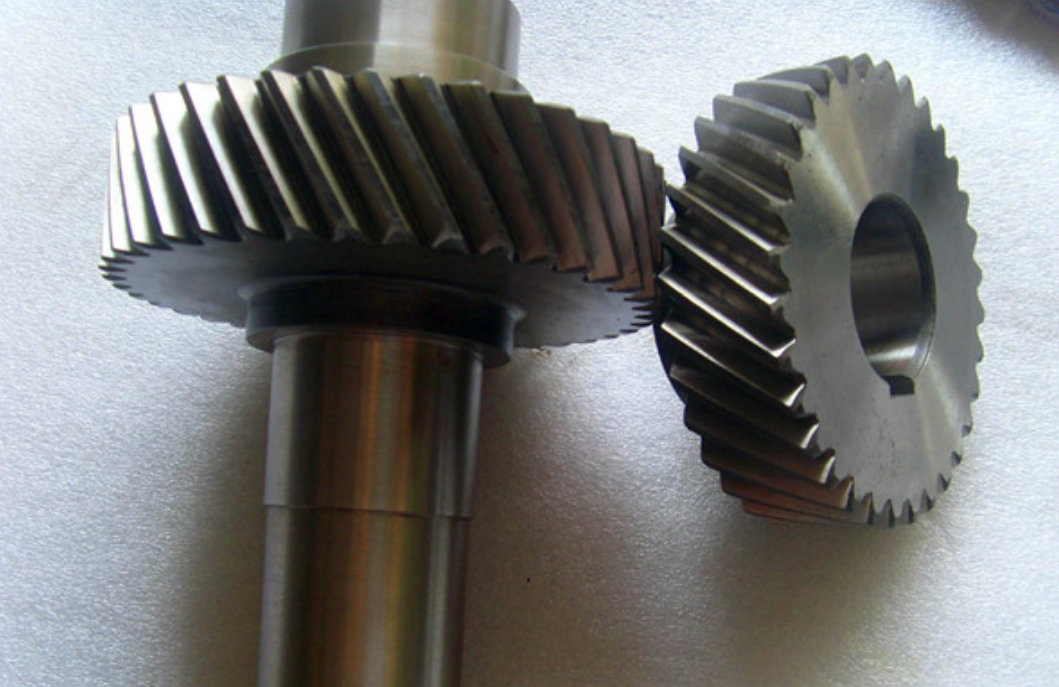
The finite element model of the helical gear is depicted above, showing the discretized structure used for thermal analysis. This visualization highlights the complex geometry of helical gears, which necessitates detailed modeling to account for heat flux distribution. In the simulations, I applied boundary conditions that reflect real-world scenarios. For instance, heat flux was applied to the contacting tooth surfaces of the helical gear pair, while convective cooling was imposed on non-contacting surfaces, front faces, and back faces. The parameters were varied over time to simulate unstable conditions, allowing me to observe transient temperature fields.
Next, I conducted a series of analyses to investigate the temperature field of helical gears under three distinct unstable working states. Each case involved a linear change over 200 seconds, mimicking gradual operational shifts. The results are summarized in the following tables to provide a clear comparison of thermal responses.
First, consider the effect of ambient temperature variation on helical gear temperature. In this scenario, the ambient temperature increased linearly from 60°C to 90°C over 200 seconds, while other parameters like rotational speed and torque were held constant. The heat flux and convective coefficients were set based on steady-state calculations for helical gears. The temperature distribution was monitored, and key metrics are tabulated below:
| Time (s) | Minimum Temperature (°C) | Maximum Temperature (°C) | Average Temperature (°C) | Remarks on Helical Gear Regions |
|---|---|---|---|---|
| 0 | 59.8 | 315.0 | 187.4 | Low temp near surfaces; high temp at contact points |
| 100 | 61.5 | 320.1 | 190.8 | Internal regions warm slowly due to poor散热 |
| 200 | 63.8 | 325.2 | 194.5 | Surface temp rises faster; contact zones remain hottest |
From this table, it is evident that ambient temperature changes significantly affect all regions of the helical gear. The minimum temperature, initially located at the front and back faces, gradually shifts inward as the surfaces equilibrate with the rising environment. The maximum temperature, concentrated at the meshing contacts of the helical gear, increases due to enhanced heat transfer to the surroundings. This underscores the sensitivity of helical gear thermal balance to external temperature fluctuations.
Second, I analyzed the impact of rotational speed variation on helical gear temperature. Here, the rotational speed of the pinion helical gear increased linearly from 960 rpm to 1920 rpm over 200 seconds. According to the heat flux formula, doubling the speed doubles the heat input, while the convective coefficient increases by a factor of \( \sqrt{2} \). The ambient temperature was fixed at 60°C, and the results are presented in the following table:
| Time (s) | Minimum Temperature (°C) | Maximum Temperature (°C) | Average Temperature (°C) | Effects on Helical Gear Dynamics |
|---|---|---|---|---|
| 0 | 59.8 | 315.0 | 187.4 | Baseline state for helical gear operation |
| 100 | 59.9 | 320.0 | 189.7 | Speed increase raises friction heat in helical gear |
| 200 | 60.0 | 325.0 | 192.1 | High temp zones expand; low temp regions stable |
This table reveals that rotational speed variation primarily influences the maximum temperature of the helical gear, with a notable rise from 315°C to 325°C. The minimum temperature remains nearly constant around 60°C, indicating that cooling effects on surfaces are sufficient to mitigate low-end changes. The average temperature shows a gradual increase, reflecting the overall heating of the helical gear body. These findings highlight how speed dynamics in helical gears can lead to localized hot spots, potentially accelerating wear.
Third, I examined the effect of torque variation on helical gear temperature. The torque applied to the helical gear pair increased linearly from 40 N·m to 80 N·m over 200 seconds. Torque changes affect the contact stress \( F_{av} \) in the heat flux equation, thereby altering heat generation. The ambient temperature and rotational speed were kept constant, and the outcomes are summarized below:
| Time (s) | Minimum Temperature (°C) | Maximum Temperature (°C) | Average Temperature (°C) | Implications for Helical Gear Loading |
|---|---|---|---|---|
| 0 | 59.8 | 315.0 | 187.4 | Standard load condition for helical gear |
| 100 | 60.2 | 322.5 | 191.0 | Increased torque elevates contact stress and heat |
| 200 | 60.5 | 330.0 | 194.6 | High temp rise may risk lubricant failure in helical gear |
From this table, torque variation is shown to have a pronounced effect on the maximum temperature of the helical gear, with an increase from 315°C to 330°C. The minimum temperature rises slightly, suggesting that even low-temperature regions are affected by increased loading. The average temperature climbs steadily, indicating that torque changes distribute heat throughout the helical gear structure. This emphasizes the importance of considering load variations in the thermal design of helical gears.
To further elucidate the thermal behavior, I derived additional formulas to describe the transient temperature response of helical gears. For instance, the rate of temperature change in a helical gear element can be approximated by the heat conduction equation with source terms:
$$ \rho C \frac{\partial T}{\partial t} = \nabla \cdot (\lambda \nabla T) + q_v $$
where \( T \) is the temperature, \( t \) is time, and \( q_v \) is the volumetric heat generation rate, which for helical gears depends on the sliding friction and meshing frequency. Integrating this over the gear volume allows for predicting temperature fields under unstable conditions. Moreover, the convective boundary condition can be expressed as:
$$ -\lambda \frac{\partial T}{\partial n} = \alpha_t (T – T_{\infty}) $$
with \( T_{\infty} \) being the ambient temperature and \( n \) the normal direction. These equations form the basis for the finite element simulations, enabling detailed analysis of helical gear thermal dynamics.
In discussing the results, it is crucial to note that helical gears exhibit unique thermal patterns due to their helix angle. The oblique contact lines lead to distributed heat sources along the tooth flank, which contrasts with spur gears. This distribution affects how temperature gradients develop during unstable states. For example, under increasing rotational speed, the helical gear may experience more uniform heating across multiple teeth, reducing the risk of localized overheating compared to other gear types. However, the transient analysis reveals that even with this advantage, helical gears are susceptible to temperature spikes when parameters change rapidly.
The practical implications of this study are significant for engineers designing helical gear systems. By understanding how temperature fields evolve under unstable conditions, preventive measures can be implemented. For instance, lubricant selection for helical gears should account for varying speeds and loads to maintain adequate cooling. Additionally, gear geometry modifications, such as profile corrections, can be optimized based on thermal expansion predictions. The tables presented above serve as a reference for estimating temperature changes in helical gears during operational transitions.
In conclusion, this investigation into the temperature field of helical gears under unstable working conditions has provided valuable insights. Through finite element analysis, I demonstrated that ambient temperature, rotational speed, and torque variations all significantly impact the thermal state of helical gears. The helical gear’s complex geometry necessitates careful modeling to capture heat flux and dissipation accurately. The findings highlight that maximum temperatures in helical gears are particularly sensitive to speed and torque changes, which can lead to failures like scuffing if not managed. Future work could explore additional factors, such as lubricant degradation or helix angle variations, to further enhance the thermal resilience of helical gears. Overall, this study underscores the importance of transient thermal analysis in ensuring the reliability and efficiency of helical gear transmissions.