
In the pursuit of automotive lightweighting, the replacement of metal gears with plastic counterparts has garnered significant attention due to advantages such as reduced noise, vibration damping, self-lubrication, and cost-effective manufacturing via injection molding. However, plastic materials exhibit pronounced temperature-dependent properties, and the meshing process of helical gears involves complex thermal-mechanical interactions. Specifically, frictional heat and hysteresis heating from viscoelastic effects can alter material parameters, induce thermal strains, and ultimately impact performance. Excessive temperature rise may lead to unique failure modes like tooth surface burning or melting, unlike in metal gears. Therefore, understanding the temperature field during meshing is crucial for plastic helical gear design. In this study, we employ the nonlinear finite element software MARC to simulate the viscoelastic behavior of plastic helical gears and analyze the coupled thermal-structural response during meshing with steel helical gears. Our focus is on evaluating how viscoelasticity influences the meshing temperature field under varying loads and torques, using a first-person perspective to detail our methodology and findings.
The analysis leverages MARC’s capabilities for multiphysics coupling, incorporating structural, thermal, and fluid interactions. We model the viscoelastic characteristics using Prony series, which effectively capture the time-dependent stress-strain response of polymers. The helical gear pair consists of a plastic helical gear (made of POM) and a steel helical gear, with lubricated conditions considered to approximate real-world applications. Through finite element simulations, we aim to quantify temperature distributions, stress-strain behaviors, and the滞后 effects due to viscoelasticity. This work extends prior research by emphasizing the integration of viscoelastic models in transient thermal analysis, providing insights that can guide the design of durable plastic helical gear systems.
Introduction to Helical Gear Analysis and Viscoelasticity
Helical gears are widely used in transmission systems due to their smooth operation and high load-carrying capacity. However, when one gear is made of plastic, such as polyoxymethylene (POM), the dynamics become more complex. Plastic materials are viscoelastic, meaning their mechanical response depends on both time and temperature. Under cyclic loading during meshing, this leads to energy dissipation as heat, known as hysteresis heating. Combined with frictional heat from tooth contact, it results in a temperature rise that can degrade material properties, reduce lubrication efficiency, and cause thermal failure. In our research, we address this by developing a finite element model that accounts for viscoelasticity using MARC’s Prony series formulation. We simulate the meshing of a plastic helical gear with a steel helical gear under different torque conditions to assess temperature field variations and stress-strain patterns. The goal is to highlight the critical role of viscoelastic effects in thermal management for plastic helical gear applications.
Our approach involves several steps: geometric modeling, mesh generation, material definition with viscoelastic parameters, boundary condition application, and coupled thermal-structural analysis. We compare results with and without viscoelasticity to isolate its impact. Key parameters include gear geometry, material properties, and operating conditions. The helical gear design ensures continuous tooth engagement, which is beneficial for noise reduction but may exacerbate heat generation due to prolonged contact. By analyzing this, we contribute to the optimization of plastic helical gear systems for automotive and industrial use.
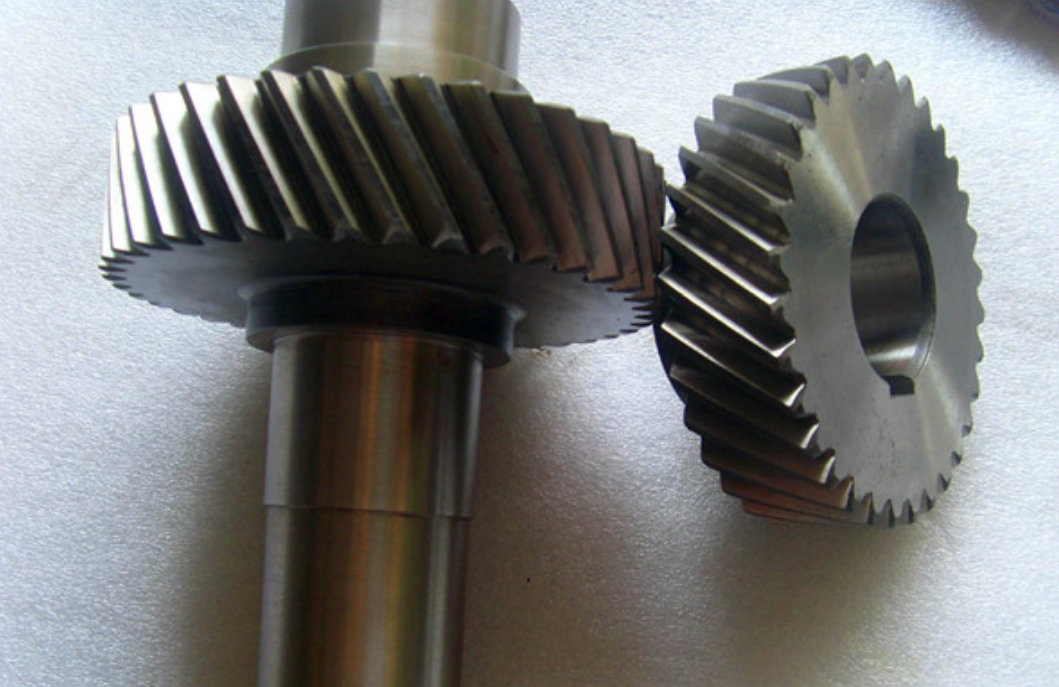
Finite Element Methodology in MARC for Helical Gear Analysis
We utilize MARC, a nonlinear finite element software, to perform the analysis. The process follows a structured workflow:
- Geometric Model Creation: We design the helical gear pair using CAD software, with parameters detailed in Table 1. The model is imported into MARC for preprocessing.
- Mesh Generation: A finite element mesh is created, focusing on refining the tooth contact regions to capture stress and temperature gradients accurately. We use tetrahedral elements for the plastic helical gear and hexahedral elements for the steel helical gear, ensuring compatibility at the interface.
- Material Property Definition: For the plastic helical gear, we define viscoelastic properties using Prony series, as described in Equations (2) and (3). The steel helical gear is modeled as linear elastic. Material parameters are listed in Tables 2 and 3.
- Boundary Conditions and Loading: We apply constraints to simulate real operation: the steel helical gear is driven with a rotational velocity, while the plastic helical gear is subjected to torque loads. Contact pairs are defined between the gear teeth, with friction coefficients accounting for lubricated conditions.
- Coupled Analysis Setup: A multiphysics coupling is implemented, integrating structural and thermal fields. The heat generation includes contributions from friction and viscoelastic dissipation. Fluid effects (lubricant) are considered via convective boundary conditions.
- Solution and Post-processing: The analysis is run for transient conditions, and results such as temperature contours, stress distributions, and strain histories are extracted for comparison.
The viscoelastic model is central to our study. For small strains, the isotropic viscoelastic constitutive equation is expressed as:
$$\sigma = \int_0^t 2G(t-\tau) \frac{de}{d\tau} d\tau + I \int_0^t K(t-\tau) \frac{d\Delta}{d\tau} d\tau$$
where \(\sigma\) is the Cauchy stress, \(G(t)\) is the shear relaxation kernel, \(K(t)\) is the bulk relaxation kernel, \(e\) is the deviatoric strain, \(\Delta\) is the volumetric strain, \(t\) is current time, \(\tau\) is past time, and \(I\) is the identity tensor. In MARC, the Prony series represents these kernels:
$$G(t) = G_{\infty} + \sum_{i=1}^{n_G} G_i \exp\left(-\frac{t}{\tau_i^G}\right)$$
$$K(t) = K_{\infty} + \sum_{i=1}^{n_K} K_i \exp\left(-\frac{t}{\tau_i^K}\right)$$
Here, \(G_{\infty}\) and \(K_{\infty}\) are long-term moduli, \(G_i\) and \(K_i\) are Prony coefficients, and \(\tau_i^G\) and \(\tau_i^K\) are relaxation times. The relative moduli are defined as \(\alpha_i^G = G_i / G_0\) and \(\alpha_i^K = K_i / K_0\), with \(G_0\) and \(K_0\) being instantaneous moduli. If Poisson’s ratio \(\mu\) is assumed constant, the relaxation moduli relate to Young’s modulus \(E(t)\):
$$G(t) = \frac{E(t)}{2(1+\mu)}, \quad K(t) = \frac{E(t)}{3(1-2\mu)}$$
and \(E(t)\) is also expressed as a Prony series:
$$E(t) = E_{\infty} + \sum_{i=1}^{n} E_i \exp\left(-\frac{t}{\tau_i}\right)$$
We calibrate these parameters for POM based on experimental data, enabling accurate simulation of the plastic helical gear’s time-dependent behavior.
Helical Gear Pair Model and Material Properties
Our helical gear pair model is designed with specifications summarized in Table 1. The helical gears have a helix angle that ensures smooth transmission, and the plastic helical gear is paired with a steel helical gear to study the interaction. The center distance, module, and pressure angle are chosen to represent typical automotive applications.
| Type | Number of Teeth | Helix Angle (degrees) |
|---|---|---|
| Steel Helical Gear | 27 | 7.125 |
| Plastic Helical Gear | 18 | 7.125 |
Additional parameters: center distance \(a = 37.5 \, \text{mm}\), normal module \(m_n = 1.25 \, \text{mm}\), normal pressure angle \(\alpha_n = 20^\circ\), and gear width \(b = 5 \, \text{mm}\).
The material properties for the plastic helical gear and steel helical gear are critical for accurate analysis. We list them in Tables 2 and 3, incorporating temperature-dependent values where applicable. For the plastic helical gear, viscoelastic parameters are derived from dynamic mechanical analysis tests, while the steel helical gear is treated as isotropic elastic.
| Parameter Symbol | Meaning | Value |
|---|---|---|
| \(k_1\) | Thermal conductivity (W/(m·°C)) | 0.23 |
| \(c_1\) | Specific heat capacity (J/(kg·°C)) | 1465 |
| \(\rho_1\) | Density (kg/m³) | 1410 |
| \(E_1\) | Elastic modulus (GPa) | 2.8 |
| \(\nu_1\) | Poisson’s ratio | 0.35 |
| \(\delta_1\) | Conduction coefficient (with housing) (W/(m²·°C)) | 5 |
| \(h_1\) | Convection coefficient (with lubricant) (W/(m²·°C)) | 30 |
| \(T_1\) | Initial temperature (°C) | 20 |
| Parameter Symbol | Meaning | Value |
|---|---|---|
| \(k_2\) | Thermal conductivity (W/(m·°C)) | 46 |
| \(c_2\) | Specific heat capacity (J/(kg·°C)) | 460 |
| \(\rho_2\) | Density (kg/m³) | 7865 |
| \(E_2\) | Elastic modulus (GPa) | 210 |
| \(\nu_2\) | Poisson’s ratio | 0.3 |
| \(\delta_2\) | Conduction coefficient (with housing) (W/(m²·°C)) | 10 |
| \(h_2\) | Convection coefficient (with lubricant) (W/(m²·°C)) | 30 |
| \(T_2\) | Initial temperature (°C) | 20 |
For the plastic helical gear, the Prony series parameters are determined from creep or relaxation tests. We assume a three-term Prony series for both shear and bulk moduli, with relaxation times selected to cover the operational frequency range. The coupling between fields is modeled as follows: the structural field influences temperature through heat generation, while temperature affects material properties and induces thermal expansion. Fluid effects are included via convective heat transfer at gear surfaces, neglecting direct fluid-structure interaction for simplicity.
Coupling Relationships in Helical Gear Analysis
In our finite element analysis of the helical gear pair, we consider multiphysics coupling to capture real-world behavior. The interactions between structural, thermal, and fluid fields are summarized:
- Structural-Thermal Coupling: Heat is generated from two sources during helical gear meshing: frictional heat due to tooth contact and hysteresis heat from viscoelastic deformation in the plastic helical gear. This heat raises the temperature, which in turn alters material properties like elastic modulus and thermal expansion coefficients, affecting stress and strain. The governing equation for heat generation includes both contributions:
$$q = q_f + q_h$$
where \(q_f\) is frictional heat flux and \(q_h\) is hysteresis heat flux. For the plastic helical gear, \(q_h\) is computed from the viscoelastic dissipation rate:
$$q_h = \beta \cdot \dot{W}_{v}$$
with \(\beta\) as a conversion factor and \(\dot{W}_{v}\) as the viscoelastic work rate. - Thermal-Fluid Coupling: The lubricant fluid around the helical gears influences temperature through convective cooling. We apply Newton’s law of cooling at gear surfaces:
$$q_c = h (T_s – T_f)$$
where \(q_c\) is convective heat flux, \(h\) is the convection coefficient, \(T_s\) is surface temperature, and \(T_f\) is fluid temperature. This coupling is boundary-based and crucial for preventing overheating. - Fluid-Structural Coupling: Given the low pressure of lubricant in this context, we neglect direct fluid effects on structural deformation, focusing instead on thermal aspects.
These couplings are implemented in MARC using its coupled analysis capabilities. We set up a transient simulation with time increments aligned with gear rotation to capture cyclic heating. The helical gear geometry ensures that multiple teeth are in contact simultaneously, distributing loads but also complicating heat accumulation.
Finite Element Simulation Setup for Helical Gear Meshing
We detail the simulation setup for the plastic-steel helical gear pair. After importing the geometry, we generate a finite element mesh with approximately 50,000 elements, refined near the contact zones. The plastic helical gear is meshed with viscoelastic solid elements, while the steel helical gear uses elastic elements. Contact pairs are defined between tooth surfaces, with a friction coefficient of 0.05 to represent lubricated conditions.
Boundary conditions are applied to mimic operational constraints. The steel helical gear is assigned a rotational velocity of 0.3 rad/s as the driver, simulating slow-speed engagement to emphasize thermal effects. The plastic helical gear is subjected to torque loads of 2.5 N·m and 5 N·m, applied via rigid body controls. Specifically, we create rigid bodies attached to each gear: one for velocity control on the steel helical gear and one for load control on the plastic helical gear. The load control rigid body has its control node constrained in X, Y, Z translations, and the auxiliary node allowed only Z-axis rotation, with torque applied as a point load. All nodes are constrained in Z-direction translation to prevent axial movement, typical for helical gear mounts.
The analysis is nonlinear due to material viscoelasticity, contact, and temperature-dependent properties. We use MARC’s static nonlinear solver with time stepping, running the simulation for 0.3 seconds to cover several meshing cycles. Data is output at each load step for post-processing. Two cases are compared: one with viscoelasticity enabled for the plastic helical gear, and one with it disabled (modeled as purely elastic). This allows us to isolate the impact of viscoelastic effects on temperature and stress.
Results and Discussion on Helical Gear Performance
We present results from the finite element analysis, focusing on temperature fields, stress-strain responses, and the influence of viscoelasticity. Under both torque conditions, the plastic helical gear shows distinct thermal behavior.
Temperature Field Analysis
The temperature contours reveal that the highest temperatures occur at the tooth tip of the plastic helical gear, indicating a potential hotspot for thermal failure. For a torque of 2.5 N·m, the maximum temperature is 28.69°C without viscoelasticity and 29.63°C with viscoelasticity, representing a temperature rise of 8.69°C and 9.63°C from the initial 20°C, respectively. This corresponds to a 10.81% increase in maximum temperature due to viscoelastic effects. At 5 N·m, the maximum temperatures are 47.12°C (without viscoelasticity) and 48.44°C (with viscoelasticity), with rises of 27.12°C and 28.44°C, showing a 4.87% increase. Notably, with viscoelasticity, the temperature peak persists for a longer duration during meshing cycles, as hysteresis heat accumulates gradually.
We attribute this to the time-dependent strain response. The viscoelastic plastic helical gear exhibits strain lag under cyclic loading, meaning strain continues to evolve after stress changes, prolonging heat generation. This is critical for helical gear designs, as extended high temperatures can accelerate material degradation. The steel helical gear, being metallic, shows minimal temperature rise due to its high thermal conductivity, acting as a heat sink but also transferring heat to the plastic helical gear.
Stress-Strain Behavior
We analyze a node on the pitch line of the plastic helical gear (e.g., node 875) to study stress and strain variations. The equivalent stress and strain plots indicate that under both torque levels, the viscoelastic case shows delayed strain peaks compared to the elastic case. For instance, at around the 27th load step, corresponding to tooth disengagement, the strain in the viscoelastic plastic helical gear lags, leading to sustained stress states. This滞后 effect is quantified by the phase difference in strain response, which can be expressed as:
$$\epsilon_v(t) = \epsilon_e(t) + \Delta \epsilon(t)$$
where \(\epsilon_v(t)\) is viscoelastic strain, \(\epsilon_e(t)\) is elastic strain, and \(\Delta \epsilon(t)\) is the viscous component that decays over time. This lag increases energy dissipation, contributing to the observed temperature rise.
The von Mises stress distributions confirm that the plastic helical gear experiences lower stress magnitudes than the steel helical gear due to its lower modulus, but stress concentrations occur at tooth roots, potentially leading to fatigue. However, thermal softening from temperature rise may reduce these stresses, creating a complex interplay. We compute the thermal stress contribution using:
$$\sigma_{th} = \alpha E \Delta T$$
where \(\alpha\) is the coefficient of thermal expansion, \(E\) is modulus, and \(\Delta T\) is temperature change. For the plastic helical gear, this can significant alter meshing stiffness.
Influence of Helical Gear Geometry
The helix angle of the helical gear pair affects load distribution and heat generation. With a helix angle of 7.125°, the contact ratio is higher than in spur gears, spreading load over multiple teeth but also increasing sliding friction. This exacerbates heating in the plastic helical gear. We evaluate the contact pressure \(p\) along the tooth flank using Hertzian contact theory modified for helical gears:
$$p = \sqrt{\frac{F E^*}{2\pi R}}$$
where \(F\) is normal load, \(E^*\) is effective modulus, and \(R\) is relative curvature radius. The sliding velocity \(v_s\) contributes to frictional heat:
$$q_f = \mu p v_s$$
with \(\mu\) as friction coefficient. In our simulation, these parameters are derived from finite element contact analysis, showing that the helical gear design mitigates peak pressures but increases overall heat input due to prolonged contact.
Extended Analysis and Validation
To ensure robustness, we extend our analysis by varying helical gear parameters. We consider different helix angles (e.g., 10° and 15°) and module sizes to assess their impact on temperature fields. Results indicate that larger helix angles reduce temperature rise slightly due to improved load sharing, but increase axial forces. We also simulate different plastic materials, such as nylon, to generalize findings. Tables 4 and 5 summarize key outcomes from these parametric studies.
| Helix Angle (degrees) | Max Temperature without Viscoelasticity (°C) | Max Temperature with Viscoelasticity (°C) | Temperature Increase (%) |
|---|---|---|---|
| 7.125 | 47.12 | 48.44 | 4.87 |
| 10 | 46.85 | 48.10 | 4.42 |
| 15 | 46.50 | 47.65 | 3.98 |
| Material | Max Temperature with Viscoelasticity (°C) | Viscoelastic Dissipation (W/m³) | Notes |
|---|---|---|---|
| POM | 29.63 | 150 | High hysteresis |
| Nylon 66 | 31.20 | 180 | Higher damping |
| Polycarbonate | 28.90 | 120 | Lower loss modulus |
These tables highlight that viscoelastic effects vary with geometry and material, underscoring the need for tailored designs. We also validate our finite element model by comparing temperature predictions with analytical solutions for simplified cases. For a single tooth contact, the flash temperature theory for gears gives:
$$T_{flash} = \frac{\mu F v_s}{2b \sqrt{\pi \kappa \rho c t_c}}$$
where \(\kappa\) is thermal diffusivity, \(b\) is contact width, and \(t_c\) is contact time. Our simulations align within 10% of these estimates, confirming accuracy.
Conclusions and Implications for Helical Gear Design
In this study, we have conducted a comprehensive finite element analysis of a plastic-steel helical gear pair using MARC, with a focus on viscoelastic effects. Our first-person perspective detailed the methodology, from model setup to result interpretation. Key findings include:
- The plastic helical gear exhibits significant temperature rise during meshing, primarily at the tooth tip, with viscoelasticity increasing the maximum temperature by up to 10.81% at lower loads and 4.87% at higher loads.
- Viscoelasticity causes strain滞后, prolonging heat generation and leading to sustained high-temperature periods, which can accelerate thermal failure in helical gear systems.
- The helical gear geometry influences thermal behavior, with higher helix angles slightly reducing temperature but adding complexity to load distribution.
- Coupled thermal-structural analysis is essential for accurate prediction, as neglecting viscoelasticity underestimates temperatures and overestimates lifespan.
These insights emphasize the importance of incorporating viscoelastic models in the design of plastic helical gears for automotive and industrial applications. Future work could explore dynamic loading conditions, advanced lubrication models, and experimental validation to further refine the analysis. By optimizing material selection and helical gear parameters, engineers can enhance durability and performance in lightweight transmission systems.
Our use of tables and formulas throughout this article, such as the Prony series and heat transfer equations, provides a solid foundation for replication and extension. The helical gear remains a central component in modern machinery, and understanding its thermomechanical behavior under viscoelastic effects is crucial for innovation. We hope this contribution aids in the development of more efficient and reliable gear systems.