
In the pursuit of higher performance in power transmission systems, particularly within demanding sectors such as aerospace and marine propulsion, the reduction of vibration and noise in helical gear pairs is paramount. Traditional profile and lead crowning modifications, while effective to a degree, often compromise contact ratio and load-bearing capacity. A more sophisticated approach involves introducing a diagonal modification on the tooth flank. This modification strategically removes material primarily at the tips and roots—the points of entry and exit into mesh—while largely preserving the involute geometry in the central region. This targeted relief smoothens the transition of load between successive teeth, minimizing transmission error fluctuation and reducing meshing impact, thereby significantly lowering noise and vibration without sacrificing the inherent strength benefits of the helical gear design.
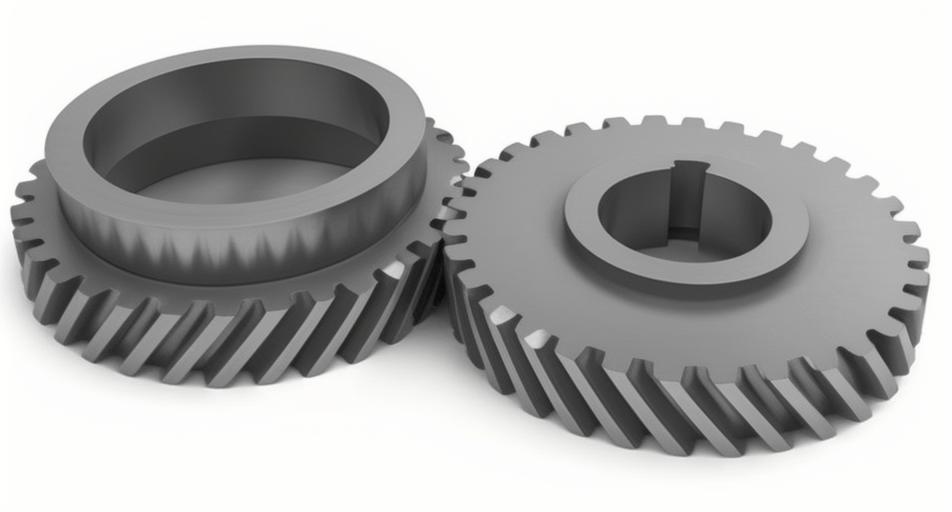
Precision finishing processes like gear shaving and grinding are essential for implementing such complex topological modifications. Plunge shaving, where the cutter feeds radially into the workpiece gear, is a highly efficient finishing method. The key to generating a diagonally modified helical gear via shaving lies in first designing the target gear flank and then deriving the conjugate flank of the plunge shaving cutter. However, the shaving cutter’s flank is no longer a simple involute helicoid; it becomes a complex, subtly warped surface that must be manufactured with extreme precision, typically by grinding. This necessitates advanced CNC grinding techniques capable of generating these free-form surfaces. This work presents a comprehensive methodology, from the design of the diagonal modification for a helical gear to the CNC grinding model for its corresponding plunge shaving cutter, incorporating sensitivity analysis and optimization to minimize manufacturing errors.
Design of Helical Gear with Diagonal Modification
The diagonal modification is applied to specific zones on the tooth flank, primarily the entry and exit regions, as conceptually illustrated below. The goal is to create a smooth, controlled deviation from the perfect involute surface in these areas. The modified flank surface can be defined mathematically by adding a modification function $\delta(u_1, l_1)$ along the unit normal vector of the theoretical involute surface.
The position vector and unit normal vector of the modified pinion flank are given by:
$$ \mathbf{R}_{1}^{r}(u_1, l_1) = \delta(u_1, l_1) \mathbf{n}_1(u_1, l_1) + \mathbf{R}_1(u_1, l_1) $$
$$ \mathbf{N}_{1}^{r} = \left( \frac{\partial \mathbf{R}_1}{\partial u_1} + \frac{\partial \delta}{\partial u_1} \mathbf{n}_1 + \delta \frac{\partial \mathbf{n}_1}{\partial u_1} \right) \times \left( \frac{\partial \mathbf{R}_1}{\partial l_1} + \frac{\partial \delta}{\partial l_1} \mathbf{n}_1 + \delta \frac{\partial \mathbf{n}_1}{\partial l_1} \right) $$
Here, $\mathbf{R}_1$ and $\mathbf{n}_1$ are the position and unit normal vectors of the theoretical helical gear involute surface, $u_1$ and $l_1$ are the surface parameters (corresponding to the involute roll angle and lead direction), and $\delta$ is the modification amount. The core of the design process is the intelligent specification of $\delta(u_1, l_1)$, which is a function of the applied load and anticipated errors to ensure shock-free engagement and smooth load transfer.
Topological Flank Calculation for the Plunge Shaving Cutter
The plunge shaving process can be kinematically modeled as the meshing of two crossed helical gears. The cutter and the workpiece have different helix angles, creating a shaft crossing angle. The cutter flank is the envelope of the family of the modified workpiece flanks relative to the cutter coordinate system during the radial infeed motion. Based on the theory of gearing and using the homogeneous coordinate transformation, the conjugate cutter surface $\mathbf{R}_s$ is determined by solving the following equation system:
$$ \mathbf{R}_s(u_1, l_1, \theta_1) = \mathbf{M}_{st}(\theta_s(\theta_1)) \mathbf{M}_{tf} \mathbf{M}_{f1}(\theta_1) \mathbf{R}_{1}^{r}(u_1, l_1) $$
$$ f(u_1, l_1, \theta_1) = \mathbf{L}_{st}(\theta_s(\theta_1)) \mathbf{L}_{tf} \mathbf{L}_{f1}(\theta_1) \mathbf{N}_{1}^{r}(u_1, l_1) \cdot \frac{\partial \mathbf{R}_s(u_1, l_1, \theta_1)}{\partial \theta_1} = 0 $$
Where $\theta_1$ is the workpiece rotation angle, $\theta_s = i \theta_1$ is the cutter rotation angle ($i$ is the gear ratio), and $\mathbf{M}_{ij}$ and $\mathbf{L}_{ij}$ are the coordinate transformation matrices for position and orientation vectors, respectively. The resulting shaving cutter surface deviates only slightly (on the order of micrometers) from an involute helicoid. The normal topological modification $\delta_s$ on the cutter relative to a standard involute cutter is calculated as the projection of this deviation onto the normal direction:
$$ \delta_s(u_1, l_1) = \left( \mathbf{R}_s(u_1, l_1) – \mathbf{R}_{1}^{inv}(u_1, l_1) \right) \cdot \mathbf{n}_1(u_1, l_1) $$
where $\mathbf{R}_{1}^{inv}$ is the position vector of the theoretical involute cutter surface.
CNC Grinding Model with a Translating Flat Wheel
To accurately manufacture this complex cutter flank, a CNC grinding model is established. A flat grinding wheel is used to simulate the rack-cutter. To enable the grinding of wide-face-width helical gear tools with large helix angles without interfering with the root fillet, the wheel is given an additional translational motion along the direction of the virtual rack’s tooth trace. The grinding process for generating an involute surface is described by:
$$ \mathbf{R}_1(u_w, \phi_w, \varphi_1) = \mathbf{M}_{1a}(\varphi_1)\mathbf{M}_{ab}\mathbf{M}_{bc}\mathbf{M}_{cw}(\varphi_1) \mathbf{r}_w(u_w, \phi_w) $$
$$ f_1(u_w, \phi_w, \varphi_1) = \frac{\partial \mathbf{R}_1}{\partial \varphi_1} \cdot \left( \frac{\partial \mathbf{R}_1}{\partial u_w} \times \frac{\partial \mathbf{R}_1}{\partial \phi_w} \right) = 0 $$
The wheel surface $\mathbf{r}_w$ is defined with a parabolic modification in its axial profile:
$$ \mathbf{r}_w(u_w, \phi_w) = \begin{bmatrix} (R_w – u_w \cos\theta_w – \delta_w \sin\theta_w) \sin\phi_w \\ (R_w – u_w \cos\theta_w – \delta_w \sin\theta_w) \cos\phi_w \\ -u_w \sin\theta_w + \delta_w \cos\theta_w \\ 1 \end{bmatrix}, \quad \delta_w = a_w (u_w – d_w)^2 $$
Here, $u_w$ and $\phi_w$ are wheel parameters, $R_w$ is the wheel radius, $\theta_w$ is the wheel cone angle, and $a_w$ and $d_w$ define the parabolic profile modification $\delta_w$.
Based on a Y7432-type grinder, a 6-axis CNC kinematic model is constructed. The machine axes include three linear motions ($C_x, C_y, C_z$) and three rotary motions ($C_a$ for pressure angle, $C_b$ for helix angle, $C_c$ for workpiece rotation). By equating the relative tool-workpiece position and orientation in the theoretical generation model and the CNC model, the basic machine settings (or “theoretical” axis motions $C_k^0$) are derived. Crucially, the wheel translation $C_s$ along the tooth trace decomposes into components on the workpiece rotation axis and a linear axis:
$$ C_z^0 = K_1 \cos\alpha_n \cos\beta – r_j \varphi_1 – K_2 \sin\beta – s_z \cos\beta – C_s \varphi_1 \sin\beta $$
$$ C_y^0 = -K_1 \sin\alpha_n + r_j + s_y $$
$$ C_x^0 = K_1 \cos\alpha_n \sin\beta + K_2 \cos\beta – s_z \sin\beta + C_s \varphi_1 \cos\beta $$
$$ C_a^0 = \beta, \quad C_b^0 = \alpha_n, \quad C_c^0 = \varphi_1 $$
where $\alpha_n$ is normal pressure angle, $\beta$ is helix angle, $r_j$ is pitch radius, and $K_1, K_2, s_y, s_z$ are machine constants. When $C_s = 0$, the wheel is fixed. Introducing $C_s$ allows the use of a smaller-diameter wheel for larger helical gears, as the required wheel radius $R_w$ is determined by the longer instantaneous contact line length: $R_w \ge 0.5(l_s + h_s)^2 / (l_s \sin\kappa + h_s)$, where $l_s$ is the contact length and $\kappa$ is its inclination.
Sensitivity Analysis and High-Order Correction Model
To grind the topological cutter flank, the theoretical axis motions $C_k^0$ must be corrected. A high-order correction model is formulated. Each machine axis movement $C_k$ (for $k = x, y, z, a, b, c$) is expressed as a 6th-degree polynomial in terms of the generating roll angle $\varphi_1$:
$$ C_i = \sum_{k=0}^{6} a_{k,i} \varphi_1^k, \quad (i = x, y, z, a, b, c) $$
The parabolic wheel profile parameters $(a_w, d_w, \theta_w)$ also serve as correction variables. The resulting normal deviation $\delta$ at a grid point on the ground flank, due to changes in these polynomial coefficients ($\zeta_j$), can be linearly approximated through a sensitivity matrix $\mathbf{S}$:
$$ \delta = \mathbf{S} \zeta $$
Here, $\zeta$ is a column vector containing all 45 adjustable parameters (42 polynomial coefficients + 3 wheel parameters). The matrix $\mathbf{S}$ is constructed by analyzing the influence (sensitivity) of a small perturbation in each parameter on the flank deviation at each evaluation point. For plunge shaving cutter grinding, which is a material-removing process, a contact condition must be enforced: a negative calculated deviation indicates the wheel penetrates the nominal surface (correct grinding), while a positive deviation indicates the wheel is away from the surface (no material removal). The optimization problem is thus to find the parameter set $\zeta$ that minimizes the sum of squared differences between the calculated modifications and the desired cutter modifications $\delta_s$, subject to the contact condition.
| Corrected Parameter | Primary Effect on Ground Flank | Typical Form of Modification |
|---|---|---|
| $C_a$ (0th order) | Pressure angle shift, tooth thickness change | Uniform profile shift |
| $C_a$ (1st order) | Linear pressure angle change along face width | Diagonal modification (one end) |
| $C_a$ (2nd order) | Parabolic pressure angle change along face width | Diagonal modification (both ends) |
| $C_c$ (1st order) | Linear timing shift along face width | Diagonal modification (one end) |
| $\theta_w$ (wheel angle) | Basic lead crowning or tilting | Longitudinal correction |
| $a_w, d_w$ (wheel profile) | Profile crowning or specific profile form | Profile correction |
The Particle Swarm Optimization (PSO) algorithm is employed to solve this constrained, non-linear optimization problem, effectively searching for the optimal machine commands and wheel profile to minimize the grinding error $F(\zeta) = \min \sum f^2(\zeta)$.
Numerical Example and Analysis
A numerical case is presented to validate the proposed methodology. The basic parameters for the workpiece helical gear and the designed plunge shaving cutter are listed below.
| Component | Number of Teeth | Normal Module (mm) | Face Width (mm) | Normal Pressure Angle (°) | Helix Angle (°) |
|---|---|---|---|---|---|
| Work Gear (Pinion) | 19 | 6 | 75 | 20 | -9.91 (Left-hand) |
| Plunge Shaving Cutter | 37 | 6 | 78 | 20 | 15.00 (Right-hand) |
The target diagonal modification surface for the pinion is designed. Tooth Contact Analysis (TCA) of the pinion and its conjugate shaving cutter confirms that the contact lines cover the entire flank without edge contact or undercutting, indicating a viable design. The calculated topological modification required on the shaving cutter is found to be a complex superposition of a longitudinal crown (opposite to the desired gear crown) and the diagonal modification pattern.
For grinding this cutter, the wheel translation is set to zero ($C_s=0$), and a wheel radius of $R_w=350$ mm is selected. The PSO algorithm converges stably after about 200 iterations. The optimization results in very small corrections for axes $C_x, C_y, C_z, C_b$, indicating they contribute little to this specific diagonal form. The primary corrections come from:
- A constant (0th order) shift in the pressure angle axis $C_a$, mainly for tooth thickness adjustment.
- A linear (1st order) correction in the workpiece rotation axis $C_c$. This linear timing shift along the face width is the principal mechanism for generating the required diagonal modification on the cutter flank. The correction $\Delta C_c$ is such that the actual generating roll lags the theoretical value, resulting in less material removal at the entry and exit regions of the cutter flank, consistent with the required superposition of modifications.
- Adjustments to the wheel cone angle $\theta_w$.
The final CNC-ground cutter surface is smooth, and the achieved deviation from the theoretically required topological surface is less than 2 μm, demonstrating the high accuracy of the proposed correction method. The optimized polynomial coefficients for the primary correcting axes are summarized as follows, where $\varphi_1$ is in radians.
| Axis | $a_0$ | $a_1$ | $a_2$ | $a_3$ | $a_4$ | $a_5$ | $a_6$ |
|---|---|---|---|---|---|---|---|
| $C_a$ (rad) | 2.69e-3 | -1.52e-6 | 8.74e-8 | -2.11e-10 | 1.95e-13 | -6.32e-17 | ~0 |
| $C_c$ (rad) | ~0 | -5.84e-5 | 2.13e-7 | -3.88e-10 | 3.56e-13 | -1.63e-16 | 2.95e-20 |
Furthermore, the analysis confirms that by activating the wheel translation along the tooth trace ($C_s \neq 0$), a smaller grinding wheel can be used to manufacture wide-face-width helical gears with large helix angles, making the process more practical for industrial applications. This transforms the grinding process into a 3-axis (work rotation, linear feed, and wheel translation) coordinated motion for generating free-form flanks.
Conclusion
This work establishes a complete digital process chain for manufacturing high-performance, low-noise helical gears with diagonal modifications via plunge shaving. The key contributions are:
- Design and Synthesis: A method for designing a diagonal modification on a helical gear flank and analytically deriving the corresponding complex topological surface of the conjugate plunge shaving cutter is presented.
- Advanced CNC Grinding Model: A versatile CNC grinding model based on a translating flat wheel is developed. This model enables the generation of free-form surfaces and allows for the use of smaller wheels for large helical gear components.
- High-Order Correction via Sensitivity Analysis: A robust correction methodology is formulated by modeling machine axes as high-order polynomials and conducting sensitivity analysis. This approach effectively links minute adjustments in machine motion (particularly 1st-order changes in generating roll and pressure angle) to the generation of specific diagonal modifications.
- Optimization-Based Solution: The use of the PSO algorithm to solve the grinding parameter optimization problem ensures stable convergence and minimizes flank error to the micrometer level.
The results demonstrate that the topological flank of a plunge shaving cutter for a diagonally modified helical gear is essentially a superposition of a longitudinal crown and a diagonal twist. This can be accurately manufactured by applying corrective commands, primarily linear corrections to the generating motion and pressure angle, on a CNC grinder equipped with a profilable flat wheel. The methodology provides a solid theoretical foundation for the precision manufacturing of advanced topological gear flanks aimed at achieving superior dynamic performance in gear transmission systems.