
In the field of internal combustion engine design, particularly for diesel engines, the transmission system plays a critical role in ensuring efficient power delivery to auxiliary components such as the valve train and fuel injection pump. Among these components, helical gears are widely employed due to their smooth operation and high load-carrying capacity. However, with the trend towards higher power density and increased operating speeds, helical gears in diesel engines often face challenges related to uneven contact stress distribution along the tooth width, leading to premature wear, pitting, and even failure. This study focuses on analyzing the contact stress characteristics of helical gears used in diesel engine crankshaft assemblies, employing advanced finite element methods to identify root causes and propose effective improvement strategies. Throughout this investigation, the term “helical gear” will be emphasized to underscore its significance in power transmission systems.
The primary objective of this research is to investigate the longitudinal (axial) contact stress distribution in helical gear pairs under operational loads, with a specific focus on structural parameters that influence this distribution. Using three-dimensional contact finite element analysis (FEA), we model a typical crankshaft helical gear pair and simulate its behavior under torque transmission. The results are compared with conventional Hertzian theory calculations to validate the FEA approach. Furthermore, we explore the impact of gear geometry, such as web thickness, on stress uniformity and introduce helix angle modification as a corrective measure to enhance load distribution. This work aims to provide actionable insights for designing more reliable and durable helical gears in diesel engine applications.
Helical gears are integral to diesel engine timing drives, where they transmit motion from the crankshaft to camshafts and other accessories. These gears are characterized by their inclined teeth, which engage gradually, reducing noise and vibration compared to spur gears. However, the helical geometry also introduces axial forces that can lead to bending deformations, especially in gears with thin webs or large diameters relative to their width. In high-power diesel engines, where space and weight constraints dictate compact designs, helical gears often exhibit non-uniform contact stress along the tooth flank. This uneven distribution, if unaddressed, can cause localized overloading, accelerated fatigue, and reduced service life. Therefore, understanding and mitigating this issue is crucial for improving gear performance and reliability.
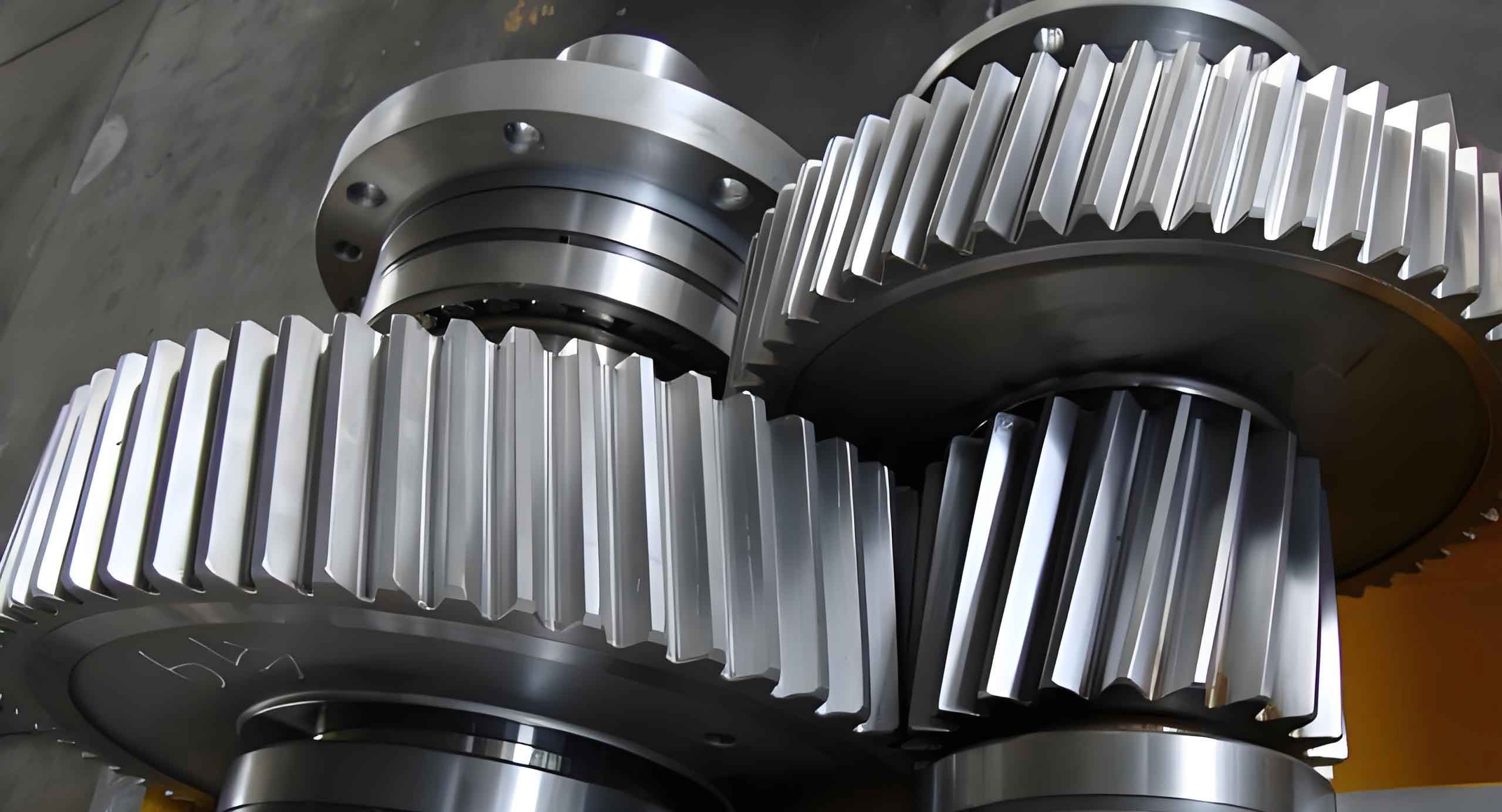
To begin our analysis, we develop a detailed finite element model of the helical gear pair. The gears under consideration are angle-modified helical gears with the following specifications: module of 4 mm, pressure angle of 20 degrees, helix angle of 12 degrees, face width of 30 mm, and a transmission ratio of 78/31 (approximately 2.52). The center distance is 227 mm. The material used is 34CrNiMo6 alloy steel, with an elastic modulus of 2.01 × 10^5 MPa and a Poisson’s ratio of 0.3. These parameters are representative of typical diesel engine helical gears used in heavy-duty applications.
We employ parametric modeling techniques in Pro/ENGINEER (Pro/E) to create precise three-dimensional geometries of both the crankshaft helical gear and the intermediate helical gear. The modeling process involves defining key curves such as the tip circle, root circle, involute profile, and helix using mathematical relations. A single tooth is constructed via sweep-blend operations and then arrayed to form the complete gear. This approach ensures accuracy in tooth geometry, which is essential for reliable contact stress analysis. The assembled gear pair is positioned at the pitch point, where contact stress is theoretically maximum, to simulate the worst-case loading scenario. The assembly is achieved by aligning the tooth surfaces to pass through a common node on the line of action, ensuring proper meshing at the pitch point.
The finite element model is imported into ANSYS for meshing and analysis. To reduce computational cost while maintaining accuracy, only four teeth from each helical gear are retained in the model. We use SOLID92 elements, which are 10-node tetrahedral elements suitable for complex geometries and contact simulations. The contact region is finely meshed with an element size of 0.4 mm after convergence studies, while coarser meshing is applied to non-critical areas. Contact pairs are defined with the crankshaft helical gear tooth surface as the contact surface and the intermediate helical gear tooth surface as the target surface. A friction coefficient of 0.05 is assumed between the contacting surfaces to account for lubricated conditions.
Boundary conditions and loads are applied to simulate real-world operating conditions. The intermediate helical gear is constrained at its shaft ends by fixing all degrees of freedom on the bearing surfaces. For the crankshaft helical gear, a torque of 500 N·m is applied to simulate the driving load. To facilitate torque application, a MASS21 element with six degrees of freedom is attached to the rotational center of the crankshaft helical gear and coupled to the nodes on its front face, creating a rigid region that transfers the torque effectively. This setup allows us to analyze the stress and deformation responses under typical diesel engine loads.
Upon solving the finite element model, we obtain the contact stress distribution on the tooth surfaces. The results reveal a significant non-uniformity in contact stress along the face width of the helical gears. Specifically, the maximum contact stress occurs at the front edge of the tooth (closest to the torque input) with a value of 754 MPa, while the minimum stress is at the rear edge with 203 MPa, resulting in a stress difference of 551 MPa. This indicates severe localized loading, which could lead to premature pitting and wear. The stress contour plot clearly shows a gradient from front to rear, highlighting the need for corrective measures.
To understand the root cause of this uneven distribution, we examine the deformations of the helical gears under load. By extracting radial and circumferential displacements along the pitch line of the contacting teeth, we observe that the intermediate helical gear exhibits a linearly decreasing radial deformation from front to rear, whereas the crankshaft helical gear’s radial deformation remains relatively constant. This disparity in radial deformation leads to unequal transmission gaps along the tooth width; smaller gaps at the front cause earlier contact and higher elastic compression, while larger gaps at the rear reduce contact pressure. Consequently, the front portion of the tooth experiences higher stresses.
Additionally, the circumferential deformations show opposite trends for the two helical gears. The intermediate helical gear’s circumferential deformation increases towards the front, while the crankshaft helical gear’s decreases. This differential deformation induces a change in the effective helix angle during operation. We calculate the helix angle variation using the formula:
$$ \delta\beta = \arctan\left(\frac{\delta L – \delta R}{b}\right) $$
where $\delta L$ and $\delta R$ are the circumferential deformations at the front and rear edges, respectively, and $b$ is the face width. For the intermediate helical gear, $\delta\beta_{\text{intermediate}} = 1.38’$ (minutes of arc), and for the crankshaft helical gear, $\delta\beta_{\text{crankshaft}} = -0.6’$. The net relative helix angle mismatch is:
$$ \Delta\beta = \delta\beta_{\text{intermediate}} – \delta\beta_{\text{crankshaft}} = 1.98′ $$
This mismatch means that the helical gears must deform elastically to achieve full tooth contact, creating a spiral misalignment that exacerbates the uneven stress distribution. The axial bending deformation, primarily due to the thin web of the intermediate helical gear, is identified as the key factor causing this issue.
To quantify the influence of structural parameters, we conduct a parametric study by varying the web thickness of the intermediate helical gear from 8 mm to 30 mm while keeping other dimensions constant. The results are summarized in Table 1, which shows the maximum contact stress, stress difference along the face width, and the calculated helix angle mismatch for different web thicknesses.
| Web Thickness (mm) | Max Contact Stress (MPa) | Stress Difference (MPa) | Helix Angle Mismatch (minutes) |
|---|---|---|---|
| 8 | 754 | 551 | 1.98 |
| 10 | 720 | 480 | 1.65 |
| 12 | 690 | 420 | 1.40 |
| 15 | 650 | 350 | 1.10 |
| 20 | 610 | 250 | 0.75 |
| 25 | 590 | 180 | 0.50 |
| 30 | 580 | 120 | 0.30 |
As evident from Table 1, increasing the web thickness improves the axial stiffness of the helical gear, reducing both the maximum contact stress and the stress unevenness. For web thicknesses below 12 mm, the stress difference exceeds 400 MPa, indicating severe偏载 (partial loading). Beyond 20 mm, the distribution becomes more uniform, with stress differences dropping below 250 MPa. This confirms that thin webs in helical gears are susceptible to large axial bending deformations, which distort tooth alignment and cause non-uniform contact.
To validate our finite element results, we compare them with conventional Hertzian contact stress calculations. The Hertzian formula for helical gears is given by:
$$ \sigma_H = Z_E Z_H Z_\epsilon Z_\beta \sqrt{\frac{2 K T_1}{b d^2} \frac{u+1}{u}} $$
where:
– $Z_E$ is the elasticity coefficient (188 $\sqrt{\text{MPa}}$ for steel-steel pairs),
– $Z_H$ is the zone factor (2.3 for a pressure angle of 20°),
– $Z_\epsilon$ is the contact ratio factor (0.81 for this gear pair),
– $Z_\beta$ is the helix angle factor (0.98 for a helix angle of 12°),
– $K$ is the load factor (1.06 assuming moderate shock loads),
– $T_1$ is the torque on the pinion (500,000 N·mm),
– $b$ is the face width (30 mm),
– $d$ is the pinion pitch diameter (127 mm for the crankshaft helical gear),
– $u$ is the gear ratio (2.52).
Substituting the values, we get:
$$ \sigma_H = 188 \times 2.3 \times 0.81 \times 0.98 \times \sqrt{\frac{2 \times 1.06 \times 500000}{30 \times 127^2} \times \frac{2.52+1}{2.52}} \approx 598 \text{ MPa} $$
This theoretical value aligns closely with the finite element result for a web thickness of 30 mm (580 MPa), but deviates for thinner webs. For instance, at 8 mm web thickness, the FEA gives 754 MPa, while Hertzian theory predicts 598 MPa, indicating that conventional methods may underestimate stress when structural deformations are significant. This highlights the advantage of FEA in capturing complex gear behavior, especially for helical gears with flexible components.
Given that increasing web thickness adds weight—a concern in diesel engine design—we explore an alternative improvement method: helix angle modification. This technique involves intentionally altering the design helix angle of one gear in the pair to compensate for the operational deformation-induced mismatch. The modification amount $\Delta\beta_{\text{mod}}$ should equal the calculated helix angle mismatch $\Delta\beta$ under load. For our case, $\Delta\beta = 1.98’$, so we modify the crankshaft helical gear by reducing its helix angle to 11.96° (i.e., 12° – 1.98′), while keeping the intermediate helical gear at 12°.
We recreate the finite element model with the modified helix angle and re-run the analysis. The results, compared with the original design and the thick-web case, are presented in Table 2.
| Configuration | Max Contact Stress (MPa) | Min Contact Stress (MPa) | Stress Difference (MPa) |
|---|---|---|---|
| Original Helical Gear (8 mm web) | 754 | 203 | 551 |
| Helical Gear with 30 mm web | 580 | 460 | 120 |
| Helix Angle Modified Helical Gear | 541 | 430 | 111 |
Table 2 demonstrates that helix angle modification significantly improves the contact stress distribution. The maximum stress drops from 754 MPa to 541 MPa—a reduction of 213 MPa—and the stress difference decreases from 551 MPa to 111 MPa. The modified helical gear performs similarly to the thick-web version, but without the weight penalty. This confirms that helix angle modification is an effective strategy for mitigating偏载 in helical gears, particularly when weight constraints prohibit thicker webs.
To further elucidate the mechanics, we derive the relationship between axial deformation and helix angle change. For a helical gear under axial load $F_a$, the axial bending deflection $\delta_a$ can be approximated by beam theory:
$$ \delta_a = \frac{F_a L^3}{3 E I} $$
where $L$ is the effective length, $E$ is Young’s modulus, and $I$ is the area moment of inertia of the gear web. The axial force $F_a$ in a helical gear is related to the tangential force $F_t$ by:
$$ F_a = F_t \tan \beta $$
with $\beta$ being the helix angle. The circumferential deformation $\delta_c$ along the tooth due to this bending affects the helix angle as:
$$ \Delta\beta \approx \frac{\delta_c}{b} $$
Combining these, we see that reducing $\delta_a$ (via stiffer webs) or compensating $\Delta\beta$ (via modification) can enhance stress uniformity. This theoretical framework supports our FEA findings and provides a basis for designing optimized helical gears.
In addition to web thickness and helix angle, other parameters such as face width, pressure angle, and material properties also influence contact stress in helical gears. We briefly explore these via sensitivity analysis. For instance, increasing face width $b$ reduces nominal stress but may exacerbate bending if not stiffened appropriately. The pressure angle $\alpha$ affects the curvature radius at the pitch point, altering the Hertzian stress. Material choices with higher elastic limits can allow higher stresses but do not address distribution issues. Therefore, a holistic design approach is essential for helical gears in diesel engines.
Our study also considers dynamic effects, though in a simplified static analysis. In reality, diesel engine helical gears operate under fluctuating loads and speeds, which can induce vibrations and impact loads. Future work could incorporate transient FEA to capture these dynamics. Nonetheless, the static analysis here provides a foundation for understanding the fundamental contact behavior of helical gears.
To summarize, the uneven contact stress distribution in diesel engine helical gears stems primarily from axial bending deformations that cause unequal transmission gaps along the tooth width. This is particularly pronounced in gears with thin webs, where flexibility leads to significant helix angle mismatches under load. Through finite element analysis, we have quantified this phenomenon and demonstrated that both increasing web thickness and applying helix angle modification can effectively improve stress uniformity. The latter offers a weight-efficient solution, making it attractive for modern engine designs.
In conclusion, this research underscores the importance of considering structural elasticity in helical gear design. By leveraging advanced modeling techniques like FEA, engineers can predict and mitigate contact stress concentrations, thereby enhancing the durability and performance of helical gears in diesel engines. We recommend that future designs incorporate helix angle modifications based on deformation predictions, and that web thickness be optimized to balance weight and stiffness. This approach will contribute to more reliable power transmission systems in high-demand applications.
For further validation, experimental tests on prototype helical gears could be conducted to correlate with our simulations. Additionally, exploring other modification techniques, such as profile crowning or lead corrections, may yield further improvements. The insights gained here extend beyond diesel engines to any application where helical gears are subjected to high loads and space constraints, emphasizing the universal relevance of this work.
Throughout this article, we have consistently highlighted the role of helical gears in transmitting power efficiently. Their unique geometry presents both advantages and challenges, necessitating careful analysis and optimization. By addressing contact stress distribution through methods like helix angle modification, we can unlock the full potential of helical gears in demanding mechanical systems.