
In the context of global energy shortages and the rapid development of the automotive industry, improving the transmission efficiency of vehicles has become a critical focus. Gear transmission is one of the most widely used and important methods in vehicular systems, and reducing meshing losses in helical gear pairs is essential for enhancing overall efficiency. These losses not only affect the output power but also influence energy consumption during operation, thereby impacting the economic performance of vehicles. We aim to develop a convenient analytical model for predicting meshing losses in involute helical gears under elastohydrodynamic lubrication (EHL) conditions. This study integrates EHL theory with the minimum elastic potential energy principle to propose a novel analytical framework, validated through simulation and experimental data. By analyzing the effects of operational parameters like speed and torque, we reveal underlying trends and derive a predictive model suitable for high-speed and heavy-load conditions.
The helical gear, characterized by its angled teeth, offers smoother and quieter operation compared to spur gears, making it prevalent in high-performance transmissions. Its geometry introduces complexities in contact mechanics and lubrication, necessitating advanced modeling approaches.
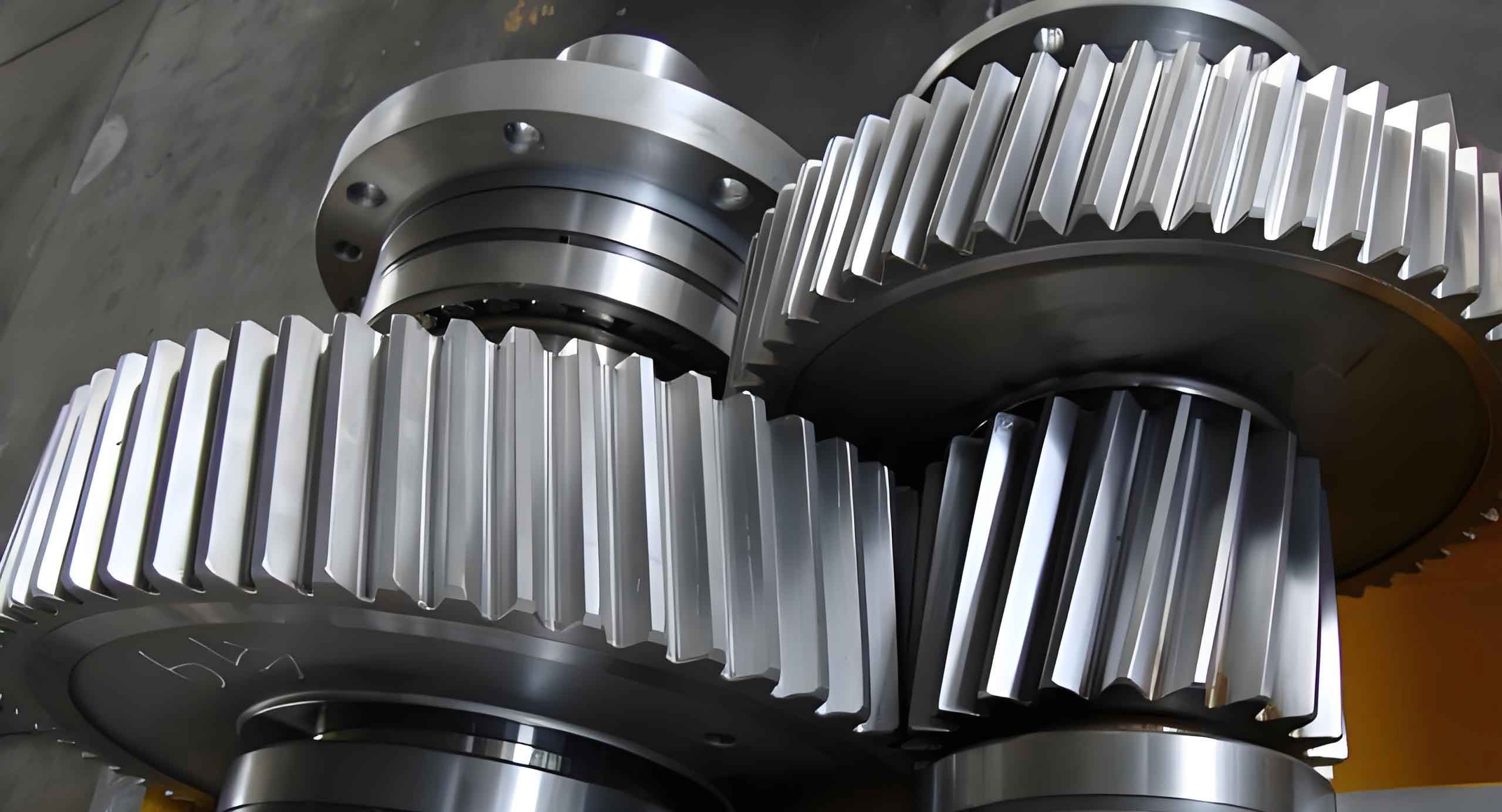
Understanding the behavior of helical gear systems under EHL conditions is crucial for optimizing design and reducing power losses. Previous research has extensively explored gear efficiency, with Martin pioneering the application of EHL theory to spur gears in 1981. Subsequent studies have incorporated numerical methods and regression techniques to simplify models, but there remains a need for practical analytical tools that balance accuracy with computational ease for engineering applications. Our work builds on these foundations by focusing on involute helical gears, leveraging the minimum elastic potential energy principle for load distribution, and developing a regression-based analytical model that captures the nonlinear relationships between meshing losses and key operational parameters.
We begin by establishing the mathematical framework for calculating meshing losses in helical gear pairs. The model comprises three main components: load distribution based on the minimum elastic potential energy principle, lubrication modeling using EHL equations, and efficiency computation through integration of shear forces. This integrated approach allows us to account for the spatial and temporal variations in contact during meshing, which are particularly pronounced in helical gear due to their gradual engagement along the tooth face. The helical gear’s geometry leads to a line contact that changes dynamically, influencing pressure and film thickness distributions. By discretizing the helical gear into multiple spur gear slices along the axis, we can analyze each segment independently and aggregate results to obtain overall performance metrics.
The load distribution model is derived by treating each tooth as a cantilever beam fixed at the root. The total strain energy \( U \) for a single tooth includes bending, axial compression, and torsional shear components, expressed as:
$$ U = U_b + U_c + U_s, $$
where \( U_b \) is bending strain energy, \( U_c \) is axial strain energy, and \( U_s \) is shear strain energy. For a helical gear pair with \( n \) teeth in contact simultaneously, the total strain energy \( U_T \) is given by:
$$ U_T = \sum_{i=1}^{n} U_i = \frac{1}{B} \sum_{i=1}^{n} F_i^2 U_e(y_c), $$
with \( F_i \) as the load on the \( i \)-th tooth pair, \( y_c \) as the distance from the load application point to the gear center, and \( B \) as the face width. The load balance relation is:
$$ \sum_{i=1}^{n} F_i = F_T, $$
where \( F_T \) is the total load. Using Lagrange multipliers, the load distribution ratio \( \gamma_i \) for each tooth pair is optimized as:
$$ \gamma_i = \frac{F_i}{F_T} = \frac{U_{ej}^{-1}(\xi)}{\sum_{j=1}^{n} U_{ej}^{-1}(\xi)}, $$
with \( \xi \) as a transient meshing variable. For a helical gear, we discretize along the axis into \( k \) spur gear slices, each with an incremental width \( dl \). The load distribution ratio per unit length for the \( k \)-th slice is:
$$ \gamma_k(\xi) = \frac{U_{ek}^{-1}}{\int_l U_e^{-1} dl} = \frac{\epsilon_\beta \cos \beta_b}{B} \frac{U_{ek}^{-1}(\xi_k)}{\int_l U_e^{-1}(\xi_k) d\xi}, $$
where \( \epsilon_\beta \) is the face contact ratio, \( \beta_b \) is the base helix angle, and \( l \) is the total contact line length. This formulation ensures that the helical gear’s load is distributed according to elastic deformations, which is critical for accurate EHL analysis.
The lubrication model is based on isothermal EHL equations, neglecting temperature effects for simplification. The dimensionless forms of the Reynolds and elasticity equations are solved iteratively using the multigrid method with four layers (\( m = 4 \)). The solution domain is set to \( x \in [-4.6, 1.4] \) in dimensionless coordinates. The pressure distribution \( p(x) \) and film thickness \( h(x) \) are obtained for each meshing instant, considering the load distribution as a boundary condition. The shear stress \( \tau \) in the lubricant is calculated using a rheological model, and the total shear force \( q(t) \) over the contact area is:
$$ q(t) = l \int_{x_{in}}^{x_{out}} \tau \, dx, $$
where \( b \) is the Hertzian contact half-width, \( l \) is the contact line length, and \( x_{in} \) and \( x_{out} \) are the inlet and outlet positions, respectively. For a helical gear, this integration accounts for the varying contact conditions along the tooth flank. The meshing friction power loss \( P \) over one engagement cycle is then:
$$ P = \int_0^{t_m} q u_s \, dt, $$
with \( u_s = |u_1 – u_2| \) as the sliding velocity and \( t_m \) as the meshing duration. This efficiency calculation method provides a comprehensive measure of losses in helical gear systems under EHL conditions.
To analyze the influence of operational parameters, we define dimensionless variables for generality. The dimensionless meshing loss \( \hat{P} \) is:
$$ \hat{P} = \frac{P_s}{P_0}, $$
where \( P_s \) is the simulated power loss and \( P_0 \) is the output power. The dimensionless speed \( \hat{U} \) is:
$$ \hat{U} = \frac{\eta_0 u}{E’ R}, $$
and the dimensionless torque \( \hat{T} \) is:
$$ \hat{T} = \frac{w}{E’ R}, $$
with \( \eta_0 \) as the ambient viscosity, \( u \) as the rotational speed, \( R \) as the equivalent radius of curvature, \( E’ \) as the equivalent elastic modulus, and \( w \) as the load per unit length. These dimensionless groups allow us to generalize findings across different helical gear designs and lubricants.
We conducted simulations for a helical gear pair with parameters summarized in Table 1. The gear geometry represents a typical high-speed application, with a focus on involute profiles and helical teeth to ensure smooth transmission. The helical gear’s design parameters influence contact patterns and lubrication effectiveness, which in turn affect meshing losses.
| Normal Module \( m_n \) (mm) | Pressure Angle \( \alpha \) (°) | Helix Angle \( \beta \) (°) | Normal Addendum Coefficient \( h_{an}^* \) | Normal Clearance Coefficient \( c_n^* \) | Normal Profile Shift Coefficients \( x_{n1} / x_{n2} \) | Addendum Reduction Coefficient \( \Delta y \) | Target Center Distance \( a \) (mm) | Face Width \( b \) (mm) |
|---|---|---|---|---|---|---|---|---|
| 5 | 20 | 16 | 1 | 0.25 | 0 / 0.087 | 0.088 | 140 | 12 |
The effects of torque on meshing losses were investigated at constant speeds of 2000, 4000, and 8000 rpm. The results, plotted on logarithmic scales, show that meshing losses increase with torque, following a linear trend in log-log space. This indicates a power-law relationship, where higher torque exacerbates losses due to increased contact pressures and shear stresses in the lubricant. For instance, at 4000 rpm, a linear regression yields:
$$ \ln \hat{P} = 2.3606 \ln \hat{T} + 19.3918, $$
with a high correlation coefficient. The residuals are minimal, confirming the model’s accuracy. This linearity suggests that for helical gear systems, torque is a dominant factor in loss generation, especially under heavy loads where boundary lubrication effects may become significant.
The influence of speed on meshing losses was studied at torques of 100 and 150 N·m. The data reveals a nonlinear relationship when plotted on logarithmic scales, approximating a quadratic curve. At lower speeds, meshing losses are higher due to inadequate film formation, leading to mixed or boundary lubrication regimes. As speed increases, the EHL film thickens, reducing friction and losses. For example, at 100 N·m, a quadratic spline fit gives:
$$ \ln \hat{P} = 0.0763 (\ln \hat{U})^2 + 3.4644 \ln \hat{U} + 34.295, $$
which aligns well with simulation data. This nonlinear behavior underscores the importance of speed optimization in helical gear design; operating at very low or very high speeds can incur efficiency penalties, with an optimal range often existing for minimal losses.
Based on these trends, we developed an analytical model for meshing losses in helical gear pairs using multivariate nonlinear regression. A dataset of 66 samples was generated from simulations, covering a range of speeds and torques. The proposed model form is:
$$ \ln \hat{P} = a (\ln \hat{U})^2 + b \ln \hat{U} + c \ln \hat{T} + d, $$
where \( a \), \( b \), \( c \), and \( d \) are coefficients determined through regression. The initial fit, including all data points, produced:
$$ \ln \hat{P} = 0.0242 (\ln \hat{U})^2 + 1.1141 \ln \hat{U} + 2.3405 \ln \hat{T} + 31.9863, $$
with a correlation coefficient \( R_1 = 0.9452 \), \( F_1 \)-value of 339.0632, and error variance \( \sigma_1 = 0.0709 \). However, residual analysis identified four outliers, which were removed to improve accuracy. The refined model is:
$$ \ln \hat{P} = -0.054 (\ln \hat{U})^2 – 0.2067 \ln \hat{U} + 2.3587 \ln \hat{T} + 17.4315, $$
with \( R_2 = 0.9796 \), \( F_2 = 862.4944 \), and \( \sigma_2 = 0.0229 \). The coefficients’ confidence intervals are narrow, indicating robust estimates. A comparison of model parameters is presented in Table 2, highlighting the improved fit of the refined model for helical gear applications.
| Parameter | Initial Model | Refined Model |
|---|---|---|
| Correlation Coefficient | 0.9452 | 0.9796 |
| F-value | 339.0632 | 862.4944 |
| Probability of F-value | 0 | 0 |
| Error Variance | 0.0709 | 0.0229 |
To validate the analytical model, we compared its predictions with experimental data from a gear rig test under varying torque and speed conditions. The test involved a helical gear pair similar to our simulation parameters, and efficiency measurements were taken across a power range of 20 to 150 kW. The results show that the model predicts meshing losses within 0.7% of experimental values, demonstrating its practical utility for high-speed and heavy-load helical gear systems. This agreement confirms that our approach, combining EHL theory with regression analysis, can reliably estimate efficiency without extensive computational resources.
The analytical model offers several insights for helical gear design and operation. First, meshing losses are linearly related to torque on a logarithmic scale, meaning that doubling torque increases losses by a constant factor, dependent on the coefficient \( c \). For our helical gear, \( c \approx 2.36 \), indicating a strong sensitivity to load. Second, losses exhibit a quadratic relationship with speed in log space, reflecting the complex interplay between film formation and sliding friction. The coefficients \( a \) and \( b \) capture this nonlinearity, with negative values in the refined model suggesting that losses may decrease at very high speeds for this helical gear configuration. These findings can guide engineers in selecting operating conditions to minimize losses, such as avoiding low-speed, high-torque regimes where lubrication is marginal.
Further analysis considers the role of helical gear geometry in meshing losses. The helix angle \( \beta \) influences the contact line length and load distribution. A larger helix angle increases overlap ratio, potentially reducing losses by distributing load over more teeth, but it also raises axial forces and complexity. Our model implicitly accounts for this through the face contact ratio \( \epsilon_\beta \) and base helix angle \( \beta_b \) in the load distribution formula. Additionally, tooth modifications like profile shifts can optimize contact patterns, and future work could integrate these into the analytical framework. The helical gear’s inherent advantages, such as smooth engagement and high load capacity, make it ideal for efficiency-critical applications, but careful modeling is essential to harness these benefits.
We also explored the impact of lubricant properties on meshing losses, though our isothermal assumption simplifies this aspect. In reality, viscosity \( \eta_0 \) and pressure-viscosity coefficients affect film thickness and shear stresses. The dimensionless group \( \hat{U} \) incorporates \( \eta_0 \), so the model indirectly captures lubricant effects. For a given helical gear system, using a higher-viscosity oil may increase film thickness but also raise churning losses, which are not considered here. Future extensions could include thermal effects and non-Newtonian fluid models to enhance accuracy for extreme conditions.
In practical applications, the analytical model can be used for quick efficiency estimation during helical gear design phases. For example, given target speed and torque values, designers can compute dimensionless parameters, plug them into the regression equation, and obtain meshing loss predictions. This avoids time-consuming simulations or experiments, speeding up optimization cycles. Table 3 provides example calculations for a helical gear pair under different operating conditions, using the refined model. The results show how losses vary with speed and torque, aiding in trade-off analyses.
| Speed \( u \) (rpm) | Torque \( T \) (N·m) | Dimensionless Speed \( \hat{U} \) | Dimensionless Torque \( \hat{T} \) | Predicted \( \ln \hat{P} \) | Meshing Loss \( \hat{P} \) (%) |
|---|---|---|---|---|---|
| 3000 | 120 | 1.2e-11 | 5.0e-10 | -4.56 | 0.31 |
| 5000 | 180 | 2.0e-11 | 7.5e-10 | -3.89 | 0.52 |
| 7000 | 200 | 2.8e-11 | 8.3e-10 | -3.45 | 0.71 |
The model’s limitations include its reliance on specific gear parameters and lubrication conditions. The regression coefficients were derived for a particular helical gear geometry, so extrapolation to vastly different designs may require recalibration. However, the dimensionless formulation offers some generality, and the methodology can be adapted to other helical gear systems by performing similar simulations and regression. Additionally, the model focuses on meshing losses only, excluding other loss sources like bearing friction or windage, which are significant in overall gearbox efficiency. For comprehensive analysis, these could be added as separate terms.
In conclusion, we have developed an analytical model for predicting meshing losses in involute helical gears under EHL conditions. By combining the minimum elastic potential energy principle for load distribution with EHL theory and multivariate regression, we derived a simple equation that relates losses to speed and torque. The model shows that meshing losses in helical gear pairs are linear with torque and quadratic with speed on logarithmic scales, providing valuable insights for optimization. Validation against experimental data confirms accuracy within 0.7% for high-speed, heavy-load scenarios. This work advances the practical calculation of helical gear efficiency, offering a tool for designers to quickly estimate losses and improve transmission performance. Future research could expand the model to include thermal effects, diverse lubricants, and broader geometric variations for helical gear applications across industries.