
The pursuit of efficient and reliable power transmission in high-speed, heavy-duty applications consistently leads to the widespread adoption of involute helical gears. The defining characteristic of the helical gear is its angled teeth, which engage more gradually compared to spur gears. This results in smoother operation, reduced noise, and higher load-carrying capacity due to multiple teeth being in contact simultaneously. However, this complex contact, characterized by a line that is inclined to the gear axis, introduces significant challenges in analyzing its lubrication performance. Effective lubrication is paramount to minimizing wear, reducing frictional power losses, and ultimately extending the service life of the gear system. Therefore, a detailed investigation into lubrication characteristics such as film thickness, temperature rise, and friction coefficient during the meshing cycle of a helical gear pair is of critical engineering importance.
Previous research on the elastohydrodynamic lubrication (EHL) of helical gears often involves simplifications, such as modeling the contact as equivalent rollers or truncated cones. While these approaches provide valuable insights, many have relied on the Newtonian fluid model and have not comprehensively accounted for the combined effects of surface roughness, thermal heating, and the non-Newtonian rheological behavior of modern lubricants. These factors are crucial for predicting realistic friction coefficients and film thicknesses in the mixed lubrication regime where gears often operate. This analysis addresses these gaps by developing a comprehensive mixed thermoelastohydrodynamic lubrication model for involute helical gears based on the load-sharing concept.
The core methodology involves discretizing the helical gear tooth contact along its inclined contact line. Each discrete segment is treated as an equivalent spur gear slice with a modified angular velocity. The local contact geometry, including the principal radii of curvature and surface velocities in the direction normal to the contact line, is precisely determined using Euler’s formula for surfaces. This allows for a transient line-contact EHL analysis at every point along the contact line throughout the meshing cycle. The model integrates Greenwood-Tripp and Gelinck-Schipper theories for rough surface contact to determine the portion of the load carried by the asperities versus the lubricant film. The lubricant’s behavior is modeled using both a Newtonian fluid and a more realistic Carreau-Yasuda non-Newtonian rheological model, with viscosity described by the Doolittle-Tait free-volume model. The energy equation is solved to obtain the temperature field, which in turn influences viscosity and shear stress. This integrated approach enables the prediction of central film thickness, load-sharing ratio, flash temperature rise, and the overall friction coefficient.
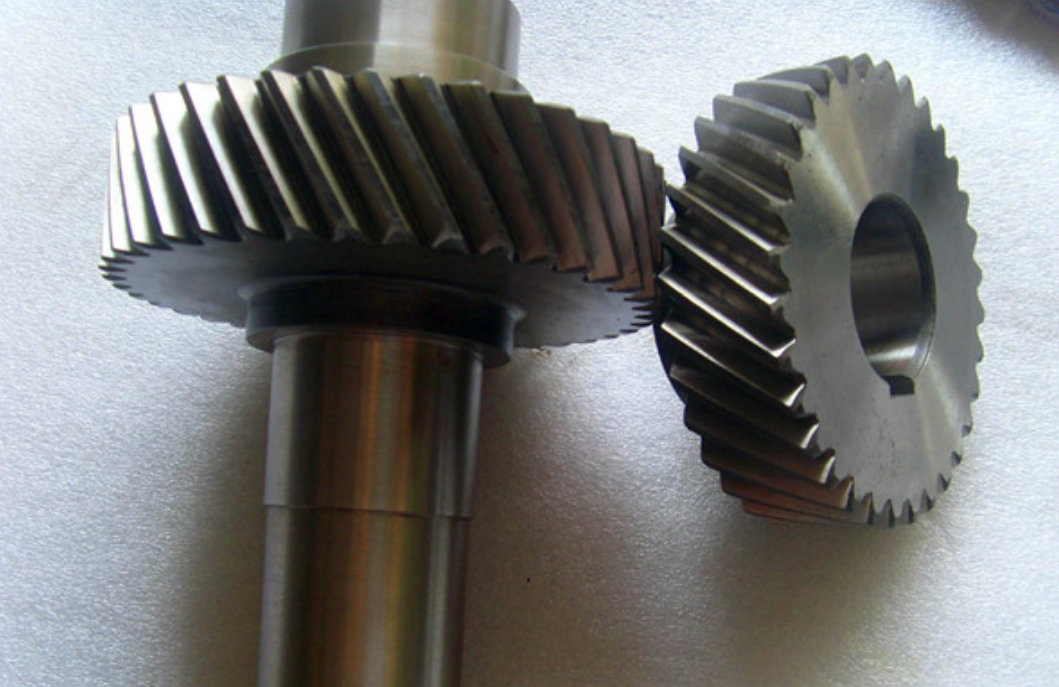
Theoretical Foundation: Helical Gear Contact and Lubrication Model
1. Geometric and Kinematic Analysis of Helical Gear Contact
The analysis begins with the precise definition of the contact geometry in an involute helical gear pair. The plane of action is tangent to the base cylinders of both gears. The line of contact within this plane is straight and inclined at the base helix angle, $\beta_b$. For computational analysis, this contact line is divided into numerous small segments along its length (y-direction). Each segment is considered as a spur gear contact with an equivalent angular velocity, $\hat{\omega} = \omega \cos \Delta$, where $\Delta$ is the angle between the path of contact and the contact line normal in the plane of action, given by $\cos\Delta = \cos\alpha’ / \cos\beta_b$ ($\alpha’$ is the operating transverse pressure angle).
Using Euler’s equation for surface curvature, the principal radii of curvature in the direction normal to the contact line (x-direction) for the driving and driven gears are derived as:
$$R_{1x}(y,t) = R_{1e}(y,t) \cos^2 \Delta$$
$$R_{2x}(y,t) = R_{2e}(y,t) \cos^2 \Delta$$
Here, $R_{1e}$ and $R_{2e}$ are the radii of curvature on the transverse section (equivalent spur gear) at a given position $y$ along the contact line and time $t$ in the meshing cycle. They are calculated based on the gear geometry and the roll angle. The corresponding surface velocities in the x-direction are:
$$U_{1x} = \hat{\omega}_1 R_{1x} = \omega_1 R_{1e} \cos^3 \Delta$$
$$U_{2x} = \hat{\omega}_2 R_{2x} = \omega_2 R_{2e} \cos^3 \Delta$$
The entrainment velocity $u_r$ (average surface speed) and sliding velocity $u_s$, which are critical for lubrication analysis, are then:
$$u_r(y,t) = \frac{U_{1x} + U_{2x}}{2}$$
$$u_s(y,t) = U_{1x} – U_{2x}$$
The length of the contact line varies during meshing. For a single tooth pair, it changes from zero at initial contact to a maximum and back to zero at the end of contact. For a helical gear with multiple teeth in contact, the total contact length $L_z(t)$ is the sum of the lengths of all active contact lines. The length of the $i$-th contact line, $L(i,t)$, depends on the transverse contact ratio ($\varepsilon_\alpha$) and the axial contact ratio ($\varepsilon_\beta$). Defining $\Delta L = B\tan\beta_b$ and $g$ as the length of the path of contact, the formulas are summarized in the table below:
| Condition | Length of i-th Contact Line, $L(i,t)$ |
|---|---|
| $\Delta L \le g$ | $ L(i,t) = \begin{cases} \frac{KA}{\sin\beta_b}, & 0 \le KA \le \Delta L \\[0.5em] \frac{\Delta L}{\sin\beta_b}, & \Delta L < KA \le g \\[0.5em] \frac{g + \Delta L – KA}{\sin\beta_b}, & g < KA \le \Delta L + g \end{cases} $ |
| $\Delta L > g$ | $ L(i,t) = \begin{cases} \frac{KA}{\sin\beta_b}, & 0 \le KA \le g \\[0.5em] \frac{g}{\sin\beta_b}, & g < KA \le \Delta L \\[0.5em] \frac{g + \Delta L – KA}{\sin\beta_b}, & \Delta L < KA \le \Delta L + g \end{cases} $ |
where $KA$ is the distance from the start of the path of contact to the current line.
2. Steady-State Load Distribution
In a helical gear transmission, the total load is shared among the several tooth pairs that are simultaneously in contact. For steady-state analysis, the “Percentage of Contact Lines” method provides a simplified yet effective way to estimate the load on a specific tooth pair. The total normal load $F_z$ is calculated from the input torque $T$ and the base radius $r_{b1}$: $F_z = T / r_{b1}$. The load carried by the first tooth pair at any meshing time $t$ is then proportional to its share of the total contact length:
$$F(t) = \frac{L(1,t)}{L_z(t)} F_z$$
where $L_z(t) = \sum_{i=1}^{N} L(i,t)$ and $N$ is the number of active contact lines (the integer part of the total contact ratio $\varepsilon_\gamma$).
3. Mixed Thermoelastohydrodynamic Lubrication Model
3.1 Load Sharing Concept
In mixed lubrication, the total applied normal load $F_d$ is supported partly by the hydrodynamic pressure in the lubricant film ($F_h$) and partly by the asperity contact pressure ($F_a$):
$$F_d = F_h + F_a$$
Similarly, the total friction force $F_f$ comprises the viscous shear force in the film ($F_{fh}$) and the asperity contact friction ($F_{fa}$): $F_f = F_{fh} + F_{fa}$. The overall coefficient of friction is defined as $f = F_f / F_d$.
3.2 Lubricant Rheology and Properties
The shear stress $\tau$ is central to calculating friction. For a Newtonian fluid, $\tau = \mu \dot{\gamma}$, where $\dot{\gamma}$ is the shear rate. However, real lubricants under high pressure and shear rate exhibit non-Newtonian behavior. The Carreau-Yasuda model is used here:
$$\mu_e = \frac{\tau}{\dot{\gamma}} = \mu \left[1 + \left( \frac{\mu \dot{\gamma}}{G_{cr}} \right)^2 \right]^{\frac{(n-1)}{2}}$$
where $\mu_e$ is the effective viscosity, $\mu$ is the low-shear viscosity (dependent on pressure and temperature), $G_{cr}$ is the critical shear stress, and $n$ is the power-law exponent.
The viscosity-pressure-temperature relationship is described by the Doolittle-Tait free volume model:
$$\mu = \mu_r \exp\left\{ \frac{B_0 R_0 [1 + \varepsilon(T-T_r)]}{\frac{V}{V_r} – R_0[1 + \varepsilon(T-T_r)]} – \frac{1}{1-R_0} \right\}$$
The density (volume) variation is given by the Tait equation of state:
$$\frac{V}{V_R} = \left[1 – \frac{1}{1+K’_0} \ln\left(1 + \frac{p}{K_0}(1+K’_0)\right) \right] \left[ 1 + \alpha_V (T – T_R) \right]$$
3.3 Film Thickness and Load Share Calculation
The central film thickness $h_c$ for a smooth line contact under isothermal, Newtonian conditions can be estimated by the Moes equation. For a rough contact in the mixed EHL regime, an empirical formula that equates the asperity contact pressure from two different rough contact theories (Gelinck-Schipper and Greenwood-Tripp) is solved iteratively to find the load share ratio $\gamma_2 = F_d / F_a$ and the corresponding central film thickness $h_{c}^{N}$. For the non-Newtonian Carreau fluid, the Newtonian film thickness $h_c^N$ is corrected using a factor derived by Jang et al.:
$$\Phi_c = \frac{h_c}{h_c^N} = \left[ 1 + 0.75(1+s_r) \Gamma^{1.6} \right]^{3.1(1-n)}$$
where $s_r$ is the slide-to-roll ratio and $\Gamma$ is a shear-thinning parameter. Finally, a thermal correction factor $C_t$ is applied to account for inlet shear heating:
$$C_t = \frac{h_{ct}}{h_c} = \left( 1 + 0.0766 G^{0.687} W^{0.447} L_c^{0.527} e^{0.875 s_r} \right)^{-1}$$
where $L_c$ is the thermal loading parameter. The final thermal, non-Newtonian central film thickness is $h_{ct} = C_t \cdot \Phi_c \cdot h_c^N$.
3.4 Thermal Analysis
The temperature rise within the contact significantly affects viscosity and friction. The simplified energy equation for the lubricant film is:
$$k_f \frac{\partial^2 T}{\partial z^2} = -\mu_e \left( \frac{\partial u}{\partial z} \right)^2 + c_f \rho_f u \frac{\partial T}{\partial x} – \frac{f_a p_a u_s}{h_{ct}}$$
The last term represents the heat generated by asperity contact friction ($f_a$ is the asperity friction coefficient, $p_a$ is the asperity pressure). The velocity profile $u(z)$ is found by integrating the momentum equation with the Carreau constitutive model:
$$\mu_e \frac{\partial^2 u}{\partial z^2} + \frac{\partial \mu_e}{\partial z} \frac{\partial u}{\partial z} = \frac{\partial p}{\partial x}$$
The surface temperatures are modeled using Jaeger’s moving heat source solution for semi-infinite bodies:
$$T(x,0) = T_0 + \frac{k_f}{\sqrt{\pi \rho_1 c_1 k_1 u_1}} \int_{-b}^{x} \frac{\frac{\partial T}{\partial z}|_{z=0} \, ds}{\sqrt{x-s}}$$
$$T(x,h) = T_0 + \frac{k_f}{\sqrt{\pi \rho_2 c_2 k_2 u_2}} \int_{-b}^{x} \frac{\frac{\partial T}{\partial z}|_{z=h} \, ds}{\sqrt{x-s}}$$
Solving the coupled system of the energy, momentum, and surface temperature equations yields the complete temperature field $T(x,z)$ and the shear stress distribution $\tau(x,z)$.
3.5 Friction Coefficient Calculation
The total friction coefficient is the final output, combining the contributions from the fluid film and asperity contact:
$$f = \frac{F_f}{F_d} = \frac{F_{fh} + F_{fa}}{F_d} = \frac{B \int_{x_{in}}^{x_{out}} \tau \, dx}{F_d} + \frac{f_a}{\gamma_2}$$
where $B$ is the face width and the integral calculates the total viscous shear force across the contact.
Results and Discussion: Lubrication Performance of Helical Gears
The analysis is performed for a specific helical gear pair. The gear parameters and lubricant properties are summarized in the tables below.
| Parameter | Driving Wheel | Driven Wheel |
|---|---|---|
| Number of Teeth, $z$ | 25 | 31 |
| Transverse Module, $m_t$ (mm) | 3.175 | |
| Transverse Pressure Angle, $\alpha_t$ (°) | 25 | |
| Helix Angle, $\beta$ (°) | 21.5 | |
| Face Width, $B$ (mm) | 31.75 | |
| Center Distance, $a$ (mm) | 88.9 | |
| Young’s Modulus, $E$ (GPa) | 210 | |
| Poisson’s Ratio, $\nu$ | 0.3 | |
| RMS Roughness, $\sigma_s$ ($\mu$m) | 0.4 | |
| Asperity Radius, $\beta_s$ ($\mu$m) | 6 | |
| Asperity Friction Coefficient, $f_a$ | 0.1 | |
| Property | Value |
|---|---|
| Thermal Conductivity, $k_f$ (W/m·K) | 0.14 |
| Density, $\rho_f$ (kg/m³) | 864 |
| Specific Heat, $c_f$ (J/kg·K) | 2000 |
| Reference Viscosity, $\mu_R$ (Pa·s) at $T_R=75$°C | 1.42 |
| Carreau Exponent, $n$ | 0.74 |
| Critical Shear Stress, $G_{cr}$ (kPa) | 31 |
For this gear pair, the total contact ratio $\varepsilon_\gamma$ is 2.74, indicating that either two or three tooth pairs are in contact at any given time. Consequently, the load on a single tooth pair varies continuously and smoothly throughout its meshing cycle, as governed by the changing total contact length $L_z(t)$ and its own contact length $L(1,t)$.
1. Lubrication Performance with a Newtonian Fluid Model
Using the Newtonian model, the central film thickness, the portion of load carried by the film ($1/\gamma_1$), the maximum film temperature rise, and the friction coefficient were calculated over the entire meshing cycle and along the entire contact line.
The central film thickness and the load-carrying portion of the film exhibit similar variation patterns. At a given meshing time, the film thickness varies along the contact line. During the initial meshing (approach to the pitch point), the film thickness tends to decrease along the contact line from one end to the other. During the final meshing (recession from the pitch point), the opposite trend is observed. When the contact line length is relatively constant near the middle of the meshing cycle, the film thickness first increases and then decreases along the contact line. Over time for a fixed segment of the helical gear tooth (i.e., following one “slice” from entry to exit), the film thickness shows an approximate “inverted V” shape: it is relatively low at entry, increases to a maximum near the pitch point region, and then decreases again at exit.
The temperature rise distribution shows a characteristic “Y” shape when plotted against time and contact line position. The highest temperatures occur at the extremes of the contact line during entry and exit, where sliding velocities are highest. The lowest temperature rise is observed at the pitch point region, where pure rolling occurs ($u_s \approx 0$).
The friction coefficient predicted by the Newtonian model is generally high over the entire contact region. Notably, in the pitch region where film thickness is typically higher, the Newtonian model yields friction coefficients that are often physically unrealistic (excessively high). This is a well-known shortcoming of the Newtonian model in EHL contacts, as it does not account for the shear-thinning behavior that limits shear stress at high strain rates.
2. Lubrication Performance with a Carreau Non-Newtonian Fluid Model
Employing the Carreau rheological model provides a more realistic prediction of the helical gear lubrication performance. The general trends for film thickness, load share, and temperature rise with respect to time and contact line position remain qualitatively similar to those from the Newtonian model. However, there are significant quantitative differences. The central film thickness calculated with the Carreau model is generally lower than its Newtonian counterpart due to the reduced effective viscosity in the high-shear inlet zone. Consequently, the portion of the load carried by the lubricant film is also slightly lower, implying a slightly higher asperity load share.
The most critical improvement is in the prediction of the friction coefficient. The Carreau model, which captures the shear-thinning plateau, predicts significantly lower and more realistic friction coefficients across the entire contact. The values align much better with expectations from engineering practice for gear contacts. Furthermore, the variation of the friction coefficient shows a distinct and logical pattern. At a fixed meshing time, the friction coefficient varies inversely with the film thickness along the contact line. Where the film is thicker, the shear stress is limited, leading to a lower friction coefficient. Where the film is thinner (often at the ends of the contact line or during entry/exit), the friction coefficient is higher due to increased asperity interaction and potentially higher shear rates in a thinner film. For a fixed tooth segment over time, the friction coefficient follows an approximate “V” shape, being higher at entry and exit and reaching a minimum near the pitch point, which is the opposite trend of the film thickness variation.
The temperature rise predicted by the Carreau model is generally lower than the Newtonian prediction because the shear-thinning behavior reduces the viscous dissipation ($\mu_e \dot{\gamma}^2$) term in the energy equation.
Conclusions
This comprehensive analysis of mixed thermoelastohydrodynamic lubrication in involute helical gears leads to several key conclusions:
- The discretization method, treating each segment along the contact line of the helical gear as an equivalent spur gear slice with geometry defined by Euler’s equation, provides an effective framework for analyzing the transient and spatially varying lubrication conditions.
- The load-sharing model, integrating rough surface contact theory with EHL film thickness formulas, is essential for predicting performance in the mixed lubrication regime typical of geared systems.
- While the Newtonian and Carreau non-Newtonian fluid models predict similar qualitative trends for central film thickness, load-carrying fraction, and temperature rise over the meshing cycle and along the contact line, they differ critically in friction prediction. The Newtonian model overestimates the friction coefficient, especially in the pitch region, yielding unrealistic values.
- The Carreau shear-thinning model provides physically realistic friction coefficients that are in better agreement with engineering experience. It reveals that the friction coefficient varies inversely with the film thickness: higher friction occurs where the film is thinner (e.g., at contact line ends and during entry/exit), and lower friction occurs where the film is thicker.
- For any given slice of the helical gear tooth followed through its meshing cycle, parameters follow recognizable patterns: film thickness shows an “inverted V” shape, temperature rise shows a “Y” shape (minimum at the pitch point), and the friction coefficient shows a “V” shape (minimum at the pitch point).
This analysis underscores the importance of incorporating realistic lubricant rheology and surface roughness into the lubrication modeling of helical gears to accurately predict friction and wear, thereby enabling better gear design for efficiency and durability.