
Helical gear pairs are one of the most prevalent power transmission mechanisms in mechanical engineering. The accurate design and strength verification of these helical gears are of paramount importance, yet they constitute a complex and intricate task fraught with uncertainties. The complexity arises from the multitude of factors influencing helical gear strength, many of which are difficult to quantify precisely. While major industrial nations and international standards organizations have published formulas for calculating gear strength, these formulas often possess inherent limitations. Comprehensive strength assessment must account for numerous factors including geometric dimensions, material properties, manufacturing tolerances, assembly errors, body and shaft stiffness, bearing deflections, contact deformations, thermal effects, heat treatment processes, lubrication characteristics, surface conditions, and actual operating loads—totaling nearly 30 different influential variables. In current engineering practice, the determination of helical gear strength relies partly on semi-empirical, semi-theoretical calculation formulas and heavily on validation through real-world application and testing.
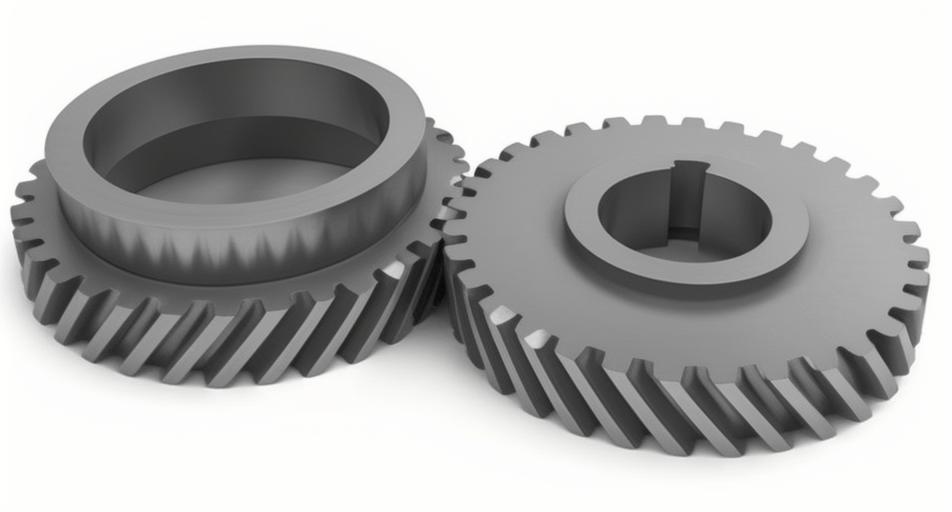
The advent and rapid development of CAD/CAE technologies have shifted preference towards the finite element method (FEM), a technique with a solid mathematical foundation that is both economical and flexible, for conducting strength analysis on helical gears. Although significant research has been conducted in this domain, a detailed report on three-dimensional contact finite element analysis using a full model of a helical gear pair remains scarce. This study addresses that gap. It employs advanced CAE technology to enhance the accuracy of helical gear strength verification. A three-dimensional contact model of an involute helical gear pair is constructed using UG NX software, utilizing its assembly and mechanism functions to ensure the correct initial meshing position. Subsequently, a comprehensive 3D contact finite element analysis of the full helical gear model is performed using Abaqus software. The results from this finite element analysis show remarkable agreement with physical test data, with relative errors for maximum root stress and maximum contact stress being only 2% and 2.6%, respectively. This validation reveals that traditional theoretical calculation methods tend to be conservative. The methodology presented provides a reliable theoretical basis and a feasible approach for the design of helical gears, ultimately aiming to improve design quality and increase gear reliability.
Theoretical Background and Gear Parameters
The classical approach to gear contact problems, such as those in helical gears, often simplifies the complex contact between tooth surfaces to the Hertzian contact of two equivalent cylinders. For helical gears, the maximum contact stress on the tooth surface is calculated using a derived formula that incorporates several correction factors. The fundamental formula is based on Hertzian contact theory and is expressed for helical gears as:
$$ \sigma_H = Z_B Z_H Z_E Z_\epsilon Z_\beta \sqrt{ \frac{F_t}{d_1 b} \cdot \frac{u + 1}{u} \cdot K_A K_V K_{H\beta} K_{H\alpha} } $$
where:
$\sigma_H$ is the calculated contact stress,
$F_t$ is the nominal tangential load at the reference circle,
$d_1$ is the reference diameter of the pinion,
$b$ is the face width,
$u$ is the gear ratio ($z_2/z_1$),
$Z_B$, $Z_H$, $Z_E$, $Z_\epsilon$, $Z_\beta$ are factors for single pair tooth contact, zone, elasticity, contact ratio, and helix angle, respectively,
$K_A$, $K_V$, $K_{H\beta}$, $K_{H\alpha}$ are application, dynamic, face load, and transverse load factors.
Similarly, calculating the bending stress at the root of a helical gear tooth is challenging due to the continuously changing contact line and critical cross-section position during meshing. The common engineering practice involves an approximate calculation based on the equivalent spur gear in the normal plane, with the introduction of a helix angle factor $Y_\beta$. The formula for maximum root bending stress is:
$$ \sigma_F = \frac{F_t}{b m_n} Y_{Fa} Y_{Sa} Y_\epsilon Y_\beta K_A K_V K_{F\beta} K_{F\alpha} $$
where:
$\sigma_F$ is the calculated bending stress,
$m_n$ is the normal module,
$Y_{Fa}$, $Y_{Sa}$, $Y_\epsilon$, $Y_\beta$ are form factor, stress correction factor, contact ratio factor, and helix angle factor,
$K_{F\beta}$, $K_{F\alpha}$ are face load and transverse load factors for bending.
The analysis in this study focuses on a mating helical gear pair from a gearbox. The pinion has 32 teeth and the gear has 67 teeth. Both helical gears are manufactured from material 20Cr2Ni4, undergo carburizing and quenching with a case depth of 1.0-1.5 mm, achieving a surface hardness of 55-65 HRC. The teeth are ground after heat treatment. The detailed parameters for this helical gear pair are summarized in the table below.
| Parameter | Pinion (Helical Gear) | Gear (Helical Gear) |
|---|---|---|
| Normal Module, $m_n$ (mm) | 4.5 | 4.5 |
| Number of Teeth, $z$ | 32 | 67 |
| Pressure Angle, $\alpha_n$ (°) | 20 | 20 |
| Helix Angle, $\beta$ (°) | 9.125 (Right Hand) | 9.125 (Left Hand) |
| Addendum Coefficient, $h_a^*$ | 1 | 1 |
| Profile Shift Coefficient, $x_n$ | 0 | 0 |
| Radial Runout Tolerance, $F_r$ (mm) | 0.025 | 0.025 |
| Total Profile Tolerance, $F_\alpha$ (mm) | 0.008 | 0.008 |
| Lead Tolerance, $F_\beta$ (mm) | 0.012 | 0.016 |
Applying the theoretical formulas with the appropriate factors for the given helical gear parameters and operating conditions (tangential load $F_t = 5157$ N), the calculated stresses are:
$$ \sigma_{H1} = 952 \text{ MPa}, \quad \sigma_{F1} = 322 \text{ MPa} $$
These values represent the theoretical baseline for contact and bending strength of the pinion helical gear.
Finite Element Model Development for the Helical Gear Pair
The finite element analysis of the helical gear pair begins with accurate 3D model generation. Creating a precise involute helical gear model with correct meshing engagement directly within general-purpose finite element software like Abaqus can be cumbersome. Therefore, a dual-software approach is adopted. First, the detailed solid models of the individual pinion and gear are created in UG NX software, accurately modeling the involute tooth profiles with the specified helix angle. Subsequently, the assembly module of UG NX is utilized to bring the two helical gears together. Crucially, the software’s mechanism functions are employed to position the gears in a correct initial meshing engagement, simulating the kinematic alignment of a real helical gear pair. This accurately assembled 3D contact model is then seamlessly imported into Abaqus for the finite element analysis, leveraging the interoperability between the two software packages.
The material for both helical gears is defined as 20Cr2Ni4 steel with linear elastic properties: Young’s Modulus $E = 2.06 \times 10^5$ MPa and Poisson’s Ratio $\nu = 0.25$. The contact interaction between the tooth surfaces of the two helical gears is defined as a finite-sliding, surface-to-surface contact. A Penalty friction formulation is used with a coefficient of friction $\mu = 0.1$ to account for the tangential forces during meshing of the helical gears.
To balance computational accuracy and efficiency, the full helical gear models are discretized using 10-node modified quadratic tetrahedron elements (C3D10 in Abaqus). This element type is well-suited for capturing the stress concentrations in the complex geometry of the helical gear teeth and fillets. The final meshed model contains a total of 389,937 nodes and 274,217 elements, ensuring a sufficiently fine mesh in the contact regions of the helical gear teeth.
Boundary Conditions, Load Application, and Solution
Realistic boundary conditions and load application are critical for an accurate finite element simulation of the helical gear pair. The model is constrained as follows:
1. The inner cylindrical surface of the larger helical gear (gear) is fully fixed, restraining all translational and rotational degrees of freedom ($U_x = U_y = U_z = UR_x = UR_y = UR_z = 0$).
2. The inner cylindrical surface of the smaller helical gear (pinion) is constrained to allow only rotation about its axis. This is achieved by coupling all nodes on this surface to a reference point located at the center of the bore, and then restraining all degrees of freedom at this reference point except for the rotation about the gear axis ($UR_z$ is free).
The load is applied to simulate the transmission of torque. A pure torque $T_1$ is applied to the reference point controlling the pinion’s motion. However, to accurately distribute the resulting forces onto the contacting tooth surfaces of the helical gear pair during the solution, a multi-step approach or kinematic coupling is often used. The reaction forces from the applied torque manifest as distributed pressure/traction on the contacting tooth flanks. For the purpose of understanding the load transformation, the equivalent forces on a single tooth in the coordinate system aligned with the helical gear can be described. The tangential component $F_x$ arises directly from the torque, while the separating force $F_y$ and the axial thrust force $F_z$ are consequences of the pressure angle and the helix angle of the helical gear, respectively:
$$
\begin{aligned}
F_x &= \frac{2000 \cdot T_1}{d_1} \\
F_y &= \frac{F_x}{\tan \alpha_n \cos \beta} \\
F_z &= F_x \tan \beta
\end{aligned}
$$
The analysis is run as a static, general step, considering the nonlinearities arising from the contact conditions between the helical gear teeth. The solver iteratively finds the equilibrium state where the contact forces balance the applied torque and the boundary conditions are satisfied.
Results, Validation, and Comparative Discussion
The results from the 3D contact finite element analysis of the helical gear pair provide detailed insight into the stress distribution. The analysis reveals that during the meshing cycle of the helical gears, the location of maximum stress shifts periodically, consistently occurring on the tooth surfaces that are in contact at a given instant. The contour plot of the Von Mises stress clearly shows the stress concentration at the root fillet of the pinion helical gear tooth, which is the critical location for bending fatigue. The maximum bending stress value extracted from the FEA results is 293 MPa.
Furthermore, the contact pressure distribution on the tooth flanks of the helical gear pair can be visualized and quantified. The maximum contact pressure (Hertzian pressure) predicted by the finite element model is 925 MPa. This represents the peak compressive stress on the surface of the helical gear teeth due to the contact load.
To validate the accuracy of the finite element model and methodology for this helical gear analysis, a physical load test was conducted on the actual gearbox containing this specific helical gear pair. Strain gauges and other measurement techniques were used to experimentally determine the stresses under equivalent loading conditions. The test results yielded a maximum root stress of 299 MPa and a maximum contact stress of 950 MPa.
The comparison between the Finite Element Analysis (FEA) results and the experimental test results demonstrates excellent correlation for the helical gear pair:
| Stress Type | Theoretical Calculation | 3D Contact FEA | Experimental Test | FEA vs. Test Relative Error |
|---|---|---|---|---|
| Maximum Root Bending Stress (MPa) | 322 | 293 | 299 | $\frac{|293-299|}{299} \times 100\% \approx 2.0\%$ |
| Maximum Contact Stress (MPa) | 952 | 925 | 950 | $\frac{|925-950|}{950} \times 100\% \approx 2.6\%$ |
The close agreement, with relative errors of only 2.0% and 2.6% for bending and contact stress respectively, strongly validates the fidelity of the full 3D contact finite element analysis approach for this helical gear pair. This level of accuracy provides high confidence in using this CAE method for the design and verification of helical gears.
Comparing the traditional theoretical calculation results with both FEA and test data reveals a significant finding: the theoretical formulas yield higher stress values. Specifically, the theoretical contact stress is about 3% higher than the test, and the theoretical bending stress is about 8% higher than the test. This indicates that the traditional calculation methods, based on simplified models like equivalent cylinders for contact and cantilever beams for bending, are inherently conservative when applied to helical gears. This conservatism stems from several simplifying assumptions:
1. The Hertzian formula assumes line contact between two cylinders, whereas the actual contact between helical gear teeth is a complex, evolving elliptical patch.
2. The bending stress formula uses a standardized form factor and stress concentration factor for a fixed, worst-case loading position (typically the highest point of single pair contact), which may not coincide exactly with the most critical instantaneous position in a 3D helical gear mesh considering load sharing and load distribution.
3. The formulas often do not fully account for the stiffening effect of the adjacent teeth and the gear body, which the finite element model naturally includes.
The primary advantage of the full 3D contact finite element analysis for helical gears is its ability to simulate the real-time state of meshing with high fidelity. It automatically accounts for factors such as the actual 3D geometry of the helical gear teeth including the lead, the load sharing between multiple teeth in contact due to the contact ratio, the precise load distribution across the face width influenced by misalignments and deflections, and the mutual stiffness interaction between the mating helical gears. This leads to a more accurate and less conservative stress prediction, enabling more optimized and lightweight designs for helical gear transmissions without compromising reliability.
Conclusion
This study successfully demonstrates a robust methodology for the strength analysis of helical gears using advanced computer-aided engineering tools. By constructing an accurate three-dimensional model of an involute helical gear pair in UG NX and ensuring correct initial meshing through kinematic assembly, a reliable foundation for finite element analysis is established. Performing a full-model, three-dimensional contact analysis in Abaqus software provides a highly detailed and realistic simulation of the stress state within the helical gear pair under load.
The results from this finite element analysis show exceptional correlation with physical experimental data, validating the accuracy of the model and the approach. The identified conservatism in traditional theoretical calculation methods for helical gears highlights a significant opportunity for design optimization. By adopting this 3D contact finite element analysis methodology, engineers can achieve more precise strength verification for helical gears. This enables the development of more efficient, compact, and cost-effective helical gear transmissions by safely reducing safety margins that were previously necessary due to the limitations of simplified formulas. Consequently, this CAE-driven approach significantly contributes to enhancing the design quality, performance, and reliability of helical gear systems in modern mechanical engineering applications.