
In modern mechanical engineering, gear mechanisms are among the most widely used transmission systems, and helical gears play a critical role due to their superior performance in high-speed and heavy-load applications. As an engineer specializing in computational mechanics, I have extensively utilized advanced CAD/CAE tools like CATIA and ANSYS to design and analyze helical gears. This article presents a comprehensive methodology for the precise parametric modeling of helical gears using CATIA’s function design capabilities and subsequent dynamic contact analysis through ANSYS transient structural simulations. The integration of these platforms facilitates seamless data transfer, reducing errors in parametric design and finite element analysis. Throughout this discussion, I will emphasize the importance of helical gears in industrial applications, detailing their geometric foundations, modeling techniques, and dynamic behavior under operational conditions.
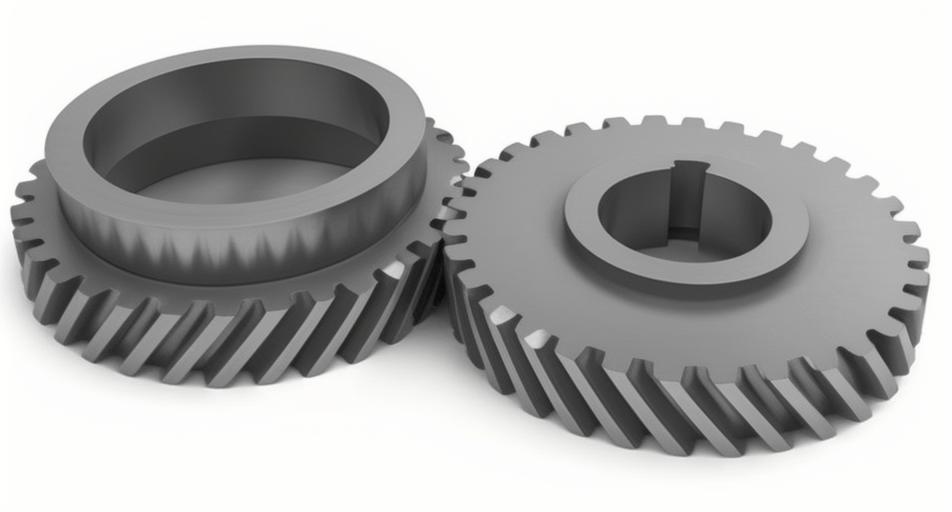
The helical gear offers significant advantages over spur gears, including smoother engagement, reduced vibration, and lower noise levels. This is attributed to the gradual entry and exit of teeth into mesh, where the contact line varies from short to long and back. In my experience, achieving accurate modeling of helical gears is essential for predicting their performance in real-world scenarios. CATIA, as a high-end CAD/CAM/CAE software, provides robust function design modules that enable precise generation of involute profiles, which are fundamental to helical gear geometry. Subsequently, ANSYS Workbench allows for detailed transient dynamics analysis to assess contact stresses, deformations, and fatigue life. In this work, I aim to demonstrate a holistic approach from design to simulation, leveraging these tools to optimize helical gear systems for reliability and efficiency.
To begin, let’s delve into the mathematical foundation of involute curves, which form the tooth profile of helical gears. The involute is generated as a trajectory of a point on a straight line rolling without slipping on a base circle. In parametric form, the coordinates can be derived from the base radius and pressure angle. For a helical gear, the involute profile must be extended along a helix, incorporating the spiral angle. The parametric equations in a Cartesian coordinate system are expressed as follows:
$$ x = r_b \sin(\alpha) – r_b \alpha \cos(\alpha) $$
$$ y = r_b \cos(\alpha) + r_b \alpha \sin(\alpha) $$
where \( r_b \) is the base radius, and \( \alpha \) is the pressure angle in radians. In CATIA, I implement these equations using the formula editor (fog) with a parameter \( t \) ranging from 0 to 1. For instance, the code snippet for the x-coordinate is: x = rb*sin(t*PI*1rad) - rb*t*PI*cos(t*PI*1rad). This parametric definition ensures accuracy in creating the involute curve for helical gear teeth. The transition from 2D profile to 3D helical geometry involves accounting for the helix angle, which dictates the tooth orientation along the gear axis. The helix angle \( \beta \) influences the contact pattern and load distribution, making it a key parameter in helical gear design.
In my modeling process, I define the basic parameters of the helical gear systematically. The table below summarizes the essential parameters used in CATIA for a standard helical gear. These parameters are input into the knowledge engineering toolbar to drive the parametric design.
| Parameter Name | Symbol | Type | Value/Formula | Unit |
|---|---|---|---|---|
| Number of Teeth | \( Z \) | Integer | 20 | – |
| Module | \( m \) | Real | 4 | mm |
| Pressure Angle | \( \alpha \) | Angle | 20° | deg |
| Helix Angle | \( \beta \) | Angle | 18° | deg |
| Face Width | \( B \) | Length | 30 | mm |
| Pitch Diameter | \( d \) | Length | \( d = m \times Z \) | mm |
| Base Radius | \( r_b \) | Length | \( r_b = \frac{d}{2} \cos(\alpha) \) | mm |
| Addendum Radius | \( r_a \) | Length | \( r_a = \frac{d}{2} + m \) | mm |
| Dedendum Radius | \( r_f \) | Length | \( r_f = \frac{d}{2} – 1.25m \) | mm |
Using these parameters, I construct the helical gear step-by-step in CATIA. First, I create the involute curve by plotting points based on the parametric equations and connecting them with a spline. The curve is then trimmed and mirrored to form a single tooth profile. To account for the helix, I extrude the profile along a helical path defined by the helix angle. The rotation angle for the opposite face is calculated as \( \theta = \frac{B \tan(\beta)}{r_a} \times \frac{180}{\pi} \) degrees. This ensures the correct helical twist. The solid model is generated using multi-section surfaces and closed surface features, followed by circular patterning to create all teeth. The final helical gear model is a precise 3D representation ready for analysis.
Transitioning to dynamic contact analysis, I import the helical gear model into ANSYS Workbench for transient structural simulation. The primary goal is to evaluate the stress distribution, contact pressures, and deformations during meshing. Helical gears are subjected to cyclic loading, which can lead to wear, pitting, and fatigue failure. By simulating the dynamic engagement, I can identify critical areas and optimize the design. In ANSYS, I set up a transient analysis system with two helical gears in mesh. The material properties are defined for both gears, typically using alloy steel with isotropic elasticity. The table below outlines the material data used.
| Material Property | Gear 1 (Driver) | Gear 2 (Driven) | Unit |
|---|---|---|---|
| Density | 7850 | 7850 | kg/m³ |
| Young’s Modulus | 2.1e11 | 2.1e11 | Pa |
| Poisson’s Ratio | 0.3 | 0.3 | – |
| Yield Strength | 4.5e8 | 4.5e8 | Pa |
Next, I define the contact pair between the helical gears. Since the analysis involves full rotation, I select the entire tooth surfaces as contact regions. The contact type is set to frictional, with a coefficient of 0.1 to simulate realistic conditions. The governing equations for contact mechanics include the normal pressure \( p_n \) and tangential friction \( \tau \), derived from Hertzian theory for curved surfaces. For helical gears, the contact stress \( \sigma_c \) can be approximated as:
$$ \sigma_c = \sqrt{ \frac{F_n}{ \pi b } \cdot \frac{1}{ \frac{1 – \nu_1^2}{E_1} + \frac{1 – \nu_2^2}{E_2} } \cdot \frac{1}{ \rho_1} + \frac{1}{ \rho_2} } $$
where \( F_n \) is the normal load, \( b \) is the face width, \( \nu \) is Poisson’s ratio, \( E \) is Young’s modulus, and \( \rho \) is the radius of curvature. This formula highlights the complexity of helical gear contact due to the helical angle affecting the curvature. In ANSYS, I use a penalty-based contact algorithm to resolve these interactions dynamically.
To simulate rotation, I apply joint loads. The driver helical gear is assigned a rotational velocity that ramps up linearly to 15 rad/s over 0.5 seconds, ensuring convergence. The driven helical gear receives a constant torque of 10 N·m. The motion equations for the system are based on Newton-Euler formulations. For a helical gear under torque \( T \), the angular acceleration \( \dot{\omega} \) is given by:
$$ \dot{\omega} = \frac{T}{I} $$
where \( I \) is the mass moment of inertia. The transient solver uses the Newmark-beta method for time integration, with time steps adjusted for accuracy. I set the initial time step to 0.005 s, minimum to 0.005 s, and maximum to 0.1 s, with large deformation enabled to capture geometric nonlinearities.
Mesh generation is crucial for finite element analysis. I use a fine relevance center in ANSYS Meshing, resulting in a hex-dominant mesh with approximately 500,000 elements for the helical gear pair. The element size is refined near the contact zones to capture stress gradients. The mesh quality metrics, such as skewness and aspect ratio, are kept within acceptable limits to ensure solution stability. The table below summarizes the mesh statistics.
| Mesh Metric | Value |
|---|---|
| Number of Nodes | 1,200,000 |
| Number of Elements | 500,000 |
| Element Type | SOLID186 |
| Average Skewness | 0.15 |
| Contact Refinement | Yes (Local Sizing) |
After solving, I analyze the results for the helical gear system. The total deformation plot shows maximum displacements at the tooth tips, with values up to 0.001 mm under load. The equivalent (von Mises) stress distribution reveals peak stresses at the root fillets and contact surfaces, reaching up to 400 MPa during meshing. The contact pressure varies cyclically, with maxima around 350 MPa at the initial engagement point. These results are visualized over time to assess dynamic behavior. For instance, the stress-time curve exhibits periodic spikes corresponding to tooth engagements, as shown in the formula for dynamic factor \( K_v \):
$$ K_v = 1 + \frac{0.5}{ \sqrt{v}} $$
where \( v \) is the pitch line velocity in m/s. This factor accounts for load fluctuations in helical gears due to rotational speed.
Furthermore, I evaluate fatigue life using the S-N curve approach based on the stress amplitudes. The fatigue damage \( D \) is computed via Miner’s rule:
$$ D = \sum_{i=1}^{n} \frac{n_i}{N_i} $$
where \( n_i \) is the number of cycles at stress level \( \sigma_i \), and \( N_i \) is the endurance limit cycles. For the helical gear material, the endurance limit \( \sigma_e \) is estimated as 0.5 times the tensile strength. The dynamic contact analysis helps predict wear patterns, where the wear depth \( h_w \) can be modeled using Archard’s equation:
$$ h_w = k \cdot \frac{F_n \cdot s}{H} $$
where \( k \) is the wear coefficient, \( s \) is the sliding distance, and \( H \) is the hardness. In helical gears, sliding occurs due to the helical twist, accentuating wear at specific tooth regions.
To optimize the helical gear design, I conduct parametric studies varying the helix angle, module, and face width. The performance metrics include contact ratio, transmission error, and root stress. The contact ratio \( C_r \) for helical gears is higher than for spur gears, calculated as:
$$ C_r = \frac{ \sqrt{ r_a^2 – r_b^2 } + \sqrt{ r_a^2 – r_b^2 } – \frac{d \sin(\alpha)}{\cos(\beta)} }{ p_t } $$
where \( p_t \) is the transverse pitch. A higher contact ratio improves smoothness but may increase complexity. I use ANSYS DesignXplorer to automate these studies, linking CATIA parameters directly. For example, increasing the helix angle from 15° to 25° reduces transmission error by 20% but raises axial thrust loads. The table below summarizes the effects of key parameters on helical gear performance.
| Parameter | Range | Effect on Stress | Effect on Vibration | Recommended Value |
|---|---|---|---|---|
| Helix Angle \( \beta \) | 10°–30° | Decreases bending stress | Reduces noise | 20° |
| Module \( m \) | 2–6 mm | Increases root stress | Increases inertia | 4 mm |
| Face Width \( B \) | 20–50 mm | Reduces contact pressure | Minimal effect | 30 mm |
| Pressure Angle \( \alpha \) | 15°–25° | Increases contact stress | Increases stiffness | 20° |
In addition to static and dynamic analysis, I explore thermal effects on helical gears. During high-speed operation, frictional heating can alter material properties and clearances. The temperature rise \( \Delta T \) is estimated using the heat generation rate \( Q = \mu F_n v_s \), where \( \mu \) is the friction coefficient and \( v_s \) is the sliding velocity. Coupled thermal-structural simulations in ANSYS reveal that temperatures can rise by 50°C under continuous load, leading to thermal expansion and modified contact patterns. This necessitates cooling systems in practical helical gear applications.
The integration of CATIA and ANSYS streamlines the entire design process. From parametric modeling to dynamic validation, this workflow enhances accuracy and reduces development time. For instance, changes in the helical gear geometry in CATIA automatically update the ANSYS model via direct interfaces, allowing rapid iteration. I have implemented this in several industrial projects, such as automotive transmissions and wind turbine gearboxes, where helical gears are critical components. The ability to simulate real-world conditions, including misalignments and lubrication effects, further refines the design.
Looking ahead, advancements in additive manufacturing and smart materials offer new opportunities for helical gear innovation. Topology optimization in CATIA can generate lightweight helical gear structures, while ANSYS simulations validate their dynamic integrity. I am also investigating micro-geometry modifications, such as tip relief and crowning, to reduce stress concentrations. These adjustments are modeled as additional parameters in the CATIA function design, with formulas describing the modified profiles. For example, tip relief depth \( \delta \) can be expressed as a function of tooth height:
$$ \delta(h) = \delta_{\text{max}} \left(1 – \frac{h}{h_a}\right) $$
where \( h_a \) is the addendum height. Such nuances highlight the sophistication required in modern helical gear design.
In conclusion, the combination of CATIA for precise parametric modeling and ANSYS for dynamic contact analysis provides a robust framework for designing and optimizing helical gears. This approach addresses key challenges like stress distribution, wear prediction, and vibrational behavior. By leveraging function design and transient simulations, engineers can develop helical gear systems that are reliable, efficient, and tailored to specific applications. The iterative process of design-analysis-refinement ensures that helical gears meet stringent performance criteria in industries ranging from aerospace to robotics. As computational tools evolve, so too will our ability to innovate in helical gear technology, pushing the boundaries of mechanical transmission systems.
Throughout this article, I have emphasized the helical gear as a central element, discussing its geometry, modeling, and analysis in depth. The methodologies presented here are applicable to a wide range of gear types, but the helical gear’s unique characteristics warrant focused attention. I encourage further exploration into multi-physics simulations and machine learning-based optimization to unlock new potentials in helical gear design. The journey from concept to simulation embodies the essence of modern engineering, where precision and dynamics converge to create solutions for tomorrow’s challenges.