
The pursuit of quieter and more refined automotive transmissions is a persistent challenge in vehicle engineering. Vibration and noise emanating from the gearbox significantly impact driving comfort and perceived quality. While sources of gear noise are multifaceted—encompassing manufacturing precision, bearing dynamics, and housing structure—the fundamental excitations originate at the gear mesh interface itself. Traditionally, significant effort is expended on micro-geometry modifications (profile and lead corrections) in later design stages to mitigate mesh-induced vibrations. However, the root cause of the time-varying mesh stiffness excitation, which is a primary driver of dynamic transmission error and consequently vibration, lies in the fundamental macro-geometric parameters of the helical gear pair. Parameters such as module, helix angle, face width, and addendum modification coefficients fundamentally define the load-sharing characteristics and the elastic deformation pattern of the meshing teeth. Therefore, addressing vibration concerns at this initial macro-parameter design stage presents a proactive and potentially more impactful opportunity for noise control, rather than relying solely on corrective micro-geometry later.
This article presents a comprehensive methodology for the vibration-damping optimization of helical gear macro-geometric parameters during the initial design phase of a transmission. The core premise is to minimize the primary excitation source by reducing the fluctuation in the quasi-static transmission error. Transmission error (TE), defined as the deviation from the perfectly conjugate motion of a gear pair, is widely recognized as a key excitation mechanism for gear dynamics. Its dynamic component excites the system, leading to vibration and noise radiation. By optimizing the macro-geometry to minimize the peak-to-peak variation of the loaded static transmission error—essentially smoothing the elastic deflection curve during mesh—we aim to reduce the dynamic forcing function from its source.
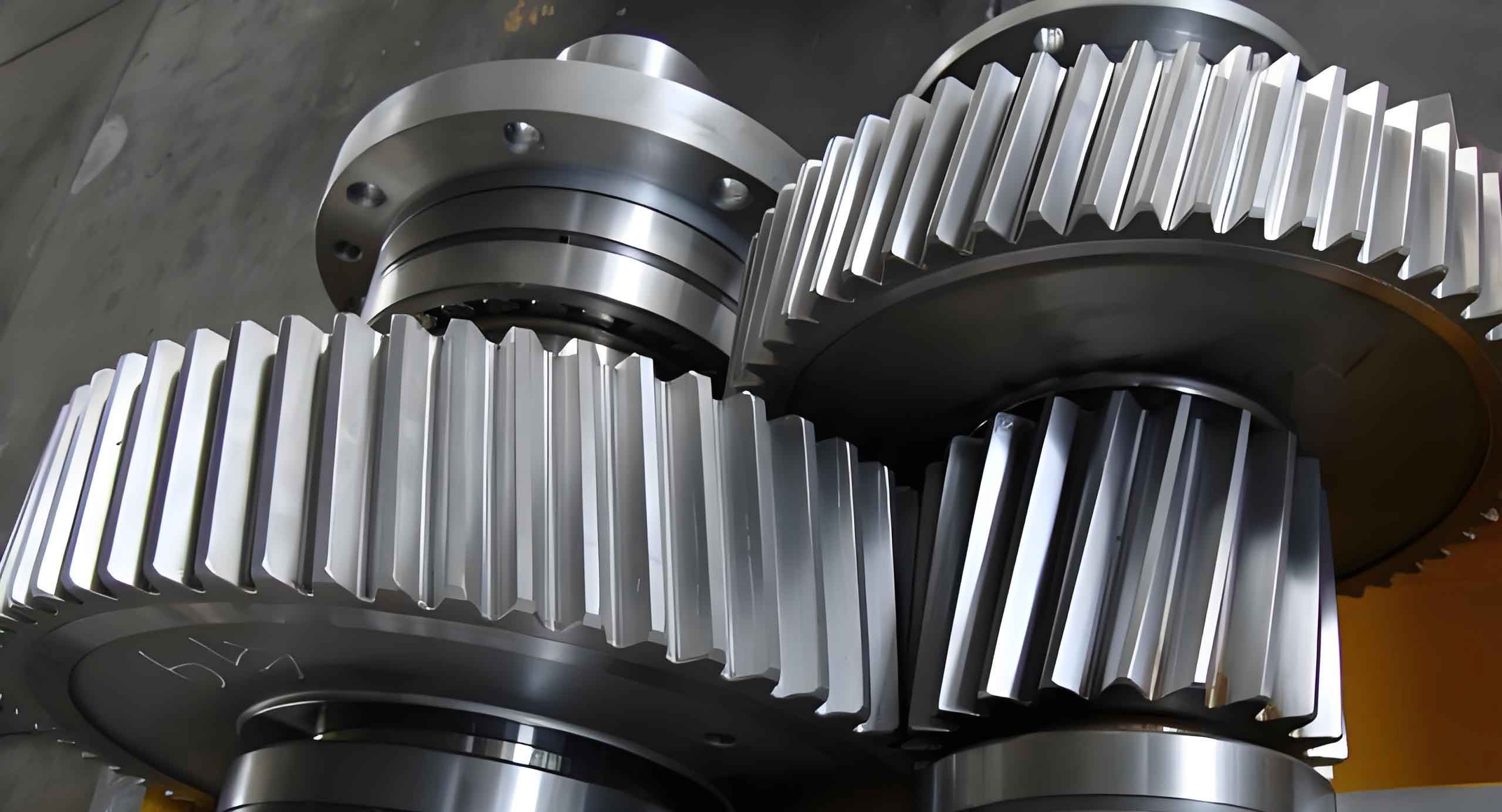
The helical gear, with its inclined teeth, offers smoother operation and higher load capacity compared to spur gears due to gradual engagement. However, modeling its complex three-dimensional contact and stiffness variation is computationally intensive if relying solely on detailed finite element analysis (FEA), making iterative optimization impractical. To overcome this, we develop an efficient and accurate analytical model for calculating the loaded transmission error of a helical gear pair. This model enables rapid evaluation within an optimization loop. Subsequently, we formulate a multi-objective optimization problem where the goals are to minimize transmission error fluctuation and minimize the overall volume (or weight) of the gear pair, subject to a comprehensive set of design constraints including gear strength (bending and contact fatigue), geometric compatibility, and established noise control guidelines.
Analytical Modeling of Helical Gear Loaded Transmission Error
The loaded static transmission error, $e_T$, for a gear pair under a specific torque is predominantly the result of the elastic deformation of the contacting teeth along the line of action. It can be expressed as the ratio of the mesh force to the instantaneous mesh stiffness:
$$ e_T(t) = \frac{F_N}{K_{mesh}(t)} $$
where $F_N$ is the normal load at the mesh and $K_{mesh}(t)$ is the time-varying mesh stiffness. For a helical gear pair, $K_{mesh}(t)$ is a complex periodic function influenced by the changing number of tooth pairs in contact and the spatial distribution of load along the contact lines.
Modeling Approach: Superposition of Narrow Spur Gear Slices
The key to efficient calculation lies in approximating the three-dimensional helical gear contact. A helical gear can be conceptually sliced into a large number, $N$, of infinitesimally narrow spur gear disks stacked together along the face width. Each disk has the same transverse plane geometry (derived from the helical gear’s normal parameters and helix angle) but a width of $b/N$. The helix angle $\beta$ introduces a phase shift in the meshing timing of each consecutive disk.
Consider two adjacent such disks, $i$ and $i+1$. Due to the helix, the start of meshing for disk $i+1$ is delayed relative to disk $i$ by a small rotation angle $\phi$. This angle corresponds to the arc length on the base circle spanned by the helix lead over one slice width. The relationship is given by:
$$ \phi = \frac{b \cdot \tan \beta}{N \cdot r_b} $$
where $r_b$ is the base circle radius. Consequently, the time delay $\Delta t_i$ between the meshing of adjacent slices is:
$$ \Delta t_i = \frac{\phi}{\omega} = \frac{b \cdot \tan \beta}{N \cdot r_b \cdot \omega} = \frac{b \cdot \tan \beta}{N \cdot v_b} $$
where $\omega$ is the angular velocity and $v_b$ is the tangential velocity at the base circle. The total phase shift $\Delta T$ from the first to the last slice is $N \cdot \Delta t_i = b \cdot \tan \beta / v_b$.
Mesh Stiffness of a Transverse Spur Gear Pair
The foundation of the model is calculating the mesh stiffness $K_{spur}(t)$ for a single, full-face-width spur gear pair that exists in the transverse plane of the helical gear. This stiffness calculation must account for both tooth deflection and body-induced deflections. We employ an enhanced Ishikawa method combined with circumferential web deformation.
The Ishikawa method models the tooth as a combination of a rectangular and trapezoidal section fixed at the root, considering bending and shear deformations. The deflection $\delta_{Ishikawa}$ at the load point under a normal force $F_n$ is computed as the sum of four components:
$$ \delta_{Ishikawa} = \delta_{Br} + \delta_{Bt} + \delta_{s} + \delta_{G} $$
where $\delta_{Br}$ and $\delta_{Bt}$ are bending deflections of the rectangular and trapezoidal parts, $\delta_{s}$ is the shear deflection, and $\delta_{G}$ is the deflection due to the foundation (gear body) tilt. The geometry for this calculation is defined by parameters such as the tooth root thickness $s_F$, rim thickness $h_r$, and the load application point.
To this, we add the circumferential deformation of the gear web, $\delta_{web}$, which arises from the tangential component of the mesh force causing shear and bending in the gear body between the bore and the root circle. This deformation is calculated by integrating the strain energy over a simplified web geometry (a curved trapezoid), yielding two components:
$$ \delta_{web} = \delta_{web1} + \delta_{web2} $$
$$ \delta_{web1} = \int_{y_1}^{y_2} \frac{-3 F_n \cos(\omega_x) (\sqrt{r_f^2 – y^2} – y)^2}{2 E b (r_f^2 – y^2)^{3/2}} \, dy $$
$$ \delta_{web2} = \int_{y_1}^{y_2} \frac{-3 F_n \cos(\omega_x) h_x^2}{2 E b (r_f^2 – y^2)^{3/2}} \, dy $$
where $E$ is Young’s modulus, $b$ is face width, $r_f$ is the root radius, and $h_x$ is the distance from the load point to the tooth root.
The total deflection for one gear is $\delta_j = (\delta_{Ishikawa} + \delta_{web})_j$, for $j = {1,2}$ (pinion and wheel). The mesh stiffness for a single tooth pair is then:
$$ k_s = \frac{F_n}{\delta_1 + \delta_2} $$
This stiffness $k_s$ varies as the contact point moves from the root to the tip of the tooth. For a spur gear pair with a transverse contact ratio $\varepsilon_{\alpha}$ between 1 and 2, the total mesh stiffness $K_{spur}(t)$ cycles between periods of double-tooth contact and single-tooth contact. If $t_m$ is the mesh period (time to advance one base pitch $p_b$) and $\lambda = \varepsilon_{\alpha} – 1$, then for $0 \le t \le \lambda t_m$ there are two pairs in contact, and for $\lambda t_m < t \le t_m$ only one pair is in contact. The total stiffness is the sum of the stiffnesses of all contacting pairs. A typical $K_{spur}(t)$ curve can be segmented and approximated by cubic polynomial functions $K_1(t)$ and $K_2(t)$ for the double and single contact zones, respectively.
| Parameter | Description | Role in Stiffness |
|---|---|---|
| Module ($m_n$) | Tooth size scale | Larger module increases tooth thickness and bending stiffness. |
| Pressure Angle ($\alpha_n$) | Tooth profile inclination | Higher pressure angle increases root thickness and reduces bending moment arm, increasing stiffness. |
| Face Width ($b$) | Gear axial length | Directly proportional to stiffness if load is uniform. |
| Helix Angle ($\beta$) | Tooth inclination angle | Affects effective face width in contact and load distribution; influences contact ratio and smoothing. |
| Addendum Coefficient ($h_a^*$) | Tooth height factor | Affects contact ratio and the path of contact, altering the stiffness variation pattern. |
Synthesizing Helical Gear Mesh Stiffness from Slices
With the spur gear stiffness $K_{spur}(t)$ known and the phase shift concept established, the mesh stiffness of the helical gear is synthesized. The stiffness contribution of the $i$-th slice, with a time delay of $i \cdot \Delta t_i$, is $(1/N) \cdot K_{spur}(t – i \cdot \Delta t_i)$. The total helical gear mesh stiffness $K_{helical}(t)$ is the sum over all $N$ slices in the limit as $N \to \infty$, which converges to a moving average integral:
$$ K_{helical}(t) = \lim_{N \to \infty} \sum_{i=0}^{N-1} \frac{1}{N} K_{spur}\left(t – i \frac{\Delta T}{N}\right) = \frac{1}{\Delta T} \int_{t – \Delta T}^{t} K_{spur}(\tau) \, d\tau $$
where $\Delta T = b \cdot \tan \beta / v_b$ is the total engagement time for a tooth along its entire face width. The evaluation of this integral depends on the relative lengths of the double-contact zone duration ($\lambda t_m$), the single-contact zone duration ($(1-\lambda)t_m$), and the total phase shift $\Delta T$. Three primary cases exist for a transverse contact ratio between 1 and 2:
- Case 1: $\Delta T \le \lambda t_m$. The integration window is shorter than or equal to the double-contact zone. The integrand $K_{spur}(\tau)$ can span combinations of: Double-Double (DD), Double-Single (DS), Double-Single-Double (DSD), and Single-Double (SD) zones.
- Case 2: $\lambda t_m < \Delta T \le t_m$. The integration window is longer than the double zone but shorter than a full mesh cycle. Possible integrand combinations: DS, DSD, SD, Single-Double-Single (SDS).
- Case 3: $\Delta T > t_m$. The integration window exceeds one mesh cycle. Possible combinations: DSD, DSD-Single (DSDS), SDS, SDS-Double (SDSD).
The piecewise polynomial representations of $K_{spur}(t)$ allow for the analytical or numerical evaluation of this integral for any time $t$. Once $K_{helical}(t)$ is obtained, the transmission error $e_T(t)$ and its critical peak-to-peak fluctuation $\Delta e_{T0}$ are calculated as:
$$ e_T(t) = \frac{F_N}{K_{helical}(t)}, \quad \Delta e_{T0} = \max(e_T(t)) – \min(e_T(t)) $$
This $\Delta e_{T0}$ serves as our primary quantitative index for mesh vibration excitation potential. A smaller $\Delta e_{T0}$ indicates a smoother transition of load and lower dynamic forcing.
Formulation of the Macro-Geometry Optimization Problem
The goal is to find the set of helical gear macro-parameters that simultaneously minimize vibration excitation and gear volume while satisfying all necessary design rules. We formulate this as a constrained multi-objective optimization problem.
Design Variables
The optimization variables are the fundamental geometric parameters that define the helical gear pair. To maintain independence and practicality, the following variables and their typical bounds are considered:
$$ \mathbf{X} = [m_n, \alpha_n, \beta, b, h_{a1}^*, h_{a2}^*, c_1^*, c_2^*]^T $$
Subject to:
$$ m_n^{L} \le m_n \le m_n^{U} $$
$$ \alpha_n^{L} \le \alpha_n \le \alpha_n^{U} $$
$$ \beta^{L} \le \beta \le \beta^{U} $$
$$ b^{L} \le b \le b^{U} $$
$$ h_{a}^*{}^{L} \le h_{a1}^*, h_{a2}^* \le h_{a}^*{}^{U} $$
$$ c^*{}^{L} \le c_1^*, c_2^* \le c^*{}^{U} $$
The number of teeth $z_1$ and $z_2$ are often pre-determined by the required transmission ratio $i$, so $z_2 = i \cdot z_1$. They may be treated as discrete variables or fixed. The profile shift coefficients $x_1$ and $x_2$ are derived from the requirement to achieve a specified center distance and balanced specific sliding, rather than being independent variables.
Objective Functions
We have two competing objectives:
- Minimize Vibration Excitation: $f_1(\mathbf{X}) = \Delta e_{T0}(\mathbf{X})$. This is directly computed using the analytical transmission error model described above for a given torque load.
- Minimize Gear Volume: $f_2(\mathbf{X}) = V_{total}(\mathbf{X})$. The total volume of the gear pair is approximated as the sum of the volumes of two cylinders with diameters equal to the tip diameters and face width $b$:
$$ f_2(\mathbf{X}) = \frac{\pi b}{4} \left( \frac{m_n^2 z_1^2}{\cos^2 \beta} + \frac{m_n^2 z_2^2}{\cos^2 \beta} \right) = \frac{\pi b m_n^2 (z_1^2 + z_2^2)}{4 \cos^2 \beta} $$
A smaller volume correlates with reduced material cost and weight.
To handle multiple objectives, we employ the linear weighted sum method, converting them into a single aggregate objective function (AOF). The weights are normalized using the ideal (or estimated) single-objective optimal values to ensure both objectives are on a comparable scale and neither dominates arbitrarily.
$$ \text{Minimize: } f(\mathbf{X}) = w_1 \cdot \frac{f_1(\mathbf{X})}{f_1^*} + w_2 \cdot \frac{f_2(\mathbf{X})}{f_2^*} $$
where $f_1^*$ and $f_2^*$ are the minimum possible values for transmission error fluctuation and volume, respectively, found through preliminary single-objective optimizations. The weights $w_1$ and $w_2$ reflect the designer’s preference (e.g., $w_1=0.7, w_2=0.3$ for prioritizing vibration reduction).
Constraint Functions
A successful helical gear design must satisfy numerous engineering constraints, categorized as follows:
1. Geometric Compatibility Constraints:
– Center Distance: The designed gears must operate at a specified nominal center distance $a_w$, a fixed input based on the transmission layout.
$$ g_1(\mathbf{X}) = \left| \frac{m_n (z_1 + z_2)}{2 \cos \beta} – a_w \right| \le \epsilon $$
where $\epsilon$ is a small tolerance.
– Undercutting Prevention: The profile shift must ensure no undercutting occurs, especially for pinions with low tooth counts.
$$ g_2(\mathbf{X}) = x_{min} – x_1 \le 0, \quad g_3(\mathbf{X}) = x_{min} – x_2 \le 0 $$
– Tip Tooth Thickness: The tooth must have sufficient thickness at the tip to prevent peening and ensure manufacturability.
$$ g_4(\mathbf{X}) = 0.25 m_n – s_{a1} \le 0, \quad g_5(\mathbf{X}) = 0.25 m_n – s_{a2} \le 0 $$
where $s_a$ is the tip tooth thickness.
2. Strength Constraints (based on standards like ISO 6336 or AGMA 2001):
– Contact Fatigue (Pitting) Strength: The calculated contact stress $\sigma_H$ must be less than the permissible stress $\sigma_{HP}$.
$$ g_6(\mathbf{X}) = \sigma_H(\mathbf{X}) – \sigma_{HP} \le 0 $$
– Bending Fatigue (Root) Strength: The calculated root bending stress $\sigma_F$ must be less than the permissible stress $\sigma_{FP}$.
$$ g_7(\mathbf{X}) = \sigma_F(\mathbf{X}) – \sigma_{FP} \le 0 $$
The stress calculations $\sigma_H$ and $\sigma_F$ are functions of geometry, load, and material properties.
3. Noise and Smoothness Guidelines (Empirical Constraints):
These constraints encapsulate design rules-of-thumb known to improve noise behavior.
– Mesh Start Point Control: To reduce impact noise, the start of the single-tooth contact should be sufficiently far from the base circle.
$$ g_8(\mathbf{X}) = \beta_{cg} – 1 \le 0, \quad \text{where } \beta_{cg} = \frac{d_{b} + 0.1 p_{bt}}{d_{fa}} $$
– Friction Force Slope Control: To avoid noise from abrupt friction force changes, the length of the approach path should be shorter than the recess path.
$$ g_9(\mathbf{X}) = \beta_z – 0.9 \le 0, \quad \text{where } \beta_z = \frac{2\rho_{2max} – d_{b2}\tan\alpha_{wt}}{2\rho_{1max} – d_{b1}\tan\alpha_{wt}} $$
Here, $\rho_{max}$ are the maximum radii of curvature, $d_b$ are base diameters, and $\alpha_{wt}$ is the working transverse pressure angle.
| Constraint Category | Constraint Equation | Physical Meaning |
|---|---|---|
| Geometry | $|m_n(z_1+z_2)/(2\cos\beta) – a_w| \le \epsilon$ | Fits specified center distance. |
| Strength | $\sigma_H \le \sigma_{HP}$ | Prevents surface pitting failure. |
| Strength | $\sigma_F \le \sigma_{FP}$ | Prevents tooth breakage. |
| Noise | $\beta_{cg} \le 1$ | Controls mesh-in impact. |
| Noise | $\beta_z \le 0.9$ | Controls friction force variation. |
Optimization Algorithm and Implementation
The optimization problem is nonlinear, non-convex, and may involve mixed continuous-discrete variables (e.g., tooth numbers). Evolutionary algorithms, such as Genetic Algorithms (GA), are well-suited for such problems as they can handle complex, discontinuous design spaces and are less likely to be trapped in local minima. We employ a real-coded GA with the following key operators:
- Encoding: Each design variable in vector $\mathbf{X}$ is represented directly as a real number within its bounds.
- Initialization: A population of $N_{pop}$ candidate designs is generated randomly within the feasible bounds.
- Fitness Evaluation: For each candidate, the analytical model computes $f_1(\mathbf{X})$ ($\Delta e_{T0}$) and $f_2(\mathbf{X})$ (Volume). Constraints are evaluated, and a penalty function $P(\mathbf{X})$ is added to the aggregate objective function for any violation, making infeasible solutions less fit:
$$ F(\mathbf{X}) = f(\mathbf{X}) + \rho \cdot \sum_{j} \max(0, g_j(\mathbf{X}))^2 $$
where $\rho$ is a large penalty coefficient. - Selection: Tournament selection is used to choose parents for reproduction, favoring individuals with better (lower) fitness $F(\mathbf{X})$.
- Crossover & Mutation: Simulated binary crossover (SBX) creates offspring by blending variable values from two parents. Polynomial mutation introduces random variations to maintain population diversity and explore the design space.
- Elitism: The best few solutions are carried over unchanged to the next generation to preserve good designs.
- Termination: The algorithm runs for a predetermined number of generations or until convergence criteria are met (e.g., minimal improvement in best fitness over several generations).
The integration of the fast analytical helical gear TE model is crucial here. A single FEA simulation for TE could take minutes to hours, making GA-based optimization with thousands of function evaluations computationally prohibitive. Our analytical model completes a TE calculation in seconds, enabling a full optimization run in a practical timeframe (e.g., minutes to a few hours on a standard computer).
Optimization Results and Analysis
To demonstrate the efficacy of the proposed method, it was applied to optimize a helical gear pair from a vehicle transmission. The baseline design parameters and the optimized results are presented below. The optimization was run with a weight preference slightly favoring vibration reduction ($w_1=0.6, w_2=0.4$).
| Design Variable / Performance Metric | Baseline Design | Optimized Design | Change |
|---|---|---|---|
| Normal Module, $m_n$ (mm) | 3.70 | 3.74 | +1.1% |
| Helix Angle, $\beta$ (deg) | 24.00 | 24.15 | +0.6% |
| Face Width, $b$ (mm) | 29.00 | 28.73 | -0.9% |
| Addendum Coeff., $h_{a1}^* / h_{a2}^*$ | 1.40 / 1.40 | 1.45 / 1.45 | +3.6% |
| Dedendum/Clearance Coeff., $c_1^* / c_2^*$ | 0.30 / 0.30 | 0.29 / 0.29 | -3.3% |
| Peak-Peak TE Fluctuation, $\Delta e_{T0}$ (μm) | 5.29 | 3.13 | -41.0% |
| Gear Pair Volume (dm³) | 1.700 | 1.677 | -1.34% |
| Contact Stress, $\sigma_H$ (MPa) | Below Allowable | Below Allowable | Constraint Active |
| Bending Stress, $\sigma_F$ (MPa) | Below Allowable | Below Allowable | Constraint Active |
| Transverse Contact Ratio, $\varepsilon_{\alpha}$ | 1.97 | ~2.05 | Increased |
The results clearly show the success of the optimization strategy. The algorithm found a new combination of macro-parameters that significantly improves the primary objective:
- Dramatic Reduction in TE Fluctuation: The peak-to-peak transmission error was reduced by 41%, from 5.29 μm to 3.13 μm. This indicates a substantially smoother meshing action, which should translate to lower dynamic mesh forces and reduced vibration and noise excitation. The increase in the addendum coefficient and a slight adjustment of the helix angle contributed to a more favorable load distribution and a slightly increased transverse contact ratio, smoothing the transition of load between tooth pairs.
- Concurrent Volume Reduction: Despite the strong focus on vibration reduction, the optimization also managed to slightly decrease the overall gear volume by 1.34%. This was achieved primarily through a small reduction in face width, demonstrating that the algorithm successfully explored trade-offs between the two objectives.
- Constraint Satisfaction: All geometric, strength, and noise guidelines were satisfied. The contact and bending stress constraints were active or near-active in the final design, indicating the optimizer pushed the design to the limits of material strength to achieve the performance gains, which is characteristic of an efficient optimal solution.
The optimized helical gear design represents a Pareto-optimal solution where any further reduction in transmission error fluctuation would likely come at the cost of increased volume or violation of a constraint, and vice-versa. The use of the fast analytical model was instrumental in exploring this trade-off surface efficiently.
Discussion and Conclusions
This work establishes a systematic methodology for the vibration-oriented optimization of helical gear macro-geometry in the early stages of transmission design. The core contribution is the integration of an efficient analytical model for helical gear loaded transmission error into a formal multi-objective optimization framework.
The analytical model, based on the superposition of phased spur gear slices and an enhanced deflection calculation (Ishikawa + web deformation), provides a critical balance between accuracy and computational speed. It captures the essential physics of the helical gear mesh stiffness variation without the overhead of finite element analysis, making iterative optimization feasible.
The formulated optimization problem effectively balances the competing goals of vibration reduction (minimizing TE fluctuation) and lightweight design (minimizing volume). The inclusion of comprehensive constraints based on gear standards and empirical noise guidelines ensures the practicality and robustness of the final design. The application of a Genetic Algorithm proves effective in navigating the complex, constrained design space to find high-performance solutions.
The demonstrated case study shows the potential of this approach: a 41% reduction in transmission error fluctuation coupled with a 1.34% reduction in volume. This underscores the significant impact that macro-parameter optimization can have on gear dynamics, an aspect often overshadowed by later micro-geometry tuning.
Future work could involve extending the model to include dynamic effects more explicitly, perhaps by coupling the quasi-static TE with a simplified linear dynamic model to optimize for dynamic TE or dynamic factor directly. Additionally, the optimization could be expanded to simultaneously consider multiple gear pairs within a transmission stage or even an entire gearbox, accounting for shaft and bearing dynamics. The integration of manufacturing cost models as an additional objective could also be a valuable enhancement. Nevertheless, the presented method provides a powerful and practical tool for designers to proactively “design-in” low-vibration characteristics into helical gears from the very beginning of the development process.