
In modern mechanical transmission systems, helical gears are widely employed due to their smooth operation, high load-carrying capacity, and reduced noise compared to spur gears. However, under load, helical gear teeth experience non-Hertzian contact, leading to edge stress concentrations at the boundaries of the contact zone, known as the edge effect. This phenomenon can cause premature pitting and fatigue failure, significantly reducing the service life of helical gears. To mitigate these issues, tooth profile modification techniques are essential. Among various modification curves, logarithmic crowning, derived from elastic contact theory, has shown superior performance in eliminating edge effects and improving stress distribution. In this article, I will explore the contact mechanics and relative fatigue life of high contact ratio helical gears with logarithmic modification, based on established models and numerical simulations.
The primary focus is on helical gears with a contact ratio greater than 2, which are common in high-power applications. I will develop a comprehensive approach that includes a contact model for analyzing stress distributions, a fatigue life model for evaluating durability, and a tooth surface model for manufacturing-oriented design. By comparing unmodified and logarithmically modified helical gears, I aim to demonstrate the effectiveness of this modification in enhancing contact fatigue strength and extending fatigue life. Throughout this discussion, the term “helical gear” will be emphasized to underscore its relevance in transmission design.
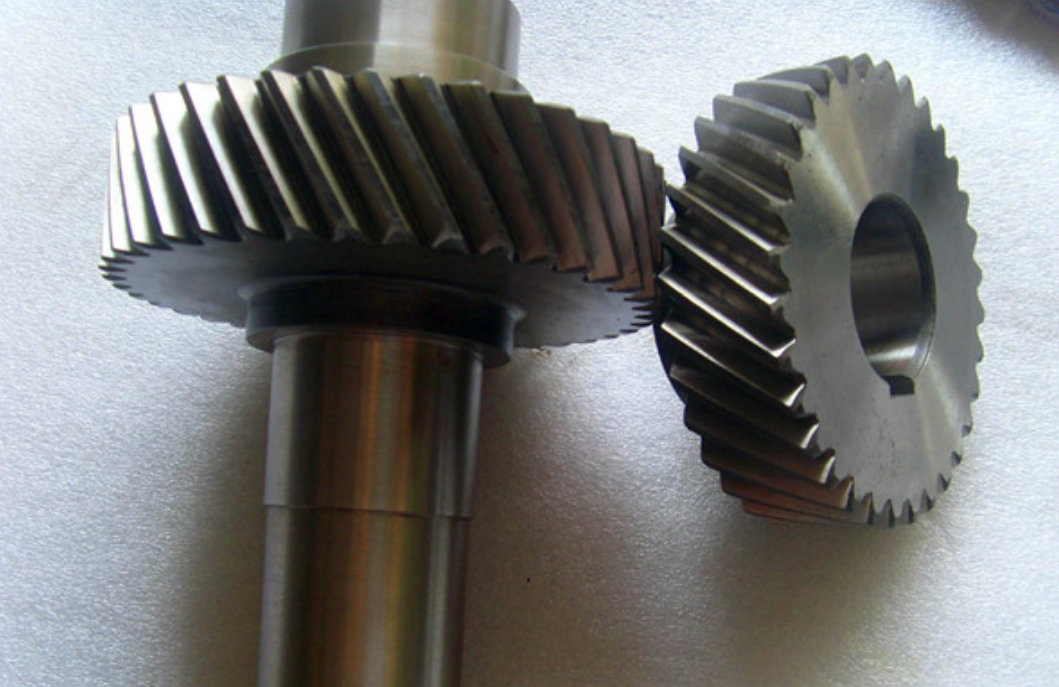
To begin, let’s consider the contact mechanics of helical gears. The meshing of helical gear teeth can be modeled as the contact between two opposing elastic truncated cones with parallel axes. This analogy simplifies the complex three-dimensional contact problem into a more tractable form. In this model, the generatrix of the cones corresponds to the contact line at any meshing position, and the axes are tangents to the base cylinders. For a helical gear pair, the geometry can be described using parameters such as base radius, helix angle, and contact line length. The composite curvature radius at any point on the contact line is given by:
$$ \frac{1}{R_{\Sigma}} = \frac{1}{R_{k1}} + \frac{1}{R_{k2}} $$
where \( R_{k1} \) and \( R_{k2} \) are the curvature radii of the pinion and gear, respectively, at point \( k \). These can be expressed as:
$$ R_{k1} = \frac{N_{1k}O_{2}}{\cos \beta_b} – (0.5L – y_k) \tan \beta_b $$
$$ R_{k2} = \frac{N_{2k}O_{2}}{\cos \beta_b} + (0.5L – y_k) \tan \beta_b $$
Here, \( \beta_b \) is the base helix angle, \( y_k \) is the coordinate along the contact line, \( L \) is the length of the contact line at a given meshing position, and \( N_{1k}O_{2} \) and \( N_{2k}O_{2} \) are geometric distances derived from the gear geometry. The meshing position can be characterized by a variable \( V_t \), which relates to the contact line movement. For high contact ratio helical gears, the contact line length \( L \) varies with the meshing cycle, and it can be computed using methods that account for multiple tooth pairs in contact.
Under a normal load \( F_n \), the elastic contact deformation forms a contact zone \( \Omega \). The fundamental equations for the contact problem are:
$$ \int_{\Omega} p(s,t) \, ds \, dt = F_n $$
and
$$ \omega_1 + \omega_2 + f_1 + f_2 + \psi_1 + \psi_2 = \delta $$
where \( p(s,t) \) is the contact stress at point \( (s,t) \), \( \omega_1 \) and \( \omega_2 \) are the elastic deformations of the pinion and gear, \( f_1 \) and \( f_2 \) are the initial separations from the nominal contact plane, \( \psi_1 \) and \( \psi_2 \) are the modification amounts, and \( \delta \) is the approach distance. The normal load \( F_n \) is distributed based on the total contact line length during a meshing cycle, ensuring accurate load sharing in helical gears. The elastic deformations are calculated using the Boussinesq formula:
$$ \omega_1 + \omega_2 = \frac{2}{\pi E’} \int_{\Omega} \frac{p(s,t) \, ds \, dt}{\sqrt{(x-s)^2 + (y-t)^2}} $$
where \( E’ \) is the equivalent elastic modulus. For logarithmic crowning, the modification curve is defined by Lundberg’s model, which is derived from conical contact theory. The modification amount \( \Psi \) is given by:
$$ \Psi = \left( \frac{1 – \nu_1^2}{E_1} + \frac{1 – \nu_2^2}{E_2} \right) \frac{F_n}{a_1 – a_2} T(r) $$
with \( T(r) \) defined piecewise for different regions of the contact line. Here, \( \nu_1 \) and \( \nu_2 \) are Poisson’s ratios, \( E_1 \) and \( E_2 \) are elastic moduli, and \( a_1 \) and \( a_2 \) are radii at the ends of the truncated cone. The parameter \( \alpha \) is determined by:
$$ \alpha = \frac{8}{\pi} \left( \frac{1 – \nu_1^2}{E_1} + \frac{1 – \nu_2^2}{E_2} \right) \sqrt{\cot \beta_b + \cot \beta_b \sqrt{a_2^2 – a_1^2}} $$
This logarithmic modification curve ensures that the crowning amount varies along the contact line, with larger modifications where contact stresses are higher, leading to a more uniform stress distribution. To solve the contact equations numerically, I discretize the contact zone into small elements, assuming constant contact stress over each element. Using influence coefficient methods in MATLAB, I iteratively compute the contact stress distribution for both unmodified and modified helical gears.
Beyond contact stress, assessing the subsurface stress field is crucial for fatigue analysis. The von Mises stress, which combines normal and shear stresses, indicates potential fatigue crack initiation sites. For helical gears under load, the Mises stress field can be computed by integrating the contact stress and frictional forces. The friction coefficient is typically set based on lubrication conditions, and for this analysis, a value of 0.08 is used. The Mises stress \( \sigma_{vm} \) is calculated as:
$$ \sigma_{vm} = \sqrt{ \frac{(\sigma_x – \sigma_y)^2 + (\sigma_y – \sigma_z)^2 + (\sigma_z – \sigma_x)^2 + 6(\tau_{xy}^2 + \tau_{yz}^2 + \tau_{zx}^2)}{2} } $$
where \( \sigma_x, \sigma_y, \sigma_z \) are normal stresses and \( \tau_{xy}, \tau_{yz}, \tau_{zx} \) are shear stresses. By programming this in MATLAB, I obtain the Mises stress distribution at various depths and positions along the contact line.
To evaluate the fatigue life of helical gears, I employ the Ioannides and Harris model, originally developed for rolling bearings but applicable to gear contacts. The model relates fatigue life to subsurface stress and material volume:
$$ \lg \frac{1}{s} \propto \frac{\tau_0^c N^e}{z_0^h V} $$
where \( s \) is the reliability, \( \tau_0 \) is the maximum subsurface Mises stress along the contact line, \( z_0 \) is the depth at which this stress occurs, \( N \) is the fatigue life in millions of cycles, \( e \) is the Weibull slope (taken as \( 9/8 \) for line contact), \( c \) and \( h \) are material constants (typically \( c = 31/3 \) and \( h = 7/3 \)), and \( V \) is the stressed volume. By comparing the relative fatigue life of modified versus unmodified helical gears, I can quantify the improvement due to logarithmic crowning.
For manufacturing purposes, I also derive a parametric equation for the tooth surface of a logarithmically crowned helical gear. Considering a pinion as an example, the coordinates of any point on the modified tooth surface are given by:
$$ \begin{aligned}
Z &= z – \psi \sin \beta_b \\
Y &= r_{b1} \sin(u+v) – r_{b1} u \cos(u+v) + \psi \cos(u) \cos \beta_b \\
X &= r_{b1} \cos(u+v) + r_{b1} u \sin(u+v) – \psi \sin(u) \cos \beta_b
\end{aligned} $$
where \( u = l_k / r_{b1} \), \( v = z / P_1 \), \( l_k \) is the distance along the contact line, \( z \) is the coordinate along the tooth width, \( r_{b1} \) is the base radius, \( \beta_b \) is the base helix angle, \( P_1 \) is the spiral parameter (\( P_1 = \frac{z_1 \pi M_n}{\sin \beta} \)), and \( \psi \) is the logarithmic modification amount. This equation allows for the generation of discrete data points for CNC machining or simulation of the helical gear tooth surface.
Now, let’s apply these models to a specific case study of high contact ratio helical gears. The gear parameters are summarized in the following table:
| Parameter | Pinion | Gear |
|---|---|---|
| Number of Teeth | 20 | 95 |
| Module (mm) | 2.5 | |
| Helix Angle (degrees) | 12°50’19” | |
| Face Width (mm) | 26 | 30 |
| Transmitted Torque (N·m) | 90.6 | – |
| Material | 45 Steel | |
| Poisson’s Ratio | 0.3 | 0.3 |
| Elastic Modulus (GPa) | 210 | 210 |
For this helical gear pair, the contact ratio exceeds 2, meaning that multiple tooth pairs are in contact simultaneously. I focus on a particular contact line that passes through the pitch point, as it is often critical for fatigue analysis. The results are divided into two parts: unmodified helical gears and logarithmically modified helical gears.
First, for the unmodified helical gear, the contact stress distribution along the contact line shows significant edge effects. As seen in the numerical computations, the contact stress at the ends of the contact zone is approximately 1.7 times higher than at the center. This stress concentration is more severe near the pinion root due to smaller curvature radii. The table below summarizes key stress values for the unmodified helical gear:
| Location on Contact Line (y/b) | Contact Stress (GPa) | Maximum Mises Stress (GPa) | Depth of Max Mises Stress (mm) |
|---|---|---|---|
| -1 (End near pinion root) | 1.12 | 0.1807 | 0.1471 |
| 0 (Center) | 0.66 | 0.1069 | 0.2060 |
| 1 (Opposite end) | 0.98 | 0.1650 | 0.1520 |
The Mises stress field indicates that the maximum subsurface stress occurs at the ends of the contact line, specifically at a depth of about 0.15 mm. This aligns with the edge effect, where fatigue cracks are likely to initiate, leading to pitting and reduced life for the helical gear. The stress distribution is non-uniform, with higher stresses concentrated near the boundaries.
Next, I apply logarithmic crowning to both the pinion and gear of the helical gear pair. The modification curve is asymmetric, with larger crowning amounts at the end where contact stress is higher. For the contact line through the pitch point, the modification amount varies as follows:
| Location on Contact Line (y/b) | Logarithmic Crowning Amount (mm) |
|---|---|
| -1 | 0.025 |
| 0 | 0.010 |
| 1 | 0.015 |
After modification, the contact stress distribution becomes more uniform. The edge stress concentrations are eliminated, and the contact zone contracts slightly at the ends. The revised stress values are:
| Location on Contact Line (y/b) | Contact Stress (GPa) | Maximum Mises Stress (GPa) | Depth of Max Mises Stress (mm) |
|---|---|---|---|
| -1 | 0.85 | 0.1200 | 0.2300 |
| 0 | 0.90 | 0.1276 | 0.2370 |
| 1 | 0.88 | 0.1245 | 0.2330 |
Notice that the maximum contact stress now occurs near the center of the contact line, with a more even distribution across the helical gear tooth flank. The Mises stress field shifts, with the maximum subsurface stress moving to the center region at a greater depth (around 0.23 mm). This reduces the risk of fatigue initiation at the edges, thereby improving the contact fatigue strength of the helical gear.
To quantify the fatigue life improvement, I use the Ioannides and Harris model. Based on the maximum Mises stress and its depth for the unmodified and modified helical gears, the relative fatigue life is computed. The results are presented below:
| Helical Gear Condition | Max Mises Stress (GPa) | Depth (mm) | Relative Fatigue Life |
|---|---|---|---|
| Unmodified | 0.1807 | 0.1471 | 1.0 (baseline) |
| Logarithmically Modified | 0.1374 | 0.2370 | 33.3 |
The logarithmically modified helical gear exhibits a fatigue life that is 33.3 times longer than that of the unmodified helical gear. This dramatic increase underscores the effectiveness of logarithmic crowning in enhancing durability. The modification not only redistributes stresses but also moves the critical subsurface stress region to a deeper, less vulnerable area, delaying fatigue failure.
In addition to stress and fatigue analysis, the tooth surface model for logarithmic crowning facilitates manufacturing. By discretizing the parameters in the surface coordinate equations, I can generate point clouds for CNC machining. This ensures that the designed modification is accurately imparted to the helical gear teeth during production. The asymmetric crowning profile, tailored to the contact stress distribution, is key to achieving optimal performance.
Further discussions can extend to the impact of lubrication and dynamic loads on helical gears. For instance, under elastohydrodynamic lubrication (EHL) conditions, the film thickness might interact with the modified profile, potentially further reducing wear and fatigue. However, the current model focuses on dry contact to isolate the geometric effects of logarithmic crowning. Future work could integrate EHL analyses for a more comprehensive assessment of helical gear performance.
Another aspect is the sensitivity of logarithmic crowning to manufacturing errors. Since the modification amounts are small (on the order of micrometers), precision machining is essential. Tolerance analysis could be conducted to ensure that the benefits are retained under real-world conditions. Nonetheless, the theoretical results presented here provide a strong foundation for designing high-performance helical gears.
In summary, logarithmic crowning is a powerful technique for improving the contact and fatigue behavior of high contact ratio helical gears. By eliminating edge stress concentrations and promoting uniform stress distribution, it significantly enhances the contact fatigue strength and extends the service life of helical gears. The models developed—contact mechanics, fatigue life, and tooth surface geometry—offer a holistic approach to helical gear design and optimization. As helical gears continue to be integral in advanced transmission systems, such modifications will play a crucial role in ensuring reliability and efficiency.
From this analysis, I conclude that logarithmic crowning should be considered a standard practice for high-load helical gear applications. The numerical methods and equations provided here can be implemented in design software to automate the optimization process. By repeatedly emphasizing the importance of helical gears in mechanical systems, I hope to highlight the practical relevance of this research. Ultimately, the goal is to contribute to the development of more durable and efficient helical gear transmissions for industries ranging from automotive to aerospace.