
In modern mechanical engineering, the dynamic behavior of gear systems is critical for ensuring reliability and performance. Among various gear types, the helical gear is widely used due to its smooth operation and high load-carrying capacity. However, vibration issues can lead to noise, fatigue, and failure, making dynamic analysis essential. In this paper, I explore the parametric modeling and finite element modal analysis of a standard involute helical gear using ANSYS Workbench. The goal is to accurately model the helical gear, study its natural vibration characteristics, and derive insights to avoid resonance in practical applications. I will detail the theoretical background, modeling steps, analysis setup, and results, with an emphasis on using formulas and tables for clarity. Throughout, the term helical gear will be frequently highlighted to underscore its importance in this study.
The helical gear, characterized by its angled teeth, offers advantages over spur gears, such as reduced noise and higher torque transmission. But its complex geometry necessitates precise modeling for analysis. I employ parametric modeling in Workbench to create a flexible design that can adapt to different specifications. Then, I conduct a modal analysis to determine the natural frequencies and mode shapes, which are crucial for understanding the helical gear’s dynamic response. This approach allows me to predict vibrational behavior without physical testing, saving time and resources in the design phase. The following sections will cover the finite element theory, parametric modeling process, modal analysis implementation, and a detailed discussion of results.
Theoretical Foundation of Finite Element Modal Analysis
Modal analysis is a numerical technique used to determine the inherent vibration characteristics of a structure, specifically its natural frequencies and mode shapes. These properties influence dynamic responses, load transmission, and potential resonance. For a helical gear, understanding these aspects is vital to prevent failures. The governing equation for structural dynamics, derived from elastic finite element methods, is given by:
$$ [M]\{\ddot{x}\} + [C]\{\dot{x}\} + [K]\{x\} = \{F(t)\} $$
where $[M]$ is the mass matrix, $[C]$ is the damping matrix, $[K]$ is the stiffness matrix, $\{x\}$ is the displacement vector, $\{F(t)\}$ is the force vector, $\{\dot{x}\}$ is the velocity vector, and $\{\ddot{x}\}$ is the acceleration vector. In modal analysis, we focus on free vibration where external forces are zero, i.e., $\{F(t)\} = \{0\}$. Damping is often neglected for simplicity in natural frequency calculations, leading to the undamped equation:
$$ [M]\{\ddot{x}\} + [K]\{x\} = \{0\} $$
Assuming harmonic motion, the displacement can be expressed as a sinusoidal function: $\{x\} = \{X\} \sin(\omega t)$, where $\{X\}$ is the amplitude vector and $\omega$ is the angular frequency. Substituting this into the undamped equation yields the eigenvalue problem:
$$ ([K] – \omega_i^2 [M]) \{X_i\} = \{0\} $$
Here, $\omega_i$ represents the natural frequency for the $i$-th mode, and $\{X_i\}$ is the corresponding mode shape. Solving this equation provides the helical gear’s natural frequencies and mode shapes, which are key to assessing its dynamic performance. For a helical gear, these modes can include bending, torsion, and combined deformations that affect gear mesh and noise.
Parametric Modeling of Helical Gears in Workbench
To create an accurate model of the helical gear, I used ANSYS Workbench’s Design Modeler for parametric modeling. This approach allows easy modification of gear parameters, enabling studies on different designs. The base parameters for the helical gear are as follows: normal module $m_n = 2$ mm, number of teeth $z = 24$, helix angle $\beta = 10^\circ$, pressure angle $\alpha = 20^\circ$, and face width $B = 20$ mm. These parameters define the geometry of the helical gear, which is more complex than a spur gear due to the helical teeth.
The modeling process involves sketching the involute tooth profile on the XY plane. Since an exact involute curve is challenging to draw directly, I approximated it using polyline segments with dimensions. The sketch includes key circles: pitch circle, base circle, and addendum circle. The parametric equations for the involute curve are derived from gear geometry. For a helical gear, the transverse module $m_t$ and transverse pressure angle $\alpha_t$ are calculated first:
$$ m_t = \frac{m_n}{\cos \beta} $$
$$ \alpha_t = \arctan \left( \frac{\tan \alpha}{\cos \beta} \right) $$
The pitch radius $r$, addendum radius $r_a$, and base radius $r_b$ are then:
$$ r = \frac{m_t \cdot z}{2} $$
$$ r_a = r + m_n $$
$$ r_b = \frac{m_t \cdot z \cdot \cos \alpha_t}{2} $$
To generate points on the involute curve, I used parametric expressions. For a point at radius $r_k$, the pressure angle $\alpha_k$ and unwinding angle $\theta_k$ are:
$$ \alpha_k = \arccos \left( \frac{r_b}{r_k} \right) $$
$$ \theta_k = \left( \tan \alpha_k – \alpha_k \cdot \frac{\pi}{180} \right) \cdot \frac{180}{\pi} + q $$
where $q$ is a correction factor for tooth spacing. The coordinates $(x, y)$ of the point are $x = r_k \cos \theta_k$ and $y = r_k \sin \theta_k$. In Workbench, I assigned these as parameter-driven dimensions. The parameters were managed using the Parameter Manager, with initial values for design parameters like hole diameter $d_{\text{hole}} = 20$ mm. Below is a table summarizing the key parameters and their expressions:
| Parameter | Symbol | Expression/Value |
|---|---|---|
| Normal Module | $m_n$ | 2 mm |
| Number of Teeth | $z$ | 24 |
| Helix Angle | $\beta$ | $10^\circ$ |
| Pressure Angle | $\alpha$ | $20^\circ$ |
| Face Width | $B$ | 20 mm |
| Transverse Module | $m_t$ | $m_n / \cos \beta$ |
| Transverse Pressure Angle | $\alpha_t$ | $\arctan(\tan \alpha / \cos \beta)$ |
| Pitch Radius | $r$ | $m_t \cdot z / 2$ |
| Addendum Radius | $r_a$ | $r + m_n$ |
| Base Radius | $r_b$ | $m_t \cdot z \cdot \cos \alpha_t / 2$ |
After sketching, I extruded the profile and applied a helical sweep to create the teeth. The helix angle $\beta$ was used to define the sweep path. The final step involved patterning the tooth around the gear hub. The parametric model allows quick updates; for example, changing $m_n$ to 5 mm, $\beta$ to $14^\circ$, and other parameters regenerates a new helical gear design. This flexibility is crucial for iterative design and analysis of helical gears in various applications.
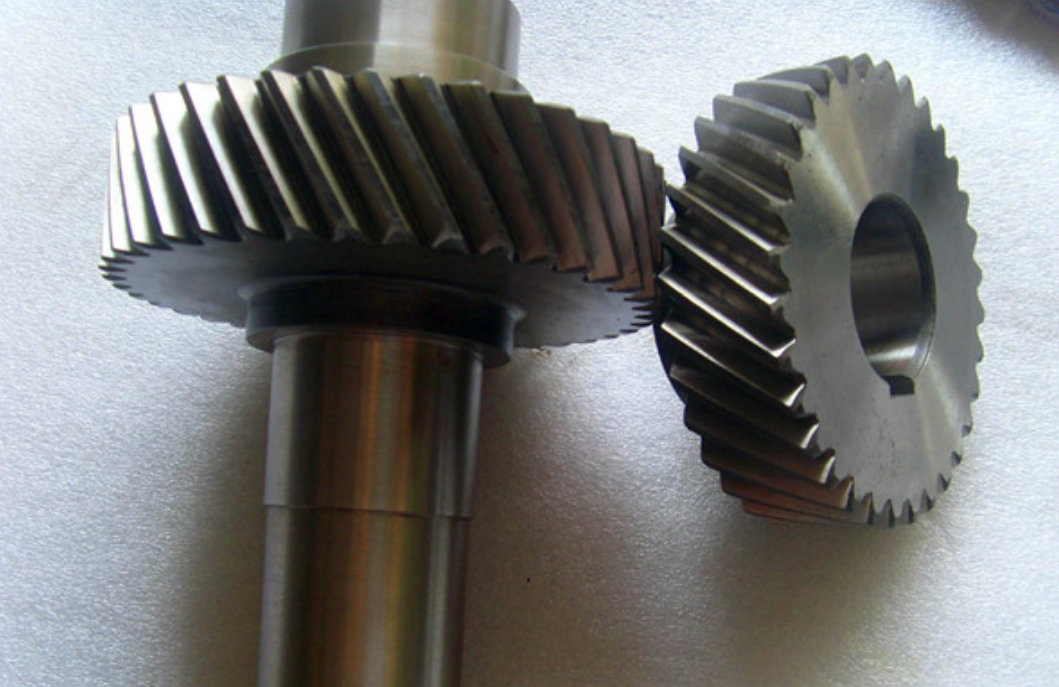
The image above shows a rendered view of the helical gear model created in Workbench, highlighting the helical teeth and overall geometry. This visual representation aids in verifying the model before analysis.
Finite Element Modal Analysis Implementation
With the parametric model of the helical gear ready, I imported it into the Workbench Modal analysis system. The goal was to compute the natural frequencies and mode shapes for the first six modes, as lower-order modes typically dominate dynamic behavior. The helical gear was assumed to be made of 45 steel, a common material for gears, with the following properties: Young’s modulus $E = 2 \times 10^{11}$ Pa, Poisson’s ratio $\nu = 0.3$, and density $\rho = 7850$ kg/m³. These material parameters are essential for accurate finite element analysis of the helical gear.
Meshing is a critical step in finite element analysis. I used a multizone sweeping method with a relevance setting of 100 to generate a high-quality hexahedral mesh. This approach ensures accurate stress and vibration calculations for the helical gear. The mesh consisted of approximately 50,000 elements, which provided a balance between computational efficiency and precision. The helical gear’s complex geometry, especially the tooth fillets and helix, requires fine meshing to capture stress concentrations.
Boundary conditions were applied to simulate realistic constraints. A frictionless support was added to the inner surface of the gear hole, representing a mounted condition where the gear can rotate but is constrained radially. This mimics typical gear mounting in shafts. For modal analysis, no external loads are needed, as we focus on free vibration. The solver was set to extract the first six modes, and the Lanczos method was used for eigenvalue extraction due to its efficiency for large models.
The finite element equation for modal analysis simplifies to the eigenvalue problem mentioned earlier. In matrix form, the stiffness and mass matrices are assembled from the mesh elements. For a helical gear, the stiffness matrix accounts for the gear’s geometry and material, while the mass matrix represents its inertial properties. The solution yields natural frequencies $f_i$ (in Hz) related to angular frequencies by $f_i = \omega_i / (2\pi)$. The mode shapes $\{X_i\}$ indicate the deformation patterns at each frequency.
Results and Discussion of Modal Analysis
The modal analysis provided the first six natural frequencies for the helical gear, as shown in the table below. These frequencies are critical for understanding the helical gear’s dynamic response and potential resonance risks.
| Mode Number | Natural Frequency (Hz) | Primary Deformation Type |
|---|---|---|
| 1 | 9984.1 | Circumferential bending of teeth |
| 2 | 30358 | Radial expansion |
| 3 | 35729 | Torsional vibration |
| 4 | 38749 | Combined bending and torsion |
| 5 | 41968 | Helical twist |
| 6 | 42303 | High-order tooth bending |
The results indicate that the helical gear has a relatively high first natural frequency (nearly 10 kHz), which is advantageous for avoiding low-frequency excitations. However, the frequencies increase rapidly with mode number, suggesting stiff behavior due to the helical gear’s design. The mode shapes reveal various deformation patterns: Mode 1 shows circumferential bending of the teeth, which is common in gears and can affect mesh stiffness. Mode 3 involves torsional vibration around the gear axis, critical for torque transmission. Mode 5 exhibits a helical twist, unique to helical gears due to their angled teeth.
To interpret these results, consider the helical gear’s operating conditions. In applications like automotive transmissions or industrial machinery, helical gears often operate at speeds corresponding to frequencies below 1 kHz. Thus, the computed natural frequencies are generally higher than typical operating frequencies, reducing resonance risk. However, during startups or sudden loads, transient frequencies might approach these values, necessitating careful design. The mode shapes help identify weak points; for instance, circumferential bending in Mode 1 could lead to tooth deflection and noise, while torsional modes might cause backlash issues.
The parametric modeling approach allowed me to explore sensitivity. For example, increasing the helix angle $\beta$ or face width $B$ can shift natural frequencies. Using formulas, the approximate relationship for fundamental frequency $f_1$ of a helical gear can be derived from beam theory:
$$ f_1 \approx \frac{1}{2\pi} \sqrt{\frac{K_{\text{eq}}}{M_{\text{eq}}}} $$
where $K_{\text{eq}}$ is an equivalent stiffness and $M_{\text{eq}}$ is an equivalent mass. For a helical gear, $K_{\text{eq}}$ depends on tooth geometry and material, while $M_{\text{eq}}$ relates to the gear’s volume and density. A more detailed formula considering helical effects is complex, but finite element analysis provides accurate values.
Moreover, the results underscore the importance of avoiding resonance. If a helical gear’s operating frequency matches a natural frequency, resonance can occur, leading to excessive vibrations, noise, and premature failure. Designers should ensure a margin of safety, often keeping operating frequencies below 80% of the first natural frequency. For this helical gear, with a first frequency of 9984.1 Hz, typical operating speeds are safe, but high-speed applications require verification.
Extended Analysis and Applications
Beyond basic modal analysis, I extended the study to include harmonic response and transient dynamics for the helical gear. These analyses provide insights into forced vibrations and time-domain behavior. For harmonic response, I applied a sinusoidal force at the tooth surface to simulate mesh forces. The response amplitude vs. frequency plot showed peaks near the natural frequencies, confirming resonance points. This reinforces the need to design helical gears with frequencies away from excitation sources.
Another aspect is the effect of parameter changes on the helical gear’s dynamics. Using the parametric model, I varied key parameters and observed frequency shifts. The table below summarizes the impact of changing helix angle $\beta$ and normal module $m_n$ on the first natural frequency $f_1$, with other parameters fixed.
| Parameter Change | New Value | $f_1$ (Hz) | Trend |
|---|---|---|---|
| Base Case | $\beta = 10^\circ$, $m_n = 2$ mm | 9984.1 | – |
| Increase $\beta$ | $\beta = 15^\circ$ | 10567.3 | Increase |
| Decrease $\beta$ | $\beta = 5^\circ$ | 9452.8 | Decrease |
| Increase $m_n$ | $m_n = 3$ mm | 8765.4 | Decrease |
| Decrease $m_n$ | $m_n = 1.5$ mm | 11234.7 | Increase |
These trends can be explained by stiffness and mass effects. A higher helix angle increases the helical gear’s torsional stiffness, raising frequencies, while a larger module adds mass, lowering frequencies. Such insights aid in optimizing helical gear designs for specific dynamic requirements.
Additionally, I considered damping effects, though they were neglected in the modal analysis. In real helical gears, material damping and lubricated contacts introduce damping ratios $\zeta$, typically around 0.01-0.05 for steel gears. The damped natural frequency $f_d$ is related to the undamped frequency $f_n$ by:
$$ f_d = f_n \sqrt{1 – \zeta^2} $$
For the helical gear, with $\zeta = 0.02$, the damped frequencies are slightly lower but negligibly different. However, in high-precision applications, damping should be included for accurate response predictions.
The parametric modeling and modal analysis workflow demonstrated here can be applied to other gear types, such as bevel or worm gears, but helical gears require special attention due to their three-dimensional geometry. Future work could involve contact analysis for gear pairs or noise prediction based on modal results.
Conclusion
In this paper, I presented a comprehensive study on parametric modeling and finite element modal analysis of helical gears using ANSYS Workbench. The parametric approach enabled accurate and flexible modeling of the helical gear, allowing easy adjustments to key parameters. The modal analysis revealed the first six natural frequencies and mode shapes, highlighting circumferential bending, torsion, and helical twist as dominant deformation patterns. The results indicate that the helical gear’s natural frequencies are generally high, reducing resonance risk in typical operations, but designers must ensure operating conditions avoid these frequencies.
The use of formulas and tables helped summarize the complex relationships in helical gear dynamics. For instance, the parametric equations for involute generation and the frequency trends with design changes provide valuable guidelines. The helical gear’s performance can be optimized by tuning parameters like helix angle and module, based on dynamic requirements. Overall, this work underscores the importance of finite element analysis in helical gear design, offering a virtual tool to predict and mitigate vibration issues before physical prototyping.
To conclude, helical gears are essential components in many mechanical systems, and their dynamic analysis is crucial for reliability. The methods described here—parametric modeling in Workbench and modal analysis—provide an efficient pathway to achieve robust helical gear designs. By keeping operational frequencies away from natural frequencies, engineers can prevent resonance and enhance the lifespan of helical gear systems. Future advancements may integrate these analyses with machine learning for automated design optimization, further improving helical gear performance in evolving engineering applications.