
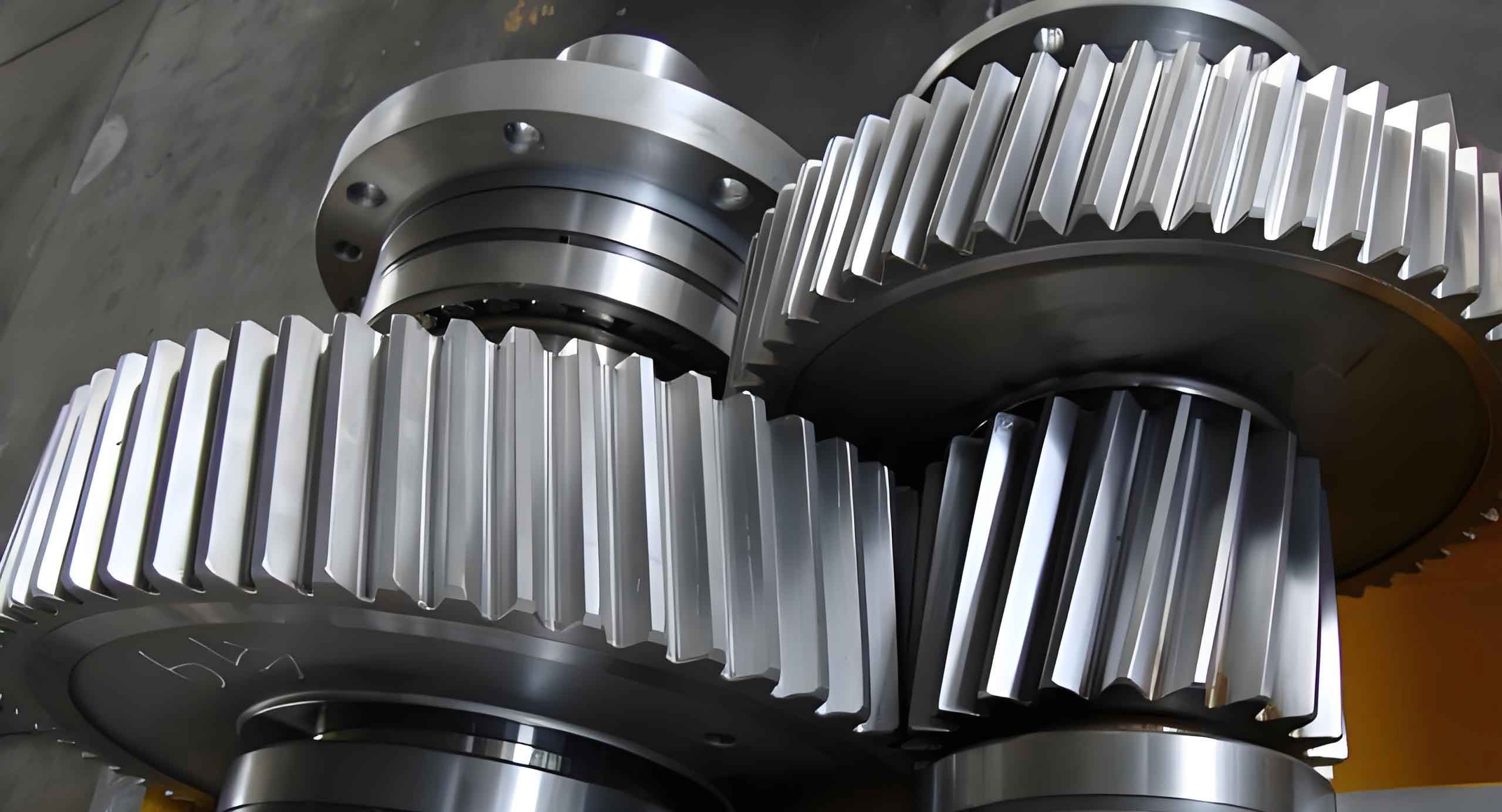
In modern mechanical engineering, the demand for high-performance helical gears has increased significantly, especially in applications involving high-speed, heavy-load, and thin-walled structures. Helical gears offer smoother operation and higher load capacity compared to spur gears, but they are susceptible to issues such as edge contact, vibration, and noise under demanding conditions. To address these challenges, tooth-trace modification, a form of topological modification, is often employed to optimize the contact pattern along the tooth flank. This modification involves deliberately altering the tooth surface geometry to improve meshing conditions, reduce stress concentrations, and extend gear life. In this study, we focus on the form grinding process for helical gears, which is a precise manufacturing method but introduces complexities due to the dynamic nature of the contact between the grinding wheel and the gear. Specifically, during the grinding of helical gears with tooth-trace modification, the contact lines between the wheel and gear change continuously, leading to additional motions that can cause distortions in the modification, often referred to as “modification distortions.” To achieve high precision in such processes, we propose a comprehensive method for constructing the modified tooth surface model and evaluating its errors. This approach involves deriving the actual contact line equations, using NURBS surface fitting to generate the tooth surface, and analyzing key error factors such as tooth profile deviation and helix deviation. Through a case study on drum-shaped modification and experimental validation, we demonstrate the accuracy and effectiveness of our model. This work aims to provide a robust framework for the design and manufacturing of precision helical gears, ensuring optimal performance in critical applications.
Helical gears are widely used in various industries due to their superior characteristics, such as reduced noise and increased torque transmission. However, the inherent complexity of their geometry makes precise manufacturing challenging. Form grinding is a common method for finishing helical gears, as it allows for the generation of complex tooth profiles with high accuracy. During this process, the grinding wheel engages with the gear tooth flank along a contact line that varies in space and time. When tooth-trace modification is applied, such as drum-shaped or other topological changes, the relative motion between the wheel and gear becomes more intricate. This can result in unintended distortions, where the intended modification shape is not accurately replicated on the tooth surface. To mitigate this, it is essential to develop a precise mathematical model that captures the actual grinding dynamics. Our method starts with a detailed analysis of the principles behind tooth-trace modification for helical gears. We consider the additional radial motion often used in form grinding to achieve modification, and we derive equations that describe the actual contact lines under these conditions. By incorporating coordinate transformations and considering the grinding wheel’s profile, we can simulate the grinding process and predict the resulting tooth surface. This model is then used to construct the modified surface via NURBS fitting, which offers flexibility and accuracy in representing complex geometries. Furthermore, we establish an error evaluation model to assess deviations in tooth profile and helix, which are critical for gear performance. Through this integrated approach, we aim to enhance the precision of form grinding for helical gears, reducing errors and improving the overall quality of manufactured gears.
The foundation of our method lies in understanding the coordinate systems involved in the form grinding of helical gears. We establish multiple coordinate frames to describe the relative positions and motions of the grinding wheel and gear. A fixed coordinate system, denoted as OXYZ, is attached to the machine tool’s stationary components. On the gear, we define a coordinate system O_g X_g Y_g Z_g, where the Z_g-axis aligns with the gear axis. Similarly, on the grinding wheel, we set up O_w X_w Y_w Z_w, with the Z_w-axis along the wheel axis. The center distance, a, represents the shortest distance between the gear and wheel axes, and the installation angle, Σ, is the angle between these axes. During tooth-trace modification, an additional radial motion is introduced, which varies the center distance by a value a_x. This variation is a function of the modification design, such as a drum shape. Using homogeneous transformation matrices, we can relate points in different coordinate systems. For instance, a point S on the gear in O_g X_g Y_g Z_g is transformed to the fixed system OXYZ via a rotation matrix M_θ, where θ is the gear rotation angle. Then, it is transformed to the wheel system O_w X_w Y_w Z_w using M_Σ, which accounts for the installation angle and center distance. The combined transformation is given by:
$$ \mathbf{r}_w = M_{\Sigma} M_{\theta} \mathbf{r}_g $$
where \(\mathbf{r}_g = (x_g, y_g, z_g, 1)^T\) and \(\mathbf{r}_w = (x_w, y_w, z_w, 1)^T\). The explicit equations are:
$$ x_w = -x_g \cos \theta + y_g \sin \theta + a – a_x $$
$$ y_w = -x_g \sin \theta \cos \Sigma – y_g \cos \theta \cos \Sigma – z_g \sin \Sigma – p \theta \sin \Sigma $$
$$ z_w = -x_g \sin \theta \sin \Sigma – y_g \cos \theta \sin \Sigma + z_g \cos \Sigma + p \theta \cos \Sigma $$
Here, p is the helical parameter of the gear, related to the helix angle. These transformations are crucial for calculating the actual contact lines during grinding, as they define the spatial relationship between the gear and wheel at any instant. For helical gears, the helical parameter p is derived from the gear geometry, and it influences the contact dynamics significantly. By varying θ and a_x according to the modification profile, we can simulate the grinding process and obtain points on the tooth surface.
To derive the actual contact lines, we first need to determine the grinding wheel’s profile. In form grinding, the wheel’s axial cross-section is designed to match the gear’s tooth profile in a specific plane. For helical gears, this involves calculating the contact line between the wheel and gear based on the gear’s geometry and the grinding parameters. The contact line equation can be expressed as:
$$ z_g n_x + a n_y \cot \Sigma + (a – x_g + p \cot \Sigma) n_z = 0 $$
where \((n_x, n_y, n_z)\) is the normal vector at a point on the helical gear surface. This equation ensures that the wheel and gear are in contact at that point during grinding. By solving this equation along with the coordinate transformations, we can obtain the wheel’s profile as a function of the pressure angle μ:
$$ R_w = \sqrt{x_w^2 + y_w^2} = m(\mu) $$
$$ Z_w = z_w = g(\mu) $$
where m(μ) and g(μ) define the wheel’s cross-sectional shape. For helical gears with tooth-trace modification, the actual contact lines deviate from the theoretical ones due to the additional radial motion. To compute these actual lines, we consider the relative velocity between the wheel and gear. The grinding wheel rotates and moves radially, while the gear rotates and may have axial motion. The relative velocity \(\mathbf{V}^w_r\) in the wheel coordinate system is given by:
$$ \mathbf{V}^w_r = \mathbf{V}^w_w – \mathbf{V}^w_g $$
where \(\mathbf{V}^w_w = (\delta_x, 0, 0)^T\) is the wheel’s velocity due to radial motion, and \(\mathbf{V}^w_g\) is the gear’s velocity at the contact point. The gear’s velocity can be derived from the gear’s rotation and translation. The condition for contact is that the relative velocity is orthogonal to the surface normal at the contact point:
$$ \mathbf{N}_w \cdot \mathbf{V}^w_r = 0 $$
Here, \(\mathbf{N}_w\) is the normal vector of the wheel surface. By expanding this equation, we obtain a relationship involving the parameters μ, θ, and φ (the wheel rotation angle). For helical gears, this leads to a transcendental equation:
$$ X_1 \cos \phi + X_2 \sin \phi + X_3 = 0 $$
where \(X_1, X_2, X_3\) are functions of μ and the grinding parameters. Solving this equation iteratively for each value of μ allows us to find φ and then compute the coordinates of points on the actual contact line using:
$$ x_g = -m(\mu) \cos \phi + a – a_x $$
$$ y_g = -m(\mu) \sin \phi \cos \Sigma – g(\mu) \sin \Sigma $$
$$ z_g = -m(\mu) \sin \phi \sin \Sigma + g(\mu) \cos \Sigma $$
By discretizing the tooth width into n segments and computing the contact lines for each segment, we generate a point cloud representing the tooth surface. This point cloud is then used for surface fitting. For helical gears, the number of points m along each contact line and n along the tooth width determines the resolution of the model. Typically, we use m = 141 and n = 81 to ensure accuracy. The following table summarizes key parameters involved in the contact line calculation for helical gears:
| Parameter | Symbol | Description |
|---|---|---|
| Gear Helical Parameter | p | Defines the helix angle, critical for helical gears’ geometry |
| Installation Angle | Σ | Angle between gear and wheel axes |
| Center Distance | a | Distance between gear and wheel axes |
| Radial Motion | a_x | Variation in center distance for modification |
| Pressure Angle | μ | Parameter for wheel profile calculation |
Once the point cloud is generated, we construct the modified tooth surface using NURBS (Non-Uniform Rational B-Spline) surface fitting. NURBS is a powerful tool for representing complex surfaces with high precision, as it allows for local control and smoothness. For helical gears, the tooth surface is a three-dimensional curved surface that requires accurate representation to ensure proper meshing. The fitting process involves two main steps: first, we determine the control points of the B-spline surface by solving a linear system based on the data points; second, we evaluate the fitted surface at any desired parameters. Given a grid of data points \(\mathbf{P}_{ij}\) with i = 0,…,m and j = 0,…,n, we define a NURBS surface of degree 3 in both directions:
$$ \mathbf{S}(u,v) = \frac{\sum_{i=0}^m \sum_{j=0}^n w_{ij} \mathbf{P}_{ij} N_{i,3}(u) N_{j,3}(v)}{\sum_{i=0}^m \sum_{j=0}^n w_{ij} N_{i,3}(u) N_{j,3}(v)} $$
where \(N_{i,3}(u)\) and \(N_{j,3}(v)\) are the B-spline basis functions, and \(w_{ij}\) are weights. For helical gears, we typically set all weights to 1 for simplicity. The knots vectors are chosen based on the parameterization of the data points. By fitting the NURBS surface to the contact line points, we obtain a smooth and continuous representation of the modified tooth surface. This model can be used for further analysis, such as error evaluation or simulation of gear meshing. The accuracy of the fit depends on the number of data points and the knot placement; we use adaptive methods to ensure that the surface closely approximates the intended modification shape for helical gears.
With the tooth surface constructed, we next develop an error evaluation model to assess the accuracy of the grinding process. For helical gears, the primary error factors are tooth profile deviation and helix deviation. Tooth profile deviation refers to the difference between the actual tooth flank and the theoretical involute profile in the transverse plane, while helix deviation measures the variation in the tooth trace along the gear axis. Both are critical for the performance of helical gears, as they affect contact patterns, load distribution, and noise. To evaluate these deviations, we compare the fitted NURBS surface with the ideal modified surface. For helix deviation, we intersect the tooth surface with a cylinder at the pitch radius to obtain the actual helix line. The deviation is calculated as the normal distance between this actual helix and the theoretical helix. For a drum-shaped modification, the theoretical helix is a curve with a specific curvature. The deviation \(\Delta_h\) at a point along the tooth width is given by:
$$ \Delta_h = \left| \mathbf{r}_{\text{actual}} – \mathbf{r}_{\text{theoretical}} \right| \cdot \mathbf{n} $$
where \(\mathbf{r}_{\text{actual}}\) is a point on the actual helix, \(\mathbf{r}_{\text{theoretical}}\) is the corresponding point on the theoretical helix, and \(\mathbf{n}\) is the unit normal vector. For tooth profile deviation, we consider a cross-section of the tooth surface perpendicular to the gear axis. The deviation \(\Delta_p\) is computed as the normal distance from the actual profile to the theoretical involute curve. In the case of helical gears, this involves projecting points onto the transverse plane and comparing them to the involute equation:
$$ \Delta_p = \left| \mathbf{r}_{\text{actual}} – \mathbf{r}_{\text{involute}} \right| \cdot \mathbf{n}_t $$
where \(\mathbf{n}_t\) is the normal in the transverse plane. To account for the incomplete contact lines during grinding (where only about 80% of the tooth width is fully ground), we restrict the evaluation to the central portion of the tooth. This ensures that the error analysis reflects the actual grinding conditions for helical gears. The following table outlines the key components of the error evaluation model:
| Error Type | Symbol | Description | Impact on Helical Gears |
|---|---|---|---|
| Tooth Profile Deviation | Δ_p | Deviation from ideal involute profile | Affects meshing smoothness and stress |
| Helix Deviation | Δ_h | Deviation from ideal helix line | Influences contact pattern and load distribution |
| Modification Distortion | – | Unintended shape changes due to grinding | Can lead to noise and reduced life |
To illustrate our method, we present a case study on drum-shaped modification of helical gears. Drum-shaped modification is a common tooth-trace modification where the tooth flank is slightly curved along the width to prevent edge contact. For helical gears, this modification is particularly important in high-speed applications. The design parameters include the drum amount δ, tooth width b, and drum radius R. The drum radius is calculated as:
$$ R = \frac{\delta}{2} + \frac{b^2}{8\delta} $$
The center distance variation a_x is derived from the drum geometry and the gear’s helical parameters. For a point at a distance l_z from the tooth center along the axis, the modification amount δ_z is:
$$ \delta_z = R – \sqrt{R^2 – l_z^2} $$
And the corresponding center distance change is:
$$ a_x = \frac{\delta_z \cos \beta_b}{\sin \alpha_n} $$
where β_b is the base helix angle and α_n is the normal pressure angle. For helical gears, l_z is related to the gear rotation angle θ via the helical parameter p: \(l_z = |p \theta – b/2|\). Using these equations, we can compute the actual contact lines for each position along the tooth width. We then fit a NURBS surface to these lines to construct the drum-shaped tooth surface. The following table shows an example set of parameters for a helical gear used in the case study:
| Parameter | Value | Unit |
|---|---|---|
| Number of Teeth (z) | 19 | – |
| Normal Module (m_n) | 5 | mm |
| Pressure Angle (α) | 20 | ° |
| Helix Angle (β) | 20 | ° |
| Tooth Width (b) | 70 | mm |
| Drum Amount (δ) | 0.02 | mm |
| Grinding Wheel Installation Angle (Σ) | 71.25 | ° |
Using these parameters, we generate contact lines and fit the NURBS surface. The resulting surface shows a smooth drum shape, but due to the grinding dynamics, distortions may occur. Our error evaluation reveals that for helical gears with drum modification, the left flank often exhibits more distortion than the right flank, a phenomenon known as “modification distortion.” This is caused by the asymmetrical contact conditions during grinding. To compensate for these errors, we optimize the grinding parameters, particularly the wheel installation angle Σ. By varying Σ and observing the change in maximum modification error, we can find an optimal angle that minimizes distortions. For the example helical gear, the optimal installation angle is found to be Σ = 71.858°, which reduces the helix deviation and tooth profile deviation significantly. The following formulas summarize the error compensation approach:
$$ \Sigma_{\text{opt}} = \arg \min_{\Sigma} \max(\Delta_h, \Delta_p) $$
where the maximum error is evaluated over the tooth surface. This optimization is crucial for achieving high precision in helical gears manufacturing.
To validate our model, we conduct grinding experiments on a custom-built form grinding machine. The machine is equipped with CNC controls that allow for precise radial and rotational motions. We grind a helical gear with the parameters from the case study, using both the initial and optimized installation angles. After grinding, the gear is measured using a coordinate measuring machine (CMM) to obtain the actual tooth surface data. The measured data is compared with the theoretical model to evaluate errors. The results show that with the optimized installation angle, the tooth profile deviation is reduced to within 0.4 μm, and the helix deviation is minimized, confirming the accuracy of our error prediction model. This validation demonstrates that our method can effectively construct high-precision tooth surfaces for helical gears with tooth-trace modification. The success of these experiments highlights the importance of accurate modeling in the manufacturing of helical gears, especially for applications requiring tight tolerances.
In conclusion, we have developed a comprehensive method for constructing and evaluating the tooth surface of helical gears with tooth-trace modification in form grinding. Our approach includes deriving actual contact line equations, using NURBS surface fitting, and establishing error evaluation models for tooth profile and helix deviations. Through a case study on drum-shaped modification and experimental validation, we have shown that our model can accurately predict and compensate for grinding errors, resulting in high-precision helical gears. This work contributes to the advancement of gear manufacturing technology by providing a robust framework for designing and producing modified helical gears with improved performance. Future research could extend this method to more complex topological modifications or integrate it with real-time control systems for adaptive grinding. Overall, the focus on helical gears throughout this study underscores their significance in modern machinery and the need for precise manufacturing techniques to meet evolving engineering demands.
The mathematical models and methods presented here are generalizable to various types of helical gears and modifications. By continuously refining these models, we can further enhance the quality and reliability of helical gears in critical applications. The use of advanced techniques like NURBS and error compensation ensures that the manufacturing process keeps pace with the increasing demands for efficiency and precision in industries such as automotive, aerospace, and renewable energy. As helical gears continue to play a vital role in power transmission systems, our work provides valuable insights and tools for engineers and manufacturers striving to achieve excellence in gear production.