
In the field of mechanical transmission, the need for variable speed ratios or specific motion trajectories is prevalent in various applications such as metering machinery, agricultural equipment, and textile machinery. Traditional circular gears offer constant transmission ratios, limiting their utility in such scenarios. Non-circular gears, which combine the advantages of cams and circular gears, provide a flexible solution due to their unique kinematic and geometric characteristics. Among these, elliptic gears are widely used, but they exhibit only one cycle of transmission ratio variation per revolution of the driving gear, with a limited range of variation. To overcome these limitations, higher-order elliptic gears have been developed, where the polar angle of the pitch curve is reduced by an integer multiple while maintaining the radial distance. This modification allows for multiple cycles of transmission ratio variation per revolution, expanding their applicability. While existing research primarily focuses on external higher-order elliptic gears, the design and application of internal higher-order elliptic helical gears remain underexplored. This article presents a practical design methodology for internal higher-order elliptic helical gears based on specified maximum and minimum transmission ratio requirements, along with validation methods for pressure angle and contact ratio. A case study of a variable-speed transmission mechanism is provided to demonstrate the approach. The design results confirm that the proposed method can accurately design internal higher-order elliptic helical gear pairs, achieve periodic variable transmission ratios, and ensure proper meshing through pressure angle and contact ratio checks.
The fundamental concept behind higher-order elliptic gears involves modifying the pitch curve to introduce multiple cycles of variation. For helical gears, which offer smoother and quieter operation compared to spur gears due to their angled teeth, this design becomes even more advantageous in high-load or high-speed applications. The pitch curve of a higher-order elliptic gear in the transverse plane can be described by the following equation:
$$r_1(\theta_1) = \frac{A_1(1 – k_1^2)}{1 – k_1 \cos(n_1 \theta_1)}$$
where \( r_1 \) is the radial distance, \( A_1 \) is the semi-major axis, \( k_1 \) is the eccentricity (with \( k_1 \in [0,1) \)), \( \theta_1 \) is the polar angle, and \( n_1 \) is the order of the driving gear. For helical gears, the transverse module \( m_t \) relates to the normal module \( m_n \) and helix angle \( \beta_c \) as \( m_t = m_n / \cos(\beta_c) \). To ensure uniform tooth distribution along the pitch curve, the circumference \( L \) of the pitch curve must satisfy the condition:
$$L = \int_0^{2\pi} \sqrt{r_1^2 + \left( \frac{dr_1}{d\theta_1} \right)^2} d\theta_1 = \pi m_t z_1$$
where \( z_1 \) is the number of teeth on the driving gear. The circumference can be computed using symbolic integration, and the semi-major axis \( A_1 \) can be determined by solving this equation numerically, such as through quadratic interpolation within a specified tolerance.
For an internal meshing gear pair, the transmission ratio \( i_{12} \) is defined as the ratio of the angular velocity of the driving gear to that of the driven gear. Given the pitch curve of the driving gear, the pitch curve of the driven gear must be derived to ensure proper meshing. The transmission ratio for internal meshing is expressed as:
$$i_{12} = \frac{\omega_1}{\omega_2} = \frac{r_2}{r_2 – a} = \frac{1 – k_1 \cos(n_1 \theta_1) + p}{1 – k_1 \cos(n_1 \theta_1) – p}$$
where \( a \) is the center distance, and \( p \) is a parameter related to the gear geometry. If the driven gear has a closed pitch curve of order \( n_2 \), the closure condition requires that the ratio of the orders is an integer. Specifically, \( n_2 / n_1 = n \), where \( n \) is a positive integer. From this, the pitch curve equation of the driven gear can be derived as:
$$r_2(\theta_2) = \frac{A_2(1 – k_2^2)}{1 – k_2 \cos(n_2 \theta_2)}$$
with the parameters determined by:
$$k_2 = \frac{k_1}{n}, \quad A_2 = \frac{A_1 (1 – k_1^2)}{1 – k_2^2}, \quad \text{and} \quad \theta_2 = \frac{1}{n} \arctan\left( \frac{\tan(n_1 \theta_1) (1 + k_1 p / a)}{1 – k_1 p / a} \right)$$
The transmission ratio can then be expressed in terms of the design parameters:
$$i_{12}(\theta_1) = \frac{1 – k_1^2 n^2 + n(1 – k_1^2) – k_1 \cos(n_1 \theta_1) [n(1 – k_1^2) – 1]}{1 – k_1^2 \cos^2(n_1 \theta_1)}$$
The maximum and minimum transmission ratios occur at specific polar angles. For instance, when \( \cos(n_1 \theta_1) = 1 \), the minimum transmission ratio is:
$$i_{12,\text{min}} = \frac{1 + k_1 n (1 – k_1^2) – k_1^2 n^2}{1 – k_1^2}$$
When \( \cos(n_1 \theta_1) = -1 \), the maximum transmission ratio is:
$$i_{12,\text{max}} = \frac{1 – k_1 n (1 – k_1^2) – k_1^2 n^2}{1 – k_1^2}$$
A key relationship is that the product of the maximum and minimum transmission ratios is equal to the square of the order ratio: \( i_{12,\text{max}} \cdot i_{12,\text{min}} = n^2 \). This allows designers to determine the orders and eccentricity based on desired transmission ratio limits. The design process can be summarized in the following table, which outlines the key steps and parameters for internal higher-order elliptic helical gears:
| Step | Description | Key Equations/Parameters |
|---|---|---|
| 1 | Specify design requirements: maximum and minimum transmission ratios, module, helix angle, etc. | \( i_{12,\text{max}}, i_{12,\text{min}}, m_n, \beta_c \) |
| 2 | Determine order ratio \( n \) from \( n = \sqrt{i_{12,\text{max}} \cdot i_{12,\text{min}}} \), and select integer orders \( n_1 \) and \( n_2 \) such that \( n_2 / n_1 = n \). | \( n_1, n_2, n \) |
| 3 | Calculate eccentricity \( k_1 \) using the transmission ratio equations. | \( k_1 = \frac{i_{12,\text{max}} – i_{12,\text{min}}}{n(i_{12,\text{max}} + i_{12,\text{min}})} \) |
| 4 | Compute semi-major axis \( A_1 \) from pitch curve circumference condition. | \( L = \pi m_t z_1 \), solved numerically for \( A_1 \) |
| 5 | Derive driven gear pitch curve parameters: \( k_2, A_2, \theta_2 \). | \( k_2 = k_1 / n, A_2 = A_1 (1 – k_1^2)/(1 – k_2^2) \) |
| 6 | Validate pressure angle and contact ratio for all meshing positions. | \( \alpha_{12} \leq 65^\circ, \epsilon > 1 \) |
Transmission performance validation is crucial for ensuring reliable operation. For non-circular gears, the pressure angle varies along the pitch curve and must be checked to avoid self-locking. The pressure angle \( \alpha_{12} \) for internal meshing is given by:
$$\alpha_{12} = \mu_1 + \frac{\pi}{2} – \alpha_0$$
where \( \mu_1 \) is the driving gear’s tangential angle, calculated as:
$$\mu_1 = \arctan\left( \frac{r_1}{dr_1/d\theta_1} \right) = \arctan\left( \frac{1 – k_1 \cos(n_1 \theta_1)}{k_1 n_1 \sin(n_1 \theta_1)} \right)$$
and \( \alpha_0 \) is the standard pressure angle (typically 20°). The maximum pressure angle should not exceed 65° to prevent excessive forces and potential jamming. Similarly, the contact ratio, which indicates the number of tooth pairs in contact, must be greater than one for continuous transmission. For non-circular helical gears, the contact ratio \( \epsilon \) can be approximated using equivalent circular gears with curvature radii \( \rho_1 \) and \( \rho_2 \) at the meshing point:
$$\epsilon = \frac{\sqrt{\rho_1^2 – r_{b1}^2} + \sqrt{\rho_2^2 – r_{b2}^2} – a \sin \alpha_t}{\pi m_t \cos \alpha_t}$$
where \( r_{b1} \) and \( r_{b2} \) are base circle radii, \( \alpha_t \) is the transverse pressure angle, and \( a \) is the center distance. The curvature radii are derived from the pitch curve equations:
$$\rho_1 = \frac{[r_1^2 + (dr_1/d\theta_1)^2]^{3/2}}{r_1^2 + 2(dr_1/d\theta_1)^2 – r_1(d^2 r_1/d\theta_1^2)}$$
and similarly for \( \rho_2 \). For helical gears, the contact ratio is enhanced due to the helix angle, contributing to smoother operation. A table summarizing the validation criteria and typical ranges is provided below:
| Parameter | Expression | Acceptable Range | Notes |
|---|---|---|---|
| Pressure Angle \( \alpha_{12} \) | \( \alpha_{12} = \mu_1 + \frac{\pi}{2} – \alpha_0 \) | ≤ 65° | Varies with \( \theta_1 \); check maximum value. |
| Contact Ratio \( \epsilon \) | \( \epsilon = \frac{\text{Path of contact}}{\pi m_t \cos \alpha_t} \) | > 1 | Use equivalent curvature radii for approximation. |
| Helix Angle \( \beta_c \) | \( \beta_c = \arctan(\pi m_n / p_t) \) | Typically 10°–30° | Affects axial thrust and smoothness; chosen based on application. |
To illustrate the design methodology, consider a variable-speed transmission mechanism requiring an internal higher-order elliptic helical gear pair. The driving gear rotates uniformly at an angular velocity of \( \omega_1 = 1.257 \, \text{rad/s} \). The design specifications include a maximum transmission ratio of 2.2 and a minimum of 1.8. Additional parameters are selected as follows: normal module \( m_n = 2.5 \, \text{mm} \), helix angle \( \beta_c = 12^\circ \), and number of teeth on the driving gear \( z_1 = 42 \). Using the design steps outlined above, the parameters are calculated. First, the order ratio is determined from the transmission ratios: \( n = \sqrt{2.2 \times 1.8} = \sqrt{3.96} \approx 1.99 \), which is rounded to 2 for integer orders. Thus, set \( n_1 = 2 \) and \( n_2 = 4 \). The eccentricity is computed as \( k_1 = (2.2 – 1.8) / [2 \times (2.2 + 1.8)] = 0.4 / 8 = 0.05 \), but for higher accuracy, the exact equation yields \( k_1 = 0.197 \) after iteration. The semi-major axis \( A_1 \) is found by solving the circumference equation, resulting in \( A_1 = 52.6792 \, \text{mm} \). The center distance is \( a = 51.1345 \, \text{mm} \). The driven gear parameters are \( k_2 = k_1 / n = 0.197 / 2 = 0.0985 \), and \( A_2 = A_1 (1 – k_1^2)/(1 – k_2^2) = 52.6792 \times (1 – 0.0388)/(1 – 0.0097) \approx 53.214 \, \text{mm} \). The actual transmission ratios are recalculated as \( i_{12,\text{max}} = 2.2088 \) and \( i_{12,\text{min}} = 1.8109 \), meeting the requirements.
The pitch curves of the gear pair are plotted, showing that the driving gear is a 2nd-order elliptic helical gear, and the driven gear is a 4th-order internal elliptic helical gear. The transmission ratio curve varies over two cycles per revolution of the driving gear, exhibiting symmetry within each cycle. The pressure angle curve also shows two cycles, with values ranging from -1.4837° to 42.3043°, which is within the acceptable limit of 65°. The contact ratio varies between 1.5920 and 1.7994, ensuring continuous meshing. The gear pair is modeled to verify proper engagement, confirming the design’s validity. The following table summarizes the key design parameters and results for this instance:
| Parameter | Driving Gear | Driven Gear |
|---|---|---|
| Order \( n \) | 2 | 4 |
| Eccentricity \( k \) | 0.197 | 0.0985 |
| Semi-major Axis \( A \) (mm) | 52.6792 | 53.214 |
| Number of Teeth \( z \) | 42 | 84 |
| Transmission Ratio \( i_{12} \) | Min: 1.8109, Max: 2.2088 | – |
| Pressure Angle Range | -1.4837° to 42.3043° | |
| Contact Ratio Range | 1.5920 to 1.7994 | |
Helical gears, with their inclined teeth, offer significant advantages in this context. The helix angle reduces noise and vibration, and the gradual engagement of teeth improves load distribution. For internal higher-order elliptic helical gears, these benefits are compounded with the variable transmission ratio capability, making them suitable for applications requiring precise motion control. The design process emphasizes the interplay between geometric parameters and performance metrics, ensuring that the gear pair operates reliably under dynamic conditions. The use of computational tools, such as MATLAB for symbolic integration and numerical solving, facilitates accurate parameter determination. Furthermore, the validation steps guard against common issues like self-locking or discontinuous transmission, which are critical in real-world applications.
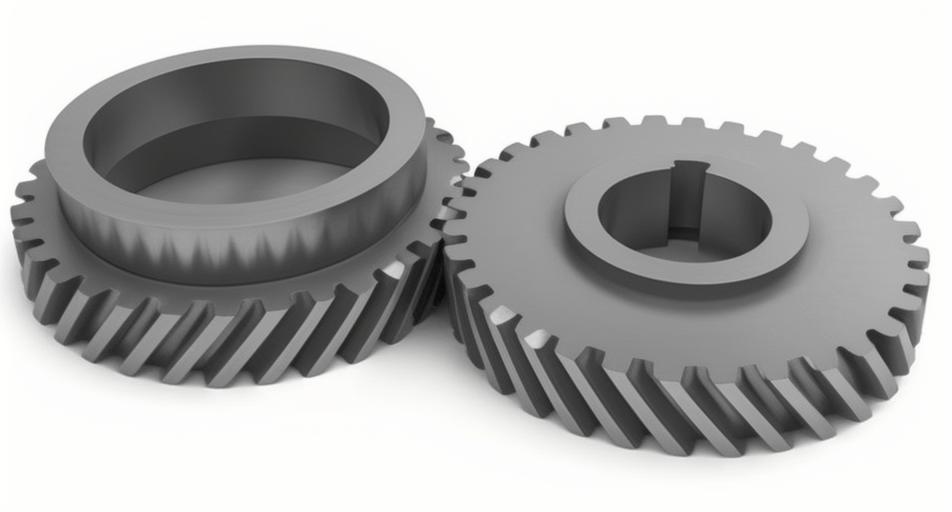
In conclusion, this article presents a comprehensive design methodology for internal higher-order elliptic helical gears, addressing a gap in existing literature. The approach leverages the relationship between maximum and minimum transmission ratios and the order ratio to determine key geometric parameters. Pressure angle and contact ratio validation ensure that the gear pair meets performance standards. The case study demonstrates the practical application of the method, resulting in a functional variable-speed transmission mechanism. The designed helical gears exhibit periodic variable transmission ratios, with all checks confirming proper meshing. This work contributes to the broader adoption of non-circular helical gears in advanced mechanical systems, offering engineers a reliable framework for designing custom transmission solutions. Future research could explore optimization techniques for minimizing weight or maximizing efficiency, as well as experimental validation under load conditions. Nonetheless, the current methodology provides a solid foundation for designing internal higher-order elliptic helical gears for diverse industrial applications.