
In the field of precision mechanical transmissions, helical gears play a critical role due to their smooth operation and high load-carrying capacity. However, traditional involute helical gears often exhibit limitations in fault tolerance, leading to vibrations and failures under high-speed and heavy-load conditions. To address these issues, tooth surface modification techniques have been widely adopted, replacing line contact with point contact to enhance performance in aerospace, marine, and other high-demand applications. In this article, I propose a comprehensive method for tooth contact analysis (TCA) of real helical gears, incorporating measured surface deviations to simulate accurate meshing behavior. This approach leverages coordinate measurement data, B-spline fitting for deviation surfaces, and advanced TCA equations to model real tooth surfaces, including edge contacts. I will detail the mathematical framework, provide simulation examples, and validate the method’s correctness through various modification cases. The goal is to offer a new, efficient tool for analyzing helical gears with practical deviations, ultimately aiding in design and optimization.
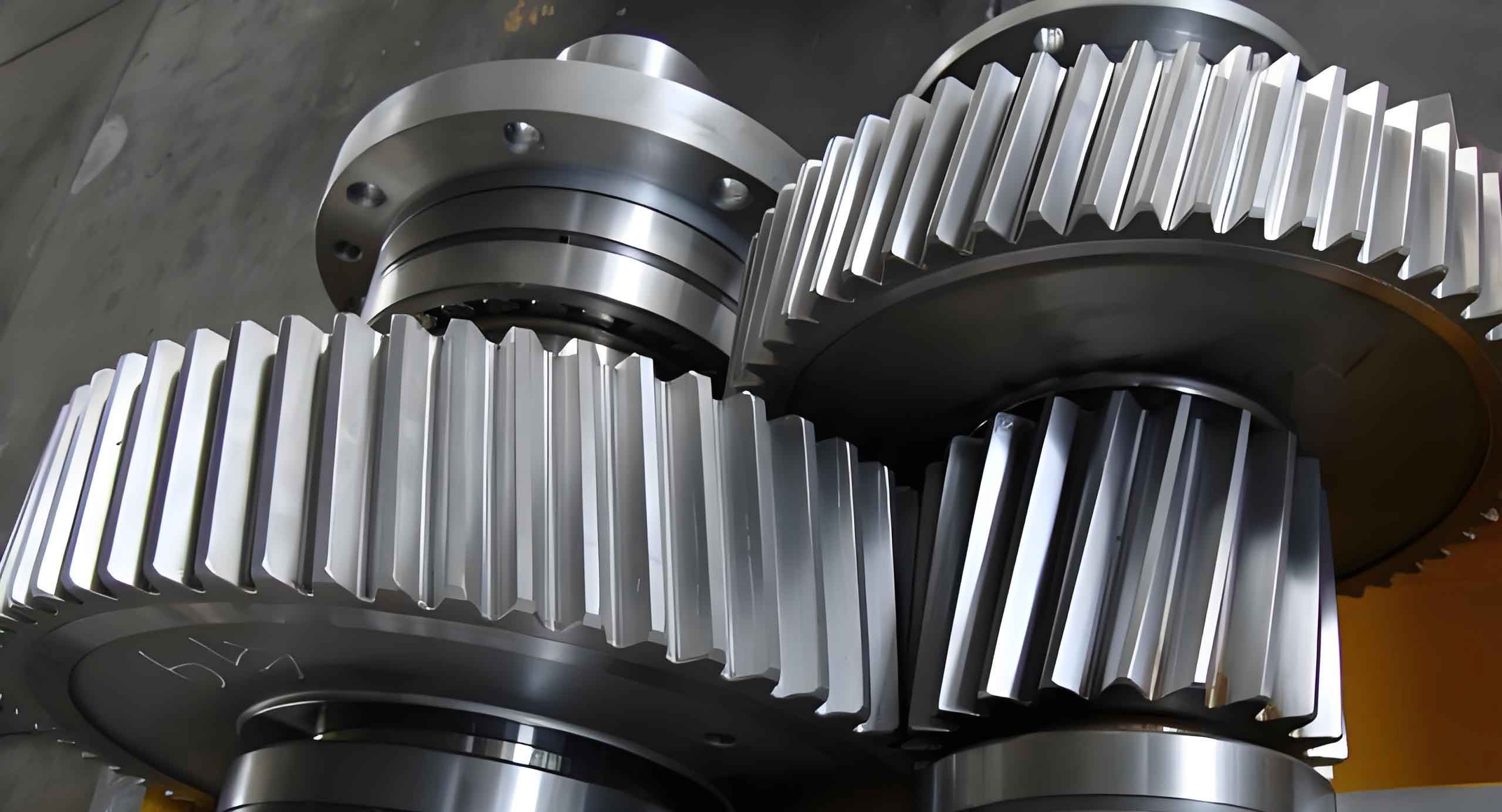
Helical gears are essential components in many mechanical systems, and their performance hinges on accurate tooth surface geometry. Traditional TCA methods often rely on theoretical tooth surfaces derived from machining principles, which may not account for manufacturing errors or intentional modifications. In practice, helical gears undergo modifications like crowning or lead corrections to mitigate edge loading and improve meshing characteristics. However, these real surfaces are complex and require precise measurement and modeling. I introduce a method that constructs real tooth surfaces by superimposing a theoretical involute helical gear surface with a deviation surface obtained from coordinate measurements. This deviation surface is fitted using bicubic B-splines based on a grid of points measured on the tooth surface, ensuring high accuracy and smoothness. The real tooth surface is then expressed as a combination of the theoretical surface and the deviation, allowing for efficient TCA simulations that include both surface and edge contacts. This approach is particularly valuable for high-precision helical gears used in critical applications, where even micron-level deviations can impact performance.
The core of my method lies in the mathematical representation of real tooth surfaces. For a helical gear, the theoretical tooth surface is generated using a rack cutter or similar tool, parameterized by coordinates such as the profile shift and lead angle. Let the theoretical tooth surface of the pinion (driving gear) be denoted by position vector $\mathbf{R}_1(u_1, l_1)$ and unit normal vector $\mathbf{n}_1(u_1, l_1)$, where $u_1$ and $l_1$ are parameters along the profile and lead directions, respectively. In real helical gears, deviations due to modifications or errors are measured at grid points on the tooth surface, typically using a coordinate measuring machine (CMM). These deviations are defined in the normal direction to the theoretical surface. I represent the real tooth surface position vector $\mathbf{R}_{1r}(u_1, l_1)$ as:
$$ \mathbf{R}_{1r}(u_1, l_1) = \delta(u_1, l_1) \mathbf{n}_1(u_1, l_1) + \mathbf{R}_1(u_1, l_1) $$
Here, $\delta(u_1, l_1)$ is the normal deviation at point $(u_1, l_1)$, which can be positive or negative depending on whether material is added or removed. The real surface normal vector $\mathbf{N}_{1r}(u_1, l_1)$ is derived from the cross product of partial derivatives of $\mathbf{R}_{1r}$ with respect to $u_1$ and $l_1$. Using the chain rule, I express it as:
$$ \mathbf{N}_{1r}(u_1, l_1) = \left( \frac{\partial \mathbf{R}_1}{\partial u_1} + \frac{\partial \delta}{\partial u_1} \mathbf{n}_1 + \delta \frac{\partial \mathbf{n}_1}{\partial u_1} \right) \times \left( \frac{\partial \mathbf{R}_1}{\partial l_1} + \frac{\partial \delta}{\partial l_1} \mathbf{n}_1 + \delta \frac{\partial \mathbf{n}_1}{\partial l_1} \right) $$
This formulation accounts for the influence of deviation on both position and orientation, which is crucial for accurate contact analysis. To obtain $\delta(u_1, l_1)$, I use a grid of measured deviation points. Suppose the tooth surface is divided into an $m \times n$ grid in a rotated projection plane, where each grid point has coordinates $(x_i, y_j)$ and corresponding normal deviation $\delta’_{i,j}$. The relationship between the projection plane and theoretical tooth surface parameters is given by transformations such as:
$$ x = \sqrt{R_x^2 + R_y^2}, \quad y = R_z $$
where $R_x, R_y, R_z$ are components of $\mathbf{R}_1$. The deviation function $\delta'(x,y)$ is fitted using bicubic B-spline surfaces, which provide $C^2$ continuity and high flexibility. The B-spline surface is composed of multiple patches, each defined for parameter intervals $u \in [u_i, u_{i+1}]$ and $v \in [v_j, v_{j+1}]$, where $u$ and $v$ are normalized parameters from $x$ and $y$. For a patch indexed by $i$ and $j$, the deviation is:
$$ \delta’_{i,j}(u,v) = \frac{1}{36} [u^3 \ u^2 \ u \ 1] \mathbf{M} \mathbf{V}_{i,j} \mathbf{M}^T [v^3 \ v^2 \ v \ 1]^T $$
with $u = (x – x_i)/(x_{i+1} – x_i)$ and $v = (y – y_j)/(y_{j+1} – y_j)$. Here, $\mathbf{M}$ is a constant matrix for cubic B-splines, and $\mathbf{V}_{i,j}$ is a $4 \times 4$ matrix of control points derived from measured data. This fitting process ensures that the deviation surface accurately interpolates or approximates the measured points, with typical errors below 1 micron for high-precision helical gears. The partial derivatives of $\delta$ with respect to $u_1$ and $l_1$ are computed using the chain rule through $\delta'(x,y)$, enabling the calculation of $\mathbf{N}_{1r}$.
For tooth contact analysis of helical gears, I consider a gear pair consisting of a pinion (gear 1) and a wheel (gear 2). The real tooth surface is applied to the pinion, while the wheel may have a theoretical surface or its own deviations. The coordinate systems include fixed frames and moving frames attached to each gear. The meshing condition requires that at any instant, the two tooth surfaces are in point contact with a common normal. Let $\phi_1$ and $\phi_2$ be the rotation angles of the pinion and wheel, respectively. The TCA equations are:
$$ \mathbf{M}_{f1}(\phi_1) \mathbf{R}_{1r}(u_1, l_1) – \mathbf{M}_{f2}(\phi_2) \mathbf{M}_{e2} \mathbf{R}_2(u_2, l_2) = \mathbf{0} $$
$$ \mathbf{L}_{f1}(\phi_1) \mathbf{N}_{1r}(u_1, l_1) – \mathbf{L}_{f2}(\phi_2) \mathbf{L}_{e2} \mathbf{n}_2(u_2, l_2) = \mathbf{0} $$
Here, $\mathbf{M}_{f1}, \mathbf{M}_{f2}$ are transformation matrices from gear coordinates to a fixed frame, $\mathbf{M}_{e2}$ accounts for installation errors such as axis misalignment or center distance variation, and $\mathbf{L}$ matrices handle normal vector transformations. Given $\phi_1$ as input, I solve for $u_1, l_1, u_2, l_2, \phi_2$ using numerical methods like Newton-Raphson iteration. This yields the contact point on both tooth surfaces for that instant.
Edge contacts in helical gears occur at the boundaries of the tooth surface, such as the tip or sides, and significantly affect load distribution and transmission error. For the pinion, edge contacts are modeled by additional conditions. For example, when contact occurs at the left or right side edge, $l_1$ is constant, and the equations become:
$$ \mathbf{M}_{f1}(\phi_1) \mathbf{R}_{1r}(u_1, l_1) – \mathbf{M}_{f2}(\phi_2) \mathbf{M}_{e2} \mathbf{R}_2(u_2, l_2) = \mathbf{0} $$
$$ \mathbf{L}_{f1} \frac{\partial \mathbf{R}_{1r}}{\partial u_1} \cdot (\mathbf{L}_{f2}(\phi_2) \mathbf{L}_{e2} \mathbf{n}_2(u_2, l_2)) = 0 $$
Similarly, for tip edge contact where $u_1$ is constant:
$$ \mathbf{M}_{f1}(\phi_1) \mathbf{R}_{1r}(u_1, l_1) – \mathbf{M}_{f2}(\phi_2) \mathbf{M}_{e2} \mathbf{R}_2(u_2, l_2) = \mathbf{0} $$
$$ \mathbf{L}_{f2} \frac{\partial \mathbf{R}_{1r}}{\partial l_1} \cdot (\mathbf{L}_{f2}(\phi_2) \mathbf{L}_{e2} \mathbf{n}_2(u_2, l_2)) = 0 $$
These equations ensure that at the edge, the tangent to the boundary is perpendicular to the normal of the contacting surface, mimicking real edge contact scenarios. The transmission error, a key performance metric, is defined as the deviation of the wheel’s actual rotation from its theoretical value:
$$ \psi(\phi_1) = (\phi_2 – \phi_2^0) – \frac{N_1}{N_2} (\phi_1 – \phi_1^0) $$
where $N_1$ and $N_2$ are tooth numbers, and $\phi_1^0, \phi_2^0$ are initial angles. This error influences noise and vibration in helical gears.
To implement this TCA method for helical gears, I developed a computational procedure in MATLAB, which handles the construction of real tooth surfaces, B-spline fitting, and solution of TCA equations. The steps are as follows:
- Input basic gear parameters and grid-based normal deviation data points $P_{i,j}(x, y, \delta’)$ from CMM measurements.
- Generate the theoretical tooth surface position $\mathbf{R}_1(u_1, l_1)$ and normal $\mathbf{n}_1(u_1, l_1)$ using gear generation equations.
- Fit the deviation data with a bicubic B-spline surface $\delta(u,v)$ and extrapolate to cover the entire tooth boundary.
- For given theoretical parameters $(u_1, l_1)$, compute projection plane coordinates $(x,y)$ and their partial derivatives with respect to $u_1$ and $l_1$.
- Normalize $(x,y)$ to B-spline parameters $(u,v)$, evaluate $\delta$ and its partials, then compute $\delta$ and its derivatives in tooth parameter space.
- Construct real tooth surface vectors $\mathbf{R}_{1r}$ and $\mathbf{N}_{1r}$.
- Solve TCA equations for contact points, tooth contact patterns, and transmission error over a range of $\phi_1$.
- Check for edge contacts and incorporate boundary conditions as needed.
This procedure efficiently simulates meshing of helical gears with real surfaces, accommodating various deviations and modifications.
For validation, I applied the method to a helical gear pair with parameters listed in Table 1. The pinion is modified with deviation surfaces, while the wheel is kept theoretical. The gear pair represents a typical high-precision application, and the parameters are chosen to demonstrate the effects of different modifications.
| Parameter | Pinion | Wheel |
|---|---|---|
| Number of Teeth | 17 | 44 |
| Module (mm) | 6 | 6 |
| Pressure Angle (°) | 20 | 20 |
| Helix Angle (°) | 24.43 | 24.43 |
| Face Width (mm) | 92 | 92 |
I consider three cases of deviation surfaces for the pinion: longitudinal (lead) modification, three-dimensional (profile and lead) modification, and helix line deviation. The deviation grid is $9 \times 15$ points uniformly spaced along the tooth height and width. For longitudinal modification, a parabolic curve is applied along the lead direction, with a central unmodified region. The deviation function $\delta'(x,y)$ is quadratic in the lead direction, and the fitted B-spline surface is a cylindrical surface. The TCA results show that in the unmodified region, contact paths follow the pitch circle, but in modified zones, tip edge contacts occur, increasing transmission error. This aligns with expectations for lead-corrected helical gears, where modifications aim to redistribute load.
For three-dimensional modification, both profile and lead directions are modified with parabolic curves, leaving a central unmodified patch. The deviation surface is a complex saddle shape, fitted with bicubic B-splines. Simulation results indicate that contact paths remain near the pitch circle in the unmodified area, with zero geometric transmission error, while modified regions reduce contact area and increase transmission error without edge contacts. When installation errors like misalignment are introduced, contact paths shift, but transmission error characteristics remain similar, demonstrating the robustness of the modification. These findings are consistent with prior studies on helical gears with topological modifications, validating my method.
Helix line deviation, simulated by a parabolic lead modification asymmetric about the center, causes non-uniform contact. The TCA results reveal a sequence of edge contacts: starting at one end, moving to the surface, and ending at the tip edge. The transmission error curve becomes asymmetric, indicating potential biased loading at the entry or exit sides of meshing. This highlights the importance of controlling helix deviations in manufacturing helical gears to avoid premature wear.
To further illustrate the mathematical details, I present key formulas used in the B-spline fitting and TCA. The B-spline basis matrix $\mathbf{M}$ for cubic splines is:
$$ \mathbf{M} = \begin{bmatrix} -1 & 3 & -3 & 1 \\ 3 & -6 & 3 & 0 \\ -3 & 0 & 3 & 0 \\ 1 & 4 & 1 & 0 \end{bmatrix} $$
The control points $\mathbf{V}_{i,j}$ are computed by solving a linear system from measured data, ensuring $C^2$ continuity across patches. For TCA, the transformation matrices depend on gear geometry. For example, $\mathbf{M}_{f1}(\phi_1)$ includes rotation about the pinion axis:
$$ \mathbf{M}_{f1}(\phi_1) = \begin{bmatrix} \cos\phi_1 & -\sin\phi_1 & 0 & 0 \\ \sin\phi_1 & \cos\phi_1 & 0 & 0 \\ 0 & 0 & 1 & 0 \\ 0 & 0 & 0 & 1 \end{bmatrix} $$
Installation errors are modeled with offsets; for instance, a center distance error $\Delta E$ adds a translation component. These matrices are incorporated into the TCA equations to simulate real assembly conditions.
The computational efficiency of my method stems from the use of B-spline surfaces, which provide analytical derivatives and fast evaluation. Compared to direct NURBS fitting of measured points, this approach reduces numerical iterations in TCA by leveraging the theoretical surface as a reference. For helical gears with deviations up to 50 microns, the fitting accuracy is within 1 micron, sufficient for high-precision applications. The TCA algorithm typically converges in a few iterations per contact point, making it suitable for dynamic simulations or optimization loops.
In discussion, the implications of this TCA method for helical gears are vast. It enables designers to predict contact patterns and transmission errors based on actual measured surfaces, rather than idealized models. This is crucial for industries like aerospace, where helical gears must operate reliably under extreme conditions. By incorporating deviation surfaces, one can assess the effects of manufacturing tolerances, wear, or intentional modifications on meshing performance. For instance, in helical gears with lead crowning, my method shows how edge contacts can be avoided, reducing stress concentrations. Similarly, for gears with profile modifications, it helps optimize the modification curves to minimize transmission error fluctuations.
Moreover, this approach can be extended to other gear types, such as spur or bevel gears, with appropriate adjustments to the theoretical surface generation. The use of B-splines for deviation fitting is versatile, allowing representation of arbitrary deviations from CMM data. Future work could integrate this TCA method with finite element analysis for stress evaluation, or with dynamics models for vibration prediction. For helical gears in high-speed transmissions, such integrated tools would provide a comprehensive design framework.
In conclusion, I have developed a novel tooth contact analysis method for real helical gears, combining theoretical tooth surfaces with measured deviations via B-spline fitting. The method efficiently constructs real tooth surfaces, solves for contact points including edge contacts, and computes transmission errors. Validation through modification examples confirms its correctness and practicality. This approach offers a new way to analyze helical gears with actual surface data, enhancing design accuracy and performance prediction. As helical gears continue to evolve in precision applications, this TCA tool will be invaluable for engineers seeking to optimize gear meshing and ensure reliability.
To summarize the key equations and steps, I provide a consolidated overview below. The real tooth surface of helical gears is given by:
$$ \mathbf{R}_{1r} = \delta \mathbf{n}_1 + \mathbf{R}_1 $$
$$ \mathbf{N}_{1r} = \left( \frac{\partial \mathbf{R}_1}{\partial u_1} + \frac{\partial \delta}{\partial u_1} \mathbf{n}_1 + \delta \frac{\partial \mathbf{n}_1}{\partial u_1} \right) \times \left( \frac{\partial \mathbf{R}_1}{\partial l_1} + \frac{\partial \delta}{\partial l_1} \mathbf{n}_1 + \delta \frac{\partial \mathbf{n}_1}{\partial l_1} \right) $$
The deviation surface $\delta(u,v)$ is a bicubic B-spline:
$$ \delta’_{i,j}(u,v) = \frac{1}{36} [u^3 \ u^2 \ u \ 1] \mathbf{M} \mathbf{V}_{i,j} \mathbf{M}^T [v^3 \ v^2 \ v \ 1]^T $$
TCA equations for helical gears are:
$$ \mathbf{M}_{f1} \mathbf{R}_{1r} – \mathbf{M}_{f2} \mathbf{M}_{e2} \mathbf{R}_2 = \mathbf{0} $$
$$ \mathbf{L}_{f1} \mathbf{N}_{1r} – \mathbf{L}_{f2} \mathbf{L}_{e2} \mathbf{n}_2 = \mathbf{0} $$
Edge contact conditions add constraints based on constant parameters. Transmission error is:
$$ \psi(\phi_1) = (\phi_2 – \phi_2^0) – \frac{N_1}{N_2} (\phi_1 – \phi_1^0) $$
This mathematical framework, implemented in computational software, provides a robust tool for analyzing helical gears with real tooth surfaces. By embracing measured deviations, it advances the state of the art in gear contact simulation, paving the way for more reliable and efficient helical gear transmissions in demanding applications.