
In modern mechanical engineering, helical gears play a pivotal role in various high-performance applications such as aerospace, marine, and automotive systems due to their superior operational characteristics. Compared to spur gears, helical gears offer smoother transmission, reduced impact, vibration, and noise, which are critical for enhancing system reliability and longevity. A fundamental aspect that distinguishes helical gears is the time-varying nature of their meshing lines, encompassing both position and length. This temporal variation directly influences load distribution along the meshing line, subsequently affecting dynamic behaviors like vibration and acoustic emissions. Therefore, a thorough numerical investigation into the meshing line characteristics of helical gears is essential for optimizing design parameters and improving transmission stability. This article presents a comprehensive methodology for calculating the meshing line position and length of helical gears, supported by numerical simulations to elucidate their time-varying patterns. Emphasis is placed on the influence of helix angle, with practical insights derived from a case study of a vehicle transmission system.
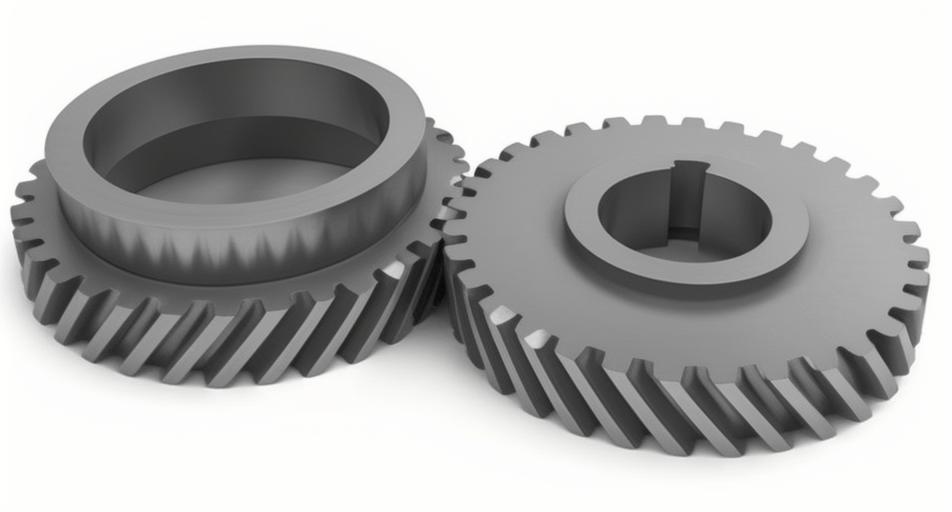
The unique geometry of helical gears, characterized by teeth that are cut at an angle to the axis of rotation, results in a gradual engagement process. This leads to multiple teeth being in contact simultaneously, which enhances load capacity and smoothness. However, this also introduces complexities in analyzing the meshing line, defined as the line of contact between mating teeth during operation. For helical gears, the meshing line is not static; it shifts and changes length cyclically as the gears rotate. Understanding this behavior is crucial for predicting performance metrics such as contact stress, fatigue life, and noise generation. Traditional approaches often simplify helical gears as stacks of infinitesimal spur gears, but this approximation may overlook dynamic effects. Hence, a precise mathematical model is necessary to capture the true nature of helical gear meshing.
To establish a foundation, we begin with the mathematical representation of the tooth surface for helical gears. The tooth flank of a helical gear is typically an involute helicoid, formed by sweeping an involute curve along a helical path. In a coordinate system, the involute curve on the transverse plane can be expressed parametrically. Let \( r_b \) denote the base circle radius, and let \( \sigma \) represent the angular position of the starting point of the involute relative to a reference axis. For any point on the involute, defined by an angle parameter \( u \), the coordinates are given by:
$$ x = r_b \cos(\sigma + u) + r_b u \sin(\sigma + u) $$
$$ y = r_b \sin(\sigma + u) – r_b u \cos(\sigma + u) $$
This describes the involute profile in the transverse section. To generate the three-dimensional helicoidal surface, this curve undergoes a helical motion about the gear axis. Introducing a helical parameter \( \theta \) and the spiral parameter \( p \) (where \( p = p_z / (2\pi) \) and \( p_z \) is the lead), the coordinates of any point on the helicoidal surface become:
$$ x’ = x \cos \theta – y \sin \theta = r_b u \sin(\sigma + u + \theta) + r_b \cos(\sigma + u + \theta) $$
$$ y’ = x \sin \theta + y \cos \theta = r_b \sin(\sigma + u + \theta) – r_b u \cos(\sigma + u + \theta) $$
$$ z’ = p \theta $$
This set of equations fully defines the tooth surface of helical gears, accounting for the helical twist. The parameter \( u \) effectively indicates the position along the involute, while \( \theta \) corresponds to the axial position along the gear width. This model is essential for subsequent analysis of meshing lines.
The meshing line between a pair of helical gears is determined by the contact conditions as they rotate. Conceptually, helical gears can be visualized as a series of thin spur gear slices stacked axially, each slightly rotated relative to its neighbors. During meshing, contact initiates at one end of the tooth and progresses across the face width. In the transverse plane, the meshing process resembles that of spur gears, with contact occurring along the line of action, which is the common tangent to the base circles. However, due to the helix angle, the actual contact in three dimensions is a line that moves and changes length. To quantify this, we consider the gear pair geometry. Let \( r_1 \) and \( r_2 \) be the pitch circle radii of the driving and driven gears, respectively, with \( \alpha \) as the transverse pressure angle. The base circle radii are \( r_{b1} = r_1 \cos \alpha \) and \( r_{b2} = r_2 \cos \alpha \). The line of action in the transverse plane is bounded by points A and B, where the line is tangent to the base circles. The coordinates of these points can be derived from geometric relations.
For a given angular position \( \sigma \) of the driving gear, the contact point on the involute is determined by solving the engagement condition. This involves finding the parameter \( u \) such that the point lies on the line of action. The line of action in the transverse plane is a straight line passing through points A and B. Its equation is:
$$ y = \frac{y_B – y_A}{x_B – x_A} (x – x_A) + y_A $$
Simultaneously, the point must satisfy the involute equations. Thus, for a specific \( \sigma \), we solve:
$$ x = r_b \cos(\sigma + u) + r_b u \sin(\sigma + u) $$
$$ y = r_b \sin(\sigma + u) – r_b u \cos(\sigma + u) $$
$$ y = \frac{y_B – y_A}{x_B – x_A} (x – x_A) + y_A $$
This yields \( u \) as a function of \( \sigma \), denoted \( u(\sigma) \). The contact points along the tooth surface are then obtained by substituting \( u(\sigma) \) and \( \theta \) into the helicoidal surface equations. However, for helical gears, the contact line is not confined to a single transverse slice; it extends across the face width. The total meshing line at any instant is the sum of contact lines from all engaged tooth slices. To compute this, we discretize the gear rotation into small angular steps \( \Delta \sigma \). For each step, we identify which portions of the tooth are in contact.
The meshing process for a single tooth can be divided into phases: entry, full engagement, and exit. Consider a tooth with its leading edge (point C in a reference diagram) entering the meshing zone. Initially, contact starts at the tip of the tooth in one transverse section and propagates as the gear rotates. The contact line length changes continuously. To calculate the total meshing line length \( L_j \) at rotation step \( j \), we aggregate the lengths of all active contact segments. Suppose we have \( N \) contact points along the meshing line, with coordinates \( (x_l, y_l, z_l) \) for \( l = 0, 1, \dots, N \). Then:
$$ L_j = \sum_{l=1}^{N} \sqrt{ (x_l – x_{l-1})^2 + (y_l – y_{l-1})^2 + (z_l – z_{l-1})^2 } $$
This requires determining the coordinates of each contact point, which depends on the tooth geometry and rotation position. The boundary conditions must be enforced: contact only occurs within the active tooth surface, bounded by the start and end of engagement.
A computational algorithm is developed to simulate the meshing over one full rotation of the driving helical gear. The steps are as follows:
- Define gear parameters: module, number of teeth, helix angle, pressure angle, face width, etc.
- Calculate geometric quantities: base radii, pitch radii, addendum radii, and line of action endpoints.
- Discretize the rotation into \( N_N = 360 / \Delta \sigma \) positions.
- For each rotation position \( \sigma_i \), determine the engaged tooth slices based on the axial overlap.
- For each engaged slice, solve for the contact point parameter \( u \) using the line of action equation.
- Compute 3D coordinates of contact points using the helicoidal surface equations.
- Sum the lengths of all contact segments to get \( L_j \).
- Repeat for all rotation positions to obtain the time-varying meshing line length.
This algorithm accounts for the helical nature by considering the axial phase shift between slices. The axial overlap is governed by the helix angle \( \beta \) and face width \( H \). An important parameter is the axial contact ratio \( \epsilon_\beta \), given by:
$$ \epsilon_\beta = \frac{H \sin \beta}{\pi m_n} $$
where \( m_n \) is the normal module. This ratio indicates the average number of tooth slices in contact. When \( \epsilon_\beta \) is an integer, the total meshing line length may become constant, as we will explore later.
To illustrate the application, we perform numerical simulations on a helical gear pair from a vehicle transmission system. The gear parameters are summarized in the table below:
| Gear Pair | Normal Module (mm) | Number of Teeth | Helix Angle (°) | Pressure Angle (°) | Center Distance (mm) | Face Width (mm) |
|---|---|---|---|---|---|---|
| Input Pair (Gear 1 & 2) | 1.65 | 29, 36 | 34 | 14.5 | 65.01 | 11.42 |
| Output Pair (Gear 3 & 4) | 2.25 | 15, 65 | 30 | 20.0 | 103.90 | 26.68 |
Using MATLAB, we implement the algorithm to compute the meshing line position and length over one revolution. The meshing lines for both pairs are visualized in 3D space. For the input helical gears, the face width is less than the axial pitch, resulting in a meshing line that varies significantly. For the output helical gears, the face width exceeds the axial pitch, leading to a more complex contact pattern. The computed meshing line lengths as functions of rotation angle are plotted for various helix angles.
The results reveal that the total meshing line length for helical gears exhibits periodic variation, unlike spur gears where it may be constant if the contact ratio is integer. This periodicity stems from the cyclic engagement of tooth slices. For the input helical gear pair, with helix angles ranging from 16° to 34°, the meshing line length sum oscillates. Notably, at a helix angle of 27°, the length sum becomes constant. This occurs because the axial contact ratio \( \epsilon_\beta \) equals 1 at this angle, as verified by:
$$ \epsilon_\beta = \frac{H \sin \beta}{\pi m_n} = \frac{11.42 \times \sin 27^\circ}{\pi \times 1.65} \approx 1 $$
Similarly, for the output helical gears, constant meshing line length is observed at helix angles where \( \epsilon_\beta \) is integer. For instance, at \( \beta = 15.36^\circ \), \( \epsilon_\beta = 1 \), and at \( \beta = 32^\circ \), \( \epsilon_\beta = 2 \). The general condition for constant meshing line length is:
$$ \beta = \arcsin\left( \frac{\pi m_n \epsilon_\beta}{H} \right), \quad \epsilon_\beta = 1, 2, \dots $$
Typically, \( \epsilon_\beta \) is chosen as 1 or 2 in design to ensure stability. When the helix angle deviates from these specific values, the meshing line length fluctuates, with amplitude increasing with deviation. This fluctuation can excite dynamic responses, hence selecting an appropriate helix angle is crucial for noise and vibration control.
To quantify the average behavior, we compute the mean meshing line length over one cycle using:
$$ L_{\text{ave}} = \frac{\sum_{k=1}^{N_k} L_k}{N_k} $$
where \( N_k \) is the number of rotation steps per period. For the simulated gear pairs, the average lengths are:
| Gear Pair | Average Meshing Line Length (mm) |
|---|---|
| Input Helical Gears | 10.57 |
| Output Helical Gears | 30.13 |
These values provide insights into the overall contact characteristics. The longer average length for the output helical gears correlates with their larger face width and higher load capacity.
The influence of helix angle on meshing line length is further analyzed through parametric studies. By varying \( \beta \) while keeping other parameters fixed, we observe the effect on the amplitude and frequency of length variation. The following table summarizes key trends for a generic helical gear pair with normal module 2 mm, 20 teeth, face width 20 mm, and pressure angle 20°:
| Helix Angle (°) | Axial Contact Ratio \( \epsilon_\beta \) | Meshing Line Length Variation | Amplitude of Fluctuation (mm) |
|---|---|---|---|
| 10 | 0.55 | High fluctuation | ~2.5 |
| 20 | 1.09 | Moderate fluctuation | ~1.8 |
| 30 | 1.60 | Low fluctuation | ~1.0 |
| 45 | 2.25 | Very low fluctuation | ~0.5 |
As the helix angle increases, the axial contact ratio rises, leading to smoother engagement and reduced fluctuation in meshing line length. However, very high helix angles may induce axial thrust forces, so a balance must be struck. The numerical simulation allows designers to optimize helix angle for minimal vibration while meeting strength requirements.
Moreover, the position of the meshing line shifts along the face width during rotation. This lateral movement affects load distribution and may cause edge loading if not properly accounted for. The simulation outputs the coordinates of meshing points, enabling analysis of stress concentrations. For instance, at a given rotation angle, the meshing line might be skewed towards one end of the tooth, potentially increasing wear. By adjusting micro-geometry modifications such as tip relief or lead crowning, these effects can be mitigated. The proposed method provides a tool for evaluating such modifications virtually.
In practical applications, helical gears are often used in high-speed transmissions where dynamic effects are pronounced. The time-varying meshing line length directly correlates with time-varying mesh stiffness, a major excitation source for gear vibrations. The mesh stiffness \( k_m \) can be approximated as proportional to the total contact length \( L \), i.e., \( k_m \approx C \cdot L \), where \( C \) is a constant depending on material and geometry. Thus, the fluctuation in \( L \) induces fluctuation in \( k_m \), leading to parametric excitation. This can be modeled by a differential equation of motion:
$$ I \ddot{\theta} + c \dot{\theta} + k_m(t) \theta = T(t) $$
where \( I \) is inertia, \( c \) damping, \( \theta \) angular displacement, and \( T \) torque. By integrating the meshing line length data from our simulation into such dynamic models, more accurate predictions of vibration responses can be achieved.
Another aspect is the impact on noise generation. Gear noise is often tonal, related to the meshing frequency and its harmonics. The varying meshing line length modulates the contact forces, generating sidebands in the frequency spectrum. Simulations show that helical gears with constant meshing line length (i.e., integer axial contact ratio) produce purer tones, while those with varying length exhibit broader spectra, which might be perceived as quieter due to less pronounced peaks. However, this depends on the application; for example, in electric vehicles, gear whine is a critical issue, and optimizing helix angle to minimize length variation can be beneficial.
The methodology presented here is not limited to standard helical gears; it can be extended to double-helical gears or gears with modified tooth profiles. For double-helical gears, which have two opposite helix angles to cancel axial thrust, the meshing lines from both helices interact, requiring superposition in the simulation. Additionally, manufacturing errors such as lead deviations or misalignments can be incorporated by perturbing the tooth surface equations. This enhances the robustness of the analysis for real-world conditions.
In conclusion, this article has detailed a numerical approach for simulating the meshing line position and length of helical gears. The mathematical model based on involute helicoids accurately captures the tooth geometry, and the algorithm computes time-varying meshing characteristics efficiently. Key findings indicate that helical gears exhibit periodic variation in meshing line length, unlike spur gears, and that specific helix angles yielding integer axial contact ratios result in constant length, promoting stability. The case study of a vehicle transmission helical gear pair demonstrated practical applications, with average meshing line lengths provided for reference. The influence of helix angle was quantified, showing that higher angles reduce fluctuation but may increase axial forces. These insights aid in the design of helical gears for improved performance, reduced vibration, and lower noise. Future work could integrate this simulation with finite element analysis for stress evaluation or with acoustic models for noise prediction, further advancing the optimization of helical gear systems.