
The pursuit of high-performance power transmission in demanding sectors such as aerospace and marine engineering places stringent requirements on vibration and noise control. In these critical applications, excessive vibration not only leads to discomfort but can also precipitate catastrophic failures like fatigue fractures, directly jeopardizing operational safety. Among the various solutions, gear tooth modification stands out as a particularly effective technique for mitigating dynamic excitations at their source. While traditional profile and lead crowning modifications have been widely studied and applied, a more specialized technique known as diagonal modification for helical gears offers unique advantages, especially for noise reduction. This article details a comprehensive methodology I have developed for the optimal design of diagonally modified helical gears, aiming to minimize key dynamic excitations and achieve superior acoustic performance.
Helical gears are favored for their smooth and quiet operation due to the gradual engagement of their teeth along the helix. This results in higher contact ratios compared to spur gears. However, under load, teeth deflect, causing deviations from ideal conjugate motion. These deviations manifest as transmission error—a primary source of vibration. Furthermore, at the moment of initial tooth contact (mesh-in), a sudden velocity difference can occur between the incoming and resident tooth surfaces, leading to impact forces that further excite the system. My approach focuses on designing a tooth surface that compensates for these loaded deformations and minimizes mesh-in impact, thereby reducing the overall vibration and noise.
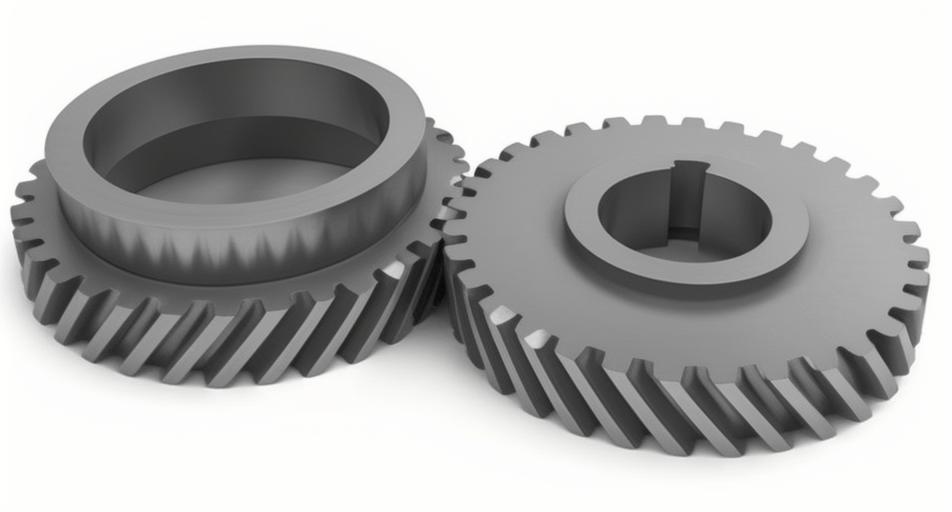
The core innovation lies in the construction of the modified tooth surface. Unlike conventional methods, diagonal modification specifically targets the entry and exit regions of the tooth contact, while largely preserving the central portion. The modified flank is represented as the superposition of the theoretical involute surface and a deviation surface. This deviation surface is meticulously defined. First, the tooth is mapped onto a rotational projection plane defined by coordinates (x, y), where:
$$ x = \sqrt{R_x^2 + R_y^2}, \quad y = R_z $$
Here, \(R_x, R_y, R_z\) are the coordinate components of the position vector of the theoretical tooth surface. This plane is then discretized into an m x n grid. The deviation (modification amount) at each grid node \(\delta’_{ij}(x, y)\) is calculated based on a prescribed modification curve. The fundamental principle is to apply modification primarily at the diagonally opposite corners of the tooth flank corresponding to mesh-in and mesh-out zones. The modification amount increases from the boundary of the unmodified central region towards the tooth edges, typically following a parabolic function to ensure a smooth transition. For a point M in the modification zone, its modification can be described as:
$$
\delta'(x, y) =
\begin{cases}
y_1 (l_M / l_{pm})^2 & \text{for } y \leq -0.5y_2 \\
y_3 (l_M / l_{qn})^2 & \text{for } y \geq 0.5y_2 \\
0 & \text{for } |y| < 0.5y_2
\end{cases}
$$
where \(y_1\) and \(y_3\) are the maximum modification depths at the two ends, \(y_2\) is the length of the unmodified central region, \(l_M\) is the distance from point M to the boundary of the unmodified zone, and \(l_{pm}, l_{qn}\) are the maximum distances within the modification zones. The final, smooth deviation surface \(\delta(u_1, l_1)\) is generated by fitting a bi-cubic B-spline surface to these grid node values. The complete modified flank is then constructed as:
$$ \mathbf{R}_{1r}(u_1, l_1) = \delta(u_1, l_1) \mathbf{n}_1(u_1, l_1) + \mathbf{R}_1(u_1, l_1) $$
with the surface normal \(\mathbf{N}_{1r}\) derived accordingly. This representation allows for precise control over the flank geometry, which is essential for advanced contact analysis.
To predict the dynamic behavior, a two-stage simulation process is employed: unloaded Tooth Contact Analysis (TCA) and Loaded Tooth Contact Analysis (LTCA). TCA simulates the kinematic meshing of the gear pair, identifying the contact path and unloaded transmission error (TE). LTCA is then performed to compute the contact pressure distribution, tooth deformations, and the resulting loaded transmission error (LTE) under operational torque. From the LTCA results, the crucial time-varying mesh stiffness \(K(t)\) is calculated as the ratio of the applied normal load to the total deflection at each meshing position. Additionally, the mesh-in impact force \(F_s\) is determined using impact theory:
$$ F_s = v_s \sqrt{\frac{b J_1 J_2}{(J_1 r’^{2}_{b2} + J_2 r’^{2}_{b1}) q_s}} $$
where \(v_s\) is the impact velocity at the mesh-in point determined from TCA, \(J_1, J_2\) are the moments of inertia, \(r’_{b1}, r’_{b2}\) are the instantaneous base circle radii, \(b\) is the face width, and \(q_s\) is the local contact compliance at the impact point.
With the excitation sources quantified, a single-degree-of-freedom torsional dynamic model of the gear pair is established. The equation of motion along the line of action is:
$$ m\ddot{x} + C\dot{x} + K(t)x = F_s(t) $$
Here, \(m\) is the equivalent mass, \(C\) is the damping coefficient (assumed constant), \(x\) is the dynamic transmission error, and \(F_s(t)\) models the impulsive mesh-in excitation. The dynamic response is solved to obtain the vibration acceleration. A key metric for noise, which is closely correlated with circumferential vibration, is the root-mean-square (RMS) of the vibration acceleration over one mesh cycle:
$$ a_v = \sqrt{ \frac{1}{n} \sum_{k=1}^{n} \ddot{x}_k^2 } $$
The optimization problem is formulated to find the best modification parameters that minimize the dynamic excitations. The design variables are the modification parameters \(\mathbf{y} = [y_1, y_2, y_3]^T\), representing the two maximum modification amounts and the length of the unmodified zone. The multi-objective function combines three key metrics:
$$ G(\mathbf{y}) = \min \left\{ w_1 \frac{\Delta LTE}{\Delta LTE_0} + w_2 \frac{F_s}{F_{s0}} + w_3 \frac{a_v}{a_{v0}} \right\} $$
subject to:
$$ Q_{min} \leq y_1, y_3 \leq Q_{max} $$
$$ l_{min} \leq y_2 \leq l_{max} $$
where \(\Delta LTE\) is the peak-to-peak amplitude of the loaded transmission error, \(F_s\) is the mesh-in impact force, and \(a_v\) is the vibration acceleration RMS. The subscript ‘0’ denotes the value for the unmodified gear pair. The weights \(w_i\) assign relative importance to each objective; based on the significance of internal excitations, values of \(w_1=0.2\), \(w_2=0.2\), and \(w_3=0.6\) are used, emphasizing vibration reduction. This optimization problem, involving continuous variables and a non-linear response, is effectively solved using a Genetic Algorithm (GA). The GA searches the design space by evolving a population of candidate solutions (modification parameter sets) through selection, crossover, and mutation, guided by the fitness function \(G(\mathbf{y})\).
| Parameter | Pinion | Gear |
|---|---|---|
| Number of Teeth | 19 | 47 |
| Normal Module (mm) | 6 | |
| Pressure Angle (°) | 20 | |
| Helix Angle (°) | 9.91 | |
| Face Width (mm) | 75 | |
A practical case study demonstrates the effectiveness of this approach. The helical gear pair with parameters listed in Table 1 is analyzed. The gear is subjected to a nominal load torque of 800 Nm, with the pinion rotating at 2500 RPM. For comparison, optimal profile modification and optimal diagonal modification are designed. The GA converged to the optimal modification parameters shown in Table 2. The performance outcomes are summarized in Table 3.
| Modification Type | Variable y1 (µm) | Variable y2 (mm) | Variable y3 (µm) |
|---|---|---|---|
| Diagonal Modification | 15 | 63.8 | 13 |
| Profile Modification* | 12 (tip) | 12 (root) | 2 / 2 (lengths) |
| Condition | ΔLTE (arc-sec) | Mesh-in Force Fs (N) | Accel. RMS av (m/s²) |
|---|---|---|---|
| Unmodified | 0.98 | 2721 | 94.74 |
| Optimal Profile Mod. | 0.63 (-36%) | 517 (-80%) | 25.56 (-73%) |
| Optimal Diagonal Mod. | 0.52 (-47%) | 28 (-97%) | 15.32 (-84%) |
The results are striking. The optimally designed diagonal modification outperforms traditional profile modification across all metrics. It achieves a 47% reduction in loaded transmission error fluctuation, a drastic 97% reduction in mesh-in impact force, and an 84% reduction in vibration acceleration RMS. The reason for this superior performance is rooted in the contact mechanics. TCA of the diagonally modified gears shows that the unloaded contact pattern shifts, potentially leading to edge contact at the tooth corners, which indicates a kinematically less smooth motion under no load. However, under operational load, this designed geometry proves highly beneficial. The LTCA results reveal that the loaded contact pattern is beautifully concentrated in the central region of the tooth flank. The highly modified entry and exit zones essentially carry negligible load, thereby preventing edge-loading and the associated high-stress concentrations. This ensures that the effective contact length remains long, preserving a high degree of contact ratio even under deformation, which is a key advantage of diagonal modification over aggressive profile relief.
The significant reduction in mesh-in impact force \(F_s\) is directly linked to the altered initial contact point and the locally reduced compliance (\(q_s\)) due to the pre-corrected surface. The combined effect of a smoother LTE and a vastly diminished impact force leads to a much lower dynamic excitation, which is reflected in the dramatically reduced vibration acceleration. Analyzing the frequency response, the diagonal modification does not eliminate resonance peaks—such as the primary torsional resonance around 6000 RPM and secondary resonances—but it substantially reduces their amplitude. Notably, a resonance peak induced by the mesh-in impact, visible in the unmodified gear’s response, is almost entirely suppressed in the diagonally modified gear’s response.
In conclusion, the methodology presented here provides a robust and effective framework for the optimal design of low-noise helical gears through diagonal modification. By integrating precise geometric modeling via B-spline surfaces, advanced loaded contact analysis (LTCA) for stiffness and impact force calculation, and dynamic simulation within a Genetic Algorithm-based optimization loop, a holistic solution is achieved. The key findings underscore that diagonal modification for helical gears is not merely a cosmetic adjustment but a targeted strategy to reshape the loaded contact pattern. It strategically unloads the sensitive entry and exit regions of the tooth flank, thereby simultaneously minimizing transmission error variation, virtually eliminating mesh-in impact, and significantly reducing overall vibration and noise. This makes it a particularly potent technique for high-speed, high-load applications where acoustic performance and reliability are paramount, offering a clear advantage over conventional profile modification techniques for helical gears.