
The global automotive industry’s relentless pursuit of efficiency, precision, and cost-effectiveness has fundamentally transformed manufacturing paradigms, particularly in the production of critical components like transmission gears. Among these, helical gears are ubiquitous due to their superior smoothness and load-bearing characteristics compared to spur gears. The machining of these helical gears, especially the turning operations (or “车序”), represents a critical bottleneck where automation is no longer a luxury but a necessity. While automated single-machine cells and lines for turning such helical gears are mature technologies abroad, domestic reliance on imports has been significant. This dependency highlights a technological gap and a substantial market opportunity. The shift from traditional, manual machining methods towards highly automated, flexible, and precise manufacturing cells is an irreversible trend driven by the need for higher throughput, consistent quality, and reduced operational costs. This article, from the perspective of a developer deeply involved in this technological frontier, details the innovative design and implementation of a side-mounted, single-machine automated cell specifically engineered for turning automotive transmission helical gears.
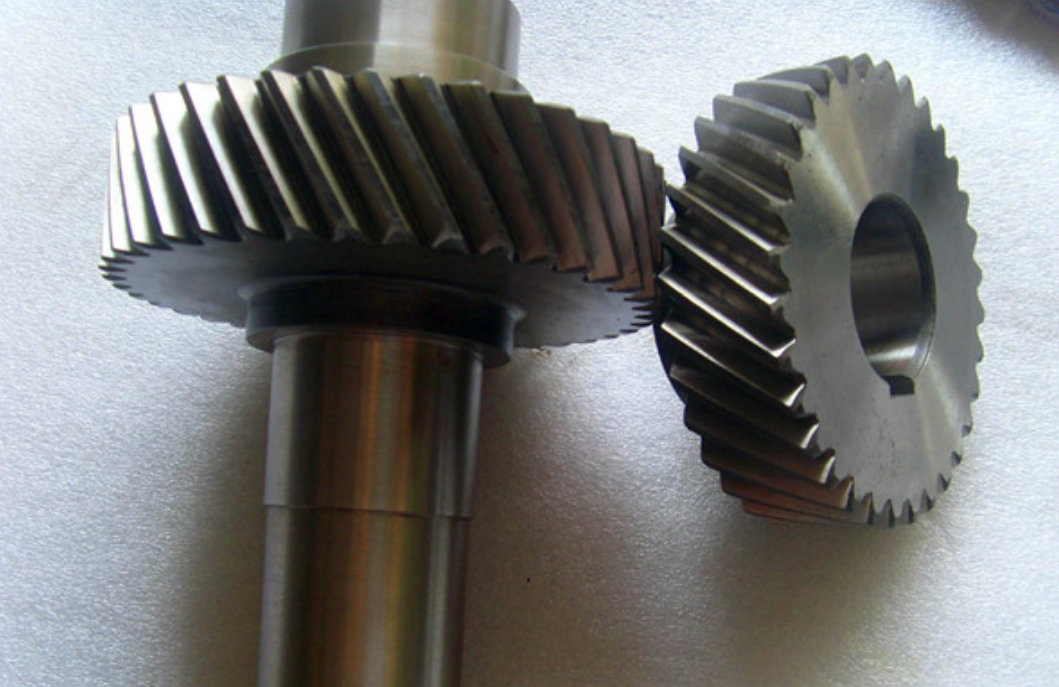
The primary challenge in automating the turning process for helical gears on vertical CNC lathes (VTC) stems from their inherent structure. Vertical lathes, with their tall column and spindle assembly, create a significant vertical profile. Traditional gantry-style robotic systems that traverse over the top of such machines require massive, floor-mounted columns and long cross-beams to clear the machine’s height. This configuration inevitably leads to compromises: reduced structural rigidity of the gantry due to the long span, increased floor space consumption, and complex, constrained maintenance access around the machine tool itself. To bridge the technological gap with international competitors and enhance the global competitiveness of domestic manufacturing equipment, our focus was to develop a novel automation solution that circumvents these limitations entirely. The resulting “side-hung” single-machine automated line embodies a new layout philosophy, addressing rigidity, footprint, and operational efficiency directly.
System Architecture and Workflow of the Side-Hung Automated Cell
The core innovation lies in the overall layout. Instead of an overhead gantry, the system employs a swing-arm robot mounted on a dedicated structure attached to the side of a high-performance vertical CNC lathe. The complete cell is an integrated system comprising several key modules:
- Full-Function CNC Vertical Turning Center (VTC): The primary machining unit responsible for all turning operations—external diameter, internal bore, face, and chamfers—on the helical gear blanks.
- Swing-Arm Robot with Dual Grippers: The material handling heart of the cell, mounted on a side column.
- Angular Phase Positioning Mechanism: A critical station that ensures each helical gear blank is presented to the lathe chuck at a consistent rotational orientation, crucial for subsequent machining and gear cutting operations.
- Part Mismatch Prevention Mechanism: An inspection station that verifies the correct part type and orientation before the blank enters the machining cycle.
- Loading/Unloading Magazine: A chain-type or pallet-based system for storing raw blanks and finished parts.
- Inspection & Scrap Disposal Unit: A combined station for placing parts for periodic quality checks and for discarding misidentified or faulty blanks.
- Integrated Control Cabinet & Perimeter Guarding: Provides centralized control and safety.
The operational workflow is a continuous, automated loop designed for minimal idle time:
- A raw helical gear blank is transported from the loading magazine to the Part Mismatch Prevention station. If the part is incorrect or misoriented, the robot is instructed to discard it directly to the scrap position.
- If verified, the robot transfers the correct blank to the Angular Phase Positioning station. Here, a pin engages with the gear’s teeth to rotate it to a precise, repeatable angular position.
- The robot, using one gripper, picks the now-oriented blank and moves to the VTC. The machine door opens, the robot inserts the blank into the lathe chuck, releases it, and retracts.
- The machine door closes, and the turning cycle begins. Simultaneously, the robot flips its arm.
- Upon completion, the VTC door opens. The robot, now with its second gripper positioned over the chuck, extracts the finished helical gear.
- The robot flips again, placing the finished part either into the unloading magazine or onto the inspection station, while its other gripper picks a new, oriented blank from the phase positioning station.
- The cycle repeats. This parallel processing—swapping a finished part for a new blank in one engagement—is key to maximizing efficiency.
Comparative Analysis and Innovative Breakthroughs
The superiority of this side-hung configuration becomes evident when compared to established international solutions, such as those employing dual-spindle vertical lathes with overhead or front-mounted gantries. The following table summarizes the critical differentiators:
| Feature | Conventional Dual-Spindle Cell with Front Gantry | Proposed Side-Hung Single-Spindle Cell |
|---|---|---|
| Lathe Configuration | Dual Spindle, Single Turret | Single Spindle, Single Turret |
| Robot Mounting | Gantry spanning in front of spindles | Swing-arm mounted on side column |
| Robot Grippers | Typically Single | Dual |
| Footprint & Rigidity | Large floor space, longer gantry beam prone to deflection | Compact, short side-beam offers high rigidity |
| Maintenance Access | Restricted around lathe due to gantry structure | Unobstructed access to lathe from front and other sides |
| Part Handling Flow | Sequential load/unload per spindle, or complex parallel routing | Parallel load/unload in single robot move (via dual grippers) |
The innovative aspects can be quantified and described in detail:
1. Dual-Gripper Swing-Arm Robot for Parallel Processing
Traditional single-gripper systems on dual-spindle machines often lead to inherent waiting periods. For instance, in a dual-spindle setup with one gripper, the sequence involves: machining in one spindle while unloading/loading the other. The turret must then move between spindles, and a protective partition must cycle, creating non-productive time segments.
Our dual-gripper design eliminates this systemic idle time. The robot’s flip action allows it to always carry both a finished part and a new blank. The exchange at the machine tool becomes a simultaneous swap. The theoretical efficiency gain can be modeled by comparing cycle times. Let the pure machining time for one helical gear be $t_m$. Let the raw material handling time (pick, phase, place) be $t_h$ and the finished part handling time (unload, deposit) be $t_h’$. For a single-gripper system on a single spindle, the total cycle time $T_{single}$ is approximately:
$$T_{single} = t_m + t_h + t_h’$$
For our dual-gripper system, because $t_h$ and $t_h’$ are performed in parallel with each other and largely in parallel with $t_m$, the effective non-machining overhead is drastically reduced. The total cycle time $T_{dual}$ approaches:
$$T_{dual} \approx t_m + \max(t_h, t_h’)$$
This represents a significant reduction in the overall takt time, pushing the cell’s productivity closer to the theoretical limit defined solely by the cutting process of the helical gears.
2. Side-Mounted Rigid Column Structure
Mounting the robot’s beam on a dedicated column attached to the side of the VTC bed is a foundational innovation. This “π-shaped” and “U-shaped” column assembly provides an exceptionally stiff platform for the robot. Since the beam only needs to span the distance from this side column to the spindle centerline, it is remarkably short compared to a front gantry that must clear the entire machine width. Bending deflection $\delta$ of a beam under a cantilever load is proportional to the cube of its length $L$:
$$\delta \propto \frac{PL^3}{3EI}$$
where $P$ is the load, $E$ is the modulus of elasticity, and $I$ is the area moment of inertia. Halving the beam length reduces potential deflection by a factor of eight. This enhanced rigidity translates directly into more precise robot positioning, higher reliability, and the ability to handle heavier helical gear blanks consistently. Furthermore, this layout frees up all other sides of the VTC for unimpeded operator access, tool changing, and maintenance.
3. Integrated Auxiliary Systems for Robust Operation
The design of peripheral stations further optimizes the flow and reliability for machining helical gears.
- Angular Phase Positioning: Mounted directly on the rigid side-column structure, this mechanism ensures high accuracy and repeatability. A pneumatically actuated pin engages with the teeth of the helical gear blank. The robot arm presents the gear axially, the pin tangentially engages, the gear rotates to a hard stop, and the robot’s gripper clamps to lock this orientation before insertion into the lathe chuck. This guarantees that every helical gear is machined with consistent angular registration.
- Part Mismatch Prevention: Integrated into the loading magazine path, this system uses optical sensors to check the blank’s profile before the robot even grips it. If a wrong part or incorrect orientation is detected, the robot bypasses the main cycle and directly deposits the part into the scrap bin. This prevents machine crashes and maximizes productive uptime.
- Combined Inspection & Scrap Unit: Housing both the periodic quality check position and the scrap drop-off in a single, compact unit minimizes the robot’s required travel range, contributing to a faster cycle time and a smaller cell footprint.
Technical Implications and Formulaic Representation of Gear Machining Parameters
While the automation cell handles the workflow, the VTC’s performance in machining the helical gears is paramount. The turning operations must achieve precise tolerances on diameter, concentricity, and surface finish to ensure proper function in the transmission. Key machining parameters can be defined. For example, the material removal rate (MRR) during facing or turning of the gear blank is a critical metric for productivity:
$$MRR = v_c \cdot f \cdot a_p$$
where $v_c$ is the cutting speed (m/min), $f$ is the feed rate (mm/rev), and $a_p$ is the depth of cut (mm). The automation cell enables aggressive optimization of these parameters by ensuring consistent loading/clamping, which improves process stability.
The relationship for cutting power $P_c$ (kW) is also relevant for machine selection:
$$P_c = \frac{MRR \cdot k_c}{60 \times 10^6}$$
where $k_c$ is the specific cutting force (N/mm²) for the workpiece material. The robust construction of both the VTC and the side-hung automation allows the cell to sustain the high dynamic forces involved in efficient machining of tough alloy steels used for helical gears.
Conclusion and Strategic Impact
The development and successful deployment of this side-hung single-machine automated cell represent a significant leap forward in domestic manufacturing technology for automotive components. By rethinking the fundamental layout of automation integration with vertical turning centers, the solution overcomes the traditional drawbacks of rigidity, space, and accessibility. The synergistic use of a dual-gripper swing-arm robot, a rigid side-column mount, and intelligently integrated auxiliary stations creates a system where the non-productive time is minimized, and operational robustness is maximized.
This innovation provides a compelling, high-productivity alternative to imported systems for the turning of automotive transmission helical gears. It empowers manufacturers to adopt advanced automation without compromising on machine tool performance or shop floor logistics. The reduction in dependency on foreign technology, coupled with the tangible gains in efficiency and quality consistency, delivers substantial economic benefits and strengthens the competitive position of the automotive supply chain. The architectural principles demonstrated here—focusing on parallel processing, structural rigidity, and compact integration—have broad applicability, signaling a promising direction for the future of flexible, precision manufacturing cells across the industry.