
During the development of a twin-countershaft transmission, a significant challenge arose concerning the assembly of a welded intermediate shaft sub-assembly. This sub-assembly featured two helical gears press-fitted and subsequently welded onto a shaft. The technical drawing mandated a precise circumferential alignment, or phasing, between the zero-reference teeth of the two helical gears at a fixed axial location post-welding. The established production sequence—machining gears pre-heat-treatment, heat treatment, post-heat-treatment grinding, gear grinding, press-fitting, and finally welding—placed the entire burden of achieving final positional accuracy on the press-fitting alignment and the control/compensation of welding distortion. This proved to be a critical bottleneck in the prototype phase. This article details the first-person perspective on the process developed to overcome this challenge and guarantee the positional accuracy of the dual helical gears.
The core issue was the interference fit between the components. The bore of the deceleration gear (a disk-type gear) was specified at Φ(58.5±0.012) mm, while the mating shaft diameter was Φ58.5 mm, resulting in an interference fit of +0.027 to +0.062 mm. Achieving the necessary rotational alignment during a conventional press-fit was impossible. Therefore, we adopted a hot-assembly process followed by welding. The deceleration gear was heated to approximately 200°C to induce thermal expansion of its bore, allowing it to be assembled onto the shaft in a free state, facilitating the required rotational alignment. The thermal expansion \( \Delta d \) was calculated using the formula:
$$ \Delta d = \alpha \cdot d_0 \cdot \Delta T $$
Where:
\( \alpha \) is the coefficient of linear thermal expansion for the gear material (~11 x 10⁻⁶ /°C),
\( d_0 \) is the nominal bore diameter (58.5 mm),
\( \Delta T \) is the temperature change (assumed 180°C from 20°C to 200°C).
$$ \Delta d \approx (11 \times 10^{-6}) \times 58.5 \times 180 \approx 0.1158 \text{ mm} $$
This calculated expansion of ~0.116 mm was significantly greater than the maximum interference of 0.062 mm, confirming the feasibility of the 200°C hot-assembly method. The key was to perform the circumferential alignment *during* this hot state and then hold it precisely for welding, for which a dedicated fixture was essential.
Design of the Specialized Positioning Fixture
The fixture was the cornerstone of the solution, designed to locate both the shaft and the hot gear accurately and allow for precise circumferential indexing of the two helical gears relative to each other.
Workpiece Location Principles
For the Intermediate Shaft: The primary locating datum was the shaft’s reference outer diameter and its shoulder face. The fixture employed a “one surface, one hole” principle to restrict five degrees of freedom. A conical pin was used to restrict rotation (the Z-axis rotation) around the shaft’s axis by engaging a gear tooth space.
For the Deceleration Helical Gear: Its locating datums were its finished bore and a face. These were aligned with the shaft’s mating diameter and shoulder in the fixture, again restricting five degrees of freedom. A second conical pin was used to restrict its rotation by engaging its tooth space.
Setting Initial Reference Points
To expedite assembly, especially critical as the heated gear would cool quickly, the fixture incorporated initial rough positioning pins. These pins allowed the operator to place the shaft and gear into an approximate aligned position. Once roughly positioned, these pins were retracted, and the final, precise alignment was achieved using the main conical locating pins.
Design of the Gear Indexing Mechanism
The heart of the fixture was the pair of spring-loaded (for the shaft gear) and pneumatically-actuated (for the hot deceleration gear) conical pins that engaged the tooth spaces of the helical gears.
1. Determining the Locating Pin Cone Angle (β)
The cone angle of the pin must correspond to the pressure angle at the chosen point of contact within the gear tooth space to ensure proper, self-centering engagement.
For the Standard Deceleration Helical Gear:
Parameters: Number of teeth \( Z = 43 \), Normal module \( m_n \approx 3.698 \), Normal pressure angle \( \alpha_n = 18^\circ 30′ \), Helix angle \( \beta \approx 14^\circ 18′ \).
The contact point P was chosen at the pitch circle for simplicity.
– Pitch Diameter: \( d_0 = m_n \cdot Z / \cos(\beta) \approx 165.97 \text{ mm} \).
– Angular tooth spacing: \( \theta = 360^\circ / Z \approx 8.372^\circ \).
– Chordal tooth space width at pitch diameter \( B_p \): \( B_p \approx d_0 \cdot \sin(\theta/2) \times 2 \). A more precise calculation considers the base circle, but for fixture design, this approximation was sufficient for pin tip diameter. The key was the pressure angle.
The pin cone angle \( \beta_{pin} \) was chosen equal to the normal pressure angle at the pitch circle: \( \beta_{pin} \approx \alpha_n = 18.5^\circ \) (rounded to 20° for manufacturability).
For the Modified Intermediate Shaft Helical Gear:
This gear had profile shift. Choosing the pitch circle for contact was less practical. The contact point P was instead chosen on a Φ70 mm circle, closer to the mid-height of the tooth for better visibility and torque resistance.
– First, the transverse parameters were calculated:
Transverse module: \( m_t = m_n / \cos(\beta) \).
Transverse pressure angle: \( \alpha_t = \arctan(\tan(\alpha_n) / \cos(\beta)) \).
– The spiral angle \( \beta_p \) at radius \( r_p = 35 \text{ mm} \) was found from the lead \( T \):
Lead: \( T = \pi \cdot d_0 \cdot \cot(\beta) \).
\( \beta_p = \arctan(2\pi \cdot r_p / T) \approx 15.37^\circ \).
– The transverse pressure angle \( \alpha_{pt} \) at radius \( r_p \) was derived from the involute geometry.
– The effective normal pressure angle \( \alpha_{pn} \) at point P is given by:
$$ \tan(\alpha_{pn}) = \tan(\alpha_{pt}) \cdot \cos(\beta_p) $$
A CAD model was used to accurately determine the chordal space width \( B_p \approx 7.02 \text{ mm} \) at this point and the corresponding pressure angle, which yielded a required pin cone angle \( \beta_{pin\_shaft} \approx 28.93^\circ \), rounded to 30°.
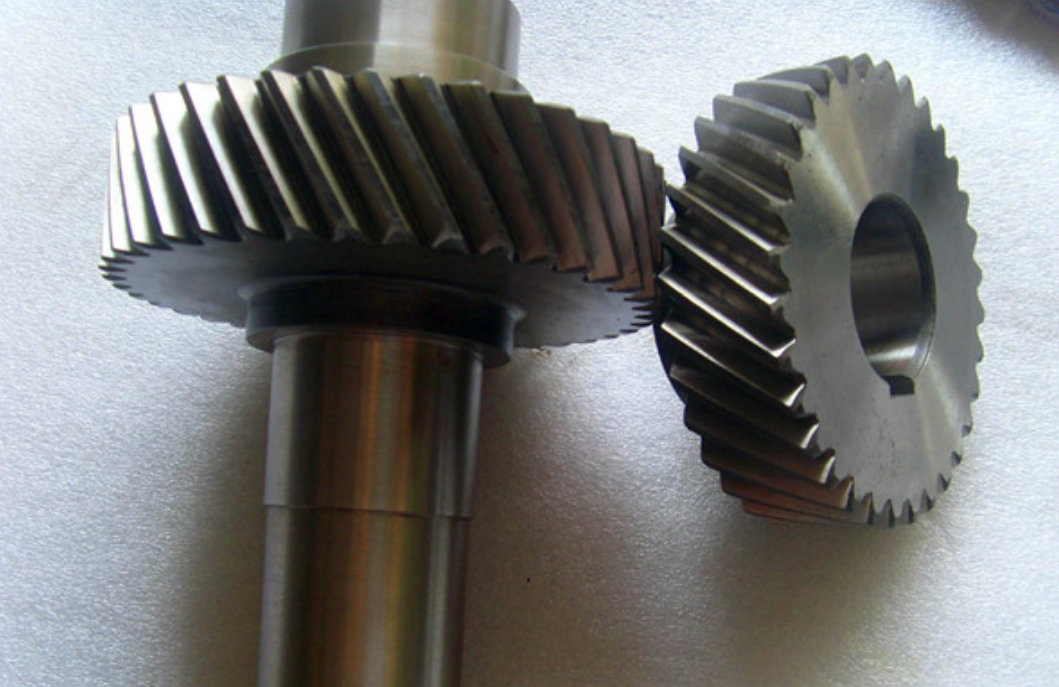
2. Calculating Axial Force for the Locating Pins
The spring (for shaft gear) and pneumatic cylinder (for deceleration gear) had to provide sufficient axial force \( F_t \) on the conical pin to overcome the frictional torque from the component’s weight and ensure positive indexing. The force analysis for a conical pin engaging a gear tooth is as follows:
$$ M_f = W \cdot \mu \cdot \frac{D}{2} $$
Where \( M_f \) is the frictional torque, \( W \) is weight, \( \mu \) is the coefficient of friction (~0.12), \( D \) is the diameter of the contacting surface.
The tangential force \( F_1 \) needed at the contact radius \( r \) to overcome this torque is:
$$ F_1 = \frac{M_f}{r} $$
From the force diagram, the relationship between the axial force \( F_t \) and the normal force \( F_n \) on the pin flank is:
$$ F_n = \frac{F_1}{\cos(\lambda)} $$
$$ F_t = \frac{F_n}{\sin(\beta_{pin})} = \frac{F_1}{\cos(\lambda) \cdot \sin(\beta_{pin})} $$
Where \( \lambda = \beta_{pin} – \gamma \), and \( \gamma = \arcsin(B_p / (2r)) \) is half the angle subtended by the pin tip width \( B_p \) at the contact radius \( r \).
This calculation was performed for both the tip and the designed contact point P for each gear, and the larger required \( F_t \) was used for sizing the actuators. For the shaft gear, the required spring force was approximately 7.2 N. For the hot deceleration gear, the pneumatic force needed was about 4.8 N.
3. Spring Design for the Shaft Gear Locator
Based on the force requirement \( F_t \approx 7.2 \text{ N} \) and a required stroke, a helical compression spring was designed. Key parameters were calculated using standard spring formulas:
Shear stress: $$ \tau = K \frac{8 F D_m}{\pi d^3} $$
Spring rate: $$ k = \frac{G d^4}{8 n D_m^3} $$
Where \( K \) is the Wahl correction factor, \( F \) is the force, \( D_m \) is the mean coil diameter, \( d \) is the wire diameter, \( G \) is the modulus of rigidity, and \( n \) is the number of active coils.
After iterations for practicality and to avoid solid height, the final specification was: Carbon steel wire, \( d = 2.0 \text{ mm} \), \( D_m = 34 \text{ mm} \), active coils \( n = 9 \), free length \( H_0 = 79.5 \text{ mm} \), spring rate \( k \approx 0.45 \text{ N/mm} \).
4. Micro-Adjustment for Welding Distortion Compensation
Recognizing that the welding process itself would induce a predictable, repeatable angular shift between the components, the fixture’s upper body, which held the primary locating elements, was made adjustable relative to the fixed lower body mounted to the worktable. By loosening connecting bolts, the upper plate could be rotated a minute amount. This allowed us to pre-offset the alignment during the hot assembly phase to compensate for the expected welding shift, ensuring the final post-weld alignment was correct.
Process Validation and Welding Distortion Compensation
The developed hot-assembly and welding process, aided by the custom fixture, underwent rigorous validation.
Fixture Calibration
Using a trial part with a transitional fit, the two helical gears were aligned in the fixture. Their phase relationship was then measured on a gear measurement machine. The micro-adjustment mechanism on the fixture was then used to iteratively correct any deviation until the alignment met the specification. The fixture was then locked in this compensated position.
Hot-Assembly Verification
Four prototype parts were heated to 200°C. Measurements confirmed bore expansion between +0.08 mm and +0.10 mm, ample for assembly. The hot assembly, indexing, and clamping sequence using the fixture proved to be feasible and operator-friendly within the short cooling window.
Quantifying and Compensating for Welding Displacement
The first batch of four assembled (but not yet welded) units was measured for gear phasing. They were then welded using the MIG circumferential process and measured again. The data revealed a consistent and predictable pattern: the welding process caused the deceleration gear to shift clockwise relative to the shaft gear by a certain amount.
| Part ID | Phase Before Welding (mm) | Phase After Welding (mm) | Welding Displacement (mm) |
|---|---|---|---|
| Sample 1 | -0.00523 | +0.03531 | +0.04054 |
| Sample 2 | +0.03228 | +0.08011 | +0.04783 |
| Sample 3 | +0.02236 | +0.05857 | +0.03621 |
| Sample 4 | -0.03471 | -0.00215 | +0.03256 |
Armed with this data, a second batch of six units was assembled. This time, during hot assembly in the fixture, the alignment was intentionally pre-offset in the *opposite* (counter-clockwise) direction by an amount equal to the average measured welding displacement. After welding, all six parts were measured and found to be within the final product specification.
| Part ID | Phase Before Welding (mm) (With Pre-offset) | Phase After Welding (mm) | Final Result vs. Spec |
|---|---|---|---|
| Sample 5 | -0.04420 | +0.00389 | Conforms |
| Sample 6 | -0.03304 | +0.02583 | Conforms |
| Sample 7 | -0.01082 | +0.02803 | Conforms |
| Sample 8 | -0.04400 | -0.01785 | Conforms |
| Sample 9 | +0.01396 | +0.05007 | Conforms |
| Sample 10 | -0.00482 | +0.00885 | Conforms |
This confirmed that the hot-assembly and welding process, combined with a calibrated, adjustable fixture, could reliably achieve the required positional accuracy for the dual helical gears.
Product Quality Verification
To ensure the process did not adversely affect the product, comprehensive checks were conducted.
Impact on Gear Accuracy
The gear quality parameters (e.g., radial runout, pitch deviation, profile, and helix errors) of the deceleration helical gear were measured before assembly and after the complete welding process. The data confirmed that the changes were minimal and well within acceptable limits for a welded assembly, proving the process did not degrade the precision of the heat-treated and ground helical gears.
| Inspection Item | Tolerance Standard (mm) | Value Before Welding (mm) | Value After Welding (mm) | Change (mm) |
|---|---|---|---|---|
| Radial Runout (Fr) | 0.086 | 0.0171 | 0.0306 | +0.0135 |
| Single Pitch Deviation (fpt) | 0.013 | 0.0036 | 0.0057 | +0.0021 |
| Total Cumulative Pitch Deviation (Fp) | 0.071 | 0.0246 | 0.0313 | +0.0067 |
| Profile Slope Deviation (fHα) | 0.010 | -0.0119 | -0.0154 | -0.0035 |
| Total Profile Deviation (Fα) | 0.026 | 0.0169 | 0.0205 | +0.0036 |
| Helix Slope Deviation (fHβ) | 0.013 | -0.0076 | -0.0150 | -0.0074 |
| Total Helix Deviation (Fβ) | 0.020 | 0.0024 | 0.0118 | +0.0104 |
Impact on Material Metallurgy and Heat Treatment
Metallographic examination and hardness tests were performed on cross-sections of welded samples. The results showed that the heat-affected zone from welding was localized and did not alter the core microstructure (tempered martensite) or the effective case depth and surface hardness of the carburized helical gears. The welding process was thus qualified for the hardened components.
| Inspection Area | Inspection Item | Requirement | Result | Status |
|---|---|---|---|---|
| Outer Gear Teeth | Surface Hardness (HRC) | 58 – 63 | 61.2 | Pass |
| Outer Gear Teeth | Effective Case Depth (mm) | 0.6 – 1.0 | 0.89 | Pass |
| Outer Gear Teeth | Core Hardness (HV30) | 300 – 450 | 363 | Pass |
Conclusion
The challenge of achieving precise circumferential alignment between two press-fitted helical gears on a welded intermediate shaft was successfully resolved. The solution centered on a hot-assembly process to overcome interference fit constraints, coupled with a meticulously designed indexing fixture. This fixture incorporated kinematic location principles, conical pins tailored to the specific geometry of each helical gear, and a micro-adjustment mechanism to compensate for predictable welding distortion. The process was validated through iterative testing, which quantified the welding displacement and allowed for its precise pre-compensation during assembly. Subsequent quality verification confirmed that the method maintained the high accuracy of the ground helical gears and did not compromise their metallurgical properties. This integrated approach, combining thermal assembly, precision fixturing, and process-based compensation, proved to be robust and reliable, enabling the successful prototyping and subsequent volume production of the twin-countershaft transmission sub-assembly.