
Helical gears are fundamental power transmission components in modern machinery, prized for their smooth engagement, high load capacity, and quiet operation. The pursuit of superior performance and longevity in high-power, precision-driven applications necessitates that these gears possess exceptional surface integrity and dimensional accuracy. To achieve the required hardness and precision, hardened helical gears invariably undergo a finishing process, with form grinding standing out as a premier method. This process employs a profiled grinding wheel that replicates the exact geometry of the gear tooth space, enabling high-efficiency, high-precision machining of the hardened tooth flanks.
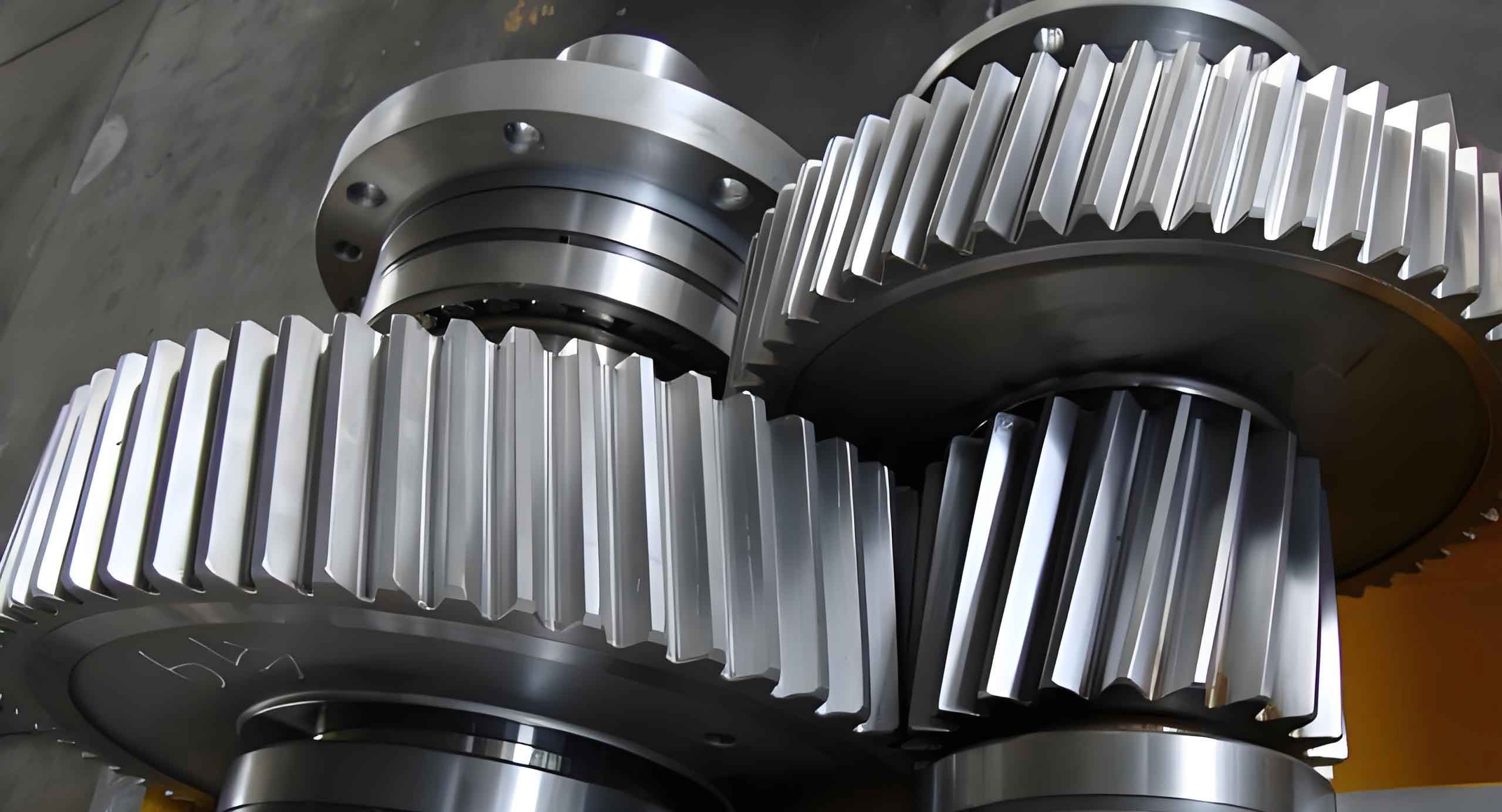
However, the very mechanism that grants form grinding its precision also presents a significant thermal challenge. The process involves the rapid removal of material by countless abrasive grains, converting almost all of the expended mechanical energy into heat within an extremely confined contact zone between the wheel and the helical gear tooth flank. This intense, localized heat generation can lead to a critical rise in temperature at the workpiece surface. Excessive grinding temperatures induce thermal damage, manifesting as grinding burns (alterations in metallurgical microstructure), the development of detrimental tensile residual stresses, and the initiation of micro-cracks. For helical gears, which are subjected to complex cyclic loading, such surface defects are catastrophic, drastically reducing their bending and contact fatigue strength, and ultimately leading to premature failure. Therefore, understanding and controlling the thermal load during the form grinding of helical gears is paramount for ensuring their reliability and service life. The objective of this analysis is to model the thermal phenomena during form grinding and investigate the influence of key grinding process parameters on the transient temperature field of helical gear teeth.
Theoretical Foundation: Heat Generation and Partition
The grinding process is inherently energy-intensive. The total heat flux generated in the grinding zone, \( Q_t \), originates from the grinding power, which is the product of the tangential grinding force \( F_t \) and the wheel velocity \( v_s \). This heat is distributed over the geometric contact area defined by the grinding width \( b_e \) and the geometric contact length \( l_g \). The contact length for surface grinding is approximated by \( l_g = \sqrt{D a_p} \), where \( D \) is the grinding wheel diameter and \( a_p \) is the depth of cut (normal to the helical gear tooth surface). Thus, the total heat flux entering the system is:
$$ Q_t = \frac{P_m}{b_e l_g} = \frac{F_t v_s}{b_e \sqrt{D a_p}} $$
In a wet grinding environment, this total heat flux is partitioned into four distinct sinks: the workpiece (helical gear tooth), the grinding wheel, the ejected chips, and the grinding fluid. This partition can be expressed as:
$$ Q_t = q_w + q_s + q_{ch} + q_f $$
Where \( q_w \), \( q_s \), \( q_{ch} \), and \( q_f \) are the heat fluxes conducted into the workpiece and wheel, carried away by the chips, and extracted by the fluid via convection, respectively. The core of thermal modeling lies in accurately estimating the fraction of total heat that enters the helical gear workpiece, \( q_w \), as this directly determines the temperature rise in the tooth.
The heat flux into the workpiece can be modeled using the moving heat source theory. For a rectangular band source moving across a semi-infinite body, the heat flux is related to the maximum (peak) surface temperature \( \theta_{max} \), the workpiece material’s thermal property \( \sqrt{k\rho c} \) (where \( k \) is thermal conductivity, \( \rho \) is density, and \( c \) is specific heat), the workpiece velocity \( v_w \) (equivalent to the feed rate in grinding), and the contact length \( l_g \):
$$ q_w = \frac{ \sqrt{k\rho c}_w \cdot v_w}{C \sqrt{\pi l_g}} \cdot \theta_{max} = h_w \cdot \theta_{max} $$
Here, \( C \) is a constant related to the Peclet number, and \( h_w \) is effectively the heat transfer coefficient for conduction into the workpiece.
The heat transported by the chips, \( q_{ch} \), is estimated based on the minimum energy required to raise the unit volume of removed material to its melting point and is a function of the material removal rate (MRR):
$$ q_{ch} = \frac{e_{ch} \cdot b_e a_p v_w}{b_e l_g} = \frac{e_{ch} a_p v_w}{\sqrt{D a_p}} \quad \text{, where } e_{ch} = \rho_w c_w \theta_m $$
Convective cooling by the grinding fluid in the contact zone is complex. Under conditions of sufficient flow and pressure, it can be modeled as forced convection over a flat plate. The convection coefficient \( h_f \) for the fluid can be derived as:
$$ h_f = 0.664 \cdot \rho_f^{1/2} \lambda_f^{2/3} c_f^{1/3} \mu_f^{-1/6} \cdot \sqrt{\frac{(v_s + v_w)/2}{2 l_g}} $$
The partition of heat between the workpiece and the grinding wheel, \( q_{ws} = q_w + q_s \), is described by a model considering grain-workpiece interaction. The fraction entering the workpiece is given by:
$$ R_w = \frac{q_w}{q_{ws}} = \left[ 1 + \frac{0.97 k_g}{\sqrt{k\rho c}_w \sqrt{r_0 v_s}} \right]^{-1} $$
Where \( k_g \) is the abrasive grain conductivity and \( r_0 \) is the effective contact radius of a grain.
Combining these models, the maximum theoretical surface temperature in wet grinding can be estimated by balancing the heat fluxes:
$$ \theta_{max} = \frac{Q_t – q_{ch}}{h_w / R_{ws} + h_f} $$
And consequently, the combined heat flux entering the workpiece and removed by convection in the immediate vicinity (the net flux dictating the temperature field) is:
$$ q_{wf} = q_w + q_f = (Q_t – q_{ch}) R_w $$
This theoretical framework clearly shows the dependency of the grinding zone thermal load on the key process parameters for helical gears: wheel speed \( v_s \), workpiece feed rate \( v_w \), and depth of cut \( a_p \). These parameters influence \( Q_t \), \( l_g \), \( h_w \), \( h_f \), and \( R_w \), and thus directly control \( \theta_{max} \).
Finite Element Simulation of the Transient Temperature Field
To visualize the complex, three-dimensional, and transient nature of the temperature field within a helical gear tooth during grinding, a finite element analysis (FEA) was conducted. The simulation focuses on a single helical gear tooth to reduce computational cost while capturing the essential physics. The geometric model of a left-hand helical gear was created with the following parameters: normal module \( m_n = 5 \) mm, number of teeth \( Z = 25 \), helix angle \( \beta = 16^\circ \), pressure angle \( \alpha = 20^\circ \), and face width \( B = 30 \) mm.
The material properties for the helical gear (40Cr steel), the grinding wheel (Al2O3 abrasive), and the water-based emulsion coolant are summarized in Table 1.
| Material | Density, \( \rho \) (kg/m³) | Specific Heat, \( c \) (J/kg·°C) | Thermal Conductivity, \( k \) (W/m·°C) |
|---|---|---|---|
| 40Cr Steel (Gear) | 7816 | 553 | 44.0 |
| Al2O3 (Abrasive) | 3980 | 765 | 35.0 |
| Water-based Coolant | 1000 | 4180 | 0.68 |
The 3D solid model was discretized using the SOLID70 thermal element in ANSYS. A sweeping mesh method was employed, resulting in a model with approximately 55,550 elements and 59,607 nodes, ensuring a balance between result accuracy and computational time. The simulation of the moving heat source was achieved by sequentially applying thermal loads over discrete time steps, each representing the passage of the grinding wheel over a segment of the tooth flank equal to the geometric contact length \( l_g \).
Boundary Conditions and Load Application
The thermal simulation required the application of three types of boundary conditions to accurately represent the wet form grinding process of helical gears:
- Initial Condition (Type I): The entire helical gear tooth model was initialized at an ambient temperature of 25°C.
- Heat Flux Load (Type II): A uniform rectangular heat source, representing the net heat flux \( q_{wf} \) calculated from the theoretical model, was applied to the active grinding zone on the tooth flank. This flux was recalculated and applied at each load step as the source “moved” along the tooth profile in the direction of the feed.
- Convective Cooling (Type III): Convective heat transfer, characterized by the coefficient \( h_f \), was applied to the grinding zone and adjacent surfaces to model the cooling effect of the grinding fluid. Surface effect elements (SURF152) were overlaid on the tooth flank to facilitate this application.
The process parameters for the baseline simulation case were set as: depth of cut \( a_p = 0.05 \) mm, wheel speed \( v_s = 31.4 \) m/s, and feed rate \( v_w = 16.7 \) mm/s. The simulation executed multiple load steps until the entire flank was traversed.
Analysis of Simulated Temperature Fields and Parameter Influence
The finite element simulation provides a detailed spatial and temporal map of the temperature distribution within the helical gear tooth. The results from the baseline case reveal several critical characteristics of the grinding temperature field.
Figure 1 shows a snapshot of the temperature distribution on the tooth flank at an intermediate load step. The highest temperature is concentrated in a narrow band corresponding to the instantaneous wheel-workpiece contact area. The temperature gradient is steep, both along the surface and into the depth of the helical gear tooth. The node with the peak temperature, \( \theta_{max} \), is consistently found near the center of the contact arc and closer to the root region of the tooth flank, a zone often subject to higher bending stresses.
The transient nature is clear when plotting the temperature history of specific nodes within the grinding zone (Figure 2). Upon the heat source’s arrival, the temperature surges rapidly to a peak within milliseconds. As the source moves away, the temperature drops quickly due to conduction into the bulk of the helical gear and convective cooling. In the stable phase of grinding, successive peaks reach a near-steady maximum value, while areas behind the contact zone cool to a much lower steady-state temperature.
Cross-sectional analysis (Figure 3) confirms that the most severe thermal effects are confined to a very thin surface layer. The temperature decays exponentially with depth below the surface. Along the direction of grinding (Figure 4), the temperature profile within the contact arc is roughly parabolic, with the maximum at the center and lower temperatures at the inlet (where pre-cooling occurs) and outlet of the grinding zone.
Influence of Grinding Process Parameters on Helical Gear Tooth Temperature
The primary advantage of the developed model is its ability to systematically evaluate how changes in grinding parameters affect the thermal load on helical gears. Table 2 summarizes the simulated effect of varying one parameter at a time from the baseline.
| Parameter | Change | Effect on \( \theta_{max} \) | Primary Physical Reason | Practical Implication for Helical Gears |
|---|---|---|---|---|
| Depth of Cut (\( a_p \)) | Increase | Significant Increase | Increased MRR leads to higher grinding power (\( Q_t \uparrow\)). Increased contact length (\( l_g \uparrow \)) reduces heat flux density but net effect is positive. | Use lighter finishing cuts to minimize thermal damage after roughing. |
| Feed Rate (\( v_w \)) | Increase | Decrease | Reduced exposure/contact time per unit area. Heat source moves faster, allowing less time for heat penetration. | Higher feed rates can improve productivity while reducing thermal risk, if machine stiffness and power allow. |
| Wheel Speed (\( v_s \)) | Increase | Moderate Increase | Increased number of active grains per unit time, raising frictional and plastic deformation energy. Higher \( v_s \) may also affect \( R_w \). | Balance wheel speed to achieve desired surface finish without excessive heat generation. Optimize coolant delivery to counteract increased heat. |
The relationship between depth of cut and temperature is particularly critical for helical gear grinding. A comparison of the simulated peak temperatures against the theoretical values calculated from Equation (6) for increasing \( a_p \) shows good agreement, with a maximum error of around 11.5%, validating the modeling approach. This confirms that even small increases in final finishing cut depth can dramatically elevate the risk of grinding burn on the critical flanks of helical gears.
Conclusion
This investigation into the thermal aspects of form grinding for helical gears, combining analytical heat partition modeling with 3D transient finite element analysis, yields several crucial conclusions for manufacturing practice:
- The temperature field on the flank of a helical gear during grinding is highly transient and localized. Peak temperatures occur within a fraction of a second in a narrow band at the center of the grinding arc, typically nearer to the tooth root region, which is a high-stress area. The thermal penetration is shallow, but the surface layer experiences the most severe thermal load.
- The key grinding process parameters—depth of cut \( a_p \), feed rate \( v_w \), and wheel speed \( v_s \)—have predictable and significant effects on the peak grinding temperature. To effectively control temperature and mitigate thermal damage like burns and tensile stresses in precision helical gears:
- Depth of cut should be minimized, especially during final finishing passes.
- Feed rate can be strategically increased to reduce heat accumulation per unit area, enhancing productivity while lowering thermal risk.
- Wheel speed requires careful optimization to balance between surface finish quality and heat generation.
- The integrated theoretical and FEA model serves as a predictive tool. It allows for the identification of high-risk zones for thermal damage on the helical gear tooth flank and enables the virtual testing of grinding parameter sets before physical trials, reducing the cost and time associated with process development for high-value helical gear components.
By applying these insights, manufacturers can optimize form grinding processes to produce helical gears with superior surface integrity, directly contributing to enhanced performance, durability, and reliability in demanding power transmission applications.