
In the field of mechanical transmission, helical gears are widely recognized for their smooth operation, low noise, and high efficiency, making them indispensable in industries such as automotive, marine, and aerospace. The precision of these helical gears directly impacts the stability and efficiency of gear systems, driving the need for advanced manufacturing techniques. Cold precision forging has emerged as a key method for producing high-quality helical gears, but challenges related to elastic deformation of dies during the process can affect the final gear accuracy. This study focuses on investigating the elastic deformation patterns of dies in cold precision forging of helical gears through numerical simulation, aiming to provide insights for improving gear成形 precision.
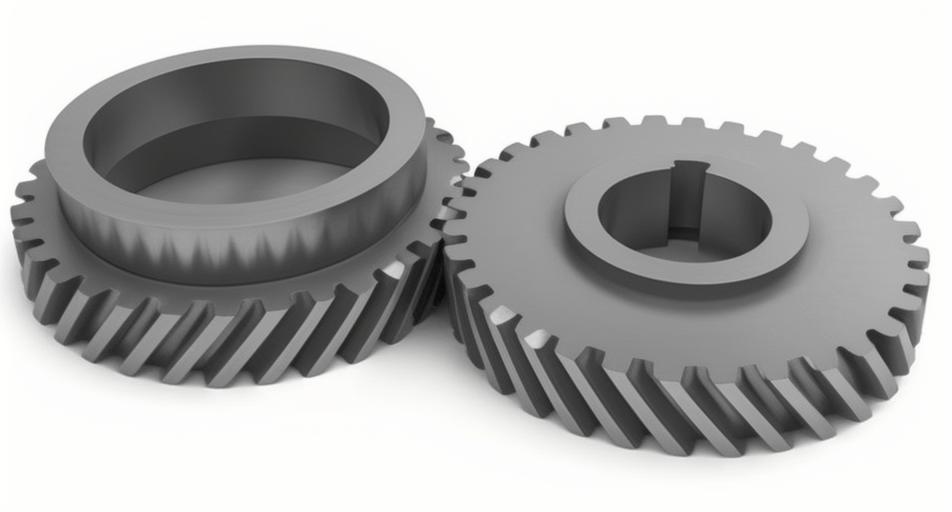
As a researcher in materials science and engineering, I have explored the complexities of helical gears manufacturing using cold precision forging. The helical gears’ unique geometry, with their helical teeth, introduces additional challenges compared to spur gears, particularly in terms of die stress and elastic deformation. In this article, I will detail the numerical simulation approach employed to analyze die elastic deformation, present findings on stress distribution and deformation规律, and discuss methods for tooth profile correction based on simulation results.
The foundation of this study lies in the finite element method (FEM), which allows for the simulation of the cold forging process for helical gears. I developed a three-dimensional model of a helical gear with specific parameters: 17 teeth, a module of 2, a pressure angle of 20°, a helix angle of 20°, and a tooth width of 10 mm. The billet material was selected as 20CrMnTiH, a common alloy steel for gear applications. The die material was AISI-H-13 tool steel, known for its high strength and wear resistance, with an elastic modulus of 210 GPa, a Poisson’s ratio of 0.3, and a yield strength of 1750 MPa. These materials are critical in ensuring the accuracy of helical gears production.
To simulate the cold precision forging process, I used a closed-die forging approach. The finite element model was constructed in DEFORM-3D software, where the billet was treated as a plastic body and the dies as rigid bodies during the initial forging simulation. The forging speed was set at 10 mm/s, and a shear friction model with a friction factor of 0.12 was applied to account for interactions between the billet and dies. The mesh was refined to 300,000 elements for both the billet and dies to ensure simulation accuracy. After the forging simulation, the die stress analysis module was utilized to evaluate elastic deformation. In this step, the dies were considered elastic bodies, and the forces from the billet were interpolated onto the dies to compute stress and displacement fields.
The stress distribution in the die during forging revealed significant insights. The equivalent stress was found to be relatively uniform in the circumferential direction but varied along the tooth profile. High-stress concentrations were observed at specific locations, such as the tooth root, the lower tooth tip, and the upper tooth root regions. This stress non-uniformity directly influences the elastic deformation of the die cavity, which is crucial for the final shape of helical gears. To quantify this, I extracted displacement data from key points on the tooth profile cavity at different heights, ranging from the upper end face (20 mm height) to the lower end face (10 mm height). By tracking 36 points on each profile curve, I analyzed the elastic deformation patterns.
The elastic deformation of the die cavity was not uniform across the tooth profile. I observed that the deformation varied along the dedendum, involute, and addendum sections of the helical gears tooth profile. Generally, the deformation was highest at the tooth tip and decreased towards the tooth root. Additionally, from the upper end face to the lower end face of the cavity, the deformation magnitude gradually reduced. This can be expressed mathematically through the deformation function. For instance, the displacement \( \delta \) at a point on the tooth profile can be related to the applied stress \( \sigma \) and material properties. Using Hooke’s law for elastic deformation:
$$ \delta = \frac{\sigma \cdot L}{E} $$
where \( L \) is the characteristic length, and \( E \) is the elastic modulus. However, due to the complex geometry of helical gears, this simple relation does not fully capture the deformation; hence, numerical simulation is essential.
To summarize the deformation data, I have compiled key findings in the following table, which shows the average elastic deformation at different heights for the left and right tooth flanks of helical gears:
| Height (mm) | Left Flank Deformation (mm) | Right Flank Deformation (mm) | Section |
|---|---|---|---|
| 20 (Upper) | 0.078 | 0.081 | Dedendum |
| 20 (Upper) | 0.071 | 0.050 | Involute |
| 20 (Upper) | 0.150 | 0.150 | Addendum |
| 15 (Middle) | 0.074 | 0.076 | Dedendum |
| 15 (Middle) | 0.047 | 0.048 | Involute |
| 15 (Middle) | 0.140 | 0.140 | Addendum |
| 10 (Lower) | 0.070 | 0.070 | Dedendum |
| 10 (Lower) | 0.012 | 0.010 | Involute |
| 10 (Lower) | 0.134 | 0.134 | Addendum |
This table highlights that for helical gears, the addendum experiences the highest deformation, while the dedendum shows more uniform deformation. The involute section has variable deformation, with values ranging from as low as 0.001 mm to 0.071 mm. The asymmetry between left and right flanks is due to the helical geometry, where material flow differs during forging. For example, in the upper half of the cavity, the left flank tends to have slightly higher deformation than the right, whereas in the lower half, the right flank shows greater deformation. This is attributed to the helical flow of material in helical gears, which affects stress distribution.
Further analysis involves mathematical modeling of the deformation. The total elastic deformation \( \Delta \) of the die cavity can be approximated by integrating the strain over the volume. For a point on the tooth profile, the strain \( \epsilon \) is related to stress via the constitutive equation:
$$ \epsilon = \frac{\sigma}{E} $$
In the context of helical gears, the stress \( \sigma \) varies with position \( (x, y, z) \) due to the helical angle. A simplified model for deformation along the tooth profile can be expressed as:
$$ \delta(z) = \int_{0}^{L} \frac{\sigma(z, \theta)}{E} \, d\theta $$
where \( z \) is the height coordinate, \( \theta \) is the angular position along the helix, and \( L \) is the tooth width. However, in practice, finite element simulation provides more accurate results. The deformation trends indicate that for helical gears, the maximum deformation occurs at the upper end face’s tooth tip, with a value of 0.167 mm, while the minimum is at the lower end face’s involute section, at 0.001 mm. This non-uniform deformation necessitates corrective measures to ensure the accuracy of helical gears.
Based on the deformation data, I applied a reverse compensation method to modify the die cavity tooth profile. This involves adjusting the cavity geometry by subtracting the elastic deformation values from the nominal tooth profile. The modified cavity is then used in a second simulation to verify the improvement. The compensation process can be described mathematically. If the nominal tooth profile is given by a function \( f(\theta, z) \), and the elastic deformation is \( \delta(\theta, z) \), the modified profile \( f'(\theta, z) \) is:
$$ f'(\theta, z) = f(\theta, z) – \delta(\theta, z) $$
This correction aims to counteract the springback effect in helical gears after forging. After implementing this, the simulation showed reduced elastic deformation in the forged gear. For instance, at the mid-width of the helical gears tooth, the maximum deviation decreased from 0.078 mm to 0.04 mm, and the minimum from 0.012 mm to 0.001 mm. This demonstrates the effectiveness of die correction for enhancing the precision of helical gears.
To further illustrate the simulation parameters, here is a table summarizing key inputs for the finite element analysis of helical gears forging:
| Parameter | Value | Description |
|---|---|---|
| Billet Material | 20CrMnTiH | Alloy steel for gears |
| Die Material | AISI-H-13 | Tool steel with high elasticity |
| Elastic Modulus (Die) | 210 GPa | Modulus of elasticity |
| Poisson’s Ratio (Die) | 0.3 | Ratio of transverse strain |
| Yield Strength (Die) | 1750 MPa | Stress at which deformation occurs |
| Friction Factor | 0.12 | Shear friction model parameter |
| Forging Speed | 10 mm/s | Speed of the punch |
| Mesh Elements | 300,000 | Number of elements for accuracy |
| Helix Angle | 20° | Angle of teeth in helical gears |
| Tooth Width | 10 mm | Width of the gear teeth |
The simulation results emphasize the importance of considering elastic deformation in die design for helical gears. The helical nature of these gears leads to asymmetric stress distributions, which in turn cause non-uniform elastic deformations. By using numerical simulation, we can predict these deformations and implement corrective strategies. In addition to reverse compensation, other factors such as die pre-stressing or optimized forging parameters could be explored to further improve the accuracy of helical gears.
In conclusion, this study highlights the elastic deformation laws in dies for cold precision forging of helical gears. Through detailed numerical simulation, I have shown that deformation is highest at the tooth tip and decreases towards the root, with variations along the helix height. The use of reverse compensation based on simulation data effectively reduces springback in helical gears, thereby enhancing成形 precision. Future work could involve experimental validation and the application of advanced materials for dies to minimize deformation. Overall, this research provides a methodological framework for optimizing the manufacturing of high-precision helical gears, ensuring their reliable performance in critical applications.
The insights gained from this study are particularly relevant for industries relying on helical gears for efficient power transmission. By addressing die elastic deformation, manufacturers can achieve tighter tolerances and better gear quality. As helical gears continue to evolve in design and application, numerical simulation will remain a vital tool for innovation and improvement in cold precision forging processes.