
In mechanical transmission systems, helical gears play a critical role due to their ability to provide smooth and quiet operation compared to spur gears. However, during operation, issues such as misalignment and uneven load distribution can significantly impact the meshing performance, leading to reduced lifespan and increased vibration. As an engineer focused on gear design, I have explored various methods to optimize helical gears, particularly through tooth profile and lead modifications. This article delves into the principles of gear modification, the application of optimization algorithms, and a detailed case study to demonstrate improvements in transmission error, load distribution, and contact stress for helical gears.
The meshing performance of helical gears is influenced by factors like manufacturing errors, assembly inaccuracies, elastic deformation under load, and thermal effects. These factors often cause edge loading or偏载 (deflected loading), where the load concentrates on one side of the tooth flank, leading to premature failure. To address this, gear modification—specifically profile and lead modification—is employed. Profile modification involves altering the tooth profile near the tip or root to prevent interference during meshing, while lead modification adjusts the tooth surface along the width to ensure even load distribution. The goal is to minimize transmission error fluctuations, which directly correlate with vibration and noise levels in helical gears.
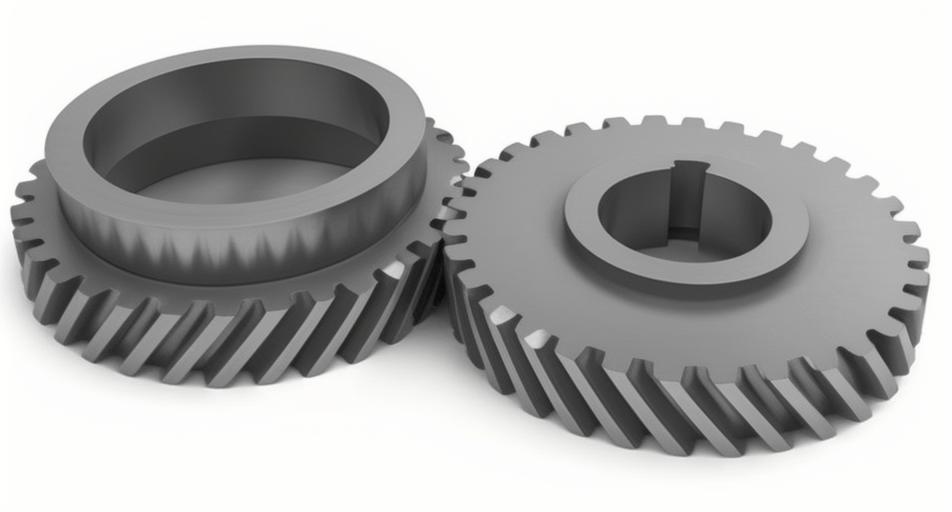
Transmission error, defined as the deviation between the actual and theoretical rotational positions of the driven gear, is a key indicator of meshing performance. For helical gears, reducing transmission error fluctuations is essential for enhancing stability. The transmission error \(\Delta \theta\) can be expressed as:
$$\Delta \theta = \theta_{\text{actual}} – \theta_{\text{theoretical}}$$
where \(\theta_{\text{actual}}\) is the actual rotation angle and \(\theta_{\text{theoretical}}\) is the ideal angle based on gear geometry. In practice, this error varies due to deformations and misalignments, especially in helical gears used in heavy-duty applications like vertical mill gearboxes.
To optimize helical gears, I consider both profile and lead modifications. Profile modification typically involves linear tip relief, where material is removed from the tooth tip to a specified depth. The maximum relief amount \(\Delta_{\text{max}}\) and the start angle \(\alpha_s\) are key parameters. The modified profile can be described as a function of the roll angle \(\phi\):
$$y(\phi) = y_0(\phi) – \Delta(\phi)$$
where \(y_0(\phi)\) is the original profile and \(\Delta(\phi)\) is the modification amount, often linear from \(\alpha_s\) to the tip. For helical gears, this helps reduce啮入 (mesh-in) and啮出 (mesh-out) impacts.
Lead modification, on the other hand, addresses axial misalignment. It includes crowning \(C_c\) and slope \(S_l\) adjustments. Crowning adds a slight curvature along the tooth width to centralize the contact pattern, while slope compensates for angular errors. The modified lead shape \(z(x)\) along the tooth width \(b\) is given by:
$$z(x) = z_0(x) + C_c \left(1 – \left(\frac{2x}{b}\right)^2\right) + S_l x$$
where \(x\) is the axial coordinate from the center, \(z_0(x)\) is the unmodified surface, and \(C_c\) and \(S_l\) are the crowning and slope amounts, respectively. For helical gears, these modifications are crucial to mitigate deflected loading and improve contact stress distribution.
In my work, I use optimization algorithms to determine the best modification parameters. Genetic algorithms (GAs) are particularly effective due to their ability to handle nonlinear, multi-variable problems. The optimization process involves encoding design variables, generating an initial population, evaluating fitness, and applying selection, crossover, and mutation operations. For helical gears, the design variables include profile relief amount, relief start angle, lead crowning, and lead slope. The objective function is to minimize the fluctuation value of transmission error, denoted as \(F_{\text{TE}}\):
$$F_{\text{TE}} = \max(\Delta \theta) – \min(\Delta \theta)$$
By iteratively adjusting these parameters, GAs converge to an optimal solution that enhances the meshing performance of helical gears.
To illustrate, I conducted a case study on a helical gear pair from a vertical mill gearbox, though specific identifiers are omitted. The helical gears had parameters as summarized in Table 1. These helical gears exhibited significant deflected loading, necessitating optimization.
| Parameter | Driving Gear | Driven Gear |
|---|---|---|
| Number of teeth, \(z\) | 19 | 70 |
| Module, \(m\) (mm) | 20 | |
| Pressure angle, \(\alpha\) (degrees) | 20 | |
| Helix angle, \(\beta\) (degrees) | 9 | |
| Profile shift coefficient, \(x\) | 0.341 | 0.391 |
| Face width, \(b\) (mm) | 470 | 450 |
| Center distance, \(a\) (mm) | 915 | |
Using a GA, I optimized the modification parameters with initial ranges: profile relief 0–30 μm, lead crowning 0–30 μm, lead slope -30–30 μm, and relief start angles based on single-tooth mesh points. After two iterations, the optimal values were refined, as shown in Table 2. This process ensured that the helical gears achieved minimal transmission error fluctuations.
| Gear | Profile Relief (μm) | Relief Start Angle (degrees) | Lead Crowning (μm) | Lead Slope (μm) |
|---|---|---|---|---|
| Driving | 13.24 | 32.277 | 9.67 | -16.34 |
| Driven | 11.65 | 24.951 | 3.99 | -37.52 |
The optimization results were evaluated by comparing transmission error, load per unit length, and contact stress before and after modification. For the helical gears, the transmission error curve showed significant improvement. Initially, the fluctuation range was 6.13 μm, but after optimization, it reduced to 0.59 μm. This reduction indicates smoother operation and less vibration for the helical gears. The transmission error harmonic analysis further confirmed this, with the first harmonic amplitude dropping from 2.81 μm to 0.25 μm.
Load distribution also improved markedly. Before optimization, the maximum normal load per unit length was 1061 N/mm, with uneven distribution across the tooth flank. After modification, this value decreased to 480 N/mm, and the load became more centralized and uniform. This is critical for helical gears, as even load distribution extends service life and reduces wear. The load curve for a single tooth pair became smoother, eliminating sharp peaks that cause冲击 (impacts).
Contact stress analysis revealed similar benefits. The maximum contact stress for the helical gears dropped from 847 MPa to 558 MPa post-optimization, and the stress distribution became more even. This reduction minimizes the risk of pitting and fatigue failures in helical gears. The contact stress \(\sigma_H\) can be estimated using the Hertzian contact formula for helical gears:
$$\sigma_H = \sqrt{\frac{F_n E^*}{\pi \rho L}}$$
where \(F_n\) is the normal load, \(E^*\) is the effective modulus of elasticity, \(\rho\) is the effective radius of curvature, and \(L\) is the contact length. For helical gears, optimization reduces \(F_n\) and improves \(L\) through better load sharing.
To quantify the meshing stiffness, which affects transmission error, I consider the time-varying stiffness \(k(t)\) of helical gears. It can be modeled as:
$$k(t) = k_0 + \sum_{i=1}^{n} \Delta k_i \sin(\omega_i t + \phi_i)$$
where \(k_0\) is the mean stiffness, and \(\Delta k_i\) represents fluctuations due to tooth modifications. For optimized helical gears, \(\Delta k_i\) is minimized, leading to lower dynamic excitation.
Additionally, the effectiveness of modification can be assessed through the contact ratio \(\varepsilon\) for helical gears. The transverse contact ratio \(\varepsilon_{\alpha}\) and overlap ratio \(\varepsilon_{\beta}\) are given by:
$$\varepsilon_{\alpha} = \frac{\sqrt{r_{a1}^2 – r_{b1}^2} + \sqrt{r_{a2}^2 – r_{b2}^2} – a \sin\alpha_t}{p_{bt}}$$
$$\varepsilon_{\beta} = \frac{b \tan\beta}{p_{bt}}$$
where \(r_a\) and \(r_b\) are tip and base radii, \(\alpha_t\) is the transverse pressure angle, \(p_{bt}\) is the base pitch, and \(\beta\) is the helix angle. Optimization maintains or improves these ratios for helical gears, ensuring continuous meshing.
In practice, the optimization of helical gears requires iterative simulations. I used software tools to model the gear system, incorporating factors like shaft flexibility and bearing deflections. The genetic algorithm was implemented with a population size of 50, crossover probability of 0.8, and mutation probability of 0.1. The fitness function evaluated transmission error fluctuations over one mesh cycle for the helical gears. Convergence was achieved within 100 generations, demonstrating the efficiency of GAs for helical gear optimization.
Further, I analyzed the impact of modification on gear dynamics. The equation of motion for a helical gear pair can be expressed as:
$$I_1 \ddot{\theta}_1 + c(\dot{\theta}_1 – \dot{\theta}_2) + k(t)(\theta_1 – \theta_2 – e(t)) = T_1$$
$$I_2 \ddot{\theta}_2 – c(\dot{\theta}_1 – \dot{\theta}_2) – k(t)(\theta_1 – \theta_2 – e(t)) = -T_2$$
where \(I\) is inertia, \(c\) is damping, \(k(t)\) is time-varying stiffness, \(e(t)\) is static transmission error, and \(T\) is torque. For optimized helical gears, \(e(t)\) is reduced, leading to lower vibration amplitudes.
The benefits of optimization extend to noise reduction as well. Helical gears are known for quieter operation, but further improvements can be achieved by minimizing transmission error harmonics. The sound pressure level \(L_p\) can be correlated with transmission error fluctuations:
$$L_p \propto 20 \log_{10}(F_{\text{TE}})$$
Thus, by reducing \(F_{\text{TE}}\) for helical gears, noise levels are decreased, which is vital for applications in sensitive environments.
To summarize the results, Table 3 compares key performance metrics for the helical gears before and after optimization. This highlights the comprehensive improvements achieved through micro-geometric design.
| Metric | Before Optimization | After Optimization | Improvement |
|---|---|---|---|
| Transmission error fluctuation (μm) | 6.13 | 0.59 | 90.4% |
| Max normal load per unit length (N/mm) | 1061 | 480 | 54.8% |
| Max contact stress (MPa) | 847 | 558 | 34.1% |
| First harmonic amplitude (μm) | 2.81 | 0.25 | 91.1% |
The optimization process for helical gears is not limited to this case; it can be generalized to other gear types. However, helical gears present unique challenges due to their helix angle, which affects load distribution and contact patterns. By applying similar optimization techniques, engineers can enhance the performance of helical gears in various applications, from industrial machinery to automotive transmissions.
In conclusion, the meshing performance of helical gears can be significantly improved through systematic profile and lead modification. Using genetic algorithms for parameter optimization allows for minimal transmission error fluctuations, even load distribution, and reduced contact stress. This approach not only extends the lifespan of helical gears but also contributes to smoother and quieter operation. Future work could explore real-time adaptation of modification parameters based on operating conditions, further advancing the reliability of helical gears in dynamic systems. The insights gained from this analysis underscore the importance of micro-geometric design in achieving optimal performance for helical gears.