
The persistent challenge of trapped oil, or pressure trapping, remains a critical area of study in the design and performance optimization of hydraulic pumps. Among various pump architectures, external helical gear pumps are distinguished by their smoother operation, reduced flow pulsation, lower acoustic emissions, and superior suitability for high-speed, high-pressure applications. These advantages are intrinsically linked to the geometry of helical gears and their engagement characteristics. However, the very meshing action that grants these benefits also creates the conditions for the formation of sealed, transient volumes that are isolated from both the inlet and outlet ports. The subsequent compression and expansion of fluid within these volumes lead to detrimental effects such as pressure spikes, cavitation, increased bearing loads, energy losses, vibration, and noise. Therefore, a profound understanding of the trapped oil phenomenon in helical gears is paramount for advancing pump technology. This article delves into the fundamental mechanisms, mathematical modeling, and parametric influences governing trapped oil characteristics in external involute helical gear pumps, providing a detailed theoretical foundation for their design and selection.
1. Fundamental Mechanism of Trapped Oil in Helical Gear Pumps
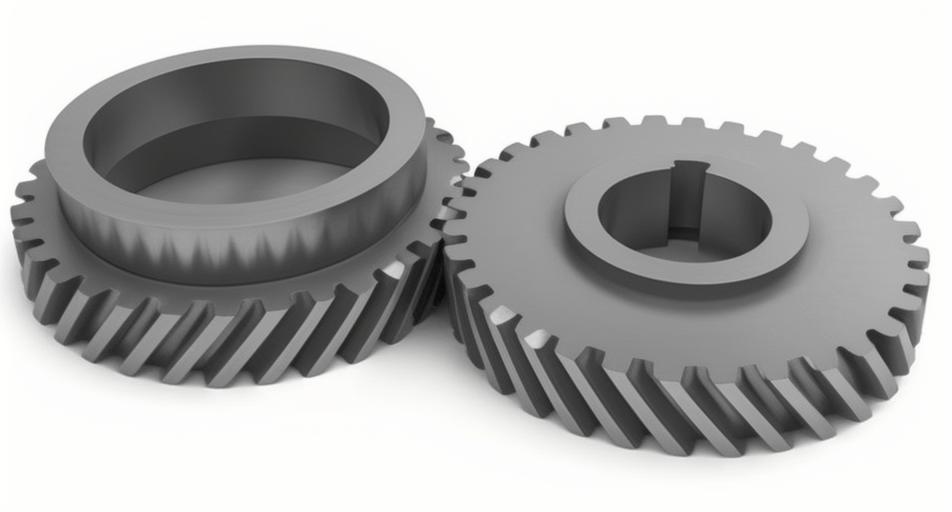
The genesis of trapped oil in helical gears is fundamentally different from that in spur gears due to the presence of the helix angle. Engagement does not occur simultaneously across the entire face width. Instead, a single tooth pair initiates contact at one end of the gear and the contact zone progressively traverses the face width. This results in a contact line that varies in length throughout the meshing cycle.
- Partial Face Width Engagement: As a tooth pair first makes contact, the engagement begins at a point, forming a short contact line. This is the phase of partial face-width engagement.
- Full Face Width Engagement: As the gears rotate, the contact line lengthens until it spans the entire face width. The tooth pair is now in a state of complete, or full-face, engagement.
- Return to Partial Engagement: Continued rotation causes the contact line to shorten from the opposite end until the teeth finally disengage, returning to a state of partial engagement before separation.
To ensure continuous and smooth power transmission, the gear design mandates overlap in engagement. Before one tooth pair (Pair A) exits the full-face engagement zone, the subsequent tooth pair (Pair B) must have already entered its own full-face engagement zone. Consequently, there exists a rotational interval where both pairs are simultaneously in the state of full-face width engagement. During this interval, the fluid entrained between the two pairs of teeth, the gear body, and the pump housing forms a closed chamber with no connection to either the low-pressure suction port or the high-pressure discharge port. The volume of this chamber changes cyclically with gear rotation, giving rise to the classic trapped oil phenomenon. The detrimental cycle comprises two phases:
- Compression Phase (Volume Decreasing): The volume of the trapped chamber diminishes. The incompressible hydraulic fluid inside experiences a drastic pressure rise. This high-pressure fluid seeks escape through any available clearance—side plates, radial gaps, or tooth tip clearances—leading to excessive radial and axial loads on bearings and gears, power loss, fluid heating, and severe pressure shocks within the pump.
- Expansion Phase (Volume Increasing): Following the minimum volume point, the chamber volume begins to increase. If this expansion occurs rapidly and the chamber is not properly vented (e.g., via relief grooves), the pressure can drop below the fluid’s vapor pressure, causing cavitation (formation and subsequent implosion of vapor bubbles). This results in metal pitting, intense vibration, and characteristic noise.
2. Mathematical Modeling of Trapped Oil for Helical Gears
To quantitatively analyze the trapped oil characteristics, we establish a mathematical model. Consider an external involute helical gear pump with zero theoretical backlash. In the transverse plane, the path of contact is the line of action, bounded by points \(k_1\) and \(k_2\), which correspond to the start and end of active profile engagement for a single tooth pair.
Let \(P\) be the pitch point. The onset of the trapped oil condition begins when the following tooth pair makes initial contact at point \(k_2\). At this precise moment, the preceding tooth pair is still in engagement at point \(D\) (which coincides with \(k_1\) for a standard full-depth tooth). Between these two points, \(k_2\) and \(D\), lies another contact point \(M\). Due to the helix angle \(\beta\), the engagement at the transverse point \(k_2\) is partial, while at points \(M\) and \(D\), the contact spans the full face width, represented by contact lines \(MM’\) and \(DB\) respectively. The volume enclosed between these two full-contact zones constitutes the primary trapped volume \(V\).
Let \(\theta_x\) be the angular displacement of a contact point from the pitch point \(P\), where \(\theta_M \leq \theta_x \leq \theta_D\). The corresponding angular position for a point that is a transverse base pitch (\(\pi / Z\), where \(Z\) is the number of teeth) away is \(\theta_y = \theta_x + \pi / Z\).
The rate of change of the volume swept by the preceding tooth pair with respect to \(\theta_x\) is derived from the geometry of the helical involute surface and its engagement. For a gear with face width \(b\), base circle radius \(r_b\), pitch circle radius \(r_w\), and tip circle radius \(r_a\), this rate is given by:
$$
\frac{dV}{d\theta_x} = b (r_a^2 – r_w^2) – r_b^2 b \theta_x^2 + \frac{b \theta_x \tan \beta}{r_w} + \frac{b^2 \tan^2 \beta}{3 r_w^2}
$$
Similarly, the rate of change of the volume associated with the following tooth pair with respect to its angular position \(\theta_y\) is:
$$
\frac{dV}{d\theta_y} = b (r_a^2 – r_w^2) – r_b^2 b \theta_y^2 + \frac{b \theta_y \tan \beta}{r_w} + \frac{b^2 \tan^2 \beta}{3 r_w^2}
$$
The net rate of change of the trapped volume \(V\) is the difference between the contributions of the two overlapping tooth pairs. If we define \(\theta_1\) as the angular position within the trapped zone (\(\theta_1 = \theta_x\) for analysis), then:
$$
\frac{dV}{d\theta_1} = \frac{dV}{d\theta_x} – \frac{dV}{d\theta_y}
$$
Substituting the expressions and simplifying using \(\theta_y = \theta_1 + \pi/Z\) yields:
$$
\frac{dV}{d\theta_1} = r_b^2 b \frac{\pi}{Z} \left( 2\theta_1 + \frac{\pi}{Z} \right) + \frac{b \tan \beta}{r_w}
$$
This equation reveals that the rate of volume change is a linear function of the angular position \(\theta_1\). The trapped volume \(V\) reaches its minimum \(V_{min}\) when \(dV/d\theta_1 = 0\). Solving for \(\theta_1\) gives the angular location of the minimum volume:
$$
\theta_{1,min} = -\frac{\pi}{2Z} – \frac{b \tan \beta}{2 r_w}
$$
Integrating the expression for \(dV/d\theta_1\) and applying the condition \(V = V_{min}\) at \(\theta_{1,min}\), we obtain the parabolic relationship for the trapped volume as a function of angular displacement:
$$
V = V_{min} + r_b^2 b \frac{\pi}{Z} \left[ \theta_1^2 + \left( \frac{\pi}{Z} + \frac{b \tan \beta}{r_w} \right) \theta_1 \right]
$$
Or, more compactly as a standard parabola centered around \(\theta_{1,min}\):
$$
V = V_{min} + r_b^2 b \frac{\pi}{Z} \left( \theta_1 – \theta_{1,min} \right)^2
$$
This key result demonstrates that, under ideal zero-backlash conditions, the trapped volume in a pump using helical gears varies quadratically (parabolically) with the gear’s angular rotation. Furthermore, the coefficients show that the magnitude of volume variation is directly proportional to the face width \(b\) and has a complex relationship with the helix angle \(\beta\) and the number of teeth \(Z\).
3. Parametric Analysis of Trapped Oil Characteristics
The derived mathematical model provides a framework for evaluating how key design parameters of helical gears influence trapped oil severity. The primary metrics of interest are the Maximum Trapped Volume (\(V_{max}\)) and the Angular Duration of Trapping (\(\alpha\)). We analyze the impact of face width and helix angle, which are critical and adjustable parameters in pump design.
3.1 Influence of Face Width (\(b\))
The face width is a primary determinant of the pump’s displacement per revolution. However, its effect on trapped oil is significant. Based on the model and corroborated by graphical modeling of gear pairs, the following relationships hold for a typical gear pump within a practical operating range (e.g., \(b\) between 23 mm and 27 mm for a given size).
The angular duration of trapping \(\alpha\) decreases approximately linearly with increasing face width. A wider face width alters the phasing of the full-face engagement zones of consecutive tooth pairs, effectively reducing the rotational angle over which both pairs are fully engaged simultaneously.
Conversely, the maximum trapped volume \(V_{max}\) increases with face width. The relationship is predominantly quadratic, as suggested by the \(b\) term in the coefficient of the parabolic volume equation. A larger \(b\) increases the volume of the chamber formed between the two full-contact lines.
The table below summarizes this parametric influence for a hypothetical pump with fixed \(Z\), \(m_n\), and \(\beta\):
| Face Width, \(b\) (mm) | Angular Duration, \(\alpha\) (degrees) | Max Trapped Volume, \(V_{max}\) (mm³) | Qualitative Trend |
|---|---|---|---|
| 23.0 | 3.85 | 125 | Reference |
| 24.5 | 3.72 | 142 | \(\alpha\) decreases, \(V_{max}\) increases |
| 26.0 | 3.58 | 162 | \(\alpha\) decreases, \(V_{max}\) increases |
| 27.0 | 3.50 | 178 | \(\alpha\) decreases, \(V_{max}\) increases |
For a specific case where \(b = 23 \text{ mm}\), the variation of trapped volume \(V\) over the angular duration \(\alpha\) follows a clear parabolic profile, as predicted by the theoretical model: $$ V(\theta_1) = V_{min} + K \cdot (\theta_1 – \theta_{1,min})^2 $$ where \(K = r_b^2 b \pi / Z\). This confirms the fundamental quadratic relationship governing the phenomenon in helical gears.
3.2 Influence of Helix Angle (\(\beta\))
The helix angle is the defining geometric feature of helical gears. It critically affects the smoothness of engagement, axial thrust, and trapped oil characteristics. For practical pump designs, helix angles are typically constrained to a range of \(8^\circ\) to \(20^\circ\) to balance smooth meshing with manageable axial forces.
Analysis shows that increasing the helix angle within this range causes a near-linear reduction in the angular duration of trapping \(\alpha\). A larger \(\beta\) increases the axial overlap of teeth, which changes the timing of the transition into and out of the full-face engagement state, shortening the overlap period between consecutive tooth pairs.
The effect on the maximum trapped volume \(V_{max}\) is more complex. While the term \(\frac{b \tan \beta}{r_w}\) appears in the linear component of the volume derivative, the overall relationship is not purely linear or quadratic. However, the primary and most significant effect of increasing \(\beta\) is the reduction of the trapping angle, which generally helps mitigate the severity of pressure pulsations even if \(V_{max}\) does not change monotonically.
| Helix Angle, \(\beta\) (degrees) | Angular Duration, \(\alpha\) (degrees) | Axial Thrust (Relative) | Design Trade-off Note |
|---|---|---|---|
| 13.0 | 3.80 | Medium-Low | Moderate trap duration |
| 14.5 | 3.65 | Medium | Improved flow smoothness |
| 15.6 | 3.50 | Medium-High | Common design compromise |
| 18.0 | 3.20 (Est.) | High | Short trap, high axial load |
3.3 Influence of Number of Teeth (\(Z\)) and Module
While not the primary focus of the provided data, the number of teeth \(Z\) and the gear module are fundamental parameters. From the volume equation: $$ V \propto \frac{1}{Z} $$ This indicates that for a given center distance and face width, using helical gears with a higher number of teeth (and consequently a smaller module) will reduce the magnitude of the trapped volume variation. However, this is often traded against gear strength and pump displacement. The base circle radius \(r_b\) also depends on \(Z\) and the module, further influencing the coefficients in the volume equation.
4. Design Considerations and Mitigation Strategies for Helical Gear Pumps
The analysis clearly indicates that the geometry of the helical gears is the principal factor dictating the inherent trapped oil characteristics. Design is therefore an exercise in optimization and compromise.
- Selecting Face Width and Helix Angle: The designer must balance the need for high volumetric displacement (favoring larger \(b\)) and smooth flow (favoring larger \(\beta\)) against the exacerbation of trapped volume (\(V_{max}\) increases with \(b\)) and the generation of axial thrust (increases with \(\beta\)). The observed linear reduction of trapping angle \(\alpha\) with both parameters is beneficial but must be weighed against the other effects.
- Relief Grooves (Porting): The most common and effective practical solution is machining relief grooves (or scallops) in the side plates or bearing blocks. These grooves connect the trapped volume to either the discharge port (during compression) or the suction port (during expansion) at the appropriate moments in the gear cycle. The timing, size, and shape of these grooves are critical and their design is informed by the calculated angular duration \(\alpha\) and the volume curve \(V(\theta)\). For helical gears, the groove design must account for the axial progression of the contact line.
- Asymmetric Tooth Profiles: Modifying the involute profile or using other tooth forms can alter the length of the approach and recess action, potentially changing the timing and magnitude of the trapped volume.
- Precision Manufacturing and Clearance Control: Minimizing and controlling backlash and clearances helps define the trapped volume more predictably but does not eliminate the fundamental phenomenon. Tight clearances can worsen pressure spikes during compression, while excessive clearances can lead to internal leakage and reduced efficiency.
5. Conclusion
The trapped oil phenomenon in external involute helical gear pumps is a complex, geometry-driven process with significant implications for pump performance and longevity. Through rigorous mathematical modeling and parametric analysis, we can draw the following key conclusions specific to pumps employing helical gears:
- The variation of trapped volume with respect to gear rotation follows a parabolic law, described by \(V = V_{min} + K (\theta_1 – \theta_{1,min})^2\), where the coefficient \(K\) is a function of base radius, face width, and number of teeth.
- Face Width (\(b\)): Within a standard operational range, increasing the face width leads to a linear decrease in the angular duration of trapping (\(\alpha\)) but a quadratic increase in the maximum trapped volume (\(V_{max}\)). This presents a direct trade-off between pump displacement and trapped oil severity.
- Helix Angle (\(\beta\)): Increasing the helix angle within typical design limits (\(8^\circ\)-\(20^\circ\)) produces a linear reduction in the trapping angular duration (\(\alpha\)). This is a primary reason why helical gears exhibit smoother operation and lower noise compared to spur gears. However, this benefit must be balanced against the associated increase in axial thrust loads.
- The interplay between \(Z\), \(b\), and \(\beta\) ultimately defines the trapped oil signature of the pump. Optimal design requires multi-variable analysis to minimize pressure pulsations while meeting displacement, pressure, and life requirements.
This comprehensive understanding of the trapped oil dynamics, rooted in the geometry of helical gears, provides an essential theoretical foundation. It enables engineers to make informed decisions during the pump design phase, select appropriate parameters, and design effective mitigation features like relief grooves, ultimately leading to the development of high-performance, reliable, and quiet helical gear pumps for demanding hydraulic applications.