
In modern mechanical transmission systems, helical gears are widely employed due to their smooth operation, high load capacity, and reduced noise compared to spur gears. However, vibration and noise remain critical issues, especially in high-speed and heavy-duty applications such as automotive transmissions, aerospace, and industrial machinery. The primary source of these vibrations is the unsteady meshing process, which arises from factors like elastic deformations, load distribution irregularities, manufacturing errors, and assembly inaccuracies. To address this, we focus on analyzing the dynamic contact behavior of helical gears and optimizing their micro-geometry through modification techniques. This study presents a detailed methodology combining finite element analysis and slice theory to evaluate transmission error—a key indicator of meshing steadiness—and proposes an optimization framework for gear modification that simultaneously minimizes transmission error fluctuation and improves load distribution. Experimental validation on an automotive transmission setup confirms the effectiveness of our approach. Throughout this work, we emphasize the importance of helical gears in transmission systems and explore advanced analytical techniques to enhance their performance.
The core problem in helical gear vibration stems from the transmission error (TE), which represents the deviation between the theoretical and actual positions of gear teeth during meshing. TE acts as a dynamic excitation source, leading to force fluctuations and subsequent noise. It is defined as the sum of geometric deviations and elastic deformations under load. Mathematically, TE can be expressed as:
$$ TE = E + \delta $$
where \( E \) denotes the composite tooth error (including manufacturing and alignment errors) and \( \delta \) represents the composite deformation due to applied loads. To analyze TE, we employ two primary methods: the finite element method (FEM) and the slice theory. FEM provides high accuracy by modeling detailed contact stresses and deformations, but it is computationally intensive. In contrast, slice theory offers a faster, simplified approach by discretizing the gear tooth into independent slices along the face width, each treated as a spur gear segment. This allows for efficient calculation of TE and load distribution, especially when considering micro-geometry modifications.
For helical gears, the meshing process involves multiple teeth in contact simultaneously due to the helical angle, leading to a contact ratio greater than one. The dynamic behavior is influenced by time-varying mesh stiffness, damping, and load sharing among teeth. To quantify this, we derive the mesh stiffness and load distribution using slice theory. Each slice is assigned a stiffness value based on its position along the tooth, and the load on each slice is calculated as:
$$ F_l = \begin{cases} K_s (TE – x), & \text{if } TE > x \\ 0, & \text{if } TE \leq x \end{cases} $$
where \( F_l \) is the load on a slice, \( K_s \) is the slice stiffness, \( TE \) is the transmission error, and \( x \) is the tooth profile error accounting for roughness and precision. This formulation enables us to simulate the load distribution across the tooth face and evaluate TE variations over a meshing cycle. In parallel, FEM models are built using ANSYS software with SOLID185 elements for detailed stress analysis. The gear material properties are typical for steel: density \( \rho = 7.8 \times 10^{-6} \, \text{kg/mm}^3 \), elastic modulus \( E = 2.1 \times 10^5 \, \text{MPa} \), and Poisson’s ratio \( \lambda = 0.3 \). Constraints and torque applications mimic real operating conditions, such as an input torque of 178 N·m and speed of 3,000 rpm.
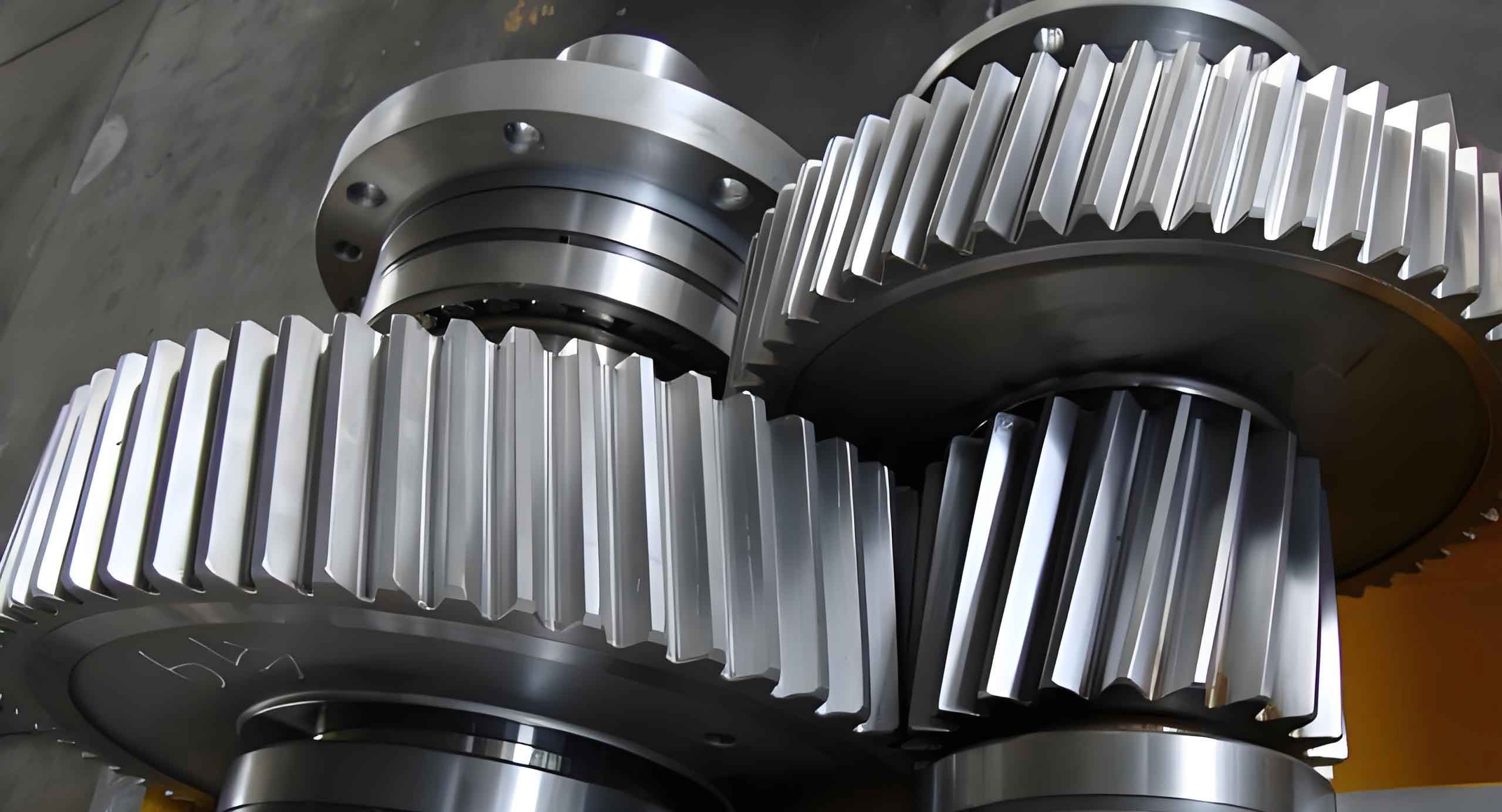
The geometric parameters of the helical gears studied are critical for analysis. We summarize them in Table 1, which includes key dimensions like normal module, number of teeth, pressure angle, helix angle, shift coefficient, and face width. These parameters define the baseline for our simulations and optimization.
| Parameter | Driving Gear | Driven Gear |
|---|---|---|
| Normal Module (mm) | 1.3 | 1.3 |
| Number of Teeth | 61 | 132 |
| Pressure Angle (degrees) | 17.5 | 17.5 |
| Helix Angle (degrees) | 18 | 18 |
| Shift Coefficient | -0.077 | 0.150 |
| Face Width (mm) | 15 | 14 |
Using FEM, we construct a 3D model of the helical gear pair, focusing on the contact region during a meshing cycle to balance accuracy and computational efficiency. The mesh is refined near the contact surfaces to capture stress concentrations. The maximum contact stress obtained is approximately 987.5 MPa, which aligns with theoretical calculations (e.g., Hertzian contact theory yielding around 963.2 MPa), validating the model. The TE curve derived from FEM shows a fluctuation amplitude of 5.7035 μm over a meshing period, with peaks corresponding to three-tooth contact and valleys to four-tooth contact (the contact ratio is 3.325). This periodic variation highlights the impact of alternating single and double tooth contact on vibration excitation.
Slice theory, implemented in a ROMAX environment, provides comparable results. The gear tooth is divided into slices along the face width (1 mm increments) and along the profile (0.5 mm increments). The calculated TE fluctuation is 5.0596 μm, closely matching the FEM result. The load distribution from slice theory indicates non-uniformity, with higher loads on one side of the tooth, reaching a maximum unit load of 196.7 N/mm. This asymmetry contributes to vibration and noise. The TE curve period is 2.73 degrees, with three-tooth contact from 0 to 1.84 degrees and four-tooth contact from 1.84 to 2.73 degrees. These insights guide our optimization efforts.
To reduce vibration and noise in helical gears, tooth modification is a proven strategy. It involves altering the tooth profile (tip and root relief) and lead (crowning) to compensate for deformations and errors. We consider three modification parameters: tip relief amount \( \Delta_1 \), tip relief height \( h_1 \), root relief amount \( \Delta_2 \), root relief height \( h_2 \), and crowning amount \( C_a \). Based on empirical formulas, the ranges for these parameters are determined. For profile modification, the maximum relief amount is \( \Delta_{\text{max}} = 0.02 m_n = 0.026 \, \text{mm} \) and the maximum relief height is \( h_{\text{max}} = 0.65 m_n = 0.845 \, \text{mm} \), where \( m_n \) is the normal module. For lead crowning, the formula is:
$$ C_a = \begin{cases} \frac{2F_m F_{\beta y}}{C b}, & \text{if } b_{\text{cal}} < b \\ 0.5 F_{\beta y} + \frac{F_m}{C b}, & \text{if } b_{\text{cal}} \geq b \end{cases} $$
where \( C \) is the mesh stiffness (11.256 GPa), \( b \) is the face width (14 mm), \( b_{\text{cal}} \) is the effective contact width (26.641 mm), \( F_m \) is the tangential force (6961.3 N), and \( F_{\beta y} \) is the lead error (2.3113 μm). This yields \( C_a = 23.8 \, \mu\text{m} \). We use linear profile modification for cost-effectiveness, and the parameter ranges are summarized in Table 2.
| Modification Parameter | Range |
|---|---|
| Tip Relief Amount \( \Delta_1 \) (μm) | 0 to 26 |
| Tip Relief Height \( h_1 \) (mm) | 0 to 0.845 |
| Root Relief Amount \( \Delta_2 \) (μm) | 0 to 26 |
| Root Relief Height \( h_2 \) (mm) | 0 to 0.845 |
| Crowning Amount \( C_a \) (μm) | 0 to 23.8 |
We optimize the modification parameters using an enumeration method based on slice theory, with step sizes of 0.01 μm for relief amounts and crowning, and 1 μm for relief heights. Three optimization objectives are considered: minimizing TE fluctuation, optimizing load distribution, and a combined approach. The results are evaluated in terms of TE amplitude and maximum unit load.
First, focusing solely on minimizing TE fluctuation, we find an optimal parameter set (Table 3) that reduces TE amplitude to 1.2253 μm—a 75.78% decrease from the unmodified case. However, the load distribution becomes more concentrated, with the maximum unit load increasing to 236 N/mm (19.98% higher). This indicates that minimizing TE alone may exacerbate load non-uniformity, potentially leading to increased stress and noise.
| Gear | \( \Delta_1 \) (μm) | \( h_1 \) (mm) | \( \Delta_2 \) (μm) | \( h_2 \) (mm) | \( C_a \) (μm) |
|---|---|---|---|---|---|
| Driving Gear | 2.30 | 0.602 | 2.30 | 0.598 | 0.70 |
| Driven Gear | 3.40 | 0.602 | 3.40 | 0.598 | 0.67 |
Second, targeting optimal load distribution (uniform across the face width and centered on the tooth profile), we obtain another parameter set (Table 4). This improves load distribution, reducing the maximum unit load to 186 N/mm, but the TE fluctuation is 2.0779 μm—only a 60% reduction from the baseline. The TE curve shows sharp peaks, suggesting residual impact during meshing. Thus, focusing only on load distribution does not fully mitigate vibration.
| Gear | \( \Delta_1 \) (μm) | \( h_1 \) (mm) | \( \Delta_2 \) (μm) | \( h_2 \) (mm) | \( C_a \) (μm) |
|---|---|---|---|---|---|
| Driving Gear | 1.90 | 0.100 | 1.90 | 0.100 | 0.45 |
| Driven Gear | 2.10 | 0.100 | 2.10 | 0.100 | 0.49 |
Third, we consider a combined approach that balances TE reduction and load distribution improvement. The optimal parameters from this multi-objective optimization are listed in Table 5. The resulting TE fluctuation is 1.2771 μm (74.76% reduction), nearly as low as the TE-minimization case, while the load distribution remains uniform with a maximum unit load of 188.7 N/mm—a slight improvement over the baseline. This demonstrates that a holistic optimization strategy is essential for helical gears to achieve both smooth meshing and reliable operation.
| Gear | \( \Delta_1 \) (μm) | \( h_1 \) (mm) | \( \Delta_2 \) (μm) | \( h_2 \) (mm) | \( C_a \) (μm) |
|---|---|---|---|---|---|
| Driving Gear | 1.100 | 0.100 | 1.100 | 0.100 | 0.700 |
| Driven Gear | 0.900 | 0.100 | 0.900 | 0.100 | 0.670 |
The performance of these modification schemes is summarized in Table 6, comparing TE fluctuation and maximum unit load. The combined approach offers the best compromise, significantly reducing TE while maintaining favorable load distribution.
| Modification Scheme | Maximum Unit Load (N/mm) | TE Fluctuation Amplitude (μm) |
|---|---|---|
| Unmodified | 196.7 | 5.0596 |
| Minimum TE Fluctuation | 236.0 | 1.2253 |
| Optimal Load Distribution | 186.0 | 2.0779 |
| Combined TE and Load Distribution | 188.7 | 1.2771 |
To validate our analytical and optimization results, we conduct experimental tests on an automotive transmission equipped with the helical gears. The setup includes microphones for noise measurement, accelerometers for vibration, and a tachometer for speed tracking, arranged to capture data in multiple directions. The transmission is operated under a constant input torque of 178 N·m, with speed ramping from 0 to 5,000 rpm. Noise and vibration data are analyzed using order tracking to isolate contributions from the helical gear pair.
The experimental results show that all modification schemes reduce overall transmission noise by 0–4 dB, with the combined approach performing best in the speed range of 1,500–3,500 rpm. Specifically, for the helical gears, noise reduction is most pronounced at 2,700–3,200 rpm, aligning with the operational conditions studied. This confirms that our optimization effectively mitigates vibration and noise in helical gears. The close agreement between simulated and experimental outcomes validates the accuracy of our FEM and slice theory models, as well as the practicality of the modification parameters.
In conclusion, this study provides a comprehensive analysis of vibration and noise in helical gears, emphasizing the role of transmission error and load distribution. We demonstrate that finite element method and slice theory are effective tools for evaluating helical gear dynamics, with slice theory offering a efficient alternative for optimization studies. Gear modification is crucial for performance enhancement, but a singular focus on either TE minimization or load distribution optimization may lead to suboptimal results. Instead, a combined approach that considers both factors yields the best outcome, significantly reducing TE fluctuation while ensuring uniform load distribution. Experimental tests on an automotive transmission corroborate our findings, showing measurable noise reduction. Future work could explore advanced modification techniques, such as nonlinear profile relief or dynamic optimization under varying loads, to further improve helical gear performance in diverse applications. This research underscores the importance of holistic design strategies for helical gears in achieving quiet and reliable transmission systems.
Throughout this analysis, we have highlighted the complexities of helical gear meshing and the need for integrated solutions. The methodologies presented here can be extended to other gear types, but helical gears remain a focal point due to their widespread use and unique challenges. By continuing to refine analytical models and optimization algorithms, we can push the boundaries of gear technology, contributing to quieter and more efficient machinery across industries.