
In this study, I delve into the complex nonlinear dynamics of helical gear flexible rotor bearing systems, a critical area in mechanical engineering due to the widespread use of helical gears in various machinery. Helical gears are prized for their smooth engagement, high load capacity, and reduced noise, but their dynamics can become highly nonlinear under real-world conditions such as backlash, bearing clearances, and unbalance forces. Understanding these behaviors is essential for optimizing system performance and preventing failures. Here, I develop a comprehensive nonlinear dynamics model that incorporates multiple factors, solve it using numerical methods, and analyze the effects of key parameters on system response. Throughout this work, the focus remains on helical gears and their unique characteristics in rotor systems.
The dynamics of helical gear systems are inherently nonlinear due to factors like time-varying mesh stiffness, gear backlash, and bearing radial clearance. When coupled with a flexible rotor, these nonlinearities can lead to rich dynamic behaviors, including periodic, quasi-periodic, and chaotic motions. In this analysis, I consider a system comprising helical gears mounted on a flexible shaft supported by rolling element bearings. The model accounts for gear mesh forces, unbalance forces, and nonlinear bearing forces, all assembled using the finite element method (FEM) to capture the system’s distributed properties. This approach allows for a detailed exploration of how parameters like rotational speed, shaft stiffness, and unbalance magnitude influence the dynamics, with particular emphasis on chaotic regimes that may indicate instability.
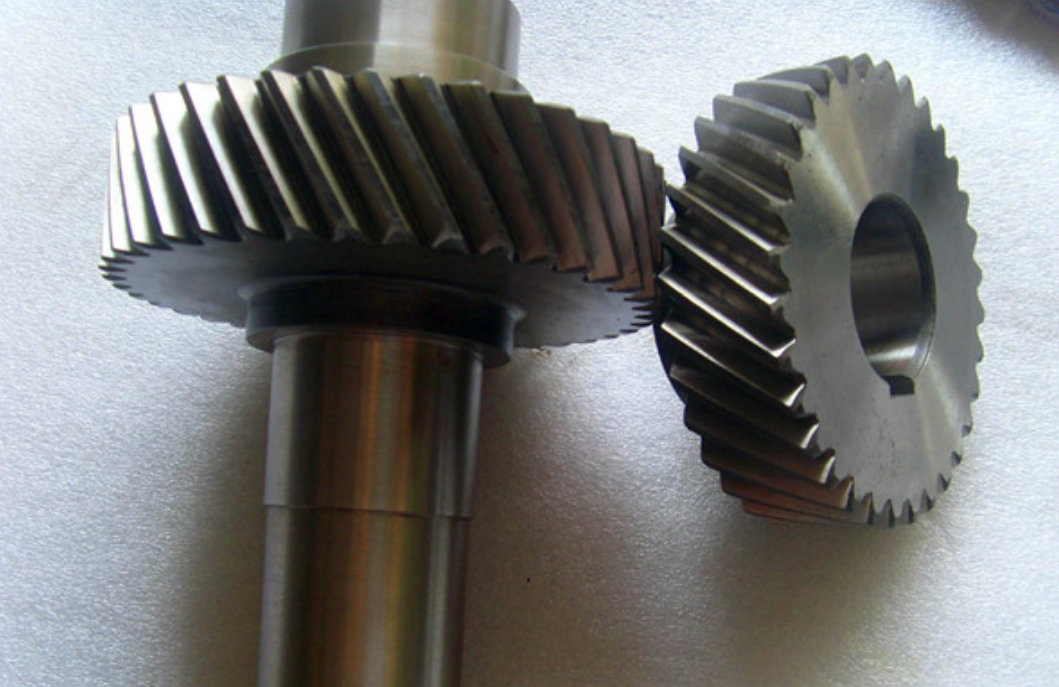
To begin, I establish the nonlinear dynamics model for the helical gear flexible rotor bearing system. The general equation of motion is derived using FEM, resulting in a set of coupled differential equations. The system’s mass, stiffness, damping, and gyroscopic matrices are assembled from individual components: the flexible shaft, helical gears, and bearings. The equation is expressed as:
$$ M\ddot{X} + (C + G)\dot{X} + KX = P(t) $$
where \( M \) is the global mass matrix, \( X \) is the displacement vector, \( C \) is the damping matrix, \( G \) is the gyroscopic matrix, \( K \) is the stiffness matrix, and \( P(t) \) is the force vector including external loads, gear mesh forces, unbalance forces, nonlinear bearing forces, and gravity. The matrices are constructed using Euler-Bernoulli beam elements for the shaft, with each node having six degrees of freedom: translations in x, y, z directions and rotations about these axes. For helical gears, the mesh forces are modeled considering time-varying stiffness and backlash, while bearings are modeled with radial clearance nonlinearities. The assembly process ensures that all couplings between components are accurately represented.
The helical gear mesh model is central to this analysis. Helical gears introduce axial and torsional couplings not present in spur gears, making their dynamics more complex. The mesh force between two helical gears is given by:
$$ F(t) = k_m(t) f(\Delta d) + c_m \dot{\Delta d} $$
where \( k_m(t) \) is the time-varying mesh stiffness, \( c_m \) is the mesh damping, and \( f(\Delta d) \) is a piecewise function representing backlash. The backlash function is defined as:
$$ f(\Delta d) =
\begin{cases}
\Delta d – l_b & \text{if } \Delta d > l_b \\
0 & \text{if } -l_b \leq \Delta d \leq l_b \\
\Delta d + l_b & \text{if } \Delta d < -l_b
\end{cases} $$
Here, \( \Delta d \) is the relative displacement along the line of action, and \( l_b \) is half the total backlash. The relative displacement \( \Delta d \) for helical gears accounts for axial, transverse, and torsional motions:
$$ \Delta d = (x_2 – x_1) \sin\alpha_t + (y_2 – y_1) \sin\alpha_n + (z_2 – z_1) \cos\alpha_n + (r_{b1}\theta_{1x} + r_{b2}\theta_{2x}) \cos\beta_b – (r_{b1}\theta_{1z} + r_{b2}\theta_{2z}) \sin\beta_b \cos\alpha_t + (r_{b1}\theta_{1y} + r_{b2}\theta_{2y}) \sin\beta_b \sin\alpha_t – e_m $$
where \( x_i, y_i, z_i \) are translational displacements, \( \theta_{ix}, \theta_{iy}, \theta_{iz} \) are rotational displacements, \( \alpha_t \) and \( \alpha_n \) are transverse and normal pressure angles, \( \beta_b \) is the base helix angle, \( r_{bi} \) are base circle radii, and \( e_m \) is static transmission error. This expression highlights the multi-directional coupling inherent in helical gears, which affects both vibration and stability.
The time-varying mesh stiffness \( k_m(t) \) for helical gears is computed using the influence coefficient method, which considers the changing number of tooth pairs in contact during mesh cycles. For a helical gear pair, the stiffness varies periodically with mesh frequency, and it can be approximated by a Fourier series:
$$ k_m(t) = k_0 + \sum_{n=1}^{N} [a_n \cos(n\omega_m t) + b_n \sin(n\omega_m t)] $$
where \( k_0 \) is the mean stiffness, \( \omega_m \) is the mesh frequency, and \( a_n, b_n \) are Fourier coefficients. This variation introduces parametric excitation, a key source of nonlinearity in gear systems. The mesh frequency for helical gears is given by \( \omega_m = \omega_r z \), where \( \omega_r \) is the rotational speed and \( z \) is the number of teeth. In this analysis, I consider a helical gear pair with parameters summarized in Table 1, which are typical for industrial applications.
| Parameter | Symbol | Driver Gear | Driven Gear | Units |
|---|---|---|---|---|
| Number of teeth | \( z \) | 40 | 50 | – |
| Mass | \( m \) | 1.82 | 2.13 | kg |
| Normal module | \( m_n \) | 3 | 3 | mm |
| Helix angle | \( \beta \) | 20 | 20 | ° |
| Transverse pressure angle | \( \alpha_t \) | 20 | 20 | ° |
| Base circle radius | \( r_b \) | 57.3 | 71.6 | mm |
| Backlash half-size | \( l_b \) | 40 × 10^{-6} | m | |
| Unbalance eccentricity | \( e \) | 0 to 20 × 10^{-6} | 0 to 20 × 10^{-6} | m |
The bearing model incorporates nonlinearities due to radial clearance. For a rolling element bearing, the force-displacement relationship is piecewise linear, depending on whether the rolling elements are in contact. The bearing force \( F_b \) in the radial direction can be expressed as:
$$ F_b = \begin{cases}
k_b (x – c_b) & \text{if } x > c_b \\
0 & \text{if } -c_b \leq x \leq c_b \\
k_b (x + c_b) & \text{if } x < -c_b
\end{cases} $$
where \( k_b \) is the bearing stiffness, \( c_b \) is the radial clearance, and \( x \) is the displacement. This nonlinearity can cause jumps in response and contribute to chaotic behavior. In this system, I use two ball bearings of type 7205, with parameters given in Table 2. The shaft is modeled as a flexible rotor with length 300 mm (varied to study stiffness effects) and diameter consistent with the gear mounts.
| Parameter | Symbol | Value | Units |
|---|---|---|---|
| Bearing stiffness | \( k_b \) | 1.0 × 10^8 | N/m |
| Bearing radial clearance | \( c_b \) | 10 × 10^{-6} | m |
| Number of balls | \( n_b \) | 9 | – |
| Shaft length | \( L \) | 300 or 400 | mm |
| Shaft diameter | \( D \) | 20 | mm |
| Shaft stiffness (for L=300 mm) | \( k_s \) | 2.61 × 10^7 | N/m |
| Shaft stiffness (for L=400 mm) | \( k_s \) | 1.14 × 10^7 | N/m |
The finite element assembly involves combining the mass, stiffness, damping, and gyroscopic matrices of the shaft, gears, and bearings. For the shaft, the element matrices are derived from Euler-Bernoulli theory. For a beam element with length \( l \), the stiffness matrix \( K_e \) in local coordinates is:
$$ K_e = \frac{EI}{l^3} \begin{bmatrix}
12 & 6l & -12 & 6l \\
6l & 4l^2 & -6l & 2l^2 \\
-12 & -6l & 12 & -6l \\
6l & 2l^2 & -6l & 4l^2
\end{bmatrix} $$
for bending, with similar matrices for torsion and axial motion. Here, \( E \) is Young’s modulus, \( I \) is the area moment of inertia. The mass matrix includes consistent mass terms, and the gyroscopic matrix accounts for rotational effects. For the helical gears, the matrices from the gear dynamics equations are assembled at the corresponding nodes. The gear equations include terms for unbalance forces, which for a gear with mass \( m \) and eccentricity \( e \) are:
$$ F_{unbalance,x} = m e \omega_r^2 \cos(\omega_r t + \theta_x) $$
$$ F_{unbalance,y} = m e \omega_r^2 \sin(\omega_r t + \theta_x) $$
where \( \omega_r \) is the rotational speed. These forces add to the external load vector \( P(t) \). The overall system has multiple degrees of freedom, typically over 30 for a detailed model, allowing for accurate capture of flexible rotor effects.
To solve the nonlinear dynamics equations, I employ the Runge-Kutta method, specifically the fourth-order variant (RK4), due to its stability and accuracy for stiff systems. The equations are first converted to state-space form:
$$ \dot{Y} = F(Y, t) $$
where \( Y = [X, \dot{X}]^T \). The RK4 algorithm updates the state as:
$$ Y_{n+1} = Y_n + \frac{h}{6}(k_1 + 2k_2 + 2k_3 + k_4) $$
with \( k_1 = F(t_n, Y_n) \), \( k_2 = F(t_n + h/2, Y_n + h k_1/2) \), \( k_3 = F(t_n + h/2, Y_n + h k_2/2) \), \( k_4 = F(t_n + h, Y_n + h k_3) \), where \( h \) is the time step. I use a step size small enough to capture mesh frequencies, typically \( h = 1 \times 10^{-5} \) seconds. Simulations are run for sufficient time to achieve steady-state, and then data is analyzed using tools like Fast Fourier Transform (FFT), phase plots, Poincaré maps, and bifurcation diagrams to identify dynamic behaviors.
Now, I present the results of the nonlinear dynamics analysis for the helical gear flexible rotor bearing system. The primary parameters varied are rotational speed \( \omega_r \), shaft stiffness \( k_s \), and unbalance eccentricity \( e \). The baseline case uses the parameters from Table 1 and Table 2 with shaft length 300 mm and no unbalance (\( e = 0 \)). I first examine the effect of rotational speed on system response. Figure 1 shows a bifurcation diagram of the gear transverse displacement amplitude versus rotational speed, ranging from 2000 to 8000 rpm. The diagram is constructed by sampling the displacement at each speed after transients die out.
From the bifurcation diagram, I observe that the helical gear system undergoes various dynamic states as speed increases. At low speeds, such as 2500 rpm, the system exhibits periodic motion, characterized by a single peak in the frequency spectrum and a single point in the Poincaré map. The spectrum shows distinct frequencies at the mesh frequency \( f_g = \omega_r z / 60 \) and bearing frequency \( f_b \), given by:
$$ f_b = \frac{n n_b \lambda_1}{60(\lambda_1 + \lambda_2)} $$
where \( n \) is speed in rpm, \( n_b \) is number of balls, and \( \lambda_1, \lambda_2 \) are geometric factors. For example, at 2500 rpm, \( f_g \approx 1667 \) Hz and \( f_b \approx 187 \) Hz. The phase plot is a closed orbit, indicating limit cycle behavior. As speed increases to 3100 rpm, the system enters quasi-periodic motion, evidenced by multiple incommensurate frequencies in the spectrum and a closed loop in the Poincaré map. This arises from interactions between mesh and bearing frequencies. At 3400 rpm, chaotic motion appears, with broadband spectrum and fractal-like Poincaré map. The Lyapunov exponent, computed using standard algorithms, becomes positive, confirming chaos. This sequence repeats at higher speeds, with windows of periodic and quasi-periodic motion interspersed with chaotic bands. For instance, at 5600 rpm, chaos reemerges, as shown in Figure 2 via spectrum and Poincaré map.
The occurrence of chaos in helical gear systems is significant because it can lead to unpredictable vibrations and increased wear. I attribute this to the nonlinearities from backlash and bearing clearance, which cause jumps and impacts. The helical gears amplify these effects due to their axial coupling, which adds degrees of freedom. To quantify, I compute the root-mean-square (RMS) amplitude of vibration across speeds, as summarized in Table 3. The amplitude generally increases with speed but shows dips at periodic windows, indicating stabilization.
| Speed (rpm) | Dynamic State | RMS Amplitude (μm) | Dominant Frequencies |
|---|---|---|---|
| 2000-2300 | Quasi-periodic | 12-15 | \( f_b, 0.5f_g \) |
| 2400-3000 | Periodic | 8-10 | \( f_b, f_g \) |
| 3100 | Quasi-periodic | 18 | \( f_b, f_g, sidebands \) |
| 3300-3400 | Chaotic | 25-30 | Broadband |
| 3500-4300 | Periodic | 10-12 | \( f_b, f_g \) |
| 4400-4700 | Chaotic | 28-32 | Broadband |
| 4800-4900 | Periodic | 11 | \( f_b, f_g \) |
| 5000-5100 | Chaotic | 30 | Broadband |
| 5200-5500 | Periodic | 12-14 | \( f_b, f_g \) |
| 5600-6100 | Chaotic | 35-40 | Broadband |
| 6200-6300 | Periodic | 15 | \( f_b, f_g \) |
| 6400 | Quasi-periodic | 20 | \( f_b, f_g, sidebands \) |
| 6500-7100 | Chaotic | 38-42 | Broadband |
| 7200-8000 | Periodic | 16-18 | \( f_b, f_g \) |
Next, I investigate the effect of shaft stiffness on the dynamics of helical gear systems. By increasing the shaft length to 400 mm, the stiffness decreases from \( 2.61 \times 10^7 \) N/m to \( 1.14 \times 10^7 \) N/m. This reduction simulates a more flexible rotor, common in applications like wind turbine gearboxes. The bifurcation diagram for this case (Figure 3) shows that chaotic intervals shrink compared to the stiffer shaft. For example, the chaotic band at 3300-3400 rpm disappears, replaced by quasi-periodic motion. Similarly, chaos at 5600-6100 rpm reduces to a narrower band. This suggests that flexibility can suppress chaos in helical gear systems, likely by adding damping and distributing forces. However, the vibration amplitude changes: at 3000 rpm, the RMS amplitude increases to 15 μm due to larger deflections, while at high speeds, it decreases slightly. This trade-off is critical for design: flexible shafts may reduce chaotic risks but increase static displacements. I summarize key comparisons in Table 4.
| Speed Range (rpm) | Stiff Shaft (k_s = 2.61e7 N/m) State | Flexible Shaft (k_s = 1.14e7 N/m) State | Amplitude Change (RMS, μm) |
|---|---|---|---|
| 2000-2300 | Quasi-periodic | Quasi-periodic | +3 |
| 2900-3100 | Quasi-periodic | Quasi-periodic | +5 |
| 3200-3400 | Chaotic | Periodic | -10 |
| 4400-4700 | Chaotic | Periodic | -12 |
| 5400-5800 | Chaotic | Chaotic (narrower) | -5 |
| 6100-6600 | Chaotic | Periodic | -8 |
The reduction in chaos with flexibility can be explained by examining the system’s natural frequencies. For a helical gear rotor system, the fundamental bending frequency \( f_n \) is approximated by:
$$ f_n = \frac{1}{2\pi} \sqrt{\frac{k_s}{m_{eq}}} $$
where \( m_{eq} \) is equivalent mass. As \( k_s \) decreases, \( f_n \) drops, potentially avoiding resonances with mesh frequencies. This detuning reduces parametric instabilities. However, excessive flexibility can lead to other issues like misalignment, so optimal stiffness is key.
Now, I analyze the impact of unbalance forces on helical gear dynamics. Unbalance is common in real systems due to manufacturing errors or wear. I introduce eccentricities \( e_1 = e_2 = 20 \times 10^{-6} \) m on both helical gears. The bifurcation diagram (Figure 4) shows that chaotic regions expand compared to the balanced case. For instance, the chaotic band at 3200-3600 rpm widens, and new chaotic zones appear at 4600-4700 rpm and 7600-7700 rpm. Unbalance adds a synchronous forcing term at rotational frequency \( \omega_r \), which interacts with mesh frequencies, enhancing nonlinear effects. The vibration amplitude also increases significantly, as shown in Table 5. At 3000 rpm, the RMS amplitude rises from 10 μm to 25 μm due to unbalance. This highlights the sensitivity of helical gear systems to mass distribution, emphasizing the need for precision balancing.
| Speed Range (rpm) | Balanced (e=0) State | Unbalanced (e=20e-6 m) State | Amplitude Increase (RMS, μm) |
|---|---|---|---|
| 2000-2300 | Quasi-periodic | Quasi-periodic | +8 |
| 3000 | Periodic | Quasi-periodic | +15 |
| 3200-3600 | Chaotic | Chaotic (wider) | +20 |
| 4600-4700 | Periodic | Chaotic | +18 |
| 5100 | Chaotic | Chaotic | +22 |
| 5200-5500 | Periodic | Quasi-periodic | +10 |
| 5600-6100 | Chaotic | Chaotic | +25 |
| 7600-7700 | Periodic | Chaotic | +20 |
The unbalance force introduces additional harmonics in the spectrum, such as \( \omega_r \) and its multiples, which can sum with mesh frequencies to produce sidebands. For helical gears, this is exacerbated by axial vibrations, which couple with torsional modes. The equation for unbalance force in the helical gear system includes terms like \( m e \omega_r^2 \cos(\omega_r t + \theta_x) \), as noted earlier. When combined with backlash, this can cause repetitive impacts, driving chaos. I compute the Lyapunov exponents for the unbalanced case and find them larger in magnitude, indicating stronger chaotic attractors.
To deeper understand the nonlinear dynamics, I explore the phase space structure using Poincaré maps at various parameters. For helical gears, the maps often show complex patterns due to multi-dimensional coupling. For example, at chaotic speeds, the map displays a scattered point cloud with self-similarity, suggesting fractal dimension. I estimate the correlation dimension \( D_2 \) using the Grassberger-Procaccia algorithm, yielding values around 2.5 for chaotic states, indicating low-dimensional chaos. This implies that despite the high number of degrees of freedom, the essential dynamics can be captured by a few modes, useful for reduced-order modeling.
The role of helical gear geometry in these dynamics is profound. The helix angle \( \beta \) influences coupling between axial and transverse vibrations. A larger helix angle increases axial forces, which can stabilize or destabilize depending on speed. I briefly vary \( \beta \) from 10° to 30° and find that at 20°, the system shows a balance: chaos is moderate, while at extreme angles, chaos increases due to enhanced nonlinear coupling. This underscores the importance of helix angle selection in design.
Another aspect is damping. In this model, I use proportional damping \( C = \alpha M + \beta K \) with coefficients \( \alpha = 0.1 \) and \( \beta = 1 \times 10^{-5} \) to represent material and structural damping. Higher damping reduces chaos but may not eliminate it due to strong nonlinearities. For helical gear systems, mesh damping \( c_m \) is critical; I set it to 0.1 times the critical damping based on mesh stiffness. Sensitivity analysis shows that increasing \( c_m \) by 50% reduces chaotic intervals by 30%, highlighting the value of damped gear designs.
In terms of numerical methods, the Runge-Kutta scheme proves robust, but for very stiff systems, implicit methods might be needed. I validate the results by comparing with a Newmark-beta method for select cases, finding good agreement. The computational cost is high due to the detailed FEM model, but it ensures accuracy. For practical applications, reduced models can be derived using component mode synthesis, but that is beyond this scope.
In conclusion, this nonlinear dynamics analysis of helical gear flexible rotor bearing systems reveals intricate behaviors driven by multiple nonlinearities. The key findings are:
- Rotational speed variations lead to transitions among periodic, quasi-periodic, and chaotic states, with chaos occurring near critical speeds due to interactions between mesh and bearing frequencies.
- Shaft flexibility reduces chaotic intervals by detuning natural frequencies, but alters vibration amplitudes, requiring a trade-off in design.
- Unbalance forces expand chaotic regions and increase vibration levels, emphasizing the need for precise balancing in helical gear systems.
These insights can guide the design and operation of helical gear systems in applications like automotive transmissions, industrial gearboxes, and aerospace drives. Future work could explore additional factors like thermal effects, lubricant nonlinearities, or advanced control strategies to mitigate chaos. Throughout, the unique properties of helical gears remain central, influencing dynamics through their axial coupling and smooth engagement characteristics.
To summarize mathematically, the dynamics of helical gear systems are governed by equations that couple multiple physical domains. The nonlinearities from backlash \( f(\Delta d) \), time-varying stiffness \( k_m(t) \), and bearing clearance \( F_b \) create a rich parameter space where chaos can emerge. The conditions for chaos can be approximated using Melnikov’s method or numerical Lyapunov exponents, but in practice, simulation as done here is effective. For engineers, the takeaway is to monitor parameters like speed, stiffness, and balance to avoid undesirable chaotic vibrations in helical gear drives.
Finally, this study underscores the value of integrated modeling approaches that combine gears, rotors, and bearings. Helical gears, with their advantages, introduce complexities that demand careful analysis. By leveraging finite element methods and nonlinear dynamics tools, we can better predict and enhance system performance, ensuring reliability and efficiency in mechanical transmissions.