
In modern mechanical transmission systems, helical gears are widely employed due to their high load-carrying capacity, smooth operation, and reduced noise compared to spur gears. However, during operation, various errors and deformations cause the actual meshing point to deviate from the theoretical meshing line, leading to velocity differences between driving and driven wheels. This results in meshing interference and impact, generating significant shock, vibration, and noise. To address these issues, dynamic contact analysis and optimization of helical gears are essential for improving performance and longevity. In this article, we explore the dynamic characteristics of helical gears through parametric modeling, explicit dynamic finite element analysis, and tooth profile modification, aiming to minimize meshing impact and enhance overall dynamic behavior.
Helical gears exhibit complex contact patterns due to their angled teeth, which engage gradually, providing multiple tooth contact and higher strength. Nonetheless, this complexity introduces challenges in analyzing dynamic stresses and impacts. Over the years, researchers have extensively studied gear dynamics using finite element methods. For instance, studies have applied dynamic contact finite element analysis to simulate meshing impacts and proposed modifications like profile relief to reduce shock. However, many works lack precise modification parameters, leading to inconsistent standards in industry. We aim to fill this gap by establishing a comprehensive model for helical gears, conducting numerical simulations, and deriving optimal modification parameters to optimize dynamic characteristics.
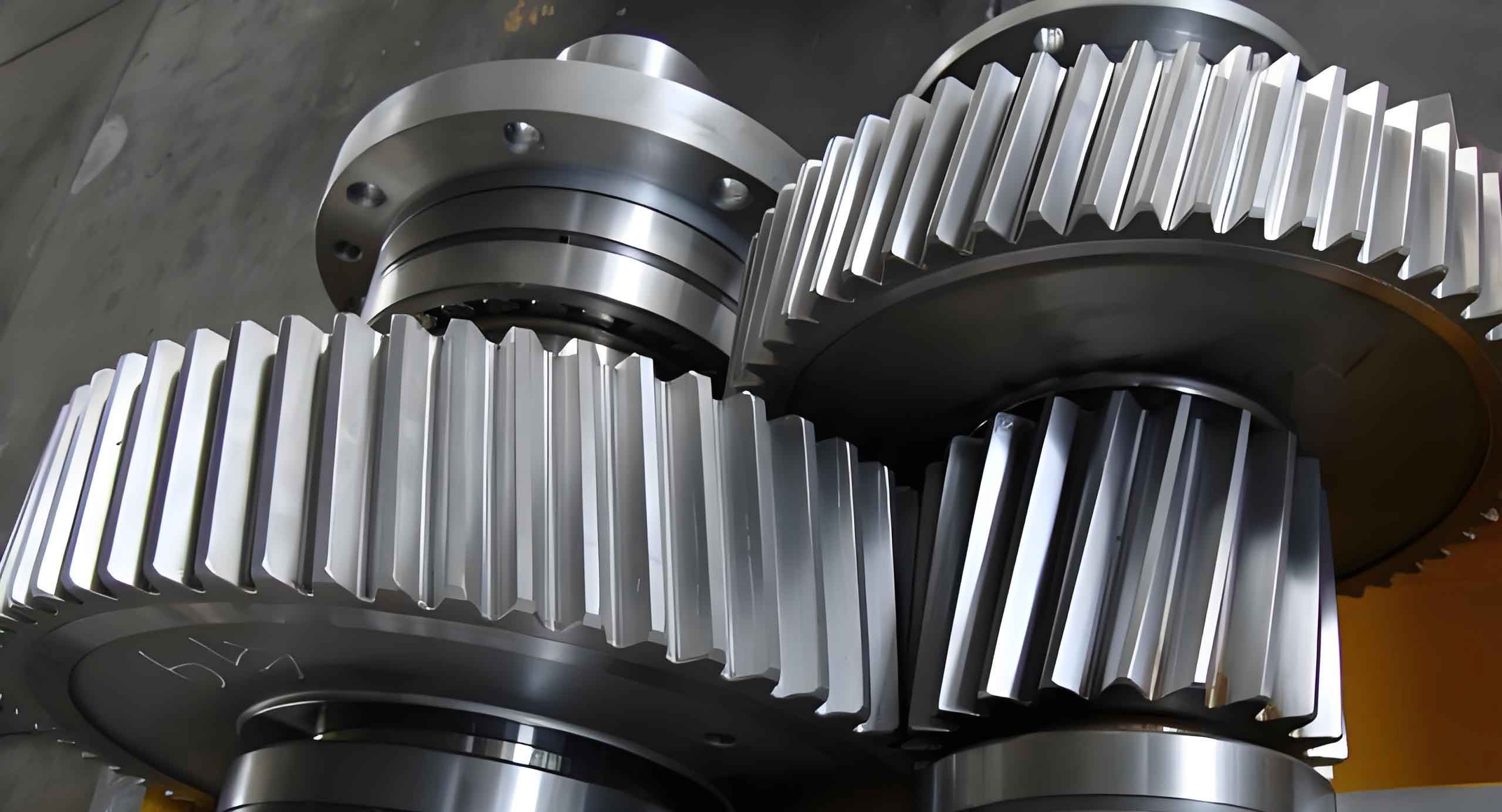
Our approach involves creating a parametric three-dimensional geometric model of a helical gear pair based on gear meshing principles and coordinate transformations. The geometric parameters are as follows: driving gear teeth \(z_1 = 18\), driven gear teeth \(z_2 = 63\), module \(m = 3.5 \, \text{mm}\), face width \(B = 50 \, \text{mm}\), profile shift coefficients \(x_1 = 0.214\) and \(x_2 = -0.1421\), pressure angle \(\alpha = 20^\circ\), helix angle \(\beta = 10^\circ\), and contact ratio \(\varepsilon = 2.28\). The material properties include elastic modulus \(E = 2.06 \times 10^{11} \, \text{Pa}\), density \(\rho = 7.85 \times 10^3 \, \text{kg/m}^3\), Poisson’s ratio \(\mu = 0.3\), and yield strength \(850 \, \text{MPa}\). The operating conditions are an input speed of \(1440 \, \text{r/min}\) and a load torque of \(200 \, \text{N·m}\). Using ANSYS/APDL parametric language, we generate an accurate geometric model, which is then meshed with SOLID164 three-dimensional solid elements for finite element analysis. To apply rotational constraints, a rigid shell element SHELL163 is attached to the inner ring of each helical gear, sharing nodes with the solid elements. This allows us to impose constraints via the rigid body, facilitating dynamic simulations.
The dynamic contact problem for helical gears is governed by the equation of motion, expressed as:
$$M_i \ddot{u}_i(t) + C_i \dot{u}_i(t) + K_i u_i(t) = P_i(t) + F_i(t) \quad (i = p, g)$$
where \(M_i\), \(C_i\), and \(K_i\) represent the mass, damping, and stiffness matrices of the driving (\(p\)) and driven (\(g\)) helical gears, respectively. \(P_i(t)\) and \(F_i(t)\) denote external loads and contact force loads, while \(u_i(t)\), \(\dot{u}_i(t)\), and \(\ddot{u}_i(t)\) are displacement, velocity, and acceleration vectors. We employ the explicit dynamics method, implemented in LS-DYNA, to solve this equation. The Newmark-\(\beta\) method is used for time integration, with parameters \(\gamma = 0.5\) and \(\beta = 0.25\) to ensure unconditional stability. The effective stiffness matrix \(\hat{K}_i\) and effective load vector \(\hat{P}_i(t+\Delta t)\) are computed as:
$$\hat{K}_i = K_i + \frac{1}{\beta \Delta t^2} M_i + \frac{1}{\beta \Delta t} C_i$$
$$\hat{P}_i(t+\Delta t) = P_i(t+\Delta t) + M_i \left[ \frac{1}{\beta \Delta t^2} u_i(t) + \frac{1}{\beta \Delta t} \dot{u}_i(t) + \left( \frac{1}{2\beta} – 1 \right) \ddot{u}_i(t) \right] + C_i \left[ \frac{\gamma}{\beta \Delta t} u_i(t) + \frac{\gamma}{\beta} \dot{u}_i(t) + \left( \frac{\gamma}{2\beta} – 1 \right) \ddot{u}_i(t) \right]$$
This formulation enables accurate simulation of dynamic contact forces and stresses in helical gears during meshing.
We perform numerical simulations to analyze dynamic equivalent stress, tooth root bending stress, relative rotational speed, and impact force. The results indicate significant meshing impact in helical gears. For example, the maximum equivalent stress time history curve shows peak fluctuations near the meshing-in position, highlighting shock effects. The tooth root bending stress for a specific tooth (tooth #5) reaches approximately \(257 \, \text{MPa}\), as derived from Hofer’s maximum stress theory. Additionally, the relative speed between driving and driven helical gears exhibits a maximum fluctuation of \(5.598 \, \text{rad/s}\), corresponding to an impact velocity of \(19.593 \, \text{rad/s}\). This speed difference contributes to meshing interference and shock. To quantify impact forces, we extract single-tooth contact force curves, identifying the meshing-in point at \(7.308 \, \text{ms}\). Furthermore, we investigate the relationship between load torque and impact force by varying the driven gear torque. As shown in Table 1, higher load torques lead to larger impact forces and longer impact durations.
| Driven Gear Torque (N·m) | Impact Force (N) | Impact Duration (μs) |
|---|---|---|
| 200 | Minimum | 249 |
| 500 | Intermediate | ~300 |
| Fixed (Infinite) | Maximum | 330 |
The dynamic behavior of helical gears is highly sensitive to geometric imperfections, prompting the need for tooth profile modification. We focus on tip relief applied to the driving helical gear, characterized by relief depth \(\Delta\) and relief height \(h\), as illustrated in the modification schematic. Based on empirical recommendations, we test seven modification parameter sets, listed in Table 2, to optimize dynamic characteristics.
| Set | Relief Depth \(\Delta\) (mm) | Relief Height \(h\) (mm) |
|---|---|---|
| I | 0.010 | 0.875 |
| II | 0.015 | 1.155 |
| III | 0.020 | 1.400 |
| IV | 0.025 | 1.725 |
| V | 0.040 | 2.625 |
| VI | 0.050 | 3.150 |
| VII | 0.150 | 3.550 |
For each set, we conduct dynamic contact finite element analysis under input speed \(1000 \, \text{r/min}\) and load torque \(200 \, \text{N·m}\). The results reveal that moderate modification (e.g., Set III) alleviates meshing impact, reducing stress fluctuations without significantly increasing stress magnitudes. In contrast, excessive modification (e.g., Set VII) eliminates peak stress fluctuations but elevates overall stress levels, including tooth root bending stress. Specifically, the maximum equivalent stress time history curves for Sets I, III, and VII demonstrate that Set III achieves optimal balance. Additionally, tooth root bending stress increases with modification depth; for Set III, it remains within acceptable limits. The relative speed analysis shows that for Set III, the maximum speed fluctuation reduces to \(4.140 \, \text{rad/s}\), representing a \(26.04\%\) decrease in impact velocity compared to the unmodified helical gears. This confirms the effectiveness of proper profile modification in enhancing dynamic performance.
To further elucidate the stress distributions, we present key equations and data. The dynamic equivalent stress \(\sigma_{\text{eq}}\) in helical gears during meshing can be approximated by the von Mises criterion:
$$\sigma_{\text{eq}} = \sqrt{ \frac{1}{2} \left[ (\sigma_1 – \sigma_2)^2 + (\sigma_2 – \sigma_3)^2 + (\sigma_3 – \sigma_1)^2 \right] }$$
where \(\sigma_1\), \(\sigma_2\), and \(\sigma_3\) are principal stresses. For tooth root bending stress \(\sigma_b\), we use the formula derived from beam theory:
$$\sigma_b = \frac{F_t}{b m_n} \cdot \frac{6h_f}{\cos \beta} \cdot Y_F Y_S Y_\beta$$
Here, \(F_t\) is the tangential load, \(b\) is face width, \(m_n\) is normal module, \(h_f\) is tooth dedendum, \(\beta\) is helix angle, and \(Y_F\), \(Y_S\), \(Y_\beta\) are form factor, stress correction factor, and helix angle factor, respectively. However, in dynamic simulations, these stresses vary with time due to impact. The impact force \(F_{\text{impact}}\) can be modeled as:
$$F_{\text{impact}} = \frac{\Delta v}{\Delta t} \cdot m_{\text{eq}}$$
where \(\Delta v\) is velocity difference, \(\Delta t\) is impact duration, and \(m_{\text{eq}}\) is equivalent mass of the helical gear pair. Our simulations validate these relationships, showing that for helical gears, impact forces scale with load torque and modification parameters.
The optimization of helical gears involves iterative analysis of modification effects. We summarize the performance metrics for different modification sets in Table 3, based on simulation data. The metrics include peak dynamic equivalent stress, maximum tooth root bending stress, and speed fluctuation reduction.
| Set | Peak Dynamic Equivalent Stress (MPa) | Max Tooth Root Bending Stress (MPa) | Speed Fluctuation Reduction (%) |
|---|---|---|---|
| Unmodified | High with peaks | ~257 | 0 |
| I | Reduced peaks | ~260 | 15 |
| III | Optimized, smooth | ~265 | 26.04 |
| VII | High, no peaks | ~300 | 10 |
From this, we deduce that Set III (\(\Delta = 0.020 \, \text{mm}\), \(h = 1.400 \, \text{mm}\)) provides the best compromise: it minimizes meshing impact, maintains low stress levels, and significantly reduces speed differences. This optimal modification for helical gears enhances dynamic stability and prolongs service life. Additionally, we explore the influence of helix angle on dynamic characteristics. For helical gears, the helix angle \(\beta\) affects contact ratio and load distribution. The total contact ratio \(\varepsilon_{\gamma}\) is given by:
$$\varepsilon_{\gamma} = \varepsilon_{\alpha} + \varepsilon_{\beta}$$
where \(\varepsilon_{\alpha}\) is transverse contact ratio and \(\varepsilon_{\beta}\) is overlap ratio. Higher \(\beta\) increases \(\varepsilon_{\beta}\), promoting smoother meshing but potentially introducing axial loads. Our model accounts for this by including axial constraints in the finite element analysis.
In conclusion, our study demonstrates the importance of dynamic contact analysis for helical gears. Through parametric modeling and explicit dynamic simulations, we identify meshing impacts and speed differences as key issues. Tooth profile modification proves effective in optimizing dynamic characteristics. For the helical gear pair studied, the optimal modification parameters are relief depth \(\Delta = 0.020 \, \text{mm}\) and relief height \(h = 1.400 \, \text{mm}\). This reduces impact velocity by over 26% and stabilizes stress distributions. Future work could extend this approach to other gear types or incorporate thermal effects. Ultimately, understanding and optimizing helical gears through such analyses contribute to more efficient and reliable mechanical transmissions.
Helical gears are complex components requiring meticulous design. The dynamic equations and modification strategies discussed here provide a framework for improvement. By leveraging finite element methods and numerical simulations, engineers can tailor helical gears for specific applications, minimizing noise and vibration while maximizing performance. The iterative process of analysis and optimization, as outlined, ensures that helical gears meet the demanding standards of modern industry. Thus, continued research in this area is vital for advancing gear technology and enhancing overall system efficiency.