
In modern mechanical engineering, helical gears are widely used in transmission systems due to their high efficiency, large power capacity, and precise transmission ratios. As an engineer specializing in gear design, I have explored advanced methods to enhance the design and analysis of helical gears. This article presents a comprehensive approach to parametric modeling and contact finite element analysis (FEA) for helical gears, leveraging software tools like UG and ANSYS. The goal is to create flexible, accurate models and assess their dynamic performance under load, ensuring reliability in applications such as aerospace and automotive industries.
Helical gears feature complex tooth profiles based on involute curves, making their design computationally intensive. Traditional design methods often treat gears as rigid bodies, focusing solely on strength and stiffness checks while neglecting elastic deformations, time-varying mesh stiffness, and transmission errors. To address this, I adopted a feature-based parametric modeling technique using UG software, which allows for rapid model reconstruction by simply inputting new design parameters. Additionally, I conducted both static and dynamic contact FEA using ANSYS and ANSYS/LS-DYNA to capture the full spectrum of gear behavior during operation. This integrated approach not only improves design efficiency but also provides insights into stress distribution and dynamic responses, critical for optimizing helical gears.
Throughout this article, I will delve into the mathematical foundations of helical gear tooth geometry, the step-by-step parametric modeling process, and the detailed FEA procedures. I will emphasize the importance of helical gears in transmission systems and highlight how parametric modeling and FEA can mitigate design flaws. Key aspects include the generation of involute tooth surfaces, the use of expressions in UG, mesh generation in HyperMesh, and the comparison of static versus dynamic contact stresses. By incorporating tables and formulas, I aim to summarize complex data effectively. The keyword “helical gears” will be repeatedly mentioned to underscore their centrality in this discussion.
To begin, let’s consider the fundamental parameters of helical gears. These include the number of teeth (z), normal module (m_n), normal pressure angle (α), helix angle (β), and face width (b). These parameters form the basis for all subsequent calculations and modeling. In parametric modeling, I define relationships between these parameters to automate design changes. For instance, the pitch diameter (d) is calculated as: $$d = \frac{m_n \cdot z}{\cos(\beta)}$$ Similarly, the base diameter (d_b) is given by: $$d_b = d \cdot \cos(\alpha)$$ The addendum diameter (d_a) and dedendum diameter (d_f) are derived as: $$d_a = d + 2 \cdot h_a$$ $$d_f = d – 2 \cdot h_f$$ where h_a and h_f are the addendum and dedendum heights, respectively. These expressions are input into UG’s expression editor to drive the model geometry.
The tooth profile of helical gears is based on an involute curve, which can be described mathematically. From the polar coordinate equations of an involute, I derived the Cartesian coordinates for accurate 3D modeling. The polar equations are: $$r_k = \frac{r_b}{\cos(\alpha_k)}$$ $$\theta_k = \tan(\alpha_k) – \alpha_k$$ where r_k is the radius at any point K on the involute, r_b is the base radius, α_k is the pressure angle at point K, and θ_k is the involute angle. Converting to Cartesian coordinates yields: $$x = r_b \cos(\theta_k) + r_b \cdot \theta_k \cdot \sin(\theta_k)$$ $$y = r_b \sin(\theta_k) – r_b \cdot \theta_k \cdot \cos(\theta_k)$$ For the root fillet, which connects the dedendum circle to the base circle, I used a transition curve equation based on rack-type tool generation: $$x = r \sin(\phi) – \left( \frac{a_1}{\sin(\alpha)} + r_\rho \right) \cos(\alpha’ – \phi)$$ $$y = r \cos(\phi) – \left( \frac{a_1}{\sin(\alpha)} + r_\rho \right) \sin(\alpha’ – \phi)$$ where a_1, r_ρ, and φ are tool-specific parameters. These equations ensure precise tooth geometry for helical gears.
Moreover, the helical nature of the gear requires defining a helix curve that dictates the tooth orientation along the face width. The helix is characterized by its radius (r_1) and pitch (p), with the equation: $$r_1 = r_{ap}$$ $$p = \frac{\pi d}{\tan(\beta)}$$ where r_{ap} is the tip radius and β is the helix angle. In UG, I generated multiple helices as guide curves to sweep the tooth profile, ensuring accuracy across the entire gear width.
To streamline the parametric modeling process, I utilized UG’s feature-based approach. This involves creating sketches, curves, and solids that are driven by expressions. The steps are as follows: First, I drew reference circles (pitch, base, addendum, and dedendum) in a sketch. Second, I used the “Law Curve” tool to plot the involute and transition curves based on the above equations. Third, I mirrored these curves to form a complete tooth profile. Fourth, I generated helix curves using the same tool. Fifth, I swept the tooth profile along the helices to create a single helical tooth. Sixth, I extruded the dedendum circle to form the gear blank. Seventh, I arrayed the tooth around the gear axis using the circular pattern command. Finally, I added features like shaft holes and keyways. This process results in a fully parametric helical gear model that updates automatically when parameters change.
The table below summarizes key expressions used in UG for helical gear parametric modeling, highlighting the relationship between input parameters and derived dimensions. This table serves as a quick reference for designers working with helical gears.
| Parameter | Symbol | Expression in UG |
|---|---|---|
| Number of Teeth | z | z = 20 (example value) |
| Normal Module | m_n | m_n = 3 mm |
| Helix Angle | β | β = 15° |
| Pitch Diameter | d | d = m_n * z / cos(β) |
| Base Diameter | d_b | d_b = d * cos(α) |
| Addendum Diameter | d_a | d_a = d + 2 * h_a |
| Dedendum Diameter | d_f | d_f = d – 2 * h_f |
| Face Width | b | b = 30 mm |
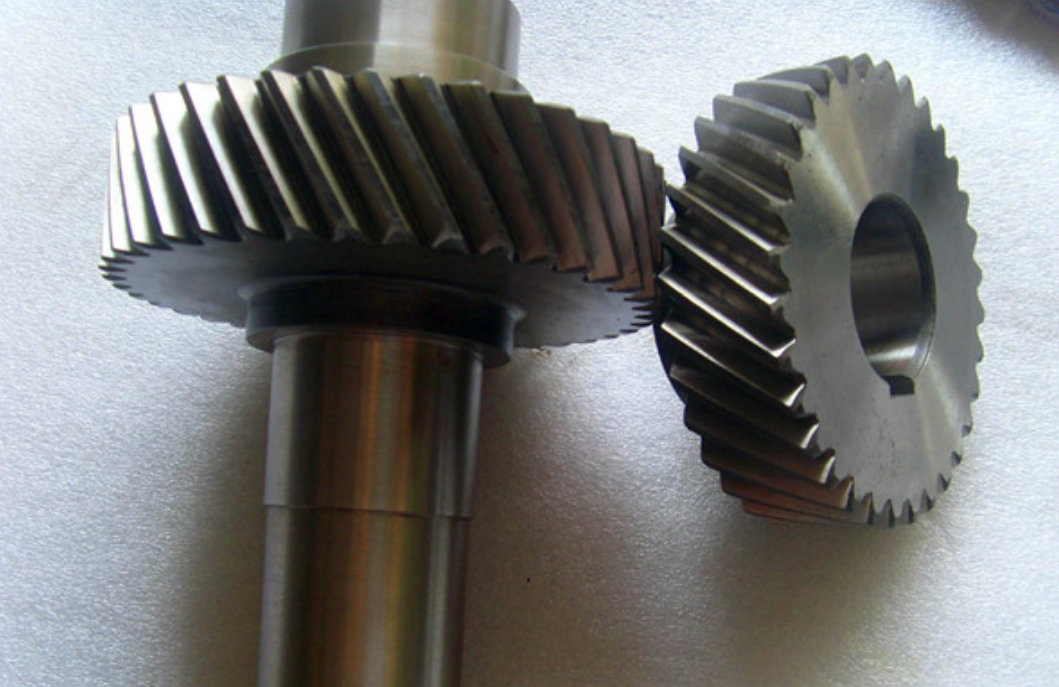
The image above illustrates a typical helical gear model generated through this parametric process. As shown, the helical teeth are inclined along the gear axis, which enhances smooth engagement and load distribution compared to spur gears. This visualization underscores the complexity of helical gears and the need for precise modeling.
Once the parametric model is ready, I proceed to finite element analysis to evaluate contact stresses. Helical gears experience fluctuating loads during meshing, leading to complex contact patterns. I performed both static and dynamic analyses using ANSYS for static cases and ANSYS/LS-DYNA for dynamic simulations. The contact stress calculation for helical gears follows the standard formula: $$\sigma_H = Z_H Z_E Z_\epsilon Z_\beta \sqrt{ \frac{K_H F_t}{b d} \cdot \frac{u + 1}{u} } \leq [\sigma_H]$$ where σ_H is the contact stress, Z_H is the zone factor, Z_E is the elasticity factor, Z_ε is the contact ratio factor, Z_β is the helix angle factor, K_H is the load factor, F_t is the tangential force, u is the gear ratio, and [σ_H] is the allowable contact stress. For my analysis, I used a material of 20CrMnTi with carburizing and quenching, giving an allowable stress of 1600 MPa.
In static FEA, I imported the helical gear model into ANSYS via a Parasolid format. Mesh generation was done in HyperMesh to ensure quality, using solid elements for accuracy. I selected SOLID45 elements, which are 8-node hexahedral elements suitable for 3D stress analysis. The material properties were defined with an elastic modulus of 206 GPa and a Poisson’s ratio of 0.3. To model contact, I used surface-to-surface contact pairs with CONTA174 and TARGE170 elements, setting real constants to control behavior. Loads were applied as equivalent tangential forces on the gear rim to simulate torque, and constraints were placed on the shaft holes. After solving with nonlinear settings, I obtained stress distributions.
The results from static FEA revealed that the maximum contact stress occurred along the tooth contact line, with a value of approximately 1.36 × 10^3 MPa. This is below the allowable limit, indicating satisfactory static strength for these helical gears. The stress cloud plots showed that stresses were concentrated near the tooth tips and along the helical path, consistent with theory for helical gears.
For dynamic FEA, I used ANSYS/LS-DYNA to capture transient effects. The model was meshed with SOLID164 elements, and shell elements were added at the inner ring to apply rotational velocities and torques. Contact was defined as automatic surface-to-surface (ASTS). I applied a rotational speed to the driving helical gear and a resistive torque to the driven gear, simulating real operation over 0.05 seconds. The output was processed in LS-PREPOST to visualize stress over time.
Dynamic analysis showed higher stresses than static analysis due to impact and inertia effects. The maximum equivalent stress peaked at 2.14 × 10^3 MPa for the driven helical gear, exceeding the allowable limit and highlighting the importance of dynamic assessment. The stress patterns were similar to static cases but with more fluctuation, as shown in stress-time curves. The table below compares key results from static and dynamic FEA for helical gears, emphasizing the differences in stress magnitudes and locations.
| Analysis Type | Maximum Contact Stress (MPa) | Location of Maximum Stress | Remarks |
|---|---|---|---|
| Static FEA | 1.36 × 10^3 | Tooth contact line | Within allowable limit |
| Dynamic FEA | 2.14 × 10^3 | Tooth tip region | Exceeds allowable limit |
The contrast between static and dynamic stresses underscores the need for comprehensive FEA in helical gear design. While static analysis provides a baseline, dynamic analysis reveals potential failure points under operational conditions. For helical gears, factors like mesh stiffness variation and damping play crucial roles. I further analyzed the contact forces and deformations using additional formulas. The normal force at the tooth contact can be expressed as: $$F_n = \frac{F_t}{\cos(\alpha) \cos(\beta)}$$ where F_n is the normal force, and α and β are the pressure and helix angles, respectively. The contact half-width (b_c) for helical gears is given by: $$b_c = \sqrt{ \frac{4 F_n}{\pi b} \cdot \frac{1 – \nu_1^2}{E_1} + \frac{1 – \nu_2^2}{E_2} }$$ where ν and E are Poisson’s ratio and elastic modulus for the two gears. These formulas help in understanding contact mechanics.
In practice, parametric modeling and FEA are iterative processes. I optimized the helical gear design by adjusting parameters like helix angle and face width to reduce stresses. For instance, increasing the helix angle can improve load sharing but may raise axial thrust. Using UG, I quickly regenerated models with different helix angles and re-ran FEA to find a balance. This iterative loop is essential for refining helical gears for specific applications.
Moreover, I explored advanced topics like thermal analysis and fatigue assessment for helical gears, but those are beyond this article’s scope. The key takeaway is that integrating parametric modeling with FEA enables robust design of helical gears. The use of software tools like UG and ANSYS streamlines the workflow, from geometry creation to performance validation. For helical gears, this integration is particularly valuable due to their geometric complexity and dynamic loads.
In conclusion, helical gears are critical components in modern machinery, and their design requires careful attention to detail. Through parametric modeling in UG, I achieved flexible and accurate representations of helical gears, driven by mathematical expressions. Finite element analysis in ANSYS and LS-DYNA provided insights into static and dynamic contact stresses, revealing that dynamic effects can significantly increase stress levels. By comparing results, I demonstrated the importance of dynamic FEA for helical gears. This approach not only enhances design efficiency but also ensures reliability, making it a valuable methodology for engineers working with helical gears. Future work could involve multi-physics simulations and optimization algorithms to further improve helical gear performance.
To summarize the key equations used in this article for helical gears, I list them below in a centralized format:
1. Pitch diameter: $$d = \frac{m_n \cdot z}{\cos(\beta)}$$
2. Involute Cartesian coordinates: $$x = r_b \cos(\theta_k) + r_b \cdot \theta_k \cdot \sin(\theta_k)$$ $$y = r_b \sin(\theta_k) – r_b \cdot \theta_k \cdot \cos(\theta_k)$$
3. Helix pitch: $$p = \frac{\pi d}{\tan(\beta)}$$
4. Contact stress: $$\sigma_H = Z_H Z_E Z_\epsilon Z_\beta \sqrt{ \frac{K_H F_t}{b d} \cdot \frac{u + 1}{u} }$$
5. Normal force: $$F_n = \frac{F_t}{\cos(\alpha) \cos(\beta)}$$
These formulas, combined with parametric modeling and FEA, form a comprehensive framework for designing and analyzing helical gears. I hope this article provides useful insights for practitioners and researchers focused on helical gears and their applications in transmission systems.