
The reliable operation of critical power transmission components is paramount in heavy industries such as steel manufacturing. Among these components, helical gear shafts are ubiquitous in drive systems, including those found in Basic Oxygen Furnace (BOF) tilting mechanisms. These mechanisms are responsible for the precise rotation of the furnace vessel for charging, tapping, and slagging operations. The failure of a high-speed helical gear shaft within such a system leads to significant production downtime and economic loss. This study presents a comprehensive engineering analysis of a failed helical gear shaft from a 210-ton BOF tilting mechanism reducer, utilizing advanced simulation techniques to diagnose the failure root cause and predict its operational life. The methodology integrates static structural analysis, detailed load spectrum development, and high-cycle fatigue life prediction, providing a framework for the structural optimization of helical gears and their shafts.
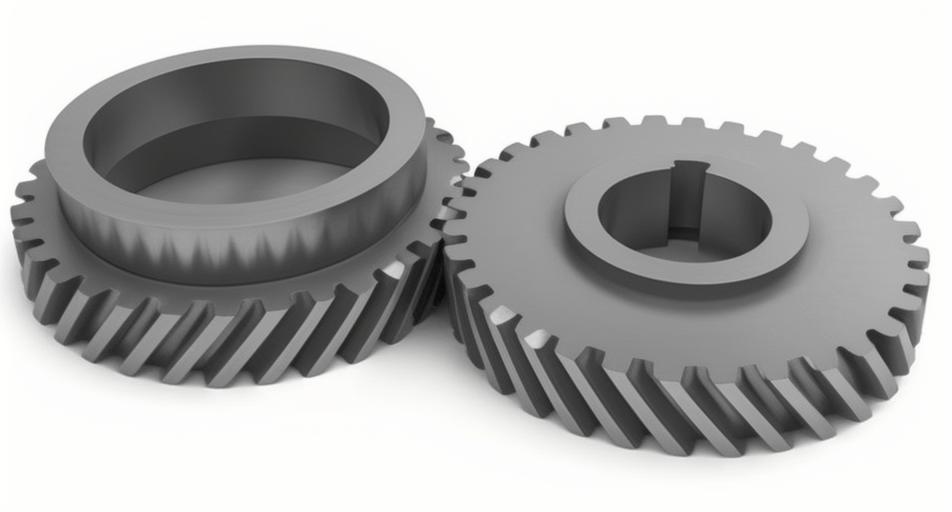
Helical gears are preferred over spur gears in such high-torque applications due to their inherent advantages. The angled teeth of helical gears provide a smoother and quieter operation as engagement is gradual, with multiple teeth in contact at any given time. This leads to a higher load-carrying capacity and reduced stress concentrations per tooth. However, this comes with the introduction of axial thrust forces that must be properly managed by bearings. The helical gear shaft in question transmits substantial torque from the drive motor through a system of helical gears to ultimately tilt the massive furnace. The cyclic and shock nature of the operational loads makes fatigue a dominant failure mode for these components.
Analytical Framework and Methodology
The investigation follows a systematic multi-step approach: (1) development of a high-fidelity three-dimensional computational model; (2) static stress analysis under peak operational loads; (3) derivation of a realistic service load history; and (4) fatigue life calculation based on cumulative damage theory.
1. Finite Element Model Development
A precise 3D solid model of the helical gear shaft assembly was created. The model included the shaft, the integrated helical gear, keyways, bearing journals, and the critical fillet regions at shoulder transitions. Particular attention was paid to geometric features known to be stress raisers, such as the groove adjacent to the threaded section (often a site for tool run-out) and the root fillets of the helical gear teeth. The material specified was 20CrNiMo alloy steel, a common choice for high-strength gearing components. Its mechanical properties are summarized below:
| Property | Value | Unit |
|---|---|---|
| Elastic Modulus, \(E\) | 208 | GPa |
| Poisson’s Ratio, \(\nu\) | 0.295 | – |
| Tensile Yield Strength, \(\sigma_y\) | 785 | MPa |
| Ultimate Tensile Strength, \(\sigma_u\) | 980 | MPa |
The model was discretized using a dense mesh of higher-order tetrahedral elements, with significant refinement in areas of expected high stress gradients, such as the helical gear tooth roots and the aforementioned groove. Boundary conditions were applied to simulate the physical constraints: radial and axial constraints at the bearing locations to represent the support from the tapered roller bearings. The loading conditions required careful consideration to accurately represent the forces on the helical gear shaft.
2. Load Application and Static Stress Analysis
The shaft is subjected to a combination of torque and bending moments. The primary load is the torque transmitted through the helical gears. The force on the helical gear tooth can be resolved into three orthogonal components: tangential (\(F_t\)), radial (\(F_r\)), and axial (\(F_a\)). For a helical gear with helix angle \(\beta\), normal pressure angle \(\alpha_n\), and pitch diameter \(d_p\), the forces are calculated as follows:
$$F_t = \frac{2T}{d_p}$$
$$F_r = F_t \frac{\tan \alpha_n}{\cos \beta}$$
$$F_a = F_t \tan \beta$$
Where \(T\) is the transmitted torque. These force components were applied as distributed loads over the relevant helical gear tooth surfaces in the finite element model. An additional torque load was applied at the drive end keyway. The static analysis solved for the stress state under the maximum anticipated operational load. The von Mises stress criterion was used to evaluate the static strength, with the allowable stress \([\sigma]\) given by:
$$[\sigma] = \frac{\sigma_y}{n_s}$$
where \(n_s\) is the factor of safety (taken as 1.3 for dynamic loading).
3. Derivation of Operational Load Spectrum
Fatigue is a process of damage accumulation under fluctuating stresses. Therefore, a mere maximum stress analysis is insufficient. A load-time history, or spectrum, representing one complete operational cycle of the BOF was essential. The dominant load is the tilting moment, which varies with the furnace’s angular position due to the shifting center of gravity of the molten charge. The total moment \(M_{total}(\theta)\) at a tilt angle \(\theta\) is the sum of the moment due to the empty vessel (\(M_{vessel}\)) and the moment due to the liquid metal (\(M_{liquid}(\theta)\)):
$$M_{total}(\theta) = M_{vessel} + M_{liquid}(\theta)$$
\(M_{liquid}(\theta)\) is a complex function but can be determined through geometric modeling of the liquid profile within the cylindrical furnace. By calculating the centroid of the liquid mass for discrete angular positions, the moment arm and thus the moment contribution were established. This process was performed for key operational stages: tapping, charging, and slagging. The torque on the high-speed helical gear shaft, \(T_{shaft}\), is related to the furnace tilting moment by the total gear ratio \(i_{total}\) and mechanical efficiency \(\eta\):
$$T_{shaft} = \frac{M_{total}(\theta)}{i_{total} \cdot \eta}$$
The resulting load spectrum for one complete production cycle was synthesized, capturing the magnitude, sequence, and frequency of the torque reversals experienced by the helical gear shaft. A simplified representation of the cycle is shown below:
| Operational Stage | Approx. Duration (min) | Motor Active Time (min) | Shaft Torque, \(T_{shaft}\) (N·m) |
|---|---|---|---|
| Tapping / Slagging | 10.0 | 2.40 | +1090 |
| Charging (Scrap/Iron) | 5.0 | 0.19 | -339 |
| Return to Vertical | 0.3 | 0.30 | +1056 |
| (Idle / Blowing) | 16.0 | 0.00 | ~0 |
4. Fatigue Life Calculation Using FE-SAFE
The results from the static finite element analysis (stress distribution) and the defined load spectrum were integrated within the FE-SAFE fatigue analysis software. The software employs the stress-life (S-N) approach, suitable for high-cycle fatigue where stresses are primarily elastic. The material’s S-N curve was generated using the Seeger approximation method based on the ultimate tensile strength. The critical step is the cycle counting of the complex load spectrum (using the Rainflow algorithm) and the application of a damage accumulation rule. The linear Palmgren-Miner rule was used:
$$D = \sum_{i=1}^{k} \frac{n_i}{N_i}$$
where \(D\) is the total damage (failure is assumed at \(D = 1\)), \(n_i\) is the number of cycles at a specific stress level, and \(N_i\) is the number of cycles to failure at that stress level as read from the S-N curve. The analysis was performed using a multiaxial stress-based algorithm (e.g., Brown-Miller with Morrow mean stress correction) to account for the complex stress state at critical locations on the helical gear shaft.
Results and Discussion
The static FEA revealed that the maximum von Mises stress under peak load was approximately 431 MPa. This stress concentration was localized at the groove near the threaded section on the motor end of the shaft. While this value is below the material’s yield strength (785 MPa) and the calculated allowable stress (604 MPa), it confirms this location as the critical stress riser. The presence of this groove creates a sharp geometric discontinuity, leading to a high theoretical stress concentration factor \(K_t\).
The fatigue life analysis output is more revealing. The software generated contour plots of logarithmic fatigue life (\(\log_{10} N_f\)) and factor of safety against fatigue. The minimum life location coincided precisely with the region of highest static stress—the groove. The predicted fatigue life \(N_f\) was on the order of \(10^{5.38}\) cycles, equating to approximately 240,000 stress cycles. Given the motor’s operational speed and the duty cycle derived from the load spectrum, this translates to a useful service life far shorter than the expected design life, explaining the premature failure. The fatigue safety factor at this location was calculated to be less than 1.0 (approximately 0.73), providing a direct quantitative measure of the design’s inadequacy under the actual cyclic loading.
This failure mechanism is classic high-cycle fatigue. Micro-cracks initiate at the surface in the stress concentration zone due to the cyclic plastic strain in a localized area. These cracks propagate incrementally with each load cycle, driven by the alternating stress intensity. Propagation continues in a stable manner until the remaining cross-sectional area can no longer support the load, leading to final, sudden fracture. The fracture surface of such a failure typically shows characteristic features like beach marks and a final fast fracture zone.
Proposed Structural Optimization for Helical Gear Shafts
Based on the analysis, the primary optimization target is the mitigation of stress concentration. Several design modifications can be implemented for helical gear shafts in similar demanding applications:
1. Fillet Radius Optimization: The most direct improvement is increasing the radius of the fillet at the shaft shoulder and, critically, optimizing the geometry of the groove/undercut. Replacing sharp corners with generous, smoothly blended radii can dramatically reduce \(K_t\). The relationship between stress concentration factor and fillet radius \(r\) and major diameter \(D\) is often expressed empirically. A design guideline is to maintain \(r/d > 0.06\) for bending, where \(d\) is the smaller shaft diameter.
2. Surface Enhancement Techniques: Since fatigue cracks initiate at the surface, improving surface integrity is highly effective. Processes like shot peening induce compressive residual stresses in the surface layer, which must be overcome by the applied tensile stress before crack initiation can occur. The beneficial compressive stress \(\sigma_{res}\) effectively increases the fatigue strength. For helical gear shafts, shot peening the fillets and other high-stress regions is a standard best practice. Other methods include nitriding or case hardening, which increase surface hardness and also introduce compressive stresses.
3. Material and Manufacturing Considerations: Ensuring high-quality material with minimal inclusions and superior cleanliness (e.g., vacuum-degassed steel) improves intrinsic fatigue resistance. Furthermore, the machining process must avoid introducing tool marks or micro-notches perpendicular to the primary stress direction. A fine surface finish (low \(R_a\) value) in critical areas is essential.
4. Load Spectrum Management: While not a modification to the helical gear shaft itself, reviewing the control logic for the tilting drive to minimize shock loads and sudden reversals can extend the operational life. Soft-start and soft-stop functionalities can be beneficial.
The potential improvement from a design change, such as increasing the fillet radius, can be estimated by recalculating the stress with the new geometry. If the modified design reduces the local stress range \(\Delta \sigma\) from \(\Delta \sigma_1\) to \(\Delta \sigma_2\), the improvement in fatigue life \(N\) can be approximated using the Basquin equation: \(N \cdot (\Delta \sigma)^m = C\), where \(m\) and \(C\) are material constants. Therefore:
$$\frac{N_2}{N_1} \approx \left( \frac{\Delta \sigma_1}{\Delta \sigma_2} \right)^m$$
For steel, the exponent \(m\) is typically between 6 and 12 for high-cycle fatigue, meaning that even a modest reduction in stress can lead to an order-of-magnitude increase in fatigue life. This underscores the critical importance of detailed stress analysis in the design of helical gear systems.
Conclusion
This study successfully demonstrated an integrated engineering approach to diagnosing and solving a fatigue failure in a critical industrial helical gear shaft. The combination of detailed static FEA and rigorous fatigue life analysis, powered by a realistic operational load spectrum, pinpointed the failure origin to a geometric stress concentrator. The analysis confirmed that the shaft was under-designed for the high-cycle fatigue environment of the BOF tilting mechanism, despite having adequate static strength. The methodology outlined here—encompassing accurate modeling of helical gear forces, derivation of service loads, and application of modern fatigue prediction tools—provides a robust framework for the design and validation of power transmission components. For helical gears and their shafts, special emphasis must be placed on minimizing stress concentrations through generous fillets, employing surface enhancement techniques, and considering the full spectrum of operational loads to ensure long-term reliability in heavy-duty applications. Future work could involve prototyping the optimized design and validating the predicted life improvement through instrumented testing, further closing the loop between simulation and real-world performance.