
The reliable operation of gear transmission systems is paramount across numerous industries, from automotive and aerospace to heavy machinery and robotics. Among the various components, helical gears are widely favored for their smooth engagement, higher load capacity, and quieter operation compared to their spur gear counterparts. This smoothness is attributed to the gradual tooth engagement along the helix. However, like all mechanical elements, helical gears are susceptible to failures, with tooth root cracking being one of the most critical and insidious forms. A crack initiating at the root fillet, a region of high stress concentration, can drastically reduce the tooth’s bending strength and stiffness. This alteration in stiffness disrupts the precise kinematic relationship of the gear mesh, leading to misalignment, increased dynamic loads, and severe impacts during the entry and exit of the faulty tooth. This creates a vicious cycle: the increased dynamic load accelerates crack propagation, which further exacerbates the dynamic forces, ultimately culminating in catastrophic tooth breakage and system failure. Therefore, the accurate and efficient diagnosis of such faults at an early stage is crucial for predictive maintenance, preventing unscheduled downtime, minimizing repair costs, and fully realizing the operational potential of the transmission system. This article delves into a comprehensive numerical study employing the Finite Element Method (FEM) to model, simulate, and analyze the dynamic response and static stress state of healthy and cracked helical gears.
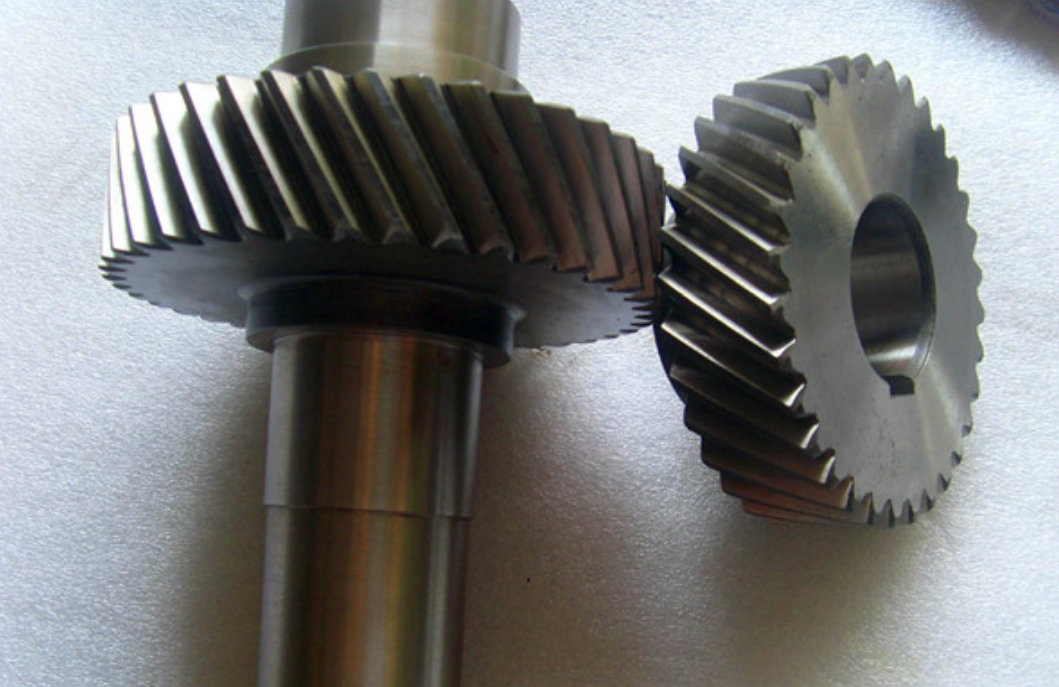
To achieve this, a parametric modeling approach using ANSYS Parametric Design Language (APDL) is adopted to generate the precise geometry of standard involute helical gears. This parameterization allows for easy modification of gear specifications for future studies. Two distinct three-dimensional models are created: one representing a pristine gear pair and another incorporating a seed crack at the root of a single tooth on the driven gear. Subsequently, two parallel streams of analysis are conducted. First, a rigid-body dynamic simulation is performed using the explicit solver LS-DYNA to investigate the transient meshing forces. Second, a nonlinear static contact stress analysis is carried out using ANSYS implicit solver to examine the stress distribution under load. By comparing the results from both analyses for the healthy and faulty conditions, this work aims to establish clear diagnostic markers for root cracks and quantify their detrimental effect on gear strength.
Parametric Finite Element Modeling of Helical Gears
The foundation of any accurate simulation is a high-fidelity geometric model. Modeling the complex shape of an involute helical gear tooth requires a systematic approach. The process begins with the generation of the tooth profile in the transverse plane. The Cartesian coordinates \((x, y)\) of an involute curve are derived from its polar definition. For the right flank of a tooth, these coordinates can be expressed as:
$$
x = r_k \cos\left(\frac{\pi}{2} – \frac{s}{d} + \theta_k – \theta\right)
$$
$$
y = r_k \sin\left(\frac{\pi}{2} – \frac{s}{d} + \theta_k – \theta\right)
$$
where \(r_k\) is the radius to an arbitrary point on the involute, \(\theta_k\) is the involute roll angle at that point, \(s\) is the arc tooth thickness at the pitch circle, \(d\) is the pitch diameter, and \(\theta\) is the roll angle at the pitch circle. A critical step is blending this involute curve smoothly with the root fillet, which is typically a trochoid or a circular arc generated by the cutting tool. In APDL, this is achieved by carefully defining keypoints and splines to ensure geometric continuity, preventing fatal errors during meshing. The 2D tooth profile is then swept along a helical path to create the three-dimensional solid tooth. The helical path is defined in a cylindrical coordinate system. The sweeping operation, followed by a circular pattern duplication around the gear axis, yields the complete solid model of the helical gear. The primary parameters for the gear pair under investigation are summarized in Table 1.
| Parameter Name | Symbol | Value |
|---|---|---|
| Number of Teeth (Driver) | \(z_1\) | 30 |
| Number of Teeth (Driven) | \(z_2\) | 45 |
| Normal Module | \(m_n\) | 4 mm |
| Face Width | \(b\) | 40 mm |
| Normal Pressure Angle | \(\alpha_n\) | 20° |
| Helix Angle | \(\beta\) | 14° |
Following geometry creation, the model is discretized into finite elements. A mapped meshing technique, known for producing regular, high-quality elements, is employed. For the explicit dynamic analysis, the SOLID164 element is used. This is an 8-node explicit solid element specifically designed for large deformation and high strain rate dynamics. For the implicit static stress analysis, the SOLID185 element, an 8-node structural solid element suitable for contact and plasticity, is selected. The material properties assigned to the gear bodies, representative of a common engineering steel, are listed in Table 2. Special attention is paid to mesh refinement in the potential contact zones and at the root fillets to accurately capture stress gradients and contact pressures.
| Property | Symbol | Value |
|---|---|---|
| Material | – | 45# Steel |
| Young’s Modulus | \(E\) | 206 GPa |
| Poisson’s Ratio | \(\nu\) | 0.3 |
| Density | \(\rho\) | 7800 kg/m³ |
For the fault simulation model, a pre-existing crack is introduced at the root of one tooth on the driven gear. This is modeled as a narrow, planar discontinuity approximately 2 mm in length, oriented perpendicular to the principal stress direction at the root. The resulting finite element models for the healthy and faulty gear pairs are shown conceptually, with the cracked model featuring a localized mesh discontinuity at the specified root location.
Rigid-Body Dynamic Analysis Using Explicit Formulation
The dynamic behavior of the helical gear pair is simulated under operating conditions using an explicit dynamics approach. In this study, the gears are treated as rigid bodies to efficiently isolate the dynamic force transmission characteristics from elastic deformation effects. The governing equation of motion for a multi-body system is given by:
$$
M \ddot{a}_t + C \dot{a}_t + K a_t = Q_t
$$
where \(M\), \(C\), and \(K\) are the global mass, damping, and stiffness matrices, respectively; \(a_t\), \(\dot{a}_t\), and \(\ddot{a}_t\) are the nodal displacement, velocity, and acceleration vectors; and \(Q_t\) is the external load vector. The explicit solver LS-DYNA employs the central difference method for temporal integration. The acceleration and velocity are approximated using displacements at successive time steps:
$$
\ddot{a}_t = \frac{1}{\Delta t^2}(a_{t-\Delta t} – 2a_t + a_{t+\Delta t})
$$
$$
\dot{a}_t = \frac{1}{2\Delta t}(-a_{t-\Delta t} + a_{t+\Delta t})
$$
Substituting these into the equation of motion yields an explicit update formula for the displacement at time \(t+\Delta t\):
$$
\left( \frac{1}{\Delta t^2} M + \frac{1}{2\Delta t} C \right) a_{t+\Delta t} = Q_t – \left( K – \frac{2}{\Delta t^2} M \right) a_t – \left( \frac{1}{\Delta t^2} M – \frac{1}{2\Delta t} C \right) a_{t-\Delta t}
$$
The simulation setup involves defining automatic surface-to-surface contact between all potential contacting tooth flanks of the driver and driven helical gears. A penalty-based contact algorithm with static and dynamic friction coefficients (e.g., 0.15 and 0.3) is used. Rigid material properties are assigned to both gears, constraining all translational degrees of freedom and allowing only rotation about their respective axes. The kinematic excitation is applied as a constant angular velocity of 62.8 rad/s (approximately 600 RPM) to the driver gear. A constant resisting torque of 1000 N·mm is applied to the driven gear. The simulation runs for a sufficient duration (0.044s) to allow initial transients to settle and capture several complete mesh cycles in a steady-state condition.
| Component | Constraint/Initial Condition | Load |
|---|---|---|
| Driver Gear | Fixed in X, Y, Z translation; Free in Z rotation | Angular Velocity: 62.8 rad/s |
| Driven Gear | Fixed in X, Y, Z translation; Free in Z rotation | Resisting Torque: 1000 N·mm |
| Contact | Automatic Surface-to-Surface (rigid bodies) | Friction: µs=0.3, µd=0.15 |
| Solver | Explicit (LS-DYNA), Central Difference | Analysis Time: 0.044 s |
The primary output of interest is the time-history of the resultant contact force between the gear pair. For the healthy gear model, the force trace shows an initial transient period (0-0.03s) as the gears settle into contact from their initial positions. Subsequently, the force reaches a steady-state equilibrium characterized by a nearly constant value with very low-amplitude, regular fluctuations corresponding to the passing of individual tooth pairs—a hallmark of healthy helical gear operation due to their overlapping contact ratio.
In stark contrast, the force trace for the model with the root crack exhibits a dramatically different signature post the initial transient. Once the cracked tooth enters the mesh, the steady-state force is no longer stable. It displays significant, periodic fluctuations with a much higher amplitude. The crack locally reduces the effective bending stiffness of the tooth. As this compliant tooth enters the load zone, it deflects more than its healthy neighbors, altering the load sharing among concurrent tooth pairs. This causes an impact-like event and a sudden shift in the total contact force. When the cracked tooth exits the mesh, another disturbance occurs as the load is transferred back to the stiffer, healthy teeth. This cyclic perturbation introduces a strong modulation in the meshing force at the gear mesh frequency, superimposed on the crack’s own characteristic frequency. This clear modulation in the dynamic force signal serves as a potent theoretical indicator for diagnosing root cracks in helical gears through vibration or torque monitoring.
Nonlinear Static Contact Stress Analysis
While dynamic analysis reveals force perturbations, a static nonlinear contact analysis provides detailed insight into the localized stress field, which is critical for assessing strength degradation. In this phase, the elastic deformation of the helical gears is considered. A surface-to-surface contact pair is defined between the contacting flanks, utilizing TARGE170 and CONTA174 elements. This formulation is robust for handling moderate sliding and deformation in static scenarios. The driven gear is fully constrained at its bore. The driver gear is constrained to allow only rotation about its axis. A tangential force \(F_y\) is applied to the nodes on the inner surface of the driver gear’s bore to simulate the input torque \(T\), calculated as:
$$
F_y = \frac{T}{N \cdot R_0}
$$
where \(N\) is the number of nodes on the loaded bore surface and \(R_0\) is the bore radius. The negative sign indicates the direction of rotation.
| Component | Boundary Condition | Loading |
|---|---|---|
| Driven Gear | Fixed Support (all DOFs) at bore | None |
| Driver Gear | Cylindrical Support (free Z-rotation) at bore | Nodal Force \(F_y\) equivalent to Torque \(T\) |
| Contact Pair | Surface-to-Surface (Flexible-Flexible) | Augmented Lagrange method |
| Element Type | SOLID185 (for both gears) | – |
The analysis solves for the equilibrium state under the applied torque. The resulting von Mises stress contours for the healthy and cracked gear pairs are profoundly illustrative. For the healthy pair, the maximum contact stress (Hertzian pressure) is located at the theoretical point of contact on the tooth flank. Furthermore, stress concentration is visibly present at the root fillet of the loaded teeth, corresponding to the maximum bending stress location. In a double-tooth contact region, the load is shared, resulting in lower stress magnitudes on each tooth compared to a single-tooth contact region.
The introduction of the root crack drastically alters this picture. The stress field in the vicinity of the crack is severely intensified. The crack tip becomes a dominant site of extreme stress concentration, with values significantly exceeding those found in the healthy root fillet. This high stress intensity factor at the crack tip is the driving force for further crack propagation under cyclic loading. Moreover, the presence of the crack disrupts the natural load path through the tooth. This can cause a shift and potential increase in the contact stress on the flank of the cracked tooth and its mating partner, as the tooth’s reduced stiffness affects the local conformity of the contact. The comparison unequivocally demonstrates that a root crack not only creates a local failure site but also elevates the general stress state, thereby compromising the overall bending and contact strength of the helical gear.
Conclusion
This investigation successfully demonstrates a finite element-based methodology for simulating and analyzing fault conditions in helical gear transmissions. The use of APDL for parametric modeling proved efficient for generating accurate gear geometries, including the introduction of a defined root crack. Two complementary analysis paths were pursued: explicit rigid-body dynamics and implicit nonlinear static contact analysis.
The dynamic simulation revealed that a root crack induces significant, periodic fluctuations in the gear meshing force once steady-state operation is achieved. These fluctuations, resulting from the altered stiffness and consequent disrupted load-sharing pattern, provide a clear dynamic signature distinct from the stable force trace of a healthy gear pair. This finding offers a theoretical basis for time-domain or frequency-domain vibration analysis as a diagnostic tool for early crack detection in helical gears.
The static contact stress analysis quantitatively and visually confirmed the detrimental impact of a root crack on gear strength. The crack acts as a potent stress concentrator, generating localized stress intensities far beyond the nominal root bending stress. This elevated stress field drastically accelerates fatigue life consumption and predisposes the gear to rapid failure. The analysis also suggested a potential secondary effect on the contact stress distribution on the tooth flank.
In summary, both the rigid-body dynamic analysis and the detailed stress analysis serve as effective and complementary tools for simulating tooth root crack faults. The dynamic approach identifies the system-level vibrational consequences, while the static approach elucidates the localized failure mechanics. Together, they provide a comprehensive understanding of the fault’s implications, forming a valuable foundation for optimizing gear design, planning maintenance strategies, and developing advanced diagnostic protocols for helical gear transmission systems. Future work could involve extending the dynamic analysis to include flexible bodies, modeling crack propagation over multiple cycles, and correlating the simulation results with experimental data from vibration sensors.