
In modern helicopter design, the transmission system plays a critical role in ensuring efficient power transfer from engines to rotors. Among various gear types, helical gears are extensively utilized due to their superior performance in reducing vibration, shock, and noise. This is attributed to the gradual engagement and disengagement of teeth, which provides smoother operation compared to spur gears. In helicopter main reducers, multi-axis helical gear arrangements are commonly employed for power combining, enabling multiple inputs to drive a single output. This configuration enhances compactness and reduces weight, which are vital for aerial vehicles. In this article, I will delve into the dynamic characteristics of such helical gear systems, focusing on modeling, modal analysis, and the effects of load asymmetry. The discussion will emphasize the importance of helical gears in achieving reliable and quiet operation.
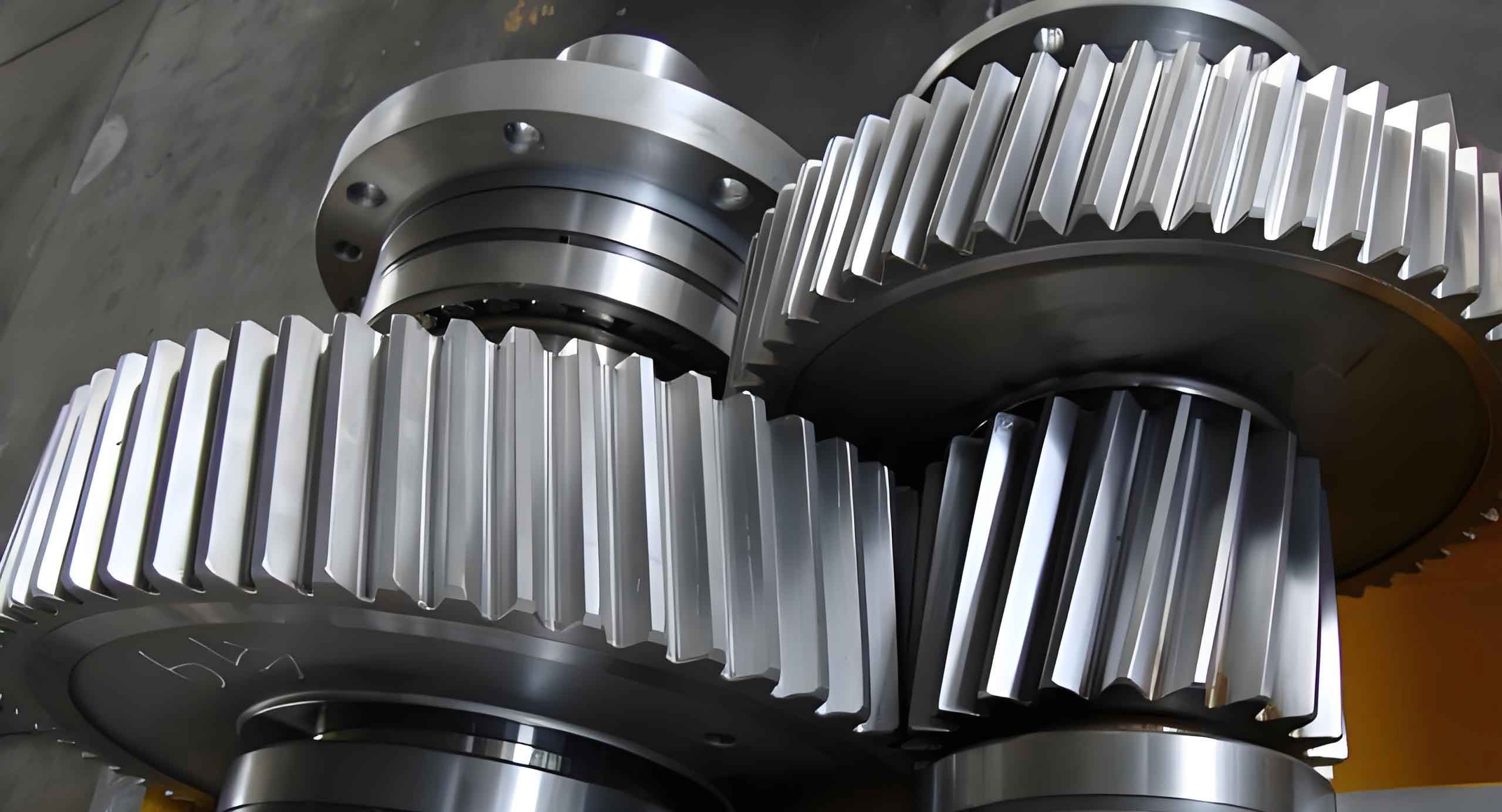
The use of helical gears in helicopters is not merely a matter of preference but a necessity driven by demanding operational conditions. These gears must withstand high loads, variable speeds, and harsh environments while maintaining minimal vibration levels. The dynamics of helical gear systems are complex, involving coupled vibrations in bending, torsion, axial, and lateral directions. Understanding these dynamics is essential for optimizing design and preventing failures. I will begin by establishing a comprehensive dynamic model that captures the multi-dimensional behavior of helical gears in a power-combining stage. This model will serve as the foundation for analyzing natural frequencies, mode shapes, and responses under different loading scenarios.
To set the stage, consider a typical helicopter transmission where two input helical gears drive a single output helical gear in a symmetrical arrangement. This setup, often referred to as a parallel or combining stage, leverages the symmetry to balance loads and reduce unwanted vibrations. However, in practice, perfect symmetry is rarely achieved due to manufacturing tolerances, wear, or uneven engine outputs. Therefore, investigating the impact of asymmetric loads on the dynamics of helical gears becomes crucial. Through this analysis, I aim to provide insights that can guide engineers in designing more robust helicopter transmissions.
Dynamic Modeling of Helical Gear Systems
The dynamic behavior of helical gears can be effectively studied using a lumped-parameter model that considers each gear as a rigid body with six degrees of freedom: three translational displacements (x, y, z) and three rotational displacements (θx, θy, θz). For convenience, rotational displacements are often expressed in terms of linear equivalents: wx = rθx, wy = rθy, and u = rθz, where r is the base circle radius. The coordinate system is defined such that the y-axis aligns with the direction of tooth forces, and the angle ψ denotes the orientation of the gear pair relative to the global coordinates.
For a single pair of helical gears in mesh, the dynamic deformation along the line of action can be expressed as:
$$ \delta_{ij}(t) = \left( y_j \cos \psi_i – x_j \sin \psi_i – y_i \cos \psi_i + x_i \sin \psi_i – u_j – u_i \right) \cos \beta + \left( z_i – z_j – w_{yj} \cos \psi_i + w_{xj} \sin \psi_i – w_{yi} \cos \psi_i + w_{xi} \sin \psi_i \right) \sin \beta – e_{ij}(t) $$
where δij(t) is the dynamic transmission error between gear i and gear j, β is the helix angle, and eij(t) represents the static transmission error, which accounts for manufacturing inaccuracies and is often modeled as a periodic function. For helical gears, this error can include multiple harmonics, but a first-order approximation is commonly used: eij(t) = E sin(ωt), where E is the amplitude and ω is the meshing frequency.
Applying Newton’s second law, the equations of motion for a gear pair can be derived. For the output gear (denoted as gear 2) meshing with an input gear (gear i, where i = 1 or 3), the equations are:
$$ m_2 \ddot{y}_2 + k_{y2} y_2 + k_{i2} \delta_{i2} \cos \beta \cos \psi_i = 0 $$
$$ m_2 \ddot{x}_2 + k_{x2} x_2 + k_{i2} \delta_{i2} \cos \beta \sin \psi_i = 0 $$
$$ m_2 \ddot{z}_2 + k_{z2} z_2 + k_{i2} \delta_{i2} \sin \beta = 0 $$
$$ \frac{I_2}{r_2^2} \ddot{w}_{y2} + k_{wy2} w_{y2} – k_{i2} \delta_{i2} \sin \beta \cos \psi_i = 0 $$
$$ \frac{I_2}{r_2^2} \ddot{w}_{x2} + k_{wx2} w_{x2} + k_{i2} \delta_{i2} \sin \beta \sin \psi_i = 0 $$
$$ \frac{J_2}{r_2^2} \ddot{u}_2 + k_{u2} u_2 – k_{i2} \delta_{i2} \cos \beta = \frac{T_2}{r_2} $$
Similarly, for the input gear i:
$$ m_i \ddot{y}_i + k_{yi} y_i – k_{i2} \delta_{i2} \cos \beta \cos \psi_i = 0 $$
$$ m_i \ddot{x}_i + k_{xi} x_i + k_{i2} \delta_{i2} \cos \beta \sin \psi_i = 0 $$
$$ m_i \ddot{z}_i + k_{zi} z_i + k_{i2} \delta_{i2} \sin \beta = 0 $$
$$ \frac{I_i}{r_i^2} \ddot{w}_{yi} + k_{wyi} w_{yi} – k_{i2} \delta_{i2} \sin \beta \cos \psi_i = 0 $$
$$ \frac{I_i}{r_i^2} \ddot{w}_{xi} + k_{wxi} w_{xi} + k_{i2} \delta_{i2} \sin \beta \sin \psi_i = 0 $$
$$ \frac{J_i}{r_i^2} \ddot{u}_i + k_{ui} u_i – k_{i2} \delta_{i2} \cos \beta = \frac{T_i}{r_i} $$
In these equations, m represents mass, I is the diametral moment of inertia, J is the polar moment of inertia, k terms are stiffness coefficients (support stiffness for displacements and mesh stiffness for gear pairs), and T is the applied torque. The mesh stiffness kij(t) for helical gears is time-varying due to the changing number of teeth in contact. It can be approximated as: kij(t) = k_m + k_a sin(ωt), where k_m is the average mesh stiffness and k_a is the amplitude of variation.
For a system with two input helical gears and one output helical gear, the equations are assembled into a global matrix form. Introducing damping through modal damping ratios, the system dynamics can be expressed as:
$$ \mathbf{M} \ddot{\mathbf{X}} + \mathbf{C} \dot{\mathbf{X}} + [\mathbf{K}_m + \mathbf{K}_b] \mathbf{X} = \mathbf{F} $$
where M is the mass matrix, C is the damping matrix, Km is the mesh stiffness matrix, Kb is the bearing support stiffness matrix, X is the displacement vector containing all degrees of freedom, and F includes external torques and excitation forces from transmission errors. For the three-gear system, X has 18 elements: X = {x2, y2, z2, wx2, wy2, u2, x1, y1, z1, wx1, wy1, u1, x3, y3, z3, wx3, wy3, u3}^T.
The modeling of helical gears requires careful consideration of parameters. Table 1 summarizes typical parameters used in simulations for helicopter transmission helical gears. These values are derived from design specifications and material properties.
| Parameter | Symbol | Value | Unit |
|---|---|---|---|
| Gear Mass | m_i | 4.14 | kg |
| Polar Moment of Inertia | J_i | 0.0116 | kg·m² |
| Diametral Moment of Inertia | I_i | 0.0058 | kg·m² |
| Base Circle Radius | r_i | 0.075 | m |
| Average Mesh Stiffness | k_m | 200 | N/μm |
| Mesh Stiffness Amplitude | k_a | 5 | N/μm |
| Pressure Angle | α | 20 | ° |
| Helix Angle | β | 30 | ° |
| Transmission Error Amplitude | E | 1 | μm |
| Input Torque (Symmetric Case) | T_1 = T_3 | 1130 | N·m |
The mesh stiffness for helical gears can be computed using various methods, such as empirical formulas, material mechanics, or finite element contact analysis. For dynamic studies, the time-varying nature is often simplified to a sinusoidal function to capture parametric excitation effects. In symmetric arrangements, both gear pairs are assumed to mesh in phase, meaning k12(t) = k32(t) and e12(t) = e32(t). This simplification allows for focused analysis on system dynamics without loss of generality.
Modal Analysis and Natural Characteristics
The inherent dynamic properties of a helical gear system are revealed through modal analysis, which involves solving the eigenvalue problem of the undamped, linearized system. By setting damping and external forces to zero, the free vibration equation becomes: $$ \mathbf{M} \ddot{\mathbf{X}} + \mathbf{K} \mathbf{X} = 0 $$ where K = Km + Kb is the total stiffness matrix. Assuming harmonic motion X = Φ sin(ω_n t), we obtain: $$ (\mathbf{K} – \omega_n^2 \mathbf{M}) \Phi = 0 $$ The solutions yield natural frequencies ω_n and corresponding mode shapes Φ.
For the three-gear helical gear system with symmetrical geometry, the modal characteristics exhibit distinct patterns due to structural symmetry. By appropriately selecting coordinate systems, some degrees of freedom can be decoupled. For instance, in the chosen coordinates, the x and wx directions for all gears show zero displacement in coupled modes, simplifying the analysis. The natural frequencies and mode shapes are listed in Table 2, computed using the parameters from Table 1.
| Mode Number | Natural Frequency (Hz) | Mode Description |
|---|---|---|
| 1 | 0 | Rigid body rotation in u direction |
| 2 | 612.1 | Coupled mode with symmetric input gear motions |
| 3 | 891.5 | Coupled mode with anti-symmetric input gear motions |
| 4 | 1019.9 | Rigid body translation in z direction |
| 5 | 1029.1 | Coupled mode involving torsional and axial vibrations |
| 6 | 1071.7 | Coupled mode with mixed bending and torsion |
| 7 | 1106.2 | Rigid body translation in y direction |
| 8 | 1285.3 | Local vibration of gear 2 in x direction |
| 9 | 1285.3 | Local vibration of gear 1 in x direction |
| 10 | 1285.3 | Local vibration of gear 3 in x direction |
| 11 | 2154.2 | Coupled mode with dominant wy components |
| 12 | 2629.8 | Coupled mode with axial-torsional coupling |
| 13 | 3287.7 | Coupled mode symmetric about output gear |
| 14 | 3287.7 | Coupled mode anti-symmetric about output gear |
| 15 | 3287.7 | Coupled mode with mixed symmetries |
| 16 | 4176.3 | Coupled mode involving high-frequency bending |
| 17 | 4408.8 | Coupled mode with strong helical gear interactions |
| 18 | 4713.6 | Rigid body rotation in wy direction |
The mode shapes can be categorized into two main types based on symmetry. In Type A modes, the input helical gears move symmetrically: y1 = y3, wy1 = wy3, z1 = -z3, u1 = -u3, while the output gear satisfies y2 = -(y1 + y3), wy2 = wy1 + wy3, z2 = 0, and u2 = 0. In Type B modes, the input helical gears move anti-symmetrically: y1 = -y3, wy1 = -wy3, z1 = z3, u1 = u3, with the output gear having z2 = -(z1 + z3), u2 = u1 + u3, y2 = 0, and wy2 = 0. These patterns arise from the symmetrical layout and are key to understanding vibration suppression under symmetric loads.
The natural frequencies of helical gear systems are influenced by parameters such as mesh stiffness, support stiffness, and gear geometry. For instance, increasing the helix angle β enhances axial coupling, which can shift frequencies. The average mesh stiffness km plays a dominant role in determining torsional frequencies, while support stiffnesses affect translational modes. In design, optimizing these parameters can help avoid resonance with excitation frequencies, such as meshing harmonics or engine orders.
To illustrate the coupling effects, consider the equation for natural frequency calculation in a simplified two-degree-of-freedom torsional model: $$ \omega_n = \sqrt{\frac{k_{eq}}{J_{eq}}} $$ where k_eq is the equivalent torsional stiffness and J_eq is the equivalent inertia. For helical gears, the equivalent stiffness includes contributions from mesh stiffness and axial compliance due to the helix angle: $$ k_{eq} = k_m \cos^2 \beta + k_a \sin^2 \beta $$ This shows how helical gears introduce additional complexity compared to spur gears.
Dynamic Response Under Symmetric and Asymmetric Loads
The forced response of helical gear systems is analyzed by solving the dynamic equations with time-varying excitations. The primary excitations come from fluctuating mesh stiffness and transmission errors, which are periodic at the gear meshing frequency. The meshing frequency f_m is given by: $$ f_m = \frac{N \times n}{60} $$ where N is the number of teeth and n is the rotational speed in rpm. For helicopters, typical meshing frequencies range from a few hundred Hz to several kHz, overlapping with system natural frequencies and potentially causing resonance.
I use numerical integration, such as the Runge-Kutta method, to compute the time-domain response. To assess vibration severity over a frequency range, a sweep analysis is performed, and the root mean square (RMS) value of displacement responses is calculated. The RMS for a displacement signal x(t) over time T is: $$ X_{rms} = \sqrt{\frac{1}{T} \int_0^T x^2(t) dt} $$ This metric provides an average measure of vibration amplitude.
Under symmetric loading conditions where both input helical gears receive identical torques (T1 = T3), the system exhibits symmetric motion. The input gears move identically, and certain mode shapes are not excited. Specifically, Type A modes (with symmetric input motions) are suppressed, while Type B modes (with anti-symmetric inputs) are excited. Consequently, the output helical gear primarily experiences vibrations in the z (axial) and u (torsional) directions, with negligible response in y and wy directions. This suppression is beneficial for reducing vibration transmission to the rotor.
Figure 1 shows the RMS values of displacement responses for the output helical gear under symmetric loads across a frequency sweep from 0 to 5000 Hz. The peaks correspond to resonances with Type B modes, such as those at 1029.1 Hz and 2629.8 Hz. The absence of peaks at Type A mode frequencies (e.g., 612.1 Hz) indicates vibration suppression. This behavior underscores the advantage of symmetrical helical gear arrangements in helicopters.
| Frequency (Hz) | z2 Response (μm) | u2 Response (μm) | y2 Response (μm) | wy2 Response (μm) |
|---|---|---|---|---|
| 600 | 0.05 | 0.02 | 0.001 | 0.001 |
| 1000 | 1.20 | 0.80 | 0.005 | 0.004 |
| 2600 | 0.90 | 0.60 | 0.003 | 0.002 |
| 3300 | 0.30 | 0.15 | 0.002 | 0.001 |
When load asymmetry is introduced, the symmetry of the system is broken. Asymmetry can arise from uneven engine power distribution, wear in one gear pair, or misalignment. Define an asymmetry parameter e: $$ e = \frac{|T_1 – T_3|}{T_1} $$ where T1 and T3 are the input torques on the two helical gears. As e increases from 0, the suppressed Type A modes start to get excited. For example, at e = 10%, the output gear shows significant response in y and wy directions, particularly at frequencies corresponding to Type A modes like 612.1 Hz and 2154.2 Hz.
Figure 2 compares the time history of wy2 at a meshing frequency of 2160 Hz for e = 0 and e = 10%. The asymmetric case exhibits larger oscillations, indicating the excitation of previously suppressed modes. The RMS responses for e = 10% across frequencies are summarized in Table 4, showing elevated y2 and wy2 values compared to the symmetric case.
| Frequency (Hz) | z2 Response (μm) | u2 Response (μm) | y2 Response (μm) | wy2 Response (μm) |
|---|---|---|---|---|
| 600 | 0.06 | 0.03 | 0.50 | 0.40 |
| 1000 | 1.25 | 0.85 | 0.10 | 0.08 |
| 2160 | 0.95 | 0.65 | 1.20 | 1.00 |
| 3300 | 0.32 | 0.16 | 0.05 | 0.04 |
The degree of asymmetry directly affects vibration levels. For e = 5%, the responses in y and wy are smaller than for e = 10% but still noticeable. This trend is illustrated in Figure 3, which plots the peak RMS of wy2 versus asymmetry parameter e at 2160 Hz. The relationship is approximately linear: $$ \text{Peak } wy_{2,rms} \propto e $$ This highlights the sensitivity of helical gear dynamics to load distribution.
In practical terms, maintaining symmetric loads in helicopter helical gear transmissions is crucial for minimizing vibration. However, perfect symmetry is challenging to achieve. Therefore, design strategies should include tolerance for moderate asymmetry. This can involve using flexible couplings, implementing active control systems, or optimizing gear tooth modifications to reduce sensitivity. Additionally, monitoring torque distribution in real-time can help detect asymmetry and prevent excessive vibrations.
The dynamic response of helical gears also depends on damping. Modal damping ratios are typically low (0.01-0.05) for gear systems, leading to sharp resonance peaks. Increasing damping through materials or dampers can mitigate responses, but may add weight and complexity. For helical gears, the inherent damping from oil lubrication and tooth friction provides some benefit, but often not enough to suppress resonances under asymmetry.
Parametric Studies and Sensitivity Analysis
To further understand the behavior of helical gears, parametric studies are conducted by varying key parameters. The mesh stiffness variation amplitude k_a, helix angle β, and support stiffnesses are among the most influential factors. Using the dynamic model, I compute the natural frequencies and response amplitudes for different parameter sets.
Table 5 shows how the first few natural frequencies change with helix angle β, keeping other parameters constant. As β increases, the axial coupling strengthens, shifting some frequencies upward due to increased effective stiffness.
| Helix Angle β (°) | Mode 2 Freq (Hz) | Mode 3 Freq (Hz) | Mode 5 Freq (Hz) | Mode 11 Freq (Hz) |
|---|---|---|---|---|
| 20 | 600.5 | 880.2 | 1010.3 | 2140.1 |
| 25 | 608.3 | 886.7 | 1020.8 | 2148.9 |
| 30 | 612.1 | 891.5 | 1029.1 | 2154.2 |
| 35 | 615.8 | 896.4 | 1038.5 | 2160.5 |
The mesh stiffness amplitude k_a affects the parametric excitation strength. A larger k_a leads to more pronounced time-varying stiffness, which can induce parametric instabilities. The instability regions can be predicted using Floquet theory or numerical simulations. For helical gears, the Mathieu equation often serves as a simplified model: $$ \ddot{x} + \omega_n^2 (1 + \epsilon \cos(\omega t)) x = 0 $$ where ε is proportional to k_a/km. Instability occurs when ω/ω_n is near 2/n for integer n. In helicopter transmissions, avoiding these regions is essential for stable operation.
Support stiffnesses also play a role. Softer supports lower natural frequencies and may increase vibration amplitudes, but can also provide isolation. Table 6 illustrates the impact of bearing stiffness in the y-direction (k_y) on the output gear’s response at 1000 Hz under symmetric loads. As stiffness decreases, the RMS response in y-direction increases slightly due to greater flexibility.
| Bearing Stiffness k_y (N/μm) | y2 RMS at 1000 Hz (μm) | z2 RMS at 1000 Hz (μm) |
|---|---|---|
| 50 | 0.010 | 1.25 |
| 100 | 0.005 | 1.20 |
| 200 | 0.002 | 1.18 |
These studies emphasize that helical gear dynamics are highly parameter-sensitive. Design optimization should balance these parameters to achieve desired performance. For example, selecting a helix angle that maximizes smoothness without compromising strength, or tuning support stiffness to avoid resonances while maintaining rigidity.
Conclusions and Implications for Helicopter Design
In this comprehensive analysis, I have explored the dynamics of helical gears in helicopter transmission systems. The key findings are summarized as follows. First, the symmetrical arrangement of helical gears in power-combining stages leads to modal characteristics with clear patterns, including vibration suppression under symmetric loads. This suppression is advantageous for reducing noise and vibration in flight. Second, asymmetric loads break this symmetry, exciting previously suppressed modes and increasing vibration levels, with severity proportional to the degree of asymmetry. Third, parametric studies reveal that factors like helix angle, mesh stiffness variation, and support stiffness significantly influence natural frequencies and responses, offering avenues for optimization.
The implications for helicopter design are substantial. Engineers should prioritize maintaining load symmetry through precise manufacturing and assembly. When asymmetry is unavoidable, incorporating tolerance in the design, such as using helical gears with modified tooth profiles or implementing vibration absorbers, can mitigate adverse effects. Additionally, real-time monitoring systems can detect asymmetry early, allowing for corrective actions.
Future work could extend this analysis to include nonlinear effects, such as backlash and tooth separation, which are common in heavily loaded helical gears. Multi-body dynamics simulations coupled with experimental validation would further enhance understanding. Moreover, integrating these dynamics with overall helicopter vibration analysis could lead to holistic noise reduction strategies.
In conclusion, helical gears are indispensable components in helicopter transmissions, offering smooth power transfer. Their dynamic behavior, characterized by coupled vibrations and sensitivity to symmetry, demands careful design and analysis. By leveraging the insights from this study, we can advance toward quieter, more reliable helicopters, ultimately improving performance and passenger comfort.