
In modern industrial machinery, helical gears are pivotal components due to their ability to transmit high torque with smooth and quiet operation. However, under heavy loads and harsh operating conditions, such as those in hot rolling mills, helical gears often experience premature failures like tooth surface scuffing or even tooth breakage. This significantly impacts production efficiency and safety. To enhance the load-bearing capacity and ensure reliable performance, tooth profile modification, particularly in the tooth width direction, has emerged as a critical design consideration. This article delves into the effects of tooth profile modification on the stress distribution and overall bearing capacity of helical gears, employing advanced modeling and finite element analysis (FEA) techniques. The focus is on optimizing modification parameters to mitigate stress concentrations, thereby extending gear life and improving operational stability.
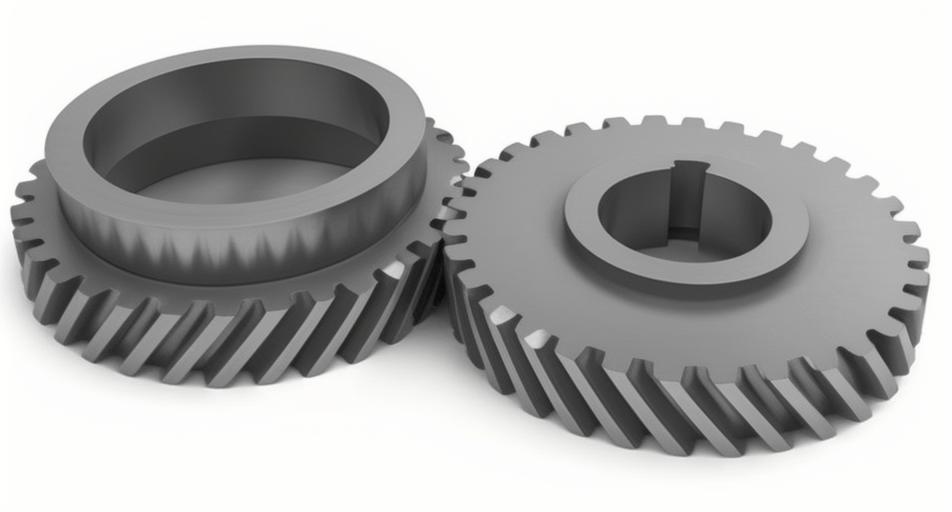
The fundamental geometry of helical gears is defined by parameters such as the normal module, number of teeth, helix angle, pressure angle, and face width. These parameters dictate the gear’s meshing characteristics and load distribution. For a pair of helical gears in mesh, the contact line progresses diagonally across the tooth face, leading to gradual engagement and disengagement. This results in lower noise and vibration compared to spur gears, but it also introduces complex stress patterns, especially at the tooth ends where edge effects can cause significant stress concentrations. The basic geometric relationships for helical gears are expressed through the following equations. The transverse module \(m_t\) is related to the normal module \(m_n\) by the helix angle \(\beta\):
$$m_t = \frac{m_n}{\cos \beta}$$
The pitch diameter \(d\) is given by:
$$d = m_t \cdot Z = \frac{m_n \cdot Z}{\cos \beta}$$
where \(Z\) is the number of teeth. The axial pitch \(p_a\) is:
$$p_a = \frac{\pi m_n}{\sin \beta}$$
These formulas are essential for generating accurate three-dimensional models of helical gears. In practical applications, helical gears are often subjected to non-uniform load distribution along the tooth width due to manufacturing errors, assembly misalignments, and elastic deformations under load. This non-uniformity can lead to localized high stresses, particularly at the tooth ends, which are prone to failure. Tooth profile modification, specifically tooth lead modification or crowning, aims to compensate for these effects by intentionally altering the tooth surface geometry. By introducing slight deviations from the theoretical involute profile along the tooth width, the contact pattern can be optimized to ensure more even load distribution, thereby reducing peak stresses and enhancing the overall bearing capacity of the helical gears.
To investigate the impact of tooth profile modification, a parametric three-dimensional model of a helical gear pair from a hot rolling mill reducer was developed. The basic parameters of the helical gears are summarized in Table 1. These parameters serve as the foundation for the geometric modeling and subsequent finite element analysis.
| Parameter | Symbol | Value |
|---|---|---|
| Normal Module | \(m_n\) | 28 mm |
| Number of Teeth (Gear) | \(Z_1\) | 110 |
| Number of Teeth (Pinion) | \(Z_2\) | 23 |
| Pressure Angle | \(\alpha\) | 20° |
| Helix Angle | \(\beta\) | 10° |
| Face Width (Gear) | \(B_1\) | 680 mm |
| Face Width (Pinion) | \(B_2\) | 700 mm |
| Addendum Coefficient | \(h_a^*\) | 1.0 |
| Dedendum Coefficient | \(c^*\) | 0.25 |
| Profile Shift Coefficient | \(x\) | 0.3372 |
The three-dimensional model was created using parametric design software, where equations were input to automatically generate gear geometry based on the above parameters. This approach ensures accuracy and consistency in the model. The assembly of the helical gear pair was performed according to meshing principles to achieve interference-free alignment, which is crucial for realistic simulation conditions. The material assigned to both the gear and pinion is 17Cr2Ni2Mo steel, commonly used for high-strength applications. The material properties include an elastic modulus \(E = 207\) GPa, Poisson’s ratio \(\mu = 0.3\), and a surface hardness of 56-61 HRC achieved through carburizing and quenching. These properties are vital for the finite element analysis, as they influence the stress-strain response under load.
Finite element analysis is a powerful tool for evaluating the stress distribution in helical gears under operational loads. The model was imported into FEA software, where meshing, boundary conditions, and loads were applied. Due to the large size of the helical gears, a submodeling technique was employed to enhance computational efficiency and accuracy. The submodel focuses on the meshing region, with a width equal to the full face width and a radial extent of 1.8 times the transverse module from the inner hole. The displacement results from the global model at the cut boundaries were used as boundary conditions for the submodel. The mesh was refined in the contact areas, with element sizes reduced to 2 mm to capture stress gradients accurately. Friction between the tooth surfaces was considered with a coefficient of 0.1. The loading condition simulated the rated input torque of the reducer, applied as a moment on the pinion shaft. The analysis aimed to determine the maximum bending stress at the tooth root and the maximum contact stress on the tooth surface at different positions along the tooth width.
The meshing process of helical gears involves a moving contact band along the tooth width. To assess stress variations, three key positions were analyzed: at the tooth end (\(Z = 0\) mm), at one-quarter of the face width (\(Z = 175\) mm), and at the center of the face width (\(Z = 350\) mm), where \(Z\) is the coordinate along the tooth width direction. The results revealed that stress concentrations are most severe at the tooth end during initial engagement. For instance, at \(Z = 0\) mm, the maximum bending stress at the tooth root of the pinion was 384.56 MPa, and the maximum contact stress was 847.23 MPa. These values decrease as the contact band moves inward, as shown in Table 2. The high stresses at the tooth end are primarily due to edge effects and misalignment, which lead to localized overload and are often the root cause of failures in helical gears.
| Stress Type | Maximum Stress at \(Z = 0\) mm (MPa) | Maximum Stress at \(Z = 175\) mm (MPa) | Maximum Stress at \(Z = 350\) mm (MPa) |
|---|---|---|---|
| Bending Stress | 384.56 | 289.17 | 223.48 |
| Contact Stress | 847.23 | 563.04 | 487.85 |
The bending stress safety factor was calculated to be 1.21, which is below the minimum required value of 1.25, indicating insufficient bending strength at the tooth end. This explains occurrences of tooth breakage in service. The contact stress safety factor was 1.33, meeting the minimum requirement of 1.0, but the high stress levels still pose a risk for surface damage. Therefore, implementing tooth profile modification is essential to redistribute the load and reduce these peak stresses in helical gears.
Tooth profile modification for helical gears typically involves altering the tooth surface along the lead direction to compensate for deflections and misalignments. In this study, a simple yet practical end-relief modification was applied, where material is removed from the tooth ends over a specified length \(b\), as illustrated in Figure 6 of the reference. This modification creates a slight taper or crown, allowing the contact pattern to shift away from the edges, thereby mitigating stress concentrations. The modification length \(b\) is a critical parameter, and its optimization is key to enhancing the performance of helical gears. Three modification lengths were evaluated: 60 mm, 70 mm, and 80 mm. For each case, finite element analysis was conducted at the same three positions along the tooth width to assess the impact on stress distribution.
The contact stress analysis showed that tooth profile modification significantly reduces the maximum contact stress, particularly at the tooth end. As the modification length increases, the stress reduction becomes more pronounced. For example, at \(Z = 0\) mm, with modification lengths of 60 mm, 70 mm, and 80 mm, the maximum contact stress decreased by 21.38%, 27.38%, and 29.30%, respectively, compared to the unmodified gear. The results are summarized in Table 3. It is evident that modification effectively transfers load away from the ends, leading to a more uniform stress distribution across the tooth face of the helical gears.
| Modification Length \(b\) (mm) | Max Contact Stress at \(Z = 0\) mm (MPa) | Max Contact Stress at \(Z = 175\) mm (MPa) | Max Contact Stress at \(Z = 350\) mm (MPa) |
|---|---|---|---|
| 0 (Unmodified) | 847.23 | 563.04 | 487.85 |
| 60 | 666.07 | 544.87 | 497.45 |
| 70 | 615.24 | 531.61 | 503.01 |
| 80 | 598.96 | 510.16 | 495.29 |
Similarly, the bending stress analysis revealed substantial improvements. After modification, the location of maximum bending stress shifted away from the tooth root end, reducing the risk of fracture. As shown in Table 4, at \(Z = 0\) mm, the maximum bending stress decreased by 16.85%, 21.66%, and 22.40% for modification lengths of 60 mm, 70 mm, and 80 mm, respectively. This demonstrates that tooth profile modification not only alleviates contact stresses but also enhances the bending strength of helical gears by preventing stress concentrations at critical points.
| Modification Length \(b\) (mm) | Max Bending Stress at \(Z = 0\) mm (MPa) | Max Bending Stress at \(Z = 175\) mm (MPa) | Max Bending Stress at \(Z = 350\) mm (MPa) |
|---|---|---|---|
| 0 (Unmodified) | 384.56 | 289.17 | 223.48 |
| 60 | 319.78 | 264.30 | 231.67 |
| 70 | 301.25 | 257.36 | 228.74 |
| 80 | 298.40 | 252.29 | 233.50 |
The optimization of modification length involves balancing stress reduction with practical manufacturing considerations. While an 80 mm modification yields the greatest stress reduction, it may incur higher production costs and complexity. Comparing the 70 mm and 80 mm cases, the stress improvements are similar, with the 70 mm modification providing a cost-effective solution that adequately meets the requirements for enhanced bearing capacity. Therefore, for the helical gears in this application, a modification length of 70 mm is recommended as the optimal value. This choice ensures significant stress relief while maintaining economic feasibility, which is crucial for industrial deployment of helical gears.
The underlying mechanics of stress reduction through tooth profile modification can be explained using Hertzian contact theory and beam bending theory. For contact stresses, the maximum Hertzian pressure \(p_{max}\) for two cylinders in contact is given by:
$$p_{max} = \sqrt{\frac{F E^*}{\pi R^*}}$$
where \(F\) is the load per unit length, \(E^*\) is the equivalent elastic modulus, and \(R^*\) is the equivalent radius of curvature. By modifying the tooth profile, the effective radius of curvature changes, and the load distribution becomes more uniform, reducing \(p_{max}\). For bending stresses, the tooth can be modeled as a cantilever beam. The bending stress \(\sigma_b\) at the root is:
$$\sigma_b = \frac{M y}{I}$$
where \(M\) is the bending moment, \(y\) is the distance from the neutral axis, and \(I\) is the area moment of inertia. Modification alters the load application point and distribution, thereby reducing \(M\) at the critical sections. These theoretical foundations support the finite element results, highlighting the importance of precise modification design for helical gears.
In addition to end-relief, other modification techniques such as lead crowning, tip relief, and bias modification can be applied to helical gears. Lead crowning involves creating a slight convex curvature along the tooth width, which helps centralize the contact pattern and accommodate misalignments. The crown amount \(C\) is typically a few micrometers and can be optimized based on load and deflection calculations. The modified tooth surface profile can be described by a parabolic function:
$$y(x) = C \left(1 – \left(\frac{2x}{B}\right)^2\right)$$
where \(x\) is the coordinate along the tooth width, \(B\) is the face width, and \(y\) is the deviation from the theoretical profile. This equation ensures smooth transition and avoids abrupt changes that could induce stress concentrations. For helical gears, the helix angle must be considered in the modification design to maintain proper meshing. Advanced manufacturing methods, such as CNC grinding, enable precise implementation of these modifications, ensuring consistent quality and performance.
The impact of tooth profile modification on dynamic performance is also significant. Helical gears are susceptible to vibrations due to time-varying mesh stiffness and transmission errors. Modification can reduce these errors by improving the contact conditions, thereby lowering vibration levels and noise. The dynamic load factor \(K_v\) can be expressed as:
$$K_v = 1 + \frac{v}{C_v}$$
where \(v\) is the pitch line velocity and \(C_v\) is a constant dependent on gear accuracy. By optimizing modification, the effective \(K_v\) decreases, leading to smoother operation and reduced dynamic stresses in helical gears. This is particularly important for high-speed applications where dynamic effects are pronounced.
Furthermore, the lubrication condition plays a crucial role in the performance of modified helical gears. Proper lubrication reduces friction and wear, enhancing the effectiveness of modification. The film thickness \(h\) in elastohydrodynamic lubrication (EHL) can be estimated using the Dowson-Higginson equation:
$$h = 2.65 \frac{R^{0.43} (\eta_0 u)^{0.7}}{E^{0.03} W^{0.13}}$$
where \(R\) is the equivalent radius, \(\eta_0\) is the dynamic viscosity, \(u\) is the rolling velocity, \(E\) is the elastic modulus, and \(W\) is the load per unit width. Modification improves the conformity between teeth, potentially increasing the EHL film thickness and reducing surface fatigue risks. Therefore, when designing modifications for helical gears, lubrication analysis should be integrated to achieve comprehensive optimization.
Case studies from various industries demonstrate the practical benefits of tooth profile modification for helical gears. In wind turbine gearboxes, modification has been shown to extend service life by reducing micropitting and tooth breakage. In automotive transmissions, it contributes to quieter operation and higher load capacity. The principles discussed herein are universally applicable, underscoring the importance of tailored modification strategies based on specific operating conditions and gear geometries.
Future research directions could explore the integration of artificial intelligence and machine learning for optimizing modification parameters. By training models on extensive finite element and experimental data, predictive algorithms could determine the ideal modification profile for given load spectra and material properties. Additionally, additive manufacturing offers new possibilities for creating complex modification geometries that were previously infeasible with traditional methods. These advancements will further push the boundaries of performance and reliability for helical gears in demanding applications.
In conclusion, tooth profile modification is a vital design enhancement for improving the bearing capacity of helical gears. Through detailed finite element analysis and parametric studies, it has been demonstrated that end-relief modification effectively reduces both bending and contact stresses, particularly at the tooth ends where failures commonly occur. The optimal modification length for the studied helical gears is 70 mm, which provides a balance between stress reduction and manufacturing practicality. By implementing such modifications, the lifespan and reliability of helical gears in heavy-duty machinery can be significantly improved, ensuring stable and efficient operation. This research contributes valuable insights for engineers and designers working with helical gears, emphasizing the need for proactive design measures to mitigate stress concentrations and enhance overall performance.