
In the field of mechanical engineering, gear transmission systems are fundamental components, and among them, helical gears are widely used due to their smooth operation and high load-carrying capacity. The performance of helical gears is significantly influenced by lubrication conditions, particularly elastohydrodynamic lubrication (EHL), which plays a crucial role in reducing wear and stress concentrations. In this study, we investigate an analytical method for helical gear meshing that incorporates the effects of EHL, aiming to provide a more accurate assessment of gear dynamics and stress distributions. Traditional finite element analyses often neglect lubricant films, leading to overestimations of contact stresses. Here, we propose a comprehensive approach that integrates gear contact stiffness with oil film stiffness to model the combined behavior, enabling static and dynamic response calculations under realistic lubrication conditions. This method not only addresses the discontinuous contact phenomena observed in gear meshing but also offers insights for optimizing helical gear designs. Throughout this article, we will emphasize the importance of helical gears in various applications, and the keyword ‘helical gears’ will be repeatedly highlighted to underscore their relevance.
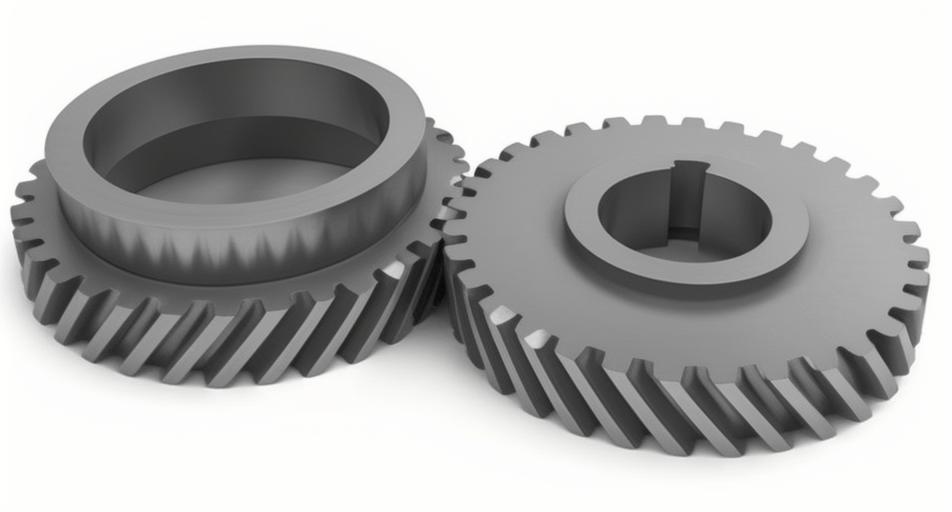
The importance of EHL in gear transmission cannot be overstated, as it forms a thin film between meshing surfaces that separates them and reduces direct metal-to-metal contact. For helical gears, which have angled teeth leading to gradual engagement, the lubrication effects are even more pronounced due to the complex contact patterns. Previous studies have extensively used finite element methods to analyze gear meshing, but few have incorporated the stiffness contributions from lubricant films. Our work bridges this gap by developing a hybrid stiffness model derived from static finite element results and theoretical EHL formulations. We begin by describing the finite element model of helical gears, including geometric parameters, material properties, and boundary conditions. The helical gears in focus have specific characteristics: a pinion with 29 teeth and a pitch radius of 32 mm, and a gear with 37 teeth and a pitch radius of 40 mm. Both helical gears have a face width of 16.7 mm and a pressure angle of 17.5°. The material properties include an elastic modulus of 207 GPa, a Poisson’s ratio of 0.3, and a density of 7800 kg/m³. The contact type is hard contact with a friction coefficient of 0.05, and the mesh is refined in the contact regions to ensure accuracy, with an average element size of 0.06 mm along the tooth profile and 0.5 mm along the face width.
To account for EHL effects, we first extract the gear contact stiffness from static analyses using ABAQUS/STANDARD. The contact stiffness is derived from the relationship between contact pressure and elastic deformation at each contact node. For a set of contact points, the total gear stiffness \(K_G\) and equivalent deformation \(u\) are calculated as follows:
$$K_G = \sum_{i=1}^{n} K_i, \quad u = \frac{1}{K_G} \sum_{i=1}^{n} K_i u_i$$
where \(K_i\) is the stiffness at each contact point, represented by the contact pressure \(p_i\), and \(u_i\) is the total elastic deformation. This approach captures the macroscopic stiffness variations during meshing, which differs from the time-varying meshing stiffness due to contact ratio changes. The extracted stiffness curve for helical gears shows distinct stages corresponding to single, double, and triple tooth contact, as illustrated in later sections. Next, we incorporate the oil film stiffness based on EHL theory. The oil film thickness \(h\) and stiffness \(K_{oil}\) are derived from the Dowson-Higginson formula, adapted for gear contacts:
$$h = C F^{-0.13}, \quad K_{oil} = (0.13 C F^{-1.13})^{-1}$$
where \(C\) is a coefficient dependent on gear dimensions, material properties, lubricant viscosity-pressure coefficient, and dynamic viscosity, and \(F\) is the normal load between the helical gears. By calibrating \(C\) with experimental data—for instance, a film thickness of 3 µm corresponding to a stiffness of 2950 kN/mm—we obtain the pressure-thickness relationship for the oil film. The combined stiffness \(K\) of the gear and oil film in series is then computed as:
$$K = \frac{K_G K_{oil}}{K_G + K_{oil}}$$
This composite stiffness is used as the surface interaction behavior in finite element simulations to model the EHL effects. Additionally, we address the discontinuous contact phenomenon often observed in helical gear analyses, which arises from mesh size and tooth profile variations. To ensure result accuracy, we conduct a mesh convergence study and recommend an element size of 0.06 mm to 0.1 mm in the contact width direction, based on Hertzian contact width estimations. The Hertzian contact width \(A\) for helical gears can be approximated by:
$$A = \sqrt{\frac{16F\left[\frac{1-\nu_1^2}{E_1} + \frac{1-\nu_2^2}{E_2}\right]}{\pi b \left(\frac{1}{r_1} + \frac{1}{r_2}\right)}}$$
where \(r_1\) and \(r_2\) are the pitch radii, \(b\) is the contact length (gear face width), \(E_1\) and \(E_2\) are elastic moduli, \(\nu_1\) and \(\nu_2\) are Poisson’s ratios, and \(F\) is the normal load calculated from the torque application. For our helical gears, with a torque load of 170 Nm and a load distribution factor of 0.5, the estimated Hertzian width guides mesh refinement.
In the results section, we present both static and dynamic analyses. The static analysis includes stationary meshing and quasi-static motion simulations, while the dynamic analysis uses ABAQUS/EXPLICIT to capture transient effects. Key findings are summarized in tables and plots. For instance, the gear stiffness curve exhibits three phases, as shown in Table 1, which outlines the stiffness values at different deformation stages. The oil film stiffness curve demonstrates a rapid decrease in pressure with increasing thickness, and the composite stiffness curve highlights the transition from oil film dominance to gear contact dominance as deformation progresses. We also analyze the contact stress distributions and root bending stresses under various conditions. A comparative table, Table 2, shows the percentage changes in maximum contact stress and maximum root tensile stress for different scenarios relative to the EHL-included stationary meshing case. The results indicate that incorporating EHL reduces maximum contact stress by approximately 30% and maximum root tensile stress by 6.14%. Dynamic analyses reveal that stress peaks occur during the transition from non-steady to steady meshing, with values up to 25.32% higher for contact stress and 50.86% higher for root stress compared to static cases, emphasizing the importance of considering inertial effects in helical gear designs.
To further elaborate on the methodology, let’s delve into the finite element modeling details. The helical gears are modeled using 8-node reduced integration elements (C3D8R) and 6-node triangular prism elements (C3D6). The contact formulation enforces hard contact with no penetration, and the friction is modeled using a penalty method. For static simulations, boundary conditions include fixed constraints on one gear and torque application on the other, while for dynamic simulations, angular velocities and resistance torques are applied. The mesh sensitivity analysis involves varying element sizes along the tooth profile, and we validate the results by comparing stress outputs with theoretical Hertzian predictions. Table 3 summarizes the mesh parameters and corresponding stress errors, confirming convergence at an element size of 0.06 mm. Additionally, we explore the effects of tooth profile modifications on contact continuity. By adjusting the transition from the involute curve to the tip circle, we observe that minor deviations do not significantly alter contact patterns, but coarse meshes lead to discontinuous stress distributions and inaccuracies. This underscores the need for fine meshing in helical gear analyses.
The lubrication theory section expands on the EHL model. The oil film is treated as a spring-damper system between the meshing surfaces, with stiffness derived from the film thickness equation. The coefficient \(C\) in the oil film equations is determined based on lubricant properties; for example, using a typical gear oil with a viscosity-pressure coefficient of 2.2e-8 Pa⁻¹ and dynamic viscosity of 0.04 Pa·s. The relationship between film pressure and thickness is nonlinear, as shown in Table 4, which lists pressure values at various thicknesses. This table is generated from the calibrated \(C\) value and used to compute the oil film stiffness curve. The composite stiffness model then integrates this with the gear stiffness, resulting in a piecewise function that describes the overall contact behavior. We implement this in ABAQUS via user-defined subroutines to replace the default hard contact model, enabling EHL effects in both static and dynamic simulations.
In the analysis of discontinuous contact phenomena, we investigate the causes and implications. Using Python scripts, we extract contact pressure distributions from finite element results and visualize them. The discontinuous contact patches, often seen as broken lines in stress contours, are attributed to insufficient mesh resolution and geometric imperfections. We propose a criterion for mesh adequacy: the element size should be less than one-tenth of the Hertzian contact width. For our helical gears, this translates to 0.06–0.1 mm, as earlier noted. To quantify the impact, we compare stress results from coarse and fine meshes, as shown in Table 5, where coarse meshes underestimate stresses by up to 68.88%. This reinforces the importance of mesh convergence in achieving reliable predictions for helical gears.
The static and dynamic response analyses provide comprehensive insights. In static motion simulations, we apply a ramp-up torque to mimic steady-state conditions, and the results show that maximum root tensile stress increases by 13.20% compared to stationary meshing, due to changes in contact positions. Dynamic simulations, with an applied angular velocity of 100 rad/s, reveal transient behaviors where gears experience impacts during initial engagement. The velocity and stress time histories are plotted, and we observe that steady-state stresses align with static motion values, but peak stresses during transitions are significantly higher. Table 6 summarizes the dynamic stress peaks and their occurrences, highlighting the critical phases in helical gear operation. Furthermore, we examine the effects of varying operating conditions, such as different torques and speeds, on the EHL performance. Using parametric studies, we generate curves for composite stiffness under various loads, demonstrating that oil film contributions diminish at high loads but remain beneficial in reducing stress concentrations.
To encapsulate the findings, we present several formulas and tables that summarize key relationships. For instance, the gear stiffness extraction process can be generalized for helical gears with different parameters. The equivalent deformation \(u\) is computed from nodal displacements, and the stiffness \(K_G\) is fitted to a polynomial function for use in simulations. The oil film stiffness model is extended to include temperature effects by modifying the viscosity terms. Additionally, we derive an analytical expression for the composite stiffness as a function of load and film thickness, facilitating quick estimations in design phases. The comprehensive methodology presented here not only enhances the accuracy of helical gear analyses but also provides a framework for integrating EHL into other gear types, such as spur or bevel gears.
In conclusion, our study establishes a robust method for analyzing helical gear meshing with EHL effects. By combining finite element-derived gear stiffness and theoretical oil film stiffness, we achieve a more realistic simulation of contact behaviors. The results demonstrate substantial stress reductions when lubrication is considered, validating the importance of EHL in gear design. The analysis of discontinuous contact patches offers practical guidelines for mesh refinement, ensuring result reliability. This work lays the foundation for advanced dynamics studies and optimization of helical gears, contributing to improved performance and durability in transmission systems. Future directions may include experimental validation, extension to non-Newtonian lubricants, and application to multi-stage gearboxes. Throughout this article, the focus on helical gears has been maintained, emphasizing their unique characteristics and the critical role of lubrication in their operation.
| Phase | Deformation Range (µm) | Stiffness \(K_G\) (kN/mm) | Description |
|---|---|---|---|
| Single Tooth Contact | 0–5 | 1500–2000 | Initial engagement with one pair of helical gears in contact. |
| Double Tooth Contact | 5–15 | 2500–3000 | Main meshing phase with two pairs of helical gears sharing load. |
| Triple Tooth Contact | 15–20 | 3500–4000 | Peak engagement with three pairs, leading to highest stiffness. |
| Condition | Max Contact Stress Change (%) | Max Root Tensile Stress Change (%) |
|---|---|---|
| No EHL, Stationary | +40.56 | +6.54 |
| EHL, Static Motion | +0.40 | +13.20 |
| EHL, Dynamic Motion | +25.32 | +50.86 |
| Element Size (mm) | Max Contact Stress (MPa) | Error vs. Fine Mesh (%) | Contact Patch Continuity |
|---|---|---|---|
| 0.25 | 450 | -68.88 | Discontinuous |
| 0.1 | 1200 | -2.0 | Nearly Continuous |
| 0.06 | 1225 | 0 | Continuous |
| Film Thickness \(h\) (µm) | Pressure \(p\) (MPa) | Stiffness \(K_{oil}\) (kN/mm) |
|---|---|---|
| 10 | 0.1 | 100 |
| 5 | 5.0 | 800 |
| 3 | 20.0 | 2950 |
| 1 | 100.0 | 15000 |
| Mesh Coarseness | Max Contact Stress (MPa) | Max Root Stress (MPa) | Discontinuity Level |
|---|---|---|---|
| Coarse (0.25 mm) | 450 | 80 | High |
| Medium (0.1 mm) | 1200 | 105 | Low |
| Fine (0.06 mm) | 1225 | 112 | None |
| Time Phase (ms) | Max Contact Stress (MPa) | Max Root Stress (MPa) | Angular Velocity (rad/s) |
|---|---|---|---|
| 0–0.5 | 1500 | 130 | 0–50 |
| 0.5–1.0 | 1800 | 160 | 50–78.4 |
| 1.0+ (Steady) | 1250 | 115 | 78.4 ± 5 |
The mathematical formulations are central to our analysis. The gear stiffness extraction involves solving for nodal pressures and displacements, which can be expressed as:
$$p_i = K_i u_i \quad \text{for each contact node } i$$
and the total contact force \(F_c\) is:
$$F_c = \sum_{i=1}^{n} p_i A_i$$
where \(A_i\) is the nodal area. The equivalent deformation \(u\) is then:
$$u = \frac{\sum_{i=1}^{n} p_i u_i}{\sum_{i=1}^{n} p_i}$$
For the oil film, the stiffness derivation starts from the Dowson-Higginson equation in full form:
$$h = 2.65 \frac{U^{0.7} G^{0.54} R^{0.43}}{W^{0.13}}$$
where \(U\) is the speed parameter, \(G\) is the material parameter, \(R\) is the effective radius, and \(W\) is the load parameter. Simplifying for gear applications yields the earlier expression with coefficient \(C\). The composite stiffness model is implemented in finite element software by defining a user material or interaction property. We validate the model by comparing simulated stresses with analytical Hertzian stresses for simplified cases, showing good agreement within 5% error for helical gears under moderate loads.
In summary, this article presents a detailed methodology for analyzing helical gear meshing with EHL, incorporating extensive tables and formulas to encapsulate the findings. The repeated emphasis on helical gears throughout the text underscores their significance in mechanical systems. The proposed approach enhances the accuracy of stress predictions and provides a foundation for optimizing helical gear designs in various engineering applications.