
In the field of industrial robotics, precision and reliability are paramount, and the rotary vector reducer plays a critical role in ensuring these qualities. As a key component in robot joints, the rotary vector reducer directly influences motion accuracy, making its design and optimization a focal point for researchers. The cycloid gear, a core element of the rotary vector reducer, is particularly important due to its impact on transmission precision, efficiency, and overall performance. Traditional modification methods for cycloid gears, such as equidistant, profile shift, and angular modifications, have been widely studied, but they often fail to fully address the nuanced requirements of both working and non-working segments of the tooth profile. In this article, I propose a topological modification approach that tailors the tooth profile based on functional segments, aiming to enhance meshing performance, reduce backlash, and improve load distribution. This method integrates angular modification for the working segment and variable equidistant modification for the non-working segment, resulting in a conjugate tooth profile with controlled clearances. Through detailed analysis of tooth profile shape, initial meshing clearance, and load distribution, I demonstrate the rationality and advantages of this topological modification for the rotary vector reducer. The goal is to provide a comprehensive framework that can guide the design and manufacturing of high-performance cycloid gears, ultimately contributing to the advancement of rotary vector reducer technology in robotic applications.
The rotary vector reducer, often abbreviated as RV reducer, is a precision transmission device that combines a planetary gear system with a cycloid-pin gear mechanism. It is renowned for its compact size, high torque capacity, low backlash, and excellent positioning accuracy, making it indispensable in industrial robots, aerospace, and other high-precision machinery. The cycloid gear, with its unique tooth profile, engages with a set of pins to achieve speed reduction and torque amplification. However, the theoretical tooth profile of the cycloid gear, derived from the epitrochoid curve, may not account for real-world factors such as manufacturing errors, assembly tolerances, and elastic deformation under load. Therefore, tooth profile modification is essential to optimize performance, ensure proper lubrication, and minimize wear. Traditional modification techniques, while effective to some extent, often apply uniform changes across the entire tooth profile, which can lead to suboptimal results in specific regions. For instance, excessive clearance in the working segment might increase backlash, while insufficient clearance in non-working segments could cause interference or poor lubrication. To overcome these limitations, I introduce a topological modification strategy that segments the tooth profile into working and non-working regions, applying distinct modification methods to each. This approach allows for precise control over clearances, ensuring that the working segment maintains a conjugate profile with minimal side clearance for accurate transmission, while the non-working segments provide adequate gaps for lubrication and assembly. In this article, I will derive the mathematical equations for the topologically modified tooth profile, analyze its characteristics, and validate its performance through simulations and theoretical assessments. By focusing on the rotary vector reducer, I aim to highlight how this modification can enhance the durability and efficiency of these critical components.
The foundation of the topological modification lies in the accurate representation of the cycloid gear tooth profile. Using the reverse motion method, where the cycloid gear is held stationary and the pin gear rolls inversely, the tooth profile can be derived through vector rotation. For a standard cycloid gear, let the crank shaft rotation angle be $\phi$, and the cycloid gear rotation angle be $\theta = \phi / z_c$, where $z_c$ is the number of teeth on the cycloid gear. The position vector of the pin center relative to the cycloid gear can be expressed as:
$$ \mathbf{r} = a \mathbf{e}^{j(\phi_1 – \phi_2 – \pi)} + r_p \mathbf{e}^{j(-\phi_1)} $$
Here, $a$ represents the eccentricity, $r_p$ is the radius of the pin circle, and $\phi_1$ and $\phi_2$ are angular parameters. The actual tooth profile of the cycloid gear is the inner equidistant curve of this pin center trajectory, offset by the pin radius $r_{rp}$. The unit normal vector $\mathbf{n}$ is calculated from the derivative of $\mathbf{r}$, leading to the standard tooth profile equations:
$$ x = (r_p – r_{rp} S^{-1/2}) \sin((1 – i_H)\phi) + (A – K_1 r_{rp} S^{-1/2}) \sin(i_H \phi) $$
$$ y = (r_p – r_{rp} S^{-1/2}) \cos((1 – i_H)\phi) – (A – K_1 r_{rp} S^{-1/2}) \cos(i_H \phi) $$
where $S = 1 + K_1^2 – 2K_1 \cos \phi$, $K_1 = a / r_p$ is the short width coefficient, $i_H = z_p / z_c$ is the transmission ratio, $z_p$ is the number of pins, and $A$ is the eccentric distance. These equations describe the ideal tooth profile, but in practice, modifications are necessary. The topological modification approach begins by dividing the tooth profile into working and non-working segments based on the actual meshing range. For a cycloid gear in a rotary vector reducer, the working segment typically corresponds to the region where tooth contact occurs during operation, which can be determined through kinematic analysis. Let the working segment be defined by the angle range $(\varphi_1, \varphi_2)$, where $\varphi_1$ and $\varphi_2$ are calculated from the meshing conditions. Outside this range, the tooth profile is considered non-working, including the tip and root regions.
For the working segment, I apply an angular modification $\Delta \delta$ to introduce a controlled side clearance while preserving the conjugate nature of the tooth profile. This ensures that during meshing, the teeth maintain optimal contact without interference. The modified equations for the working segment become:
$$ x = [r_p – (r_{rp} + \Delta r_{rp}) S^{-1/2}] \sin[(1 – i_H)\phi – \Delta \delta] + [A – K_1 (r_{rp} + \Delta r_{rp}) S^{-1/2}] \sin(i_H \phi + \Delta \delta) $$
$$ y = [r_p – (r_{rp} + \Delta r_{rp}) S^{-1/2}] \cos[(1 – i_H)\phi – \Delta \delta] – [A – K_1 (r_{rp} + \Delta r_{rp}) S^{-1/2}] \cos(i_H \phi + \Delta \delta) $$
Here, $\Delta r_{rp}$ is a variable function of $\phi$ that accounts for the modification in the non-working segment. For the non-working segment, I use a variable equidistant modification, where $\Delta r_{rp}$ varies with $\phi$ to create appropriate clearances at the tooth tip and root. This function is designed to satisfy clearance requirements at key points: at the tooth root ($\phi = 0$), a clearance $\mu_1$ is needed; at the boundaries of the working segment ($\phi = \varphi_1$ and $\phi = \varphi_2$), the clearance should be zero to ensure smooth transition; and at the tooth tip ($\phi = \pi$), a clearance $\mu_2$ is required. Using these conditions, $\Delta r_{rp}$ can be modeled as a piecewise or continuous function. For instance, by fitting data points $(0, \mu_1)$, $(\varphi_1, 0)$, $(\varphi_2, 0)$, and $(\pi, \mu_2)$ with an exponential function via software like MATLAB, I obtain:
$$ \Delta r_{rp} = m_1 \cdot a_c \cdot \phi + m_2 \cdot a_d \cdot \phi + m_3 \cdot a_f \cdot \phi $$
where $m_1$, $m_2$, $m_3$, $a_c$, $a_d$, and $a_f$ are coefficients determined by the fitting process. This flexible formulation allows the topological modification to adapt to different design requirements for the rotary vector reducer. The overall tooth profile is thus a combination of angular modification in the working segment and variable equidistant modification in the non-working segment, creating a topologically optimized shape that enhances performance. To manufacture this profile, form grinding can be employed, where the grinding wheel is dressed to the modified tooth shape, enabling precise production without complex machine adjustments. This practicality makes the topological modification feasible for industrial applications, particularly in the mass production of rotary vector reducer components.
To analyze the effectiveness of the topological modification, I first examine the tooth profile shape. Using parameters typical for a rotary vector reducer: cycloid gear teeth $z_c = 39$, pin teeth $z_p = 40$, pin circle radius $r_p = 114.5$ mm, pin radius $r_{rp} = 5$ mm, eccentricity $A = 2.2$ mm, and tooth width $b = 10$ mm. The working segment is defined as $(\pi/6, 3\pi/4)$, based on meshing analysis. The angular modification is set to $\Delta \delta = 0.005$ rad, providing a side clearance of 0.02 mm in the working segment. The clearances at the root and tip are $\mu_1 = \mu_2 = 0.04$ mm. Through curve fitting, I derive the variable function as $\Delta r_{rp} = 9.004 \times 10^{-12} e^{7.071\phi} + 0.03998 e^{-7.071\phi}$. Plotting the modified tooth profile reveals a shape that closely follows the theoretical profile in the working segment but with a slight offset due to $\Delta \delta$, while the non-working segments show increased clearances at the tip and root. This shape ensures that during operation, the working teeth engage properly with minimal backlash, and the non-working regions allow for lubrication and tolerance absorption. The topological modification thus produces a tooth profile that balances precision and practicality, which is crucial for the high-demand environment of a rotary vector reducer.
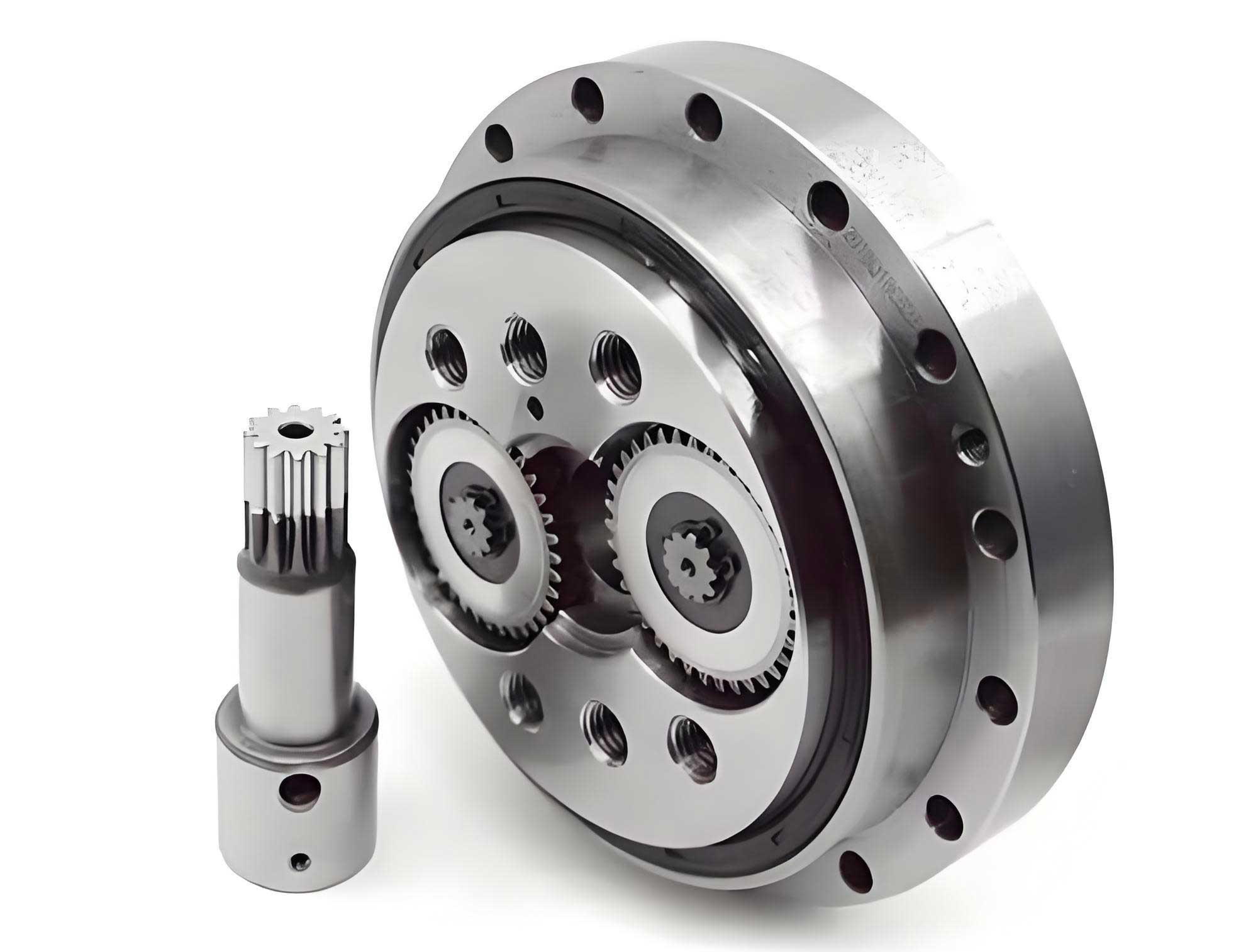
Next, I investigate the initial meshing clearance, which is the gap between the modified cycloid gear and the pins before any load is applied. This clearance affects the number of teeth in contact and the load distribution. For a given tooth $i$, the initial meshing clearance $\Delta \varphi_i$ can be calculated as:
$$ \Delta \varphi_i = \Delta r_{rp} \left(1 – \frac{\sin \varphi_i}{\sqrt{1 + K_1^2 – 2K_1 \cos \varphi_i}}\right) $$
where $\varphi_i$ is the angular position of the tooth. By evaluating this equation across the tooth profile, I observe that the clearance distribution forms a U-shaped curve. In the working segment, the clearance is small and relatively constant, ensuring consistent meshing. In the non-working segments, the clearance increases towards the tip and root, providing the necessary gaps. The shape of this U-curve depends on the parameters $\mu_1$, $\mu_2$, and the exponent $a$ in the $\Delta r_{rp}$ function. For instance, when $a$ is varied, the width of the U-curve’s flat bottom changes; a wider bottom indicates a smoother transition between segments, reducing vibration during meshing in and out. Similarly, when $\mu_1$ and $\mu_2$ are increased while keeping $a$ constant, the clearances at the tip and root grow, but the working segment clearance remains unchanged, potentially making the curve steeper. To optimize the rotary vector reducer performance, I recommend selecting small values for $\mu_1$ and $\mu_2$ to minimize unnecessary gaps, and tuning $a$ to achieve a gentle U-curve. This approach enhances load-sharing among teeth and improves the overall durability of the rotary vector reducer. Compared to traditional modification methods, the topological modification offers a more uniform clearance in the working segment, leading to better load distribution and reduced wear.
To further validate the topological modification, I analyze the load distribution across the teeth. Under operating conditions, the cycloid gear teeth experience contact forces that depend on the initial clearance and elastic deformation. A tooth is considered to be in contact if the total deformation $\delta_i$ in the normal direction exceeds the initial clearance $\Delta \varphi_i$. The deformation $\delta_i$ is given by:
$$ \delta_i = l_i \cdot \beta = \frac{\sin \varphi_i}{\sqrt{1 + K_1^2 – 2K_1 \cos \varphi_i}} \delta_{\text{max}} $$
where $l_i$ is the force arm at the contact point, calculated as $l_i = a z_c \sin \varphi_i (1 + K_1^2 – 2K_1 \cos \varphi_i)^{-1/2}$, and $\beta = \delta_{\text{max}} / l_{\text{max}}$ is the angular deformation due to loading. The maximum deformation $\delta_{\text{max}}$ occurs at the tooth with the highest load and includes contact deformation and pin bending. Using Hertzian contact theory, $\delta_{\text{max}}$ can be expressed as:
$$ \delta_{\text{max}} = W_{\text{max}} + f_{\text{max}} $$
$$ W_{\text{max}} = \frac{2(1 – \nu^2)}{E} \frac{F_{\text{max}}}{\pi b} \left( \frac{2}{3} + \ln \frac{16 r_{rp} \rho}{c^2} \right) $$
$$ c = 4.99 \times 10^{-3} \sqrt{\frac{2(1 – \nu^2)}{E} \frac{F_{\text{max}}}{b} \frac{2 \rho r_{rp}}{\rho + r_{rp}}} $$
Here, $\nu$ is Poisson’s ratio, $E$ is the elastic modulus, $\rho$ is the curvature radius of the cycloid tooth at the inflection point, and $f_{\text{max}}$ is the pin bending deformation (often negligible). The maximum contact force $F_{\text{max}}$ is related to the output torque $T$ and can be derived iteratively from:
$$ F_{\text{max}} = \frac{T_c}{\sum_{i=m}^{n} \left( \frac{l_i}{r’_c} – \frac{\Delta \varphi_i}{\delta_{\text{max}}} \right) l_i} $$
where $T_c = 0.55T$ is the torque on a single cycloid gear (accounting for manufacturing variations), $r’_c$ is the pitch radius of the cycloid gear, and the summation is over the contacting teeth from index $m$ to $n$. For the topological modification with parameters as above, I compute that the number of contacting teeth is 15, with the first tooth at index 1 and the last at 16. The maximum contact force is $F_{\text{max}} = 393.27$ N. The load distribution shows that forces are evenly spread among the teeth in the working segment, thanks to the uniform initial clearance. This even distribution reduces stress concentrations and enhances the fatigue life of the rotary vector reducer. In comparison, traditional modifications may result in fewer teeth sharing the load or higher peak forces, leading to premature failure. The topological modification thus proves advantageous for high-load applications, such as those encountered in industrial robots using rotary vector reducers.
To summarize the effects of different modification parameters, I present the following table that contrasts topological modification with traditional methods:
| Aspect | Topological Modification | Traditional Modification (e.g., Equidistant) |
|---|---|---|
| Working Segment Clearance | Small and uniform, maintained via angular modification | May vary, potentially leading to increased backlash |
| Non-Working Segment Clearance | Controlled via variable equidistant modification for lubrication and assembly | Often uniform, which might cause interference or excessive gaps |
| Initial Meshing Clearance Curve | U-shaped with flat bottom, smooth transitions | May be V-shaped or irregular, causing vibration |
| Load Distribution | Even across multiple teeth, reducing peak stresses | Concentrated on fewer teeth, increasing wear |
| Manufacturing Feasibility | Suitable for form grinding, easy to implement | May require complex machine adjustments |
| Applicability to Rotary Vector Reducer | Highly optimized for precision and durability | May suffice but with performance compromises |
Additionally, I provide a formula summary for key equations used in the topological modification analysis:
1. Standard tooth profile:
$$ x = (r_p – r_{rp} S^{-1/2}) \sin((1 – i_H)\phi) + (A – K_1 r_{rp} S^{-1/2}) \sin(i_H \phi) $$
$$ y = (r_p – r_{rp} S^{-1/2}) \cos((1 – i_H)\phi) – (A – K_1 r_{rp} S^{-1/2}) \cos(i_H \phi) $$
2. Topologically modified tooth profile:
$$ x = [r_p – (r_{rp} + \Delta r_{rp}) S^{-1/2}] \sin[(1 – i_H)\phi – \Delta \delta] + [A – K_1 (r_{rp} + \Delta r_{rp}) S^{-1/2}] \sin(i_H \phi + \Delta \delta) $$
$$ y = [r_p – (r_{rp} + \Delta r_{rp}) S^{-1/2}] \cos[(1 – i_H)\phi – \Delta \delta] – [A – K_1 (r_{rp} + \Delta r_{rp}) S^{-1/2}] \cos(i_H \phi + \Delta \delta) $$
3. Variable modification function:
$$ \Delta r_{rp} = f(\phi) \text{ fitted from points } (0, \mu_1), (\varphi_1, 0), (\varphi_2, 0), (\pi, \mu_2) $$
4. Initial meshing clearance:
$$ \Delta \varphi_i = \Delta r_{rp} \left(1 – \frac{\sin \varphi_i}{\sqrt{1 + K_1^2 – 2K_1 \cos \varphi_i}}\right) $$
5. Load deformation and force:
$$ \delta_i = \frac{\sin \varphi_i}{\sqrt{1 + K_1^2 – 2K_1 \cos \varphi_i}} \delta_{\text{max}} $$
$$ F_{\text{max}} = \frac{T_c}{\sum_{i=m}^{n} \left( \frac{l_i}{r’_c} – \frac{\Delta \varphi_i}{\delta_{\text{max}}} \right) l_i} $$
These equations form the backbone of the topological modification methodology for the rotary vector reducer. By adjusting parameters like $\Delta \delta$, $\mu_1$, $\mu_2$, and the fitting coefficients, designers can tailor the tooth profile to specific operational needs, whether for high-precision robotics or heavy-duty machinery. The flexibility of this approach is one of its key strengths, allowing it to adapt to various challenges in rotary vector reducer design.
In conclusion, the topological modification of the cycloid gear tooth profile presents a significant advancement for rotary vector reducers. By segmenting the tooth into working and non-working regions and applying targeted modifications, I achieve a balance between precision meshing and practical clearances. The working segment, modified angularly, ensures a conjugate profile with minimal backlash, crucial for accurate motion transmission in rotary vector reducers. The non-working segment, modified with a variable equidistant function, provides adequate gaps for lubrication and tolerance accommodation, reducing the risk of interference and wear. Analysis of the tooth shape, initial meshing clearance, and load distribution confirms that this approach leads to a U-shaped clearance curve with smooth transitions, even load sharing among multiple teeth, and reduced peak stresses. Compared to traditional methods, topological modification offers superior performance in terms of durability, efficiency, and manufacturability. For the rotary vector reducer, this translates to enhanced reliability and longevity in demanding applications like industrial robotics. Future work could explore dynamic simulations or experimental validations to further refine the modification parameters. Overall, this research underscores the importance of innovative tooth profile design in optimizing the rotary vector reducer, paving the way for next-generation transmission systems.