
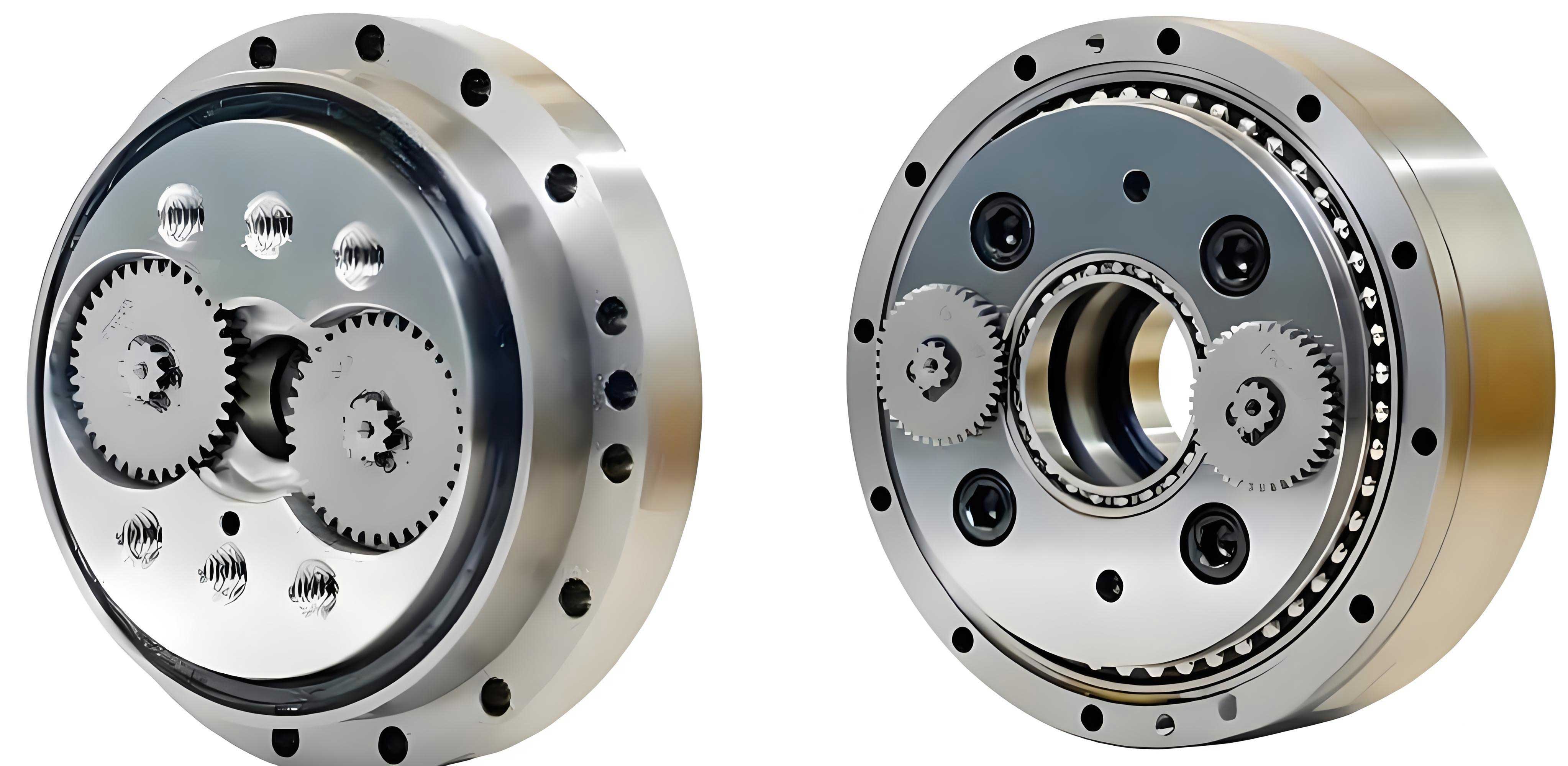
The rotary vector reducer, a core component in robotic joints, is prized for its compactness, high stiffness, and precision. At its heart lies a pair of non-standard, back-to-back mounted angular contact ball bearings, known as the main bearings. These bearings shoulder the entirety of the external loads—axial, radial, and moment—acting on the reducer. Consequently, their performance is a decisive factor for the overall rotational accuracy, load-carrying capacity, and, most critically, the operational lifespan of the rotary vector reducer. Given their custom nature, where envelope dimensions are constrained by the reducer’s internal architecture, optimizing their internal geometry for enhanced fatigue life becomes a paramount design objective. This study focuses on maximizing the basic rated life of the main bearing in a rotary vector reducer through structural parameter optimization, employing a Genetic Algorithm (GA), and provides a comparative analysis with the Full Factorial Method while evaluating parameter sensitivity.
The fundamental challenge is to identify the set of internal geometric parameters that yield the maximum basic rated life under specified operational conditions. The basic rated life in hours, according to the ISO standard, is given by:
$$
L_{10h} = \frac{10^6}{60n} \left( \frac{C}{P} \right)^\epsilon
$$
where \( C \) is the basic dynamic load rating, \( P \) is the equivalent dynamic load, \( n \) is the rotational speed, and \( \epsilon = 3 \) for ball bearings. For a constant load \( P \) and speed \( n \), maximizing \( L_{10h} \) is equivalent to maximizing \( C \). For a ball bearing with a ball diameter \( D_w \leq 25.4 \) mm, the basic dynamic load rating is calculated as:
$$
C = b_m f_c (i \cos\alpha_0)^{0.7} Z^{2/3} D_w^{1.8}
$$
Here, \( b_m \) is a material and processing coefficient (taken as 1.8), \( i \) is the number of bearing rows (1 for a single row), \( \alpha_0 \) is the nominal contact angle, \( Z \) is the number of balls, \( D_w \) is the ball diameter, and \( f_c \) is a geometry factor. The factor \( f_c \) is a complex function of the bearing’s internal geometry:
$$
f_c = 1.72 f_i^{1/3} f_o^{0.3} \left[ \frac{1.390}{1 + (1.04(1-\gamma)/(1+\gamma))^{10/3}} \right]^{0.3} \left[ \frac{2 f_i – 1}{2 f_i – 1 + \gamma} \right]^{0.41}
$$
where \( f_i = r_i / D_w \) and \( f_o = r_o / D_w \) are the curvature radius coefficients for the inner and outer raceways, respectively, and \( \gamma = D_w \cos\alpha_0 / d_m \) is a dimensionless parameter with \( d_m \) being the pitch circle diameter. Based on this formulation, five key internal geometry parameters significantly influence \( C \) and were selected as design variables for the optimization problem:
$$
\mathbf{X} = [x_1, x_2, x_3, x_4, x_5] = [f_i, f_o, D_w, d_m, Z]
$$
The optimization aims to find the vector \( \mathbf{X} \) that maximizes the objective function \( C(\mathbf{X}) \). However, practical design imposes several constraints on these variables to ensure manufacturability and proper bearing function. These constraints are formalized as follows:
- Raceway Curvature Radius: The radii must fall within practical limits, and the outer raceway radius should be slightly larger than the inner one.
$$
g_1(\mathbf{X}) = r_i: \quad 4.905 \leq r_i \leq 5.144
$$
$$
g_2(\mathbf{X}) = r_o: \quad 4.905 \leq r_o \leq 5.144
$$
$$
g_3(\mathbf{X}) = r_i – r_o \leq 0
$$ - Ball Diameter: It must be proportionate to the bearing cross-section.
$$
g_4(\mathbf{X}) = D_w: \quad 0.5K_{D,min}(D-d) \leq D_w \leq 0.5K_{D,max}(D-d)
$$
with \( K_{D,min}=0.54 \) and \( K_{D,max}=0.67 \), where \( D \) and \( d \) are the outer and inner ring diameters, respectively. - Pitch Circle Diameter: It should be close to the mean bearing diameter.
$$
g_5(\mathbf{X}) = d_m: \quad 0.5(D+d) \leq d_m \leq 0.5(D+d+e)
$$
where \( e \) is a small positive allowance. - Number of Balls: Must be sufficient for load sharing, but balls must not interfere.
$$
g_6(\mathbf{X}) = Z: \quad Z_{min} \leq Z \quad \text{and} \quad \pi d_m / Z – D_w \geq c_{w,min}
$$
with \( Z_{min} = 31 \) and a minimum cage pocket clearance \( c_{w,min} = 0.1D_w \).
The optimization problem was solved using a Genetic Algorithm. The algorithm evaluates candidate designs by scoring them based on how closely their calculated basic rated life \( L_{10h} \) matches a target maximum life. The score \( S \) is defined as \( S = Q \times |T – O| \), where \( Q \) is a weight, \( T \) is the target value, and \( O \) is the obtained life. A lower score indicates a better, more optimal design. The nominal parameters of the main bearing in the rotary vector reducer used as the baseline are listed below.
| Parameter | Symbol | Value |
|---|---|---|
| Inner Raceway Diameter | \( d \) | 115 mm |
| Outer Raceway Diameter | \( D \) | 145 mm |
| Inner Raceway Curvature Radius | \( r_i \) | 4.905 mm |
| Outer Raceway Curvature Radius | \( r_o \) | 5.001 mm |
| Ball Diameter | \( D_w \) | 9.525 mm |
| Number of Balls | \( Z \) | 37 |
| Pitch Circle Diameter | \( d_m \) | 130 mm |
| Axial Load | \( F_a \) | 6 kN |
| Radial Load | \( F_r \) | 3.5 kN |
| Rotational Speed | \( n \) | 1000 rpm |
| Nominal Basic Rated Life | \( L_{10h} \) | 6179.9 h |
The GA successfully searched the design space defined by the variables and constraints. The optimization results indicated a significant improvement in the basic rated life. The trends observed from the candidate solutions showed that increases in ball count \( Z \) and ball diameter \( D_w \) consistently led to higher fatigue life by reducing contact stress. The pitch circle diameter \( d_m \) and raceway curvature coefficients \( f_i, f_o \) exhibited a more complex, non-monotonic relationship with life. The final optimized parameters from the GA are presented in the comparison table later.
To validate the GA results and ensure a comprehensive exploration, the Full Factorial Method was employed. This method evaluates all possible combinations of predefined levels for each factor. Five levels were chosen for the main geometric parameters, as shown in the following table, leading to a total of 6000 design evaluations.
| Level | \( D_w \) (mm) | \( Z \) | \( d_m \) (mm) | \( f_i \) | \( f_o \) |
|---|---|---|---|---|---|
| 1 | 8.100 | 35 | 130.00 | 0.515 | 0.515 |
| 2 | 8.588 | 36 | 130.65 | 0.521 | 0.521 |
| 3 | 9.075 | 37 | 131.30 | 0.528 | 0.528 |
| 4 | 9.563 | 38 | 131.95 | 0.534 | 0.534 |
| 5 | 10.050 | 39 | 132.60 | 0.540 | 0.540 |
The Full Factorial Method identified the optimal combination as: \( d_m = 130.00 \) mm, \( D_w = 10.050 \) mm, \( r_i = 5.084 \) mm (\( f_i \approx 0.506 \)), \( r_o = 5.144 \) mm (\( f_o \approx 0.512 \)), and \( Z = 39 \). This configuration yielded a basic rated life of 9580.29 hours. A direct comparison between the baseline, GA-optimized, and Full Factorial-optimized designs reveals the efficacy of the optimization.
| Design | \( D_w \) (mm) | \( Z \) | \( d_m \) (mm) | \( r_i \) (mm) | \( r_o \) (mm) | \( L_{10h} \) (h) | Improvement |
|---|---|---|---|---|---|---|---|
| Baseline | 9.525 | 37 | 130.00 | 4.905 | 5.001 | 6179.9 | – |
| Genetic Algorithm | 10.050 | 39 | 130.45 | 5.038 | 5.051 | 9554.3 | +54.6% |
| Full Factorial | 10.050 | 39 | 130.00 | 5.084 | 5.144 | 9580.3 | +55.0% |
The agreement between the two optimization methods is remarkable, with only a 0.4% difference in the predicted optimal life. Both methods converge on increasing the ball diameter and count to their upper permissible limits. The primary discrepancy lies in the optimal values for the raceway curvature radii, suggesting that this parameter has a secondary influence on the basic rated life within the defined constraints.
To quantitatively assess the influence of each design variable on the basic rated life, a sensitivity analysis was conducted. This analysis modifies one variable at a time to its minimum or maximum bound while keeping others at their nominal baseline values. The resulting change in the basic rated life is then used to rank the variables’ impact. The analysis considered the main variables, and the results for key scenarios are summarized below.
| Scenario | Change | \( D_w \) (mm) | \( Z \) | \( d_m \) (mm) | \( r_i \) (mm) | \( r_o \) (mm) | \( L_{10h} \) (h) | \(\Delta\) Life (h) |
|---|---|---|---|---|---|---|---|---|
| Baseline (Nominal) | – | 9.525 | 37 | 130.00 | 4.905 | 5.001 | 6179.9 | 0 |
| Max \( D_w \) | +5.5% | 10.050 | 37 | 130.00 | 4.905 | 5.001 | 7375.4 | +1195.5 |
| Max \( Z \) | +5.4% | 9.525 | 39 | 130.00 | 4.905 | 5.001 | 6865.9 | +686.0 |
| Min \( Z \) | -13.5% | 9.525 | 32 | 130.00 | 4.905 | 5.001 | 4622.9 | -1557.0 |
| Max \( d_m \) | +1.2% | 9.525 | 37 | 131.50 | 4.905 | 5.001 | 6122.2 | -57.7 |
| Min \( D_w \) | -15.0% | 8.100 | 37 | 130.00 | 4.905 | 5.001 | 2252.2 | -3927.7 |
The sensitivity analysis yields a clear hierarchy of influence. The ball diameter \( D_w \) exhibits the most profound impact on the basic rated life of the main bearing in the rotary vector reducer. A 15% reduction catastrophically decreases life by over 60%, while a 5.5% increase offers a significant 19% boost. The number of balls \( Z \) is the second most influential parameter. The pitch circle diameter \( d_m \) shows a relatively minor influence within its constrained range. Crucially, the raceway curvature radii \( r_i \) and \( r_o \) demonstrate the least sensitivity, causing changes of less than 0.1% when varied individually across their entire allowed range. This explains the minor discrepancy in their optimal values between the GA and Full Factorial results.
In conclusion, this study successfully demonstrated the application of a Genetic Algorithm for the optimal design of the main bearing in a rotary vector reducer, with the primary goal of maximizing its basic rated fatigue life. The optimization model, incorporating key internal geometry parameters as design variables alongside practical engineering constraints, proved effective. Validation via the Full Factorial Method confirmed the robustness of the GA approach, with both methods achieving a life improvement exceeding 54% over the baseline design. The core optimal strategy involved maximizing the ball diameter and the number of balls within spatial and kinematic limits. The sensitivity analysis provided critical design insight, unequivocally identifying the ball diameter as the most critical parameter, followed by the ball count, while the raceway curvature coefficients had a negligible effect within standard design ranges. These findings provide a reliable, systematic framework for engineers to enhance the durability and reliability of rotary vector reducers through optimized main bearing design, contributing directly to the performance and longevity of robotic systems.