
The domestic robotics industry has witnessed remarkable growth in recent years. The innovation in robotic technology and the expansion of its application fields present vast opportunities alongside significant challenges. As technology advances, the use of robotics has extended from traditional sectors like automotive and electronics manufacturing to diverse areas such as food processing, pharmaceuticals, and logistics. This proliferation not only enhances production efficiency and quality but also reduces labor costs and minimizes workplace accidents. Within the industrial domain, the industrial robot serves as the core automation unit, prized for its high efficiency, safety, intelligence, and ease of management. For any industrial robot, the rotary vector reducer (RV reducer), as a key transmission component, critically influences its operational performance metrics. Currently, common reducer types on the market include harmonic reducers and RV reducers. While domestic manufacturing of harmonic reducers has seen breakthroughs, the production of high-precision rotary vector reducers still faces technical constraints, hindering mass production. Compared to traditional cycloidal pinwheel reducers, the rotary vector reducer offers advantages such as a more compact size, lighter weight, and higher transmission efficiency. With the continuous expansion of robot applications, the demand for higher performance and reliability has made the rotary vector reducer a focal point of current research.
The precision of a rotary vector reducer significantly impacts a robot’s operational accuracy. Higher reducer precision translates to smaller transmission errors during robot operation. However, the prevailing practice in many factories remains the manual selection and matching of components for rotary vector reducer assembly. This method relies heavily on the experience of technicians. The inherent subjectivity of human operators and the difficulty in handling a large inventory of diverse parts often prevent the identification of the optimal assembly combination. This leads to low accuracy in part matching, while consuming substantial time, labor, and resources through trial and error.
Therefore, this research focuses on developing an intelligent algorithm-based selection platform for rotary vector reducer components. The platform aims to drastically improve the efficiency of the parts matching process, providing factories with a superior selection service. It is designed to perform part matching operations based on user-defined requirements and constraints, while also incorporating essential functions like user management and data storage. Compared to traditional manual methods, this platform enhances both the accuracy and speed of part selection, lowers the technical threshold for factories, and alleviates the pressure on human operators.
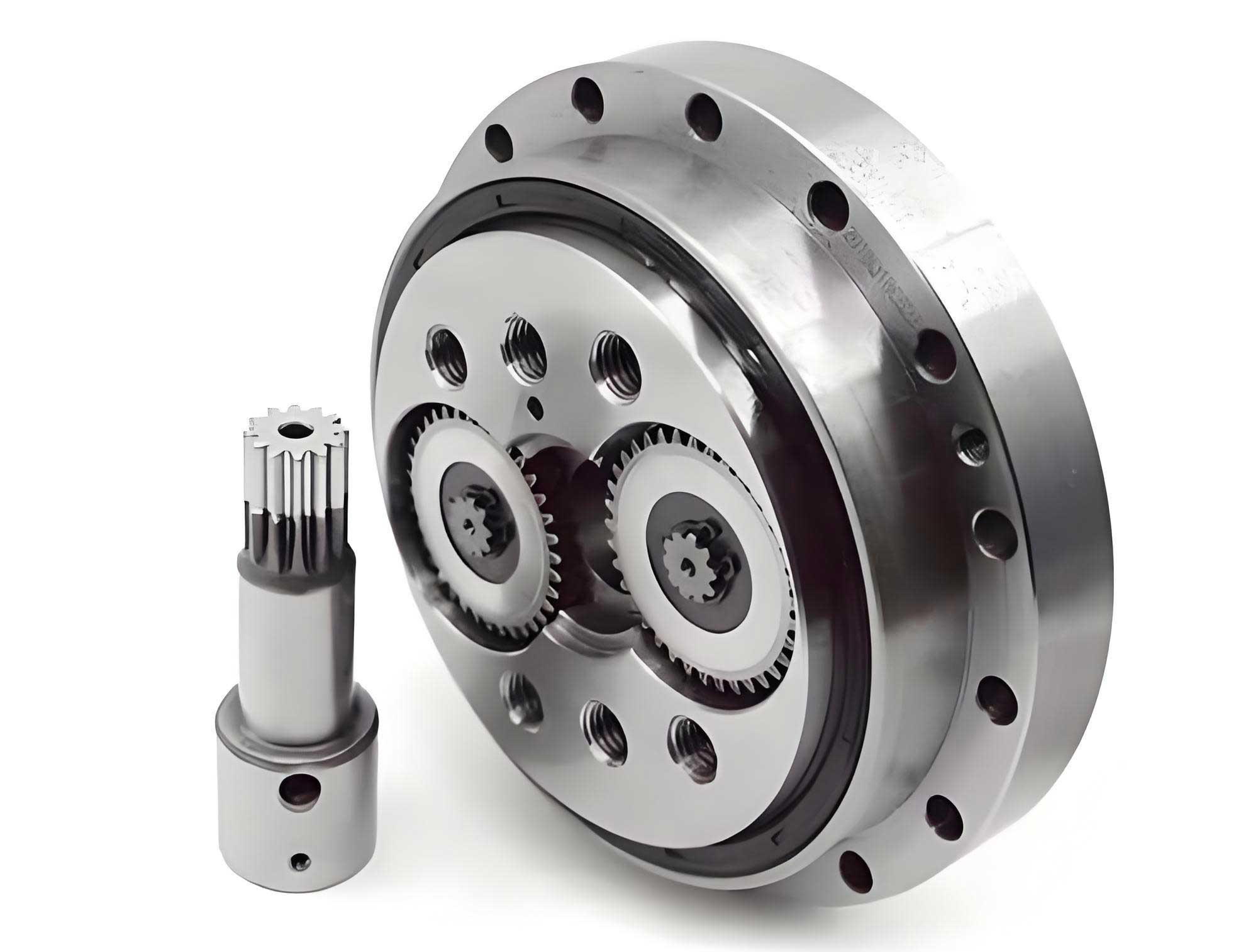
Analysis of Part Matching for the Rotary Vector Reducer
Compared to harmonic reducers, the rotary vector reducer is a novel transmission device with a more complex structure. It consists of numerous components assembled in a compact, small-volume design. Taking the RV-20E model as an example, the primary components constituting a rotary vector reducer and their matching problem are discussed here. The analysis of part matching must consider multiple factors, such as dimensional tolerances and wear characteristics of components, all of which ultimately influence the quality of the produced rotary vector reducer.
The rotary vector reducer finds wide application and holds a particularly important position in industrial robotics requiring high-precision motion. Consequently, transmission accuracy stands as its most critical performance indicator in practical production. The selection process begins with choosing an appropriate pin housing based on the required transmission error tolerance. The pin housing is the core component, and its precision and quality directly determine the reducer’s transmission performance. Subsequently, the accuracy and manufacturing process of the cycloidal gears significantly govern the transmission outcome. The crankshaft and pin needles serve to support and fix other parts, and their quality and precision must also be assured. In summary, a complete set of parts for one rotary vector reducer can be simplified to include one pin housing, two cycloidal gears, two crankshafts, and a set of pin needles. By classifying and serializing different part types and selecting them according to predefined matching rules, a complete rotary vector reducer assembly is formed.
Clearly, manually selecting parts from a vast and varied inventory to assemble a rotary vector reducer is highly inefficient and unreliable. To achieve efficient component matching, this research employs intelligent algorithms to assist in decision-making. By analyzing the parametric characteristics of components and the matching rules, a suitable mathematical model is established. Intelligent algorithms are then utilized to perform optimization calculations, thereby deriving the optimal component combination scheme.
Introduction to Relevant Intelligent Algorithms for the RV Reducer Matching Platform
The core function of the selection platform is to identify the best combination of parts from a large inventory based on user needs and constraints. Given the complexity of matching parts for a rotary vector reducer, the platform design employs swarm intelligence algorithms to search for the optimal solution. The concept of “fitness value” from intelligent algorithms is introduced to evaluate the quality of each part combination. The calculation of the fitness value depends on multiple factors, including part performance indicators and operational environment requirements. Through continuous iteration and updates, the selection platform progressively refines part combinations to converge on the optimal solution.
This section introduces three prominent swarm intelligence algorithms: the Genetic Algorithm (GA), the Artificial Bee Colony (ABC) algorithm, and the Particle Swarm Optimization (PSO) algorithm.
Genetic Algorithm (GA)
The Genetic Algorithm is a global optimization algorithm whose basic principle simulates biological evolutionary systems. The algorithm mimics operations such as chromosomal crossover, inheritance, and mutation to screen individuals meeting constraint conditions within a population, ultimately obtaining a population representing the optimal solution. In GA, a problem is first transformed into a computer-processable form, and different chromosome encoding schemes are used to represent the problem. Different encoding schemes impact solution quality and convergence speed differently. Given the characteristics of rotary vector reducer part sets, an integer encoding scheme can be adopted. Research indicates that GAs are prone to premature convergence, and traditional population initialization methods lack robust global search capability to uniformly explore the entire solution space. Therefore, strategies such as incorporating simulated annealing or adaptive functions can be introduced to prevent the algorithm from becoming trapped in local optima. After iterative optimization by the GA, part matching schemes are progressively improved to achieve an optimal assembly configuration.
The selection probability in a GA is often based on fitness. A common method is the roulette wheel selection, where the probability $P_i$ of selecting individual $i$ is given by:
$$P_i = \frac{f_i}{\sum_{j=1}^{N} f_j}$$
where $f_i$ is the fitness of individual $i$, and $N$ is the population size.
Artificial Bee Colony (ABC) Algorithm
The Artificial Bee Colony algorithm is a swarm intelligence algorithm known for its simple principle, ease of implementation, few control parameters, and fast convergence. This algorithm simulates the foraging behavior of honey bees, utilizing mechanisms of exploration and information sharing to find optimal solutions to optimization problems. In the ABC algorithm, individual employed bees perform local search, while also sharing information through communication to achieve global optimization. By simulating bee behavior, the ABC algorithm can explore the solution space for the best match and enhance search efficiency through information exchange. For rotary vector reducer part matching, the ABC algorithm can search and optimize based on part characteristics and constraints to find the best selection scheme.
Particle Swarm Optimization (PSO) Algorithm
Particle Swarm Optimization is a search algorithm based on群体协作,最初由J.Kennedy和R.C.Eberhart等人根据模拟鸟群的觅食行为提出. In this algorithm, each particle represents a potential solution to the problem. Particles evaluate their position based on a fitness value. The position of each particle in the next generation is determined by its current position, its personal best position ($pbest$), and the global best position found by the entire swarm ($gbest$). Through continuous iteration, the PSO algorithm seeks the location of the optimal solution. For matching parts of a rotary vector reducer, PSO can simulate the movement and search of “part particles” within the solution space to find the best selection scheme.
The position $x_i(t)$ and velocity $v_i(t)$ update equations for particle $i$ in PSO are:
$$v_i(t+1) = \omega v_i(t) + c_1 r_1 (pbest_i – x_i(t)) + c_2 r_2 (gbest – x_i(t))$$
$$x_i(t+1) = x_i(t) + v_i(t+1)$$
where $\omega$ is the inertia weight, $c_1$ and $c_2$ are acceleration coefficients, and $r_1$, $r_2$ are random numbers in [0,1].
By applying Genetic Algorithms, Artificial Bee Colony algorithms, and Particle Swarm Optimization, the platform can seek the optimal component assembly scheme for a rotary vector reducer. These algorithms provide one or more effective methods to address the complexity of the matching problem. Through continuous optimization and refinement of algorithm parameters and strategies, more accurate and efficient matching schemes can be obtained, offering factories superior selection services.
| Algorithm | Core Inspiration | Key Operations/Mechanisms | Advantages for Matching | Potential Challenges |
|---|---|---|---|---|
| Genetic Algorithm (GA) | Biological Evolution | Selection, Crossover, Mutation | Powerful global search, handles discrete (integer) part IDs well. | Premature convergence, parameter tuning (crossover/mutation rates). |
| Artificial Bee Colony (ABC) | Honey Bee Foraging | Employed, Onlooker, and Scout Bee phases. | Good balance of exploration/exploitation, few parameters. | Convergence speed can be slow for very large datasets. |
| Particle Swarm Optimization (PSO) | Bird Flocking / Fish Schooling | Velocity & Position update based on personal and social best. | Fast convergence, simple concept and implementation. | Can get trapped in local optima for complex, non-linear constraints. |
System Architecture
The system development for the rotary vector reducer part selection platform adopts a three-tier architecture, comprising the Presentation Layer, the Application Layer, and the Data Layer.
The Data Layer serves as the core of the entire system, responsible for managing and providing access to part-related data. This data includes part dimensions, type parameters, and experimental measurements. To facilitate the management and maintenance of this data, the system employs a MySQL database for storage and data support. Within the Data Layer, data mining and analysis techniques can be further applied to gain deeper insights from the part data, thereby better supporting subsequent matching computations.
The Application Layer acts as the bridge connecting the Data Layer and the Presentation Layer, primarily handling the business logic and implementation rules related to part matching. The system is developed using the Spring Boot framework, known for its high efficiency, simplicity, and ease of use, enabling rapid system development and deployment. Within the Application Layer, the system leverages intelligent algorithms to analyze and select from the part data to identify optimal matching schemes.
The Presentation Layer constitutes the system’s user interface, responsible for data visualization to facilitate user interaction for part matching operations. The system utilizes the Vue.js framework, enhanced with the Element UI component library for development. This framework is recognized for its high efficiency, flexibility, and extensibility, allowing for quick interface development and optimization. Within the Presentation Layer, users can perform part matching operations via a graphical interface and view matching results along with relevant data information.
Functional Modules
Based on the actual selection needs of factories, the rotary vector reducer part selection platform is primarily composed of four functional modules: the User Management Module, the Algorithm Module, the Part Data Management Module, and the Part Selection Module. The User Management Module handles user information and operational permissions. The Algorithm Module utilizes intelligent algorithms to analyze part data, perform selections, and calculate the best matching results. The Part Data Management Module includes functions for part information import, part type management, and part parameter management, enabling effective administration and maintenance of the part database. The Part Selection Module is responsible for applying selection constraints, executing the matching calculation, and generating the selection results, thereby completing the fundamental workflow of a matching operation.
| Module | Sub-functions | Primary Purpose |
|---|---|---|
| User Management | User Registration/Login, Role & Permission Assignment | Control access to platform features and data based on user roles (e.g., operator, administrator). |
| Algorithm Module | GA/ABC/PSO Engine, Fitness Function Calculator, Result Evaluator | The computational core that executes the intelligent algorithms to find optimal part combinations. |
| Part Data Management | Bulk Data Import/Export, Part Type/Catalog Management, Parameter CRUD* Operations | Maintains the integrity and currency of the part database, which is essential for accurate matching. |
| Part Selection Module | Constraint Definition Interface, Matching Execution Trigger, Results Visualization & Export | Provides the user-facing workflow: define the problem (constraints), solve it (algorithm), and review the solution. |
*CRUD: Create, Read, Update, Delete
The basic workflow for conducting a part selection operation is as follows:
- Part Data Preparation: Before part selection, part information must be imported. This information includes part model, specifications, performance indicators, and critical dimensional tolerances. By importing part information, the system establishes a comprehensive part library, providing the foundational data for subsequent matching calculations.
- Constraint Definition: Prior to system computation, the matching conditions must be constrained. Selection constraints can include requirements for the operational environment (e.g., temperature range, load cycle) and performance indicators (e.g., maximum allowable transmission error, backlash tolerance). By setting appropriate constraints, part combinations that meet the requirements are filtered.
- Matching Calculation: The matching calculation is the core of the entire workflow. Supported by the Algorithm Module, the system uses intelligent algorithms to analyze and select from the part data. Through multiple iterations, the system finds the optimal part combination to meet user-defined needs and constraints.
- Result Generation: Finally, the system generates the selection results. These results include the recommended assembly scheme and the corresponding list of part serial numbers or identifiers. The results are presented in a clear, visual format (tables, charts) for user review and analysis.
Conclusion and Future Outlook
In the application of industrial robots, the rotary vector reducer plays a crucial role. It not only provides precise speed and torque output but also ensures the stability and reliability of the robot, holding significant application value and market prospects. This research, through the study and analysis of the part matching problem for the rotary vector reducer, has developed a dedicated selection platform. The platform is based on the Spring Boot and Vue.js frameworks. Its technical core lies in utilizing intelligent optimization algorithms to search for the optimal part combination scheme from a vast inventory through iterative computation.
To validate the platform’s effectiveness, multiple tests were conducted. The results demonstrate that the platform can quickly and accurately identify the best part combinations, satisfying the performance requirements and operational environmental needs of the robots.
If factories adopt this selection platform in practical scenarios, it will significantly reduce labor and time costs. Through this platform, factories can swiftly and accurately select optimal part combinations, avoiding the tedious and error-prone manual selection process. Furthermore, the selection platform can be customized and configured according to specific needs, meeting the special requirements of different robotic applications.
| Aspect | Traditional Manual Selection | Intelligent Algorithm Platform |
|---|---|---|
| Speed | Slow, linear search based on experience. | Fast, parallel search using optimized algorithms. |
| Accuracy | Variable, highly dependent on individual skill and fatigue. | High and consistent, based on quantitative fitness evaluation. |
| Optimality | Rarely achieves the theoretical best combination. | Systematically seeks the global or near-global optimum. |
| Scalability | Becomes impractical with large part inventories. | Efficiently handles large and complex datasets. |
| Cost | High long-term labor and training costs. | Higher initial setup, but low recurring operational cost. |
| Data Utilization | Limited use of historical data and tolerances. | Fully leverages all available part parameter data and constraints. |
Based on the research and analysis of the part matching problem for the rotary vector reducer, a selection platform utilizing intelligent optimization algorithms has been developed. This platform effectively improves both the efficiency and accuracy of part selection. Looking forward, the system will be further refined in terms of functionality and performance. Potential future enhancements include integrating more sophisticated hybrid algorithms, incorporating real-time data from production line measurements for adaptive learning, and expanding the platform’s capability to handle variant designs of the rotary vector reducer, thereby meeting the evolving selection needs of the broader industrial robotics and precision manufacturing sectors.