
The precision and reliability of industrial robots are fundamentally dependent on the performance of their core components, with the RV reducer playing a pivotal role in high-precision, high-torque applications. As a two-stage closed transmission mechanism built upon a cycloidal pinwheel planetary architecture, the RV reducer offers exceptional advantages: compact axial dimensions, high reduction ratios, excellent rotational accuracy, and long service life. Within this sophisticated assembly, the main bearing, typically a customized angular contact ball bearing, is a critical element that directly influences the system’s load capacity, rigidity, and operational stability. Due to technological barriers and a later start in research, there exists a significant performance gap between domestically produced RV reducers and their foreign counterparts. A key differentiator lies in the design and application of these specialized main bearings. This article, from the perspective of an engineering practitioner, delves into the mechanical analysis, structural design principles, precision control, and application methodologies for the main bearings used in RV reducers.
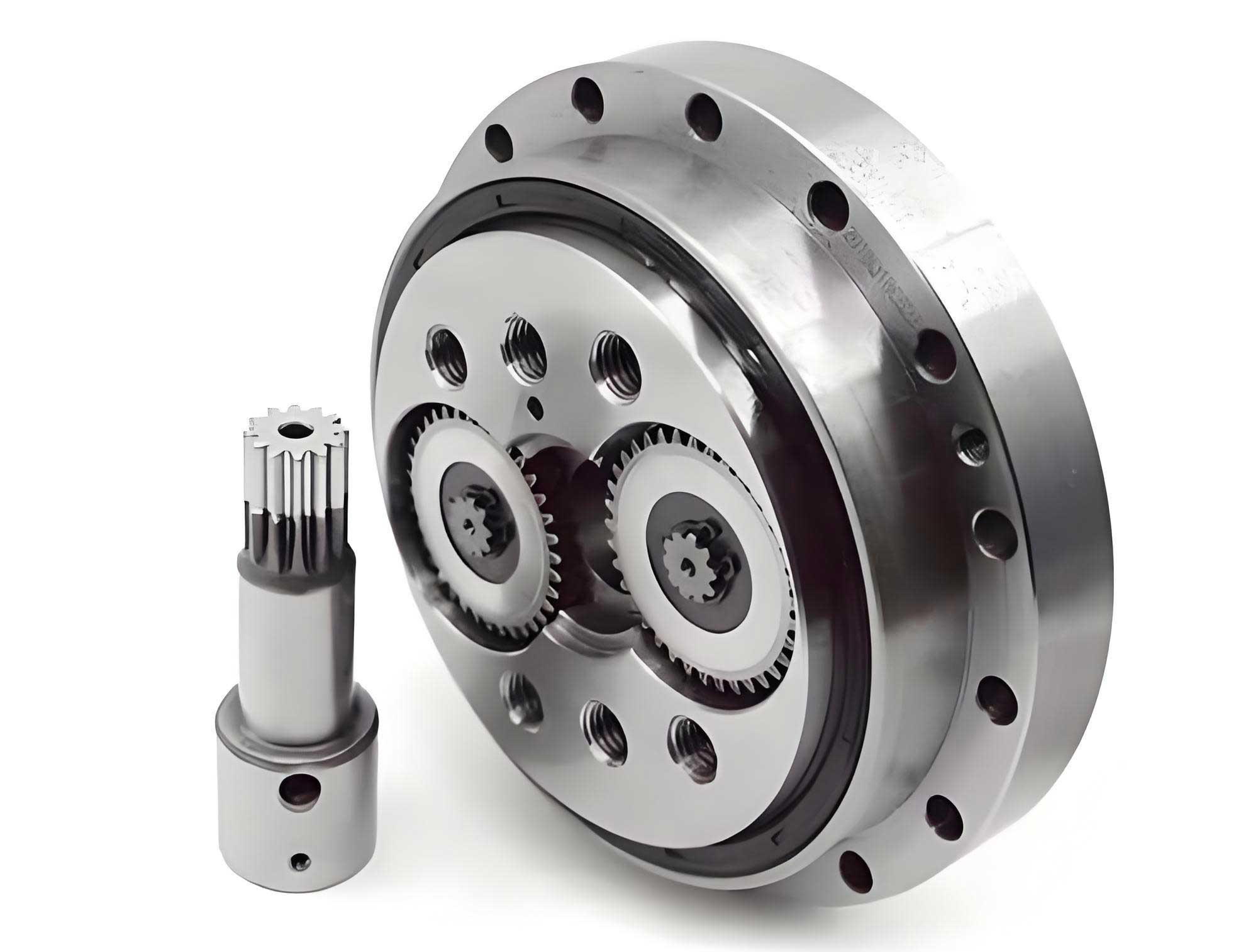
The main bearing is situated between the reducer housing (or shell) and the planet carrier, supporting their relative rotation. Its primary function is to withstand the complex interaction forces transmitted between these components. In a typical industrial robot, multiple RV reducers are employed at various joints. The load characteristics for the main bearing differ significantly depending on the reducer’s position. For instance, reducers located at the robot’s base or shoulder joints primarily endure radial loads and tilting moments, while the reducer at the wrist or flange joint must withstand substantial axial forces, radial loads, and significant tilting moments caused by the payload and the cantilevered arm’s weight. Therefore, a one-size-fits-all approach is insufficient. The main bearing for an RV reducer must be meticulously designed to offer a balanced and sufficient capacity for radial, axial, and moment loads simultaneously.
I. Mechanical Load Analysis and Modeling
To design an effective main bearing, one must first establish a clear understanding of its loading conditions within the RV reducer assembly. The bearing pair is generally installed in a back-to-back (O-type) arrangement. The external loads acting on the output flange—whether axial force \(F_a\), radial force \(F_r\), or a combination thereof—create a tilting moment \(M_{ext}\) on the entire reducer system.
This external tilting moment is counteracted by an internal reaction moment generated by the radial forces \(F_{rA}\) and \(F_{rB}\) on the two main bearings (Bearing A and Bearing B). The force equilibrium for the tilting moment can be expressed as:
$$ M_{ext} = c \cdot F_1 + e \cdot F_2 $$
$$ M_{int} = a \cdot F_{rA} + b \cdot F_{rB} = M_{ext} $$
where \(a\) and \(b\) are the distances from the application points of the bearing radial reactions to the central axis of the system. These distances \(a\) and \(b\) are not simply the bearing spacing; they are critically dependent on the bearing’s contact angle \(\alpha\). For an angular contact ball bearing, the radial load generates an axial component, and the effective lever arm for resisting the tilting moment is the distance between the load centers of the two opposing bearings. This distance \(L_{mn}\) increases with the contact angle.
$$ L_{mn} \approx L + D_{pw} \cdot \sin(\alpha) $$
Where \(L\) is the axial distance between bearing centers and \(D_{pw}\) is the pitch diameter. A larger \(L_{mn}\) improves the system’s resistance to tilting moments for a given bearing radial load capacity. Furthermore, the axial stiffness \(K_a\) of an angular contact ball bearing pair increases non-linearly with the contact angle and preload. The axial stiffness can be approximated by:
$$ K_a \approx \frac{dF_a}{d\delta_a} = C \cdot Z \cdot D_w^{1/2} \cdot (\sin\alpha)^{3/2} \cdot \delta_a^{1/2} $$
where \(Z\) is the number of balls, \(D_w\) is the ball diameter, \(\delta_a\) is the axial deflection, and \(C\) is a constant depending on groove curvature and material properties.
To quantify these effects, let’s consider a case study of an H76/182 bearing used in an RV100C-type reducer. The key structural parameters are:
| Parameter | Symbol | Value |
|---|---|---|
| Inner Diameter | \(d\) | 182 mm |
| Outer Diameter | \(D\) | 214 mm |
| Ball Diameter | \(D_w\) | 10.319 mm |
| Number of Balls | \(Z\) | 51 |
| Pitch Diameter | \(D_{pw}\) | \( (d + D)/2 \) |
Using a multibody dynamics simulation software (e.g., RomaxDesigner) with a fixed bearing center distance \(L = 100\) mm and an applied external tilting moment \(M_{ext} = 1000\) N·m, we can analyze the performance under different contact angles.
| Performance Metric | Contact Angle \(\alpha = 30^\circ\) | Contact Angle \(\alpha = 40^\circ\) | Trend & Implication |
|---|---|---|---|
| Dynamic Load Rating \(C_r\) | 49.0 kN | 43.4 kN | Decreases slightly. Basic radial capacity is adequate. |
| Static Load Rating \(C_{0r}\) | 73.4 kN | 64.5 kN | Decreases slightly. |
| Load Center Distance \(L_{mn}\) | ~214 mm | ~266 mm | Significantly increases. |
| Radial Deformation under \(M_{ext}\) | 27.43 μm | 23.75 μm | Decreases. Superior moment rigidity. |
| Axial Stiffness \(K_a\) (approx.) | 830 kN/mm | 1117 kN/mm | Substantially increases. |
This analysis clearly demonstrates the trade-off. While a larger contact angle slightly reduces the basic load ratings, it dramatically enhances the two properties most critical for an RV reducer in demanding positions: tilting moment rigidity (lower deformation) and axial stiffness. Therefore, the selection is not arbitrary. For RV reducers subjected primarily to radial loads, a contact angle around \(30^\circ-35^\circ\) may be suitable. For those enduring high axial loads and tilting moments (like a robot’s wrist joint), a contact angle in the range of \(40^\circ-50^\circ\) is necessary to ensure sufficient system stiffness and stability. The design of the RV reducer main bearing must be optimized based on its specific mission profile within the robot.
II. Structural Design and Precision Control Philosophy
The design of the RV reducer main bearing deviates significantly from standard angular contact ball bearings. The focus shifts from universal interchangeability to optimized integration within the specific mechanical envelope and function of the RV reducer. The goal is to achieve maximum performance while controlling manufacturing costs by intelligently relaxing tolerances on non-critical features.
1. Contact Angle Optimization
As established, the contact angle \(\alpha\) is the foremost design parameter. The nominal value is selected from the \(30^\circ-50^\circ\) range based on the reducer’s load case. However, manufacturing consistency is key. The final achieved contact angle in the assembled, preloaded state is a function of the groove curvature radii (\(R_i\), \(R_e\)), groove diameter, ball diameter, and radial internal clearance before preload. These parameters must be controlled with high precision to ensure the contact angle falls within a narrow scatter band (e.g., \(\pm 2^\circ\)) around the target value. This consistency is vital for predictable system stiffness and life across all produced units.
2. Asymmetric Ring Widths and Critical Control Dimensions
Unlike standard bearings, the inner and outer rings of an RV reducer main bearing often have unequal widths. This asymmetry contributes to the lightweight design of the overall reducer. This design decision fundamentally changes which dimensions are critical.
Outer Ring: The non-base side face of the outer ring is typically a free face. The functionally critical dimension is the location of the groove relative to the base side face (which contacts the housing shoulder). This dimension, along with the groove diameter and curvature, dictates the contact angle and stress distribution. The flatness and perpendicularity of the base side face are crucial for proper load transfer and to avoid inducing parasitic moments. However, the total outer ring width and its parallelism can have relaxed tolerances, as they do not directly affect the bearing’s functional geometry or assembly. The outer ring rib height is another distinctive feature. It is designed not just to retain the balls but also to axially locate the pinwheel assembly or cycloidal disks inside the RV reducer housing. Its height is therefore determined by the internal kinematics of the reducer, not just by the contact ellipse boundary.
Inner Ring: Similarly, for the inner ring, the groove location relative to its base side face and the base side flatness are paramount. The inner ring width is usually greater than the outer ring width. After preloading, the inner ring’s non-base side face often protrudes beyond the outer ring’s base side face, creating a positive “protrusion.” This design can help limit the axial movement of the cycloidal disks. The protrusion value does not require the extremely tight control needed for universal matching of standard bearings; a tolerance of \(\pm 0.1\) mm is generally sufficient for the RV reducer application.
3. Assembly Height and Preload Control Strategy
For a standard precision angular contact ball bearing pair, the assembly height (or stack height) and protrusion are tightly controlled to allow selective assembly for precise preload setting. For the RV reducer main bearing, a more cost-effective and practical approach is adopted.
The assembly height \(T\) (the axial distance between the inner ring base side face and the outer ring base side face under a defined measuring load) is still important. However, instead of controlling its absolute value to a micron level, the manufacturing process focuses on controlling the scatter within a production batch. If the scatter of \(T_A\) and \(T_B\) (for bearing A and B) is small, then the adjustment required during final reducer assembly becomes predictable and manageable.
The primary method for achieving the correct preload in an RV reducer is through the selective fitting of a shim or spacer on one side of the planet carrier. This shifts the focus from ultra-precise bearing grinding to a manageable shim selection process during assembly. The relationship between preload force \(F_p\) and axial displacement \(\delta_a\) (approach of the inner and outer rings) is governed by the bearing’s stiffness characteristic, which for ball bearings is non-linear:
$$ F_p = K \cdot \delta_a^{n} $$
where \(n\) is approximately 1.5 for ball bearings, and \(K\) is a constant incorporating geometry and material factors. This relationship, specific to the bearing design, must be characterized to guide assembly.
III. Application: Assembly Methodology and Preload Adjustment
The successful application of the main bearing hinges on correct installation and preload setting within the RV reducer’s dimensional chain. The bearings are installed in a back-to-back arrangement using the locational preload method.
The relevant assembly dimension chain involves the following components: the width of the housing shoulder (\(L_1\)), the assembly height of the left-side bearing \(T_A\), the distance between the planet carrier’s two mounting shoulders (\(L\)), the assembly height of the right-side bearing \(T_B\), and the thickness of the adjustable shim (\(L_3\)). The nominal shim thickness \(L_{3, nominal}\) is determined by the other fixed dimensions:
$$ L_{3, nominal} = L – L_1 – T_A – T_B $$
In reality, to achieve the desired preload force \(F_{p, target}\), the actual shim thickness \(L_{3, actual}\) must be smaller than the nominal value to create an axial interference. This required interference \(\Delta L\) is equivalent to twice the axial displacement \(\delta_a\) needed to generate \(F_{p, target}\) in the bearing pair (one bearing from each side).
$$ \Delta L = 2 \cdot \delta_a(F_{p, target}) $$
$$ L_{3, actual} = L_{3, nominal} – \Delta L $$
Since \(T_A\) and \(T_B\) have controlled batch scatter, the variation in \(L_{3, nominal}\) is limited. The assembler measures the actual dimensions \(L_1\), \(L\), \(T_A\), and \(T_B\) for a specific reducer, calculates \(L_{3, nominal}\), and then selects a shim from a graded set with thickness \(L_{3, actual}\) based on the preload requirement \(\Delta L\). This process ensures each RV reducer unit leaves the assembly line with the optimal preload, guaranteeing consistent stiffness, running accuracy, and service life.
The target preload itself is a careful compromise. Insufficient preload leads to low stiffness, vibration, and early failure due to skidding and slippage under dynamic loads. Excessive preload increases friction, torque, heat generation, and can lead to premature fatigue. The optimal preload for an RV reducer is determined through extensive testing, balancing the rigidity needs of the robot joint with efficiency and thermal performance.
IV. Summary of Key Design and Control Parameters
The following table summarizes the critical aspects of designing and applying an RV reducer main bearing, contrasting it with standard bearing practice.
| Aspect | Standard Angular Contact Bearing | RV Reducer Main Bearing | Rationale for RV Design |
|---|---|---|---|
| Contact Angle (\(\alpha\)) | Often 15° or 25° for general purpose; 40° for high axial load. | 30° to 50°, selected based on robot joint position. | Optimizes trade-off between radial capacity, axial stiffness, and moment rigidity for specific load case. |
| Ring Widths | Usually equal or with small differences for universal mounting. | Often asymmetric (inner wider than outer). | Allows lightweight, compact RV reducer design. Functional width is defined by groove location. |
| Critical Control Parameters | Width, bore/OD, groove geometry, assembly height, protrusion. | Groove diameter & location, base side face flatness, assembly height scatter. | Determines contact angle, load path, and preload consistency. Non-functional dimensions can be relaxed. |
| Non-Critical Parameters | All dimensions are typically controlled. | Total ring width, width parallelism (within reason), absolute protrusion value. | These do not affect the functional geometry or final assembly preload setting via shims. |
| Outer Rib Height | Designed to contain contact ellipse. | Extra tall; also functions as axial stop for pinwheels/cycloidal disks. | Integrates a housing function into the bearing, simplifying RV reducer internal design. |
| Preload Setting Method | Selective assembly based on precise gaging of assembly height/protrusion. | Fixed bearing batch scatter + adjustable shim selection during reducer assembly. | More practical and cost-effective for the specific, fixed application within the RV reducer. |
| Key Application Focus | Interchangeability, universal mounting. | System Integration: Stiffness, moment resistance, thermal management, and life within the specific RV reducer. | The bearing is an integral subsystem; its performance is judged by the total RV reducer system metrics. |
In conclusion, the main bearing for an RV reducer is not merely an off-the-shelf component but a highly engineered subsystem tailored for its specific mission. Its design revolves around a deep understanding of the complex loading within the RV reducer, particularly the need to resist tilting moments. This leads to the selection of a relatively large contact angle. Its manufacturing emphasizes control over the geometric features that directly govern contact mechanics and preload consistency, while intelligently relaxing tolerances on non-functional dimensions to reduce cost. Finally, its successful application relies on a well-designed assembly process centered on shim selection to achieve the optimal preload, ensuring the RV reducer delivers the high stiffness, precision, and reliability demanded by advanced industrial robotics.