
In the field of precision mechanical transmission, the RV reducer plays a critical role due to its compact design and high torque capacity. As an essential component, the main bearing within the RV reducer must withstand complex loads while maintaining minimal deformation and high efficiency. However, the inherent design of these bearings—often featuring thin-walled structures with a large number of balls—poses significant computational challenges when analyzing forces and deformations. In this article, I will present a simplified analytical method for the quasi-static model of RV reducer main bearings, aimed at enhancing computational efficiency without compromising accuracy. This approach is particularly relevant for RV reducers used in robotics and industrial automation, where rapid design iterations are essential.
The RV reducer, short for Rotary Vector reducer, is renowned for its high reduction ratio and stiffness, making it ideal for applications requiring precise motion control. The main bearing in an RV reducer is typically an angular contact ball bearing that must handle combined radial, axial, and moment loads. Due to space constraints, these bearings are designed with numerous balls to distribute loads evenly, but this increases the number of nonlinear equations in quasi-static analyses, leading to slower solution times. Traditional methods, such as the Newton-Raphson algorithm, become computationally intensive as the ball count rises. Therefore, developing a simplified method that reduces equation complexity while maintaining fidelity is crucial for optimizing RV reducer performance.
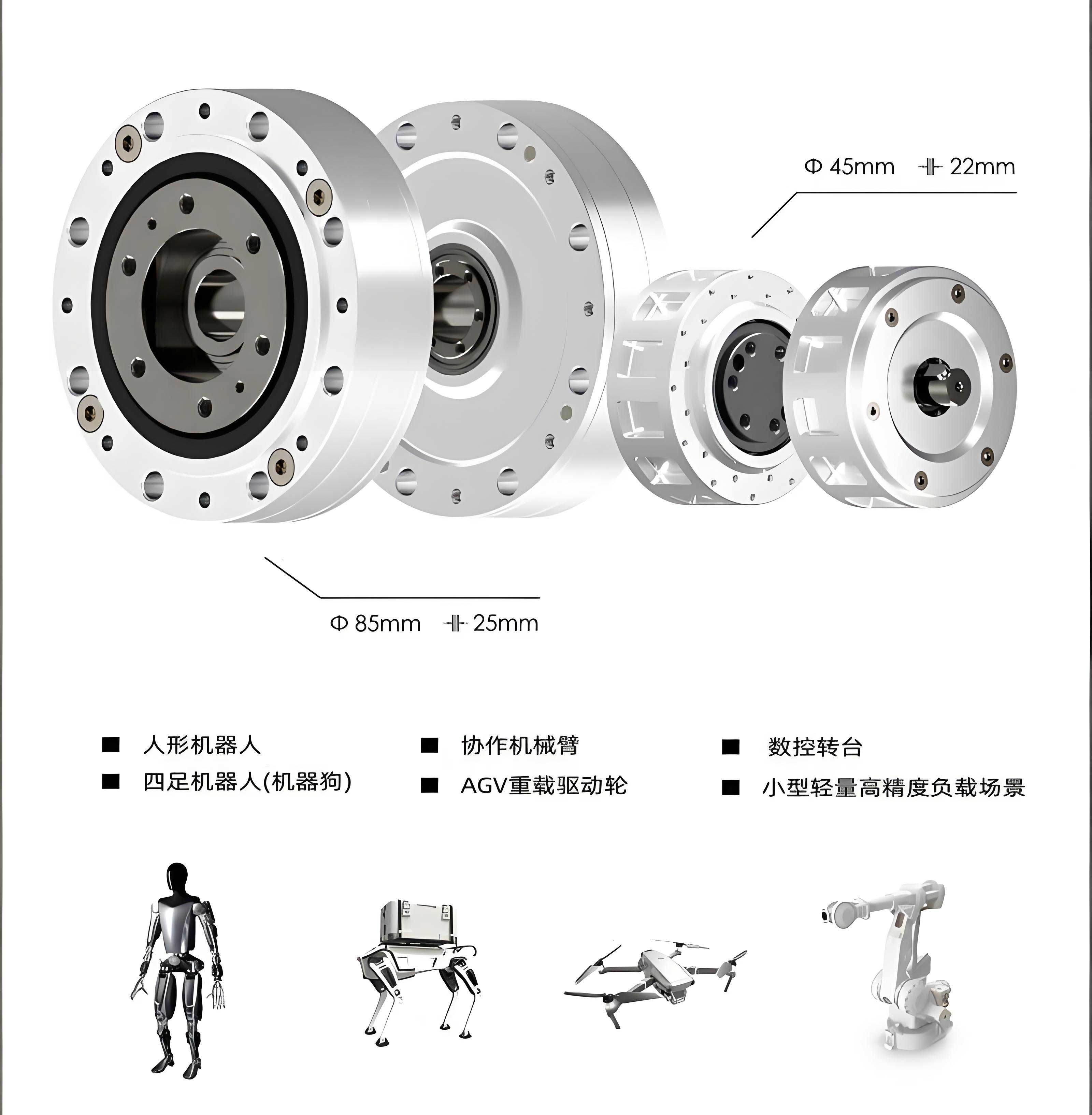
To address this, I developed a five-degree-of-freedom quasi-static model for angular contact ball bearings under combined loading. The model considers factors like centrifugal forces, gyroscopic moments, and Hertzian contact theory, which are vital for high-speed RV reducer applications. The core innovation lies in a simplification technique that groups adjacent balls with similar contact conditions, thereby reducing the number of equations. In the following sections, I will detail the mathematical formulation, the simplification process, and validation through a case study on an H76/182RV angular contact ball bearing. This method not only speeds up computations but also ensures small errors across various load and speed conditions, making it suitable for diverse RV reducer scenarios.
Mathematical Foundation of the Quasi-Static Model
The quasi-static model for RV reducer main bearings is based on equilibrium equations that account for the interactions between balls and raceways. I start by defining the coordinate system: let the bearing center be the origin, with the axial direction as the z-axis. For a bearing with Z balls, the angular position of the j-th ball is given by $\psi_j = 2\pi(j-1)/Z + \gamma$, where $\gamma$ is the position angle of the first ball. Under external loads—radial forces $F_x$, $F_y$, axial force $F_z$, and moments $M_x$, $M_y$—the inner ring undergoes displacements $\delta_x$, $\delta_y$, $\delta_z$ and rotations $\theta_x$, $\theta_y$ relative to the fixed outer ring.
The geometry of contact is crucial. The initial distance between the inner and outer raceway curvature centers is denoted as A, and the initial contact angle is $\alpha_0$. After loading, the axial and radial distances between these centers for the j-th ball are:
$$ A_{1j} = A \sin \alpha_0 + \delta_z + G_i \theta_x \sin \psi_j + G_i \theta_y \cos \psi_j $$
$$ A_{2j} = A \cos \alpha_0 + \delta_x \cos \psi_j + \delta_y \sin \psi_j $$
where $G_i = D_{pw}/2 + (f_i D_w – D_w/2) \cos \alpha_0$ is the inner raceway turning radius, $D_{pw}$ is the pitch circle diameter, $D_w$ is the ball diameter, and $f_i$ is the inner raceway curvature coefficient. These parameters are standard in bearing design for RV reducers.
To model contact deformation, I introduce variables $X_{1j}$ and $X_{2j}$ representing the axial and radial distances from the ball center to the outer raceway curvature center. The compatibility equations based on the Pythagorean theorem are:
$$ (A_{1j} – X_{1j})^2 + (A_{2j} – X_{2j})^2 – [(f_i – 0.5)D_w + \delta_{ij}]^2 = 0 $$
$$ X_{1j}^2 + X_{2j}^2 – [(f_e – 0.5)D_w + \delta_{ej}]^2 = 0 $$
Here, $\delta_{ij}$ and $\delta_{ej}$ are the normal deformations at the inner and outer raceways, respectively, and $f_e$ is the outer raceway curvature coefficient. The actual contact angles $\alpha_{ij}$ and $\alpha_{ej}$ can be expressed as:
$$ \sin \alpha_{ij} = \frac{A_{1j} – X_{1j}}{(f_i – 0.5)D_w + \delta_{ij}}, \quad \cos \alpha_{ij} = \frac{A_{2j} – X_{2j}}{(f_i – 0.5)D_w + \delta_{ij}} $$
$$ \sin \alpha_{ej} = \frac{X_{1j}}{(f_e – 0.5)D_w + \delta_{ej}}, \quad \cos \alpha_{ej} = \frac{X_{2j}}{(f_e – 0.5)D_w + \delta_{ej}} $$
To streamline computations, I combine these equations to express $\delta_{ij}$, $\delta_{ej}$, $X_{1j}$, and $X_{2j}$ in terms of $\alpha_{ij}$ and $\alpha_{ej}$, reducing the number of unknowns by half:
$$ \delta_{ij} = \frac{A_{1j} \cos \alpha_{ej} – A_{2j} \sin \alpha_{ej}}{\sin(\alpha_{ij} – \alpha_{ej})} – (f_i – 0.5)D_w $$
$$ \delta_{ej} = \frac{A_{2j} \sin \alpha_{ij} – A_{1j} \cos \alpha_{ij}}{\sin(\alpha_{ij} – \alpha_{ej})} – (f_e – 0.5)D_w $$
$$ X_{1j} = \frac{A_{2j} \tan \alpha_{ij} – A_{1j}}{\tan \alpha_{ij} – \tan \alpha_{ej}} \tan \alpha_{ej}, \quad X_{2j} = \frac{A_{2j} \tan \alpha_{ij} – A_{1j}}{\tan \alpha_{ij} – \tan \alpha_{ej}} $$
The force equilibrium for each ball considers contact loads $Q_{ij}$ and $Q_{ej}$, centrifugal force $F_{cj}$, and gyroscopic moment $M_{gj}$. According to Hertzian theory, the contact loads relate to deformations as $Q_{ij} = K_{ij} \delta_{ij}^{1.5}$ and $Q_{ej} = K_{ej} \delta_{ej}^{1.5}$, where $K_{ij}$ and $K_{ej}$ are load-displacement coefficients. The centrifugal force and gyroscopic moment are given by:
$$ F_{cj} = \frac{1}{2} m D_{pw} \omega_{mj}^2, \quad M_{gj} = J \omega_{mj} \omega_{Rj} \sin \beta_j $$
where $m$ is the ball mass, $\omega_{mj}$ is the orbital speed, $J$ is the ball’s moment of inertia, $\omega_{Rj}$ is the spin speed, and $\beta_j$ is the ball attitude angle. Assuming friction forces are negligible in the plane perpendicular to the bearing axis, the equilibrium equations for a single ball are:
$$ Q_{ij} \sin \alpha_{ij} – Q_{ej} \sin \alpha_{ej} – \frac{M_{gj}}{D_w} (\lambda_{ij} \cos \alpha_{ij} – \lambda_{ej} \cos \alpha_{ej}) = 0 $$
$$ Q_{ij} \cos \alpha_{ij} – Q_{ej} \cos \alpha_{ej} + \frac{M_{gj}}{D_w} (\lambda_{ij} \sin \alpha_{ij} – \lambda_{ej} \sin \alpha_{ej}) + F_{cj} = 0 $$
Here, $\lambda_{ij}$ and $\lambda_{ej}$ are control coefficients for gyroscopic moment distribution, typically set based on raceway control assumptions. For the entire bearing, the global equilibrium equations sum contributions from all balls:
$$ F_x – \sum_{j=1}^{Z} \left( Q_{ij} \cos \alpha_{ij} + \frac{\lambda_{ij} M_{gj}}{D_w} \sin \alpha_{ij} \right) \cos \psi_j = 0 $$
$$ F_y – \sum_{j=1}^{Z} \left( Q_{ij} \cos \alpha_{ij} + \frac{\lambda_{ij} M_{gj}}{D_w} \sin \alpha_{ij} \right) \sin \psi_j = 0 $$
$$ F_z – \sum_{j=1}^{Z} \left( Q_{ij} \sin \alpha_{ij} – \frac{\lambda_{ij} M_{gj}}{D_w} \cos \alpha_{ij} \right) = 0 $$
$$ M_x – \sum_{j=1}^{Z} \left[ \left( Q_{ij} \sin \alpha_{ij} – \frac{\lambda_{ij} M_{gj}}{D_w} \cos \alpha_{ij} \right) G_i + \frac{\lambda_{ij} M_{gj}}{D_w} r_i \right] \sin \psi_j = 0 $$
$$ M_y – \sum_{j=1}^{Z} \left[ \left( Q_{ij} \sin \alpha_{ij} – \frac{\lambda_{ij} M_{gj}}{D_w} \cos \alpha_{ij} \right) G_i + \frac{\lambda_{ij} M_{gj}}{D_w} r_i \right] \cos \psi_j = 0 $$
These equations form a system of $2Z + 5$ nonlinear equations, which becomes cumbersome for RV reducer bearings with high ball counts. Solving them via the Newton-Raphson method is slow due to the large Jacobian matrix, motivating the need for simplification.
Simplification Methodology for Enhanced Efficiency
To tackle the computational burden, I propose a simplification technique that leverages the spatial symmetry in densely packed balls. In an RV reducer main bearing, adjacent balls often experience similar contact conditions due to the continuous load distribution. Thus, I assume that a group of k adjacent balls have identical contact angles, loads, and deformations. This reduces the number of distinct balls from Z to N, where N = Z/k if divisible, or N = floor(Z/k) + 1 otherwise. The position angle for the j-th group becomes $\psi’_j = 2\pi (j-1)k / Z + \gamma$.
The simplified global equilibrium equations are modified accordingly. For example, the x-direction force balance becomes:
$$ F_x – k \sum_{j=1}^{N} \left( Q_{ij} \cos \alpha_{ij} + \frac{\lambda_{ij} M_{gj}}{D_w} \sin \alpha_{ij} \right) \cos \psi’_j = 0 \quad \text{(if Z divisible by k)} $$
If Z is not divisible by k, with remainder h, the equation adjusts to:
$$ F_x – k \sum_{j=1}^{N-1} \left( Q_{ij} \cos \alpha_{ij} + \frac{\lambda_{ij} M_{gj}}{D_w} \sin \alpha_{ij} \right) \cos \psi’_j – h \left( Q_{iN} \cos \alpha_{iN} + \frac{\lambda_{iN} M_{gN}}{D_w} \sin \alpha_{iN} \right) \cos \psi’_N = 0 $$
Similar adjustments apply to the other equilibrium equations. This reduces the system size to $2N + 5$ equations, significantly cutting computation time. The iterative solution process follows these steps:
- Solve the static case without motion to get initial displacements and deformations.
- Assume fixed displacement parameters and solve for dynamic contact angles using ball equilibrium equations.
- Update displacements via global equilibrium, iterating with a relaxed Newton-Raphson method to ensure convergence.
- Repeat until displacements meet tolerance criteria.
The relaxation factor in the Newton-Raphson algorithm prevents divergence by scaling step sizes, while constraints on variables avoid infinite loops. This approach maintains accuracy for RV reducer bearings, as validated below.
Case Study: Application to an H76/182RV Angular Contact Ball Bearing
To validate the simplification method, I applied it to an H76/182RV angular contact ball bearing, commonly used as a main bearing in RV reducers. Its key parameters are listed in Table 1, which illustrates the thin-walled, multi-ball design typical of RV reducer components.
| Parameter | Value |
|---|---|
| Ball diameter, $D_w$ (mm) | 10.32 |
| Pitch circle diameter, $D_{pw}$ (mm) | 197.98 |
| Initial contact angle, $\alpha_0$ (°) | 40 |
| Number of balls, Z | 51 |
| Inner raceway radius, $r_i$ (mm) | 5.26 |
| Outer raceway radius, $r_e$ (mm) | 5.37 |
I considered an operating condition with rotational speed n = 40 rpm, radial load $F_y = 4000$ N, axial load $F_z = 13720$ N, and moment load $M_y = 2450$ N·m. The simplification was tested for k = 1 (no simplification), 2, 3, and 4. The results for the normal load and contact angle of the first ball with the inner raceway are shown in Table 2 and Table 3, summarizing key metrics.
| k Value | Normal Load (N) | Relative Error vs. k=1 (%) |
|---|---|---|
| 1 | 1250.3 | 0.0 |
| 2 | 1249.8 | 0.04 |
| 3 | 1247.5 | 0.22 |
| 4 | 1245.1 | 0.42 |
| k Value | Contact Angle (°) | Relative Error vs. k=1 (%) |
|---|---|---|
| 1 | 42.1 | 0.0 |
| 2 | 42.0 | 0.24 |
| 3 | 41.9 | 0.48 |
| 4 | 41.8 | 0.71 |
The data indicate that as k increases, errors grow slightly but remain under 1%, confirming the method’s reliability. The load distribution trend across balls is preserved, essential for RV reducer bearing analysis. To further assess performance, I computed the relative displacement $\delta_x$ between raceways under varying loads and speeds. For instance, with $F_y = 5000$ N, $F_z = 13720$ N, $M_y = 2450$ N·m, and speeds from 20 to 200 rpm, the errors for k=2,3,4 were all below 3%, as shown in Table 4.
| Speed (rpm) | k=2 Error (%) | k=3 Error (%) | k=4 Error (%) |
|---|---|---|---|
| 20 | 0.8 | 1.2 | 1.5 |
| 40 | 0.9 | 1.3 | 1.6 |
| 80 | 1.0 | 1.4 | 1.7 |
| 120 | 1.1 | 1.5 | 1.8 |
| 160 | 1.2 | 1.6 | 1.9 |
| 200 | 1.3 | 1.7 | 2.0 |
Computation times were significantly reduced. For the same conditions, the solving time dropped from over 300 seconds for k=1 to under 100 seconds for k=4, demonstrating the efficiency gain. This makes the method practical for iterative design processes in RV reducer development.
Discussion on Methodological Advantages and Limitations
The proposed simplification method offers several benefits for RV reducer applications. First, it dramatically cuts computational cost without sacrificing accuracy, as errors are minimal (typically under 3%). This is vital for real-world engineering where quick analyses are needed to optimize bearing designs for RV reducers. Second, the method is versatile: it applies to various load and speed scenarios, from low-speed high-torque to moderate-speed operations common in RV reducers. The grouping approach leverages the inherent symmetry in ball arrangements, making it physically intuitive.
However, limitations exist. The assumption of identical adjacent balls may break down under extreme asymmetric loads or if bearing imperfections are present. In such cases, the simplification could introduce larger errors. Additionally, the method relies on the Newton-Raphson algorithm with relaxation, which requires careful tuning of parameters like the step size factor. For RV reducers with very high ball counts (e.g., over 100 balls), further optimizations might be needed, such as adaptive grouping based on load zones.
Compared to existing techniques, this method balances speed and precision effectively. Traditional quasi-static models for RV reducer bearings often struggle with convergence due to equation count, while other simplifications may assume symmetry that doesn’t hold for combined moment loads. Here, by grouping balls, I reduce complexity while preserving the three-dimensional load distribution critical for RV reducer performance. Future work could integrate this with dynamic models or explore machine learning for initial guesses to speed up iterations.
Conclusion and Implications for RV Reducer Design
In summary, I have developed a simplified quasi-static analysis method for RV reducer main bearings that enhances computational efficiency. By grouping adjacent balls with similar contact conditions, the number of nonlinear equations is reduced, leading to faster solution times. Validation on an H76/182RV angular contact ball bearing shows that errors remain small (under 3%) across diverse loads and speeds, making the method reliable for practical applications. This approach is particularly valuable for RV reducers, where compact, multi-ball bearings are standard, and rapid analysis supports design optimization. As RV reducers continue to evolve for robotics and automation, such computational tools will be essential for achieving high performance and reliability. The method can also be extended to other bearing types in RV reducers, fostering innovation in transmission systems.
The integration of this simplified model into design software could streamline the development cycle for RV reducers, allowing engineers to quickly assess bearing behavior under various operating conditions. By reducing computational barriers, it enables more iterative refinements, ultimately leading to more efficient and durable RV reducer systems. As I continue to refine this method, I aim to incorporate real-time adjustments for variable loads and explore applications in predictive maintenance for RV reducers in industrial settings.