
In the realm of industrial robotics, the precision and reliability of core components are paramount to achieving high performance and accuracy. Among these components, the RV reducer stands out as a critical element, directly influencing the control precision and operational stability of robots. The RV reducer, a type of精密减速器, is renowned for its compact structure, high transmission ratio, and excellent torsional rigidity. However, the comprehensive performance evaluation of RV reducers remains a significant challenge, particularly in the context of domestic manufacturing and research. Current market offerings for testing such reducers are scarce, often limited in functionality and cumbersome to operate. This gap underscores the need for an integrated, automated test platform that can accurately measure key performance parameters like transmission efficiency, transmission error, and torsional stiffness. In this work, we present the development and thorough analysis of a comprehensive performance test platform specifically designed for RV reducers. This platform leverages opto-mechatronic integration to enable dynamic measurement, providing valuable insights for mechanical design optimization and quality control in RV reducer production.
The RV reducer is a two-stage精密减速装置 consisting of a front-stage involute planetary gear differential mechanism and a rear-stage cycloidal gear transmission mechanism. Its complex structure includes components such as the sun gear, planetary gears, cycloidal gears, pin teeth, pin housing, crankshafts, and output plate. This design endows the RV reducer with advantages like high load capacity, minimal backlash, and long service life, making it indispensable in applications requiring precise motion control, such as industrial robot joints. However, the technical challenges associated with RV reducers include achieving high transmission accuracy, withstanding overload impacts, and ensuring extended operational lifespan. These demands necessitate rigorous performance testing to validate design and manufacturing processes.
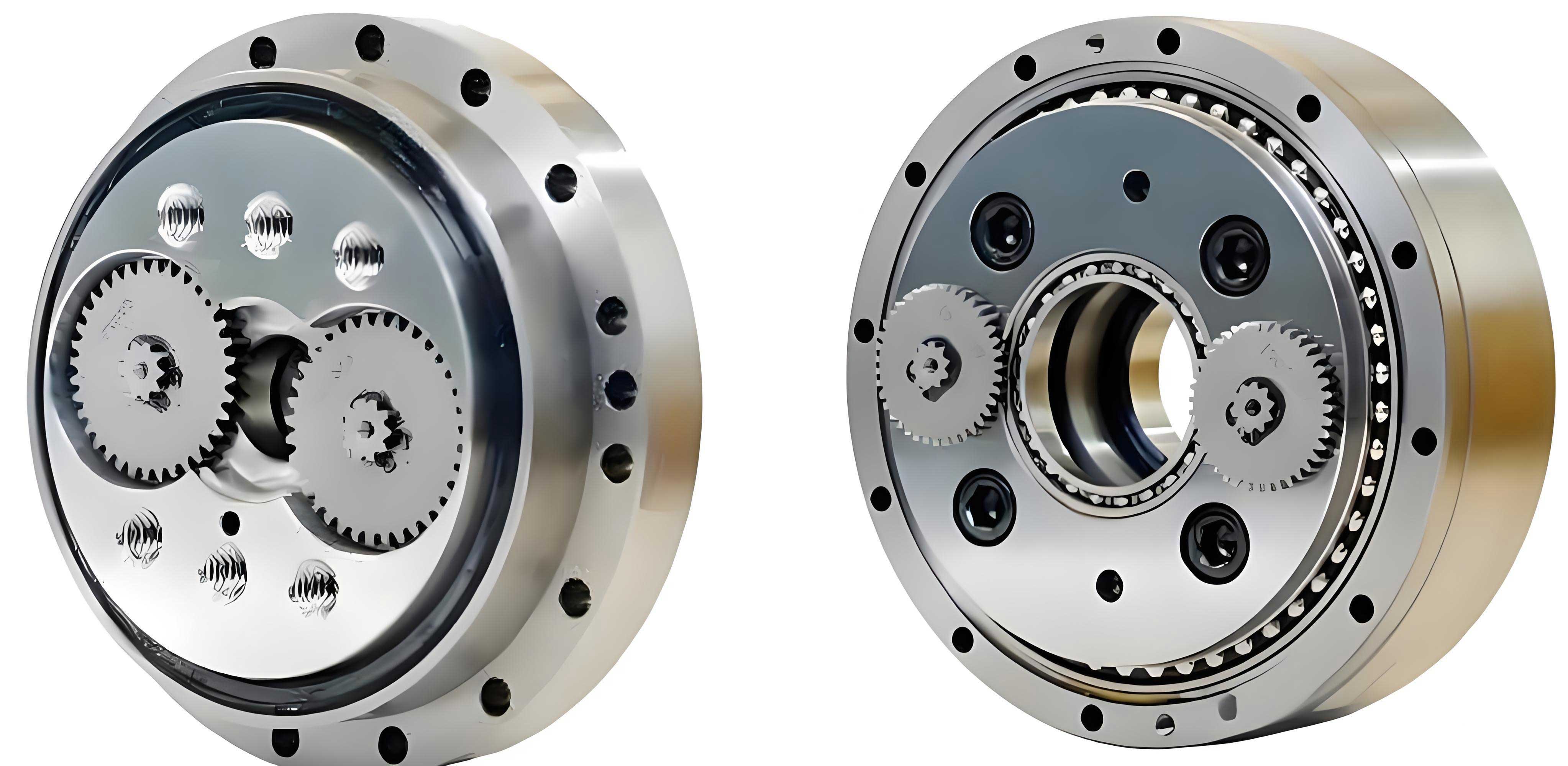
To effectively assess the performance of an RV reducer, it is essential to define and quantify its key parameters. The primary metrics include transmission efficiency, transmission error, and torsional stiffness, each of which plays a vital role in determining the overall functionality of the RV reducer. Transmission efficiency, denoted by $\eta$, is a measure of the power loss during operation and is calculated as the ratio of output power to input power. Given that power is the product of torque and angular velocity, the transmission efficiency for an RV reducer can be expressed as:
$$ \eta = \frac{T_2 n_2}{T_1 n_1} \times 100\% $$
where $T_1$ and $n_1$ are the input torque and input speed, respectively, and $T_2$ and $n_2$ are the output torque and output speed. This formula highlights the dependency of efficiency on both torque and speed, necessitating simultaneous measurement of these variables during dynamic testing.
Transmission error, on the other hand, quantifies the deviation between the actual output rotation angle and the theoretical output rotation angle. It is a critical indicator of the precision of an RV reducer, affecting positioning accuracy in robotic systems. The transmission error $E(t)$ as a function of time is given by:
$$ E(t) = \frac{\theta_1(t)}{i} – \theta_2(t) $$
where $\theta_1(t)$ is the input shaft rotation angle, $i$ is the transmission ratio of the RV reducer, and $\theta_2(t)$ is the output shaft rotation angle. Minimizing transmission error is essential for high-precision applications, and dynamic measurement allows for capturing temporal variations that static tests might miss.
Torsional stiffness reflects the ability of the RV reducer to resist elastic deformation under applied torque. It is derived from the hysteresis curve obtained during loading and unloading cycles. The torsional stiffness $k$ is defined as the ratio of the load torque to the corresponding elastic deformation angle:
$$ k = \frac{b}{a} $$
where $b$ represents half of the rated torque, and $a$ is the elastic deformation angle. A higher torsional stiffness indicates greater rigidity, which is crucial for maintaining accuracy under varying loads. These parameters collectively define the comprehensive performance of an RV reducer, and our test platform is designed to measure them accurately and efficiently.
The design of our comprehensive performance test platform for RV reducers integrates mechanical, measurement, and software subsystems to facilitate automated and continuous dynamic testing. The mechanical framework comprises a robust base, driving and loading devices, sensors, the RV reducer under test, and connecting flanges to ensure coaxial alignment. The driving unit employs a servo motor controlled via a frequency converter, capable of operating in speed control mode, while the loading unit uses another servo motor in torque control mode to simulate various load conditions. To achieve the high torque requirements typical of RV reducers (e.g., up to 200 N·m), a secondary RV-40E reducer is incorporated into the loading side to amplify torque. Sensors are pivotal in data acquisition; we utilize torque sensors and circular grating encoders on both the input and output shafts to measure torque and rotation angle simultaneously. This symmetrical setup ensures balanced measurement and minimizes systemic errors.
The measurement and control subsystem orchestrates motor operations and data collection. Motor control is implemented through a motion control card and motor drivers communicating via RS485 interface using the MODBUS protocol. Data acquisition involves reading sensor outputs through RS232 or TCP communication protocols, with torque and angle values captured in real-time by data acquisition cards. The software subsystem, developed as a Windows-based application using C# WinForms, provides a user-friendly interface for parameter configuration, motor control, data acquisition, and analysis. Key features include user authentication for security, device status checks prior to testing, and modules for conducting specific performance tests. The software employs multithreading and event-driven programming to handle asynchronous data processing, ensuring that sensor data are parsed and displayed without latency. For instance, serial port data are buffered and processed in a dedicated thread, with delegates updating the UI and database in real-time. This architecture guarantees accurate and timely measurement, which is crucial for dynamic performance evaluation of RV reducers.
The workflow of the test platform is streamlined to enhance usability and reliability. After user login and hardware verification, operators can set parameters for transmission efficiency, transmission error, or torsional stiffness tests. For transmission efficiency measurement, torque zeroing is performed to eliminate residual torque effects, followed by setting drive motor speed, load motor torque, and rotation direction. The system then computes efficiency based on sensor data. Transmission error testing involves adjusting the drive motor speed, transmission ratio, and direction, with data collected over approximately one minute to calculate error. Torsional stiffness assessment uses gradient torque loading in正向 and反向 directions, with torque sensors measuring deformation angles to compute stiffness. The software automatically generates performance curves and stores results in a database for future reference, enabling comprehensive analysis and reporting.
To validate the effectiveness of our test platform, we conducted extensive experiments on RV reducers from different manufacturers. We selected four samples: one imported RV reducer (Sample A) and three domestic RV reducers (Samples B, C, and D), all of the same specification RV-20E. Each RV reducer was tested ten times to ensure statistical reliability, with parameters including transmission error, transmission efficiency, and torsional stiffness measured under both forward and reverse rotation conditions. The results are summarized in the following tables, which provide a comparative analysis of the performance of these RV reducers.
First, the transmission error measurements, expressed in arcseconds (″), highlight the precision of each RV reducer. As shown in Table 1, Sample A exhibits the lowest error, while domestic samples show higher deviations, indicating room for improvement in manufacturing accuracy.
| Sample | Forward Transmission Error (″) | Reverse Transmission Error (″) |
|---|---|---|
| Sample A (Imported) | 38.91 | 41.81 |
| Sample B (Domestic) | 152.14 | 142.10 |
| Sample C (Domestic) | 79.88 | 85.50 |
| Sample D (Domestic) | 59.23 | 65.70 |
Transmission efficiency, a key indicator of energy performance, is presented in Table 2. The imported RV reducer demonstrates higher efficiency, whereas domestic samples show lower values, suggesting potential losses due to friction or design imperfections.
| Sample | Forward Transmission Efficiency (%) | Reverse Transmission Efficiency (%) |
|---|---|---|
| Sample A (Imported) | 86.06 | 87.22 |
| Sample B (Domestic) | 71.47 | 72.48 |
| Sample C (Domestic) | 73.01 | 70.77 |
| Sample D (Domestic) | 78.54 | 83.86 |
Torsional stiffness, measured in N·m per arcminute (′), reflects the rigidity of the RV reducer under load. Table 3 shows that Sample A has the highest stiffness, consistent with its superior overall performance, while domestic samples exhibit lower stiffness values.
| Sample | Forward Torsional Stiffness (N·m/′) | Reverse Torsional Stiffness (N·m/′) |
|---|---|---|
| Sample A (Imported) | 60.52 | 61.12 |
| Sample B (Domestic) | 48.60 | 47.90 |
| Sample C (Domestic) | 54.64 | 53.24 |
| Sample D (Domestic) | 57.03 | 56.32 |
These results underscore the performance gap between imported and domestic RV reducers, particularly in terms of transmission error and efficiency. The data suggest that domestic manufacturers need to focus on enhancing precision in gear machining and optimizing mechanical design to improve the comprehensive performance of their RV reducers. Our test platform effectively captures these differences, providing actionable insights for quality improvement.
Beyond the basic parameters, our platform allows for deeper analysis through dynamic performance curves. For instance, during transmission efficiency testing, the system plots efficiency versus torque or speed, revealing trends such as efficiency drop at low loads or high speeds. Similarly, transmission error curves over time can identify periodic errors linked to gear meshing frequencies, aiding in fault diagnosis. The hysteresis curves for torsional stiffness provide insights into nonlinear behaviors and hysteresis losses, which are critical for understanding the elastic properties of the RV reducer. These capabilities make our platform a powerful tool for research and development in RV reducer technology.
The hardware components of the test platform are carefully selected to ensure accuracy and durability. The servo motors have a rated torque of 47.8 N·m and a maximum speed of 8000 r/min, providing sufficient range for testing various RV reducer models. Torque sensors with high resolution and low drift are used to capture minute torque variations, while circular grating encoders offer angular resolution down to arcseconds for precise error measurement. The use of flange connections and alignment tools minimizes misalignment errors, which is crucial for reliable testing of RV reducers. Additionally, the integration of a load减速器 extends the torque capacity, allowing the platform to test RV reducers under realistic operating conditions.
In terms of software architecture, the modular design facilitates scalability and maintenance. The parameter setting module allows users to define test profiles for different RV reducer types, storing configurations for repeatability. The motor control module implements PID algorithms for precise speed and torque regulation, ensuring stable operation during tests. Data acquisition modules handle multiple sensor inputs concurrently, with error-checking mechanisms to filter noise and outliers. The analysis module computes performance metrics in real-time and generates graphical outputs, such as efficiency curves and error histograms, for immediate visualization. Database management enables long-term storage and retrieval of test data, supporting trend analysis and comparative studies across multiple RV reducers.
To further enhance the platform’s utility, we incorporated calibration procedures and uncertainty analysis. Regular calibration of sensors using reference standards ensures measurement traceability, while uncertainty budgets account for factors like sensor resolution, environmental variations, and alignment errors. This rigorous approach validates the accuracy of our test results, making the platform suitable for certification and quality assurance purposes. Moreover, the platform supports automated report generation, exporting data to formats like Excel for further processing, which streamlines documentation in industrial settings.
The development of this comprehensive performance test platform addresses a critical need in the robotics industry, where the demand for high-quality RV reducers is growing. By providing a unified solution for measuring key parameters, our platform enables manufacturers to benchmark their products against international standards and identify areas for improvement. For researchers, it offers a versatile tool for investigating the dynamic behavior of RV reducers under various operating conditions, contributing to advancements in design and materials. The successful application of the platform in testing multiple RV reducer samples demonstrates its robustness and reliability, paving the way for widespread adoption in both academic and industrial contexts.
In conclusion, the RV reducer comprehensive performance test platform we have developed represents a significant step forward in the evaluation of精密减速器. Through the integration of advanced hardware and software, the platform enables accurate, dynamic measurement of transmission efficiency, transmission error, and torsional stiffness for RV reducers. Experimental validation with samples from different manufacturers confirms the platform’s effectiveness in highlighting performance disparities and providing quantitative data for improvement. As the RV reducer continues to be a vital component in industrial robots, tools like this test platform will play an essential role in driving innovation and quality in domestic manufacturing. Future work may involve expanding the platform to test other types of reducers or incorporating additional sensors for thermal and vibrational analysis, further enhancing its capabilities in the realm of robotic传动系统 evaluation.