
In the field of gear transmission systems, the time-varying friction on tooth surfaces plays a critical role in influencing dynamic behavior, wear, and failure mechanisms. As an internal excitation source, tooth surface friction significantly affects vibration, noise, and overall system reliability. In this paper, I investigate the impact of time-varying friction coefficients on the dynamic characteristics of spur gears, focusing on how microscopic surface variations lead to macro-scale dynamic responses. The study aims to deepen the understanding of friction-induced激励 in spur gears and provide insights for design optimization.
Spur gears are widely used in mechanical transmissions due to their simplicity and efficiency. However, during meshing, the alternating single and double tooth contact regions cause periodic changes in load distribution, leading to time-varying friction forces. This non-harmonic internal excitation can promote root crack initiation, propagation, and even tooth fracture. Numerous studies have highlighted the importance of considering friction in gear dynamics, but many models oversimplify friction as constant or忽略 its time-varying nature. Here, I develop a comprehensive model that incorporates time-varying friction based on mixed lubrication theory, analyzing its effects on dynamic mesh force, transmission error, and vibration velocity.
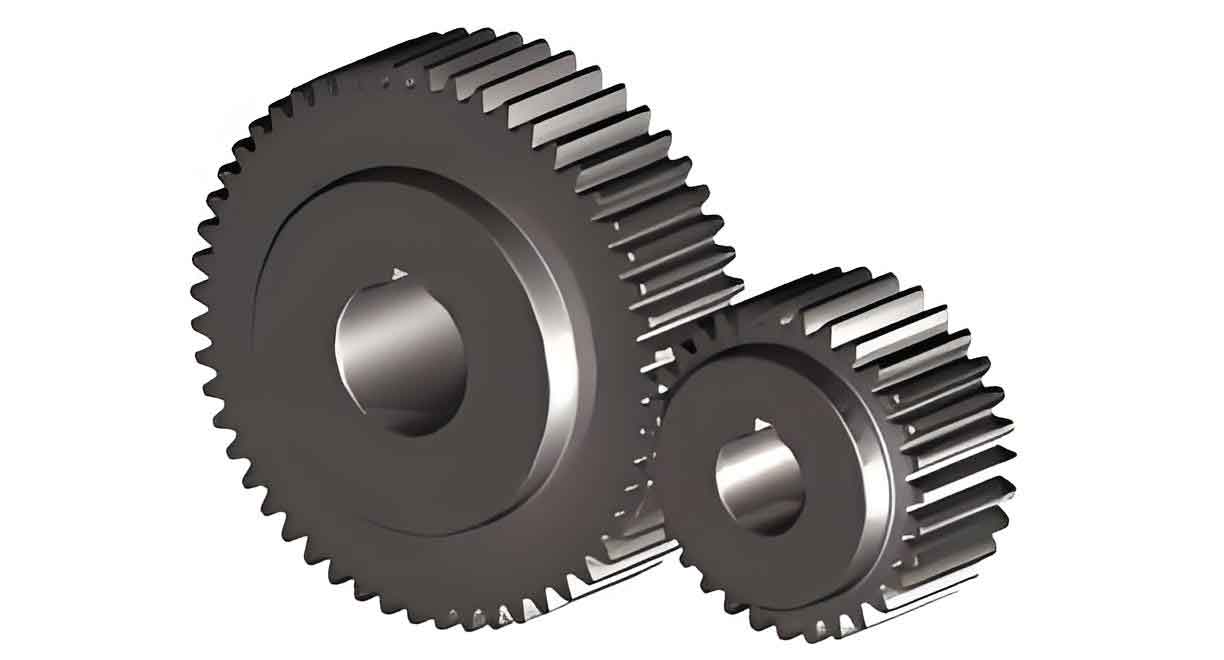
The friction coefficient between spur gear teeth is influenced by factors such as surface roughness, hardness, normal load, and relative sliding velocity. Experimental evidence suggests that models based on elastohydrodynamic lubrication (EHL) theory provide more accurate predictions compared to simplistic Coulomb friction. In this work, I adopt an EHL-based friction coefficient model that accounts for these parameters. The time-varying friction coefficient \(\mu(t)\) can be expressed as a function of the slide-to-roll ratio \(\xi(t)\), surface roughness \(S\), and contact pressure \(p(t)\). A commonly used form is:
$$ \mu(t) = a \cdot \exp\left(b \cdot \frac{\xi(t)}{v_e(t)}\right) \cdot \left( \frac{S}{\sqrt{p(t)}} \right)^c $$
where \(a\), \(b\), and \(c\) are empirical constants, \(\xi(t)\) is the sliding velocity, \(v_e(t)\) is the entrainment velocity, and \(p(t)\) is the Hertzian contact pressure. This model captures the reduction in friction near the pitch line, where sliding velocity approaches zero.
To analyze the dynamic behavior of spur gears, I establish a lumped-parameter model with six degrees of freedom, including torsional and translational motions. The equations of motion for a spur gear pair can be written as:
$$ I_1 \ddot{\theta}_1 + c_{m} (\dot{\theta}_1 – \dot{\theta}_2) + k_m(t) (\theta_1 – \theta_2 – e(t)) = T_1 – F_f(t) \cdot r_{b1} $$
$$ I_2 \ddot{\theta}_2 – c_{m} (\dot{\theta}_1 – \dot{\theta}_2) – k_m(t) (\theta_1 – \theta_2 – e(t)) = -T_2 + F_f(t) \cdot r_{b2} $$
$$ m_1 \ddot{x}_1 + c_x \dot{x}_1 + k_x x_1 = -F_{n}(t) \sin(\phi) + F_f(t) \cos(\phi) $$
$$ m_2 \ddot{x}_2 + c_x \dot{x}_2 + k_x x_2 = F_{n}(t) \sin(\phi) – F_f(t) \cos(\phi) $$
$$ m_1 \ddot{y}_1 + c_y \dot{y}_1 + k_y y_1 = -F_{n}(t) \cos(\phi) – F_f(t) \sin(\phi) $$
$$ m_2 \ddot{y}_2 + c_y \dot{y}_2 + k_y y_2 = F_{n}(t) \cos(\phi) + F_f(t) \sin(\phi) $$
Here, \(I_1\) and \(I_2\) are moments of inertia, \(\theta_1\) and \(\theta_2\) are angular displacements, \(c_m\) is mesh damping, \(k_m(t)\) is time-varying mesh stiffness, \(e(t)\) is static transmission error, \(T_1\) and \(T_2\) are input and output torques, \(F_f(t)\) is the friction force, \(r_{b1}\) and \(r_{b2}\) are base circle radii, \(m_1\) and \(m_2\) are masses, \(x\) and \(y\) are translational coordinates, \(c_x\), \(c_y\), \(k_x\), \(k_y\) are damping and stiffness in transverse directions, \(\phi\) is pressure angle, and \(F_n(t)\) is dynamic mesh force. The friction force is calculated as \(F_f(t) = \mu(t) \cdot F_n(t)\), where \(\mu(t)\) is the time-varying friction coefficient.
The time-varying mesh stiffness \(k_m(t)\) for spur gears is derived using potential energy methods, considering bending, shear, and contact deformations. For a spur gear pair with contact ratio between 1 and 2, the stiffness varies periodically with tooth engagement. An approximate rectangular wave function can be used:
$$ k_m(t) = k_{avg} + \Delta k \cdot \text{square}(\omega_m t) $$
where \(k_{avg}\) is average stiffness, \(\Delta k\) is stiffness variation, \(\omega_m\) is mesh frequency, and \(\text{square}\) is a periodic function representing single and double tooth contact. More精确 models use Fourier series expansion:
$$ k_m(t) = k_0 + \sum_{n=1}^{N} [a_n \cos(n\omega_m t) + b_n \sin(n\omega_m t)] $$
Table 1 summarizes the key parameters used in the dynamic analysis of spur gears, based on typical industrial applications.
| Parameter | Symbol | Value Range | Unit |
|---|---|---|---|
| Number of teeth (pinion) | \(z_1\) | 15-30 | – |
| Number of teeth (gear) | \(z_2\) | 20-40 | – |
| Module | \(m\) | 2-6 | mm |
| Pressure angle | \(\alpha\) | 20 | ° |
| Face width | \(b\) | 10-30 | mm |
| Young’s modulus | \(E\) | 210 | GPa |
| Poisson’s ratio | \(\nu\) | 0.3 | – |
| Surface roughness | \(S\) | 0.4-3.2 | μm |
| Input speed | \(n\) | 500-3000 | r/min |
| Input torque | \(T\) | 10-100 | N·m |
| Damping ratio | \(\zeta\) | 0.05-0.15 | – |
The dynamic mesh force \(F_n(t)\) is critical for assessing spur gear performance. It is derived from the relative displacement along the line of action:
$$ F_n(t) = k_m(t) \cdot (\delta(t) – e(t)) + c_m \cdot (\dot{\delta}(t) – \dot{e}(t)) $$
where \(\delta(t)\) is dynamic transmission error, defined as \(\delta(t) = r_{b1} \theta_1 – r_{b2} \theta_2 – (x_1 – x_2) \sin(\phi) – (y_1 – y_2) \cos(\phi)\). The friction force component introduces additional nonlinearity, affecting vibration responses.
To study the influence of time-varying friction, I simulate a spur gear pair under various surface roughness conditions. The friction coefficient \(\mu(t)\) is computed using the EHL model over one mesh cycle. Results show that \(\mu(t)\) exhibits abrupt changes at the boundaries between single and double tooth contact, due to load sharing variations. Near the pitch point, sliding velocity minimizes, leading to \(\mu(t) \approx 0\). After the pitch point, \(\mu(t)\) is generally smaller than before, attributed to differences in sliding direction and lubrication conditions.
Table 2 presents the computed time-varying friction coefficients for different surface roughness values at key meshing positions, emphasizing the impact on spur gears.
| Meshing Position | Roughness \(S = 0.8 \mu m\) | Roughness \(S = 1.6 \mu m\) | Roughness \(S = 3.2 \mu m\) |
|---|---|---|---|
| Start of engagement | 0.052 | 0.078 | 0.112 |
| Single-tooth region | 0.048 | 0.071 | 0.104 |
| Pitch point | 0.001 | 0.002 | 0.003 |
| Double-tooth region | 0.041 | 0.062 | 0.091 |
| End of engagement | 0.045 | 0.068 | 0.099 |
The dynamic mesh force \(F_n(t)\) is analyzed under time-varying friction for spur gears. With increasing surface roughness, friction coefficients rise, leading to higher friction forces. However, the friction force acts as a damping mechanism in certain phases. When the friction torque opposes the driving torque, it suppresses vibrations along the line of action, thereby reducing the amplitude of dynamic mesh force and transmission error. This effect is quantified using the root mean square (RMS) value of \(F_n(t)\):
$$ F_{n,\text{RMS}} = \sqrt{\frac{1}{T} \int_0^T F_n^2(t) dt} $$
Table 3 lists RMS dynamic mesh forces for different roughness levels, demonstrating the抑制 effect.
| Surface Roughness \(S (\mu m)\) | RMS Dynamic Mesh Force (N) | Reduction Compared to No Friction (%) |
|---|---|---|
| 0.4 | 245.3 | 12.5 |
| 0.8 | 251.7 | 10.3 |
| 1.6 | 260.2 | 7.8 |
| 3.2 | 272.8 | 4.1 |
Dynamic transmission error (DTE) is another key metric for spur gears, defined as the difference between actual and theoretical positions of gear teeth. It is influenced by time-varying friction through the equation:
$$ \text{DTE}(t) = \delta(t) – e(t) $$
Simulations show that DTE amplitude decreases with higher friction due to the damping effect, but this is limited to moderate roughness. For very rough surfaces, increased friction may exacerbate nonlinearities, leading to complex behaviors. The frequency spectrum of DTE reveals harmonics of mesh frequency, with friction introducing sidebands.
Vibration velocity, particularly along the line of action, is assessed to understand energy dissipation. The relative velocity \(v_r(t)\) between mating spur gear teeth is computed as:
$$ v_r(t) = \dot{\delta}(t) – \dot{e}(t) $$
Results indicate that vibration velocity is less sensitive to time-varying friction compared to dynamic mesh force and DTE. This suggests that friction primarily affects force transmission rather than kinematic consistency in spur gears.
To further explore parameter sensitivity, I vary input torque and speed for spur gears. The friction coefficient model incorporates torque effects via contact load. A higher torque increases normal load, which can reduce \(\mu(t)\) due to better lubrication film formation, but also raises friction force magnitude. The slide-to-roll ratio \(\xi(t)\) is expressed as:
$$ \xi(t) = \frac{v_{s1}(t) – v_{s2}(t)}{v_e(t)} $$
where \(v_{s1}(t)\) and \(v_{s2}(t)\) are sliding velocities of pinion and gear, and \(v_e(t) = (v_{s1}(t) + v_{s2}(t))/2\). For spur gears, these velocities vary along the path of contact.
Numerical integration of the equations of motion is performed using the Runge-Kutta method. Time-domain responses are analyzed over multiple mesh cycles to ensure steady-state conditions. Phase portraits and Poincaré maps are constructed to identify nonlinear phenomena such as bifurcations and chaos, which can be triggered by high friction in spur gears.
The impact of lubrication regime on spur gear friction is also considered. In mixed lubrication, both fluid film and asperity contact contribute to friction. The total friction force can be modeled as:
$$ F_f(t) = F_{f,\text{EHL}}(t) + F_{f,\text{asperity}}(t) $$
where \(F_{f,\text{EHL}}(t)\) is from fluid shear and \(F_{f,\text{asperity}}(t)\) is from solid contact. This approach refines the prediction of time-varying friction for spur gears under real operating conditions.
In summary, the dynamic characteristics of spur gears are profoundly influenced by time-varying friction coefficients. Key findings include: time-varying friction因数 exhibits突变 at single-double tooth transition zones and approaches zero near the pitch point; surface roughness significantly increases friction因数, altering dynamic responses; friction forces can suppress vibrations along the line of action, reducing dynamic mesh force and transmission error amplitudes; vibration velocity remains relatively unaffected by friction variations. These insights underscore the importance of incorporating accurate friction models in the design and analysis of spur gears to enhance performance and durability.
Future work should focus on experimental validation of the proposed model for spur gears, considering real-world lubrication conditions and material properties. Additionally, extending the analysis to helical gears and planetary systems could provide broader applicability. Advanced control strategies might leverage friction effects to mitigate vibrations in spur gear transmissions.
The mathematical models and simulations presented here offer a foundation for optimizing spur gear design. By carefully controlling surface roughness and operating parameters, engineers can minimize adverse friction effects while maintaining efficiency. This study contributes to the ongoing effort to improve the reliability and quietness of spur gear systems in various industrial applications.