
My research focuses on enhancing the lubrication performance of involute spur gears. Given that many mechanical components like rolling bearings and spur gear transmissions operate in the mixed lubrication regime, a thorough investigation into this state is crucial for ensuring reliability and longevity. In this analysis, I have developed a transient thermal mixed lubrication model for infinite line contact in spur gears. This model integrates a statistical approach with an asperity contact model, meticulously accounting for factors such as non-Newtonian fluid behavior, transient effects, and thermal phenomena. My goal is to systematically analyze the influence of various parameters, including the composite surface roughness σ, the roughness texture parameter γ, and key gear operating conditions, on the overall lubrication performance.
The foundation of this analysis lies in the statistical treatment of rough surfaces. I adopt the average flow model, which introduces pressure flow factors (φ_x), shear flow factors (φ_s), and a contact factor (φ_c) to modify the classical Reynolds equation for rough surfaces. For modeling the contact between asperities, which is inherent to mixed lubrication, I employ an advanced model that considers the complete deformation spectrum: elastic, elastoplastic, and fully plastic stages. This provides a more realistic representation compared to simpler elastic-only models.
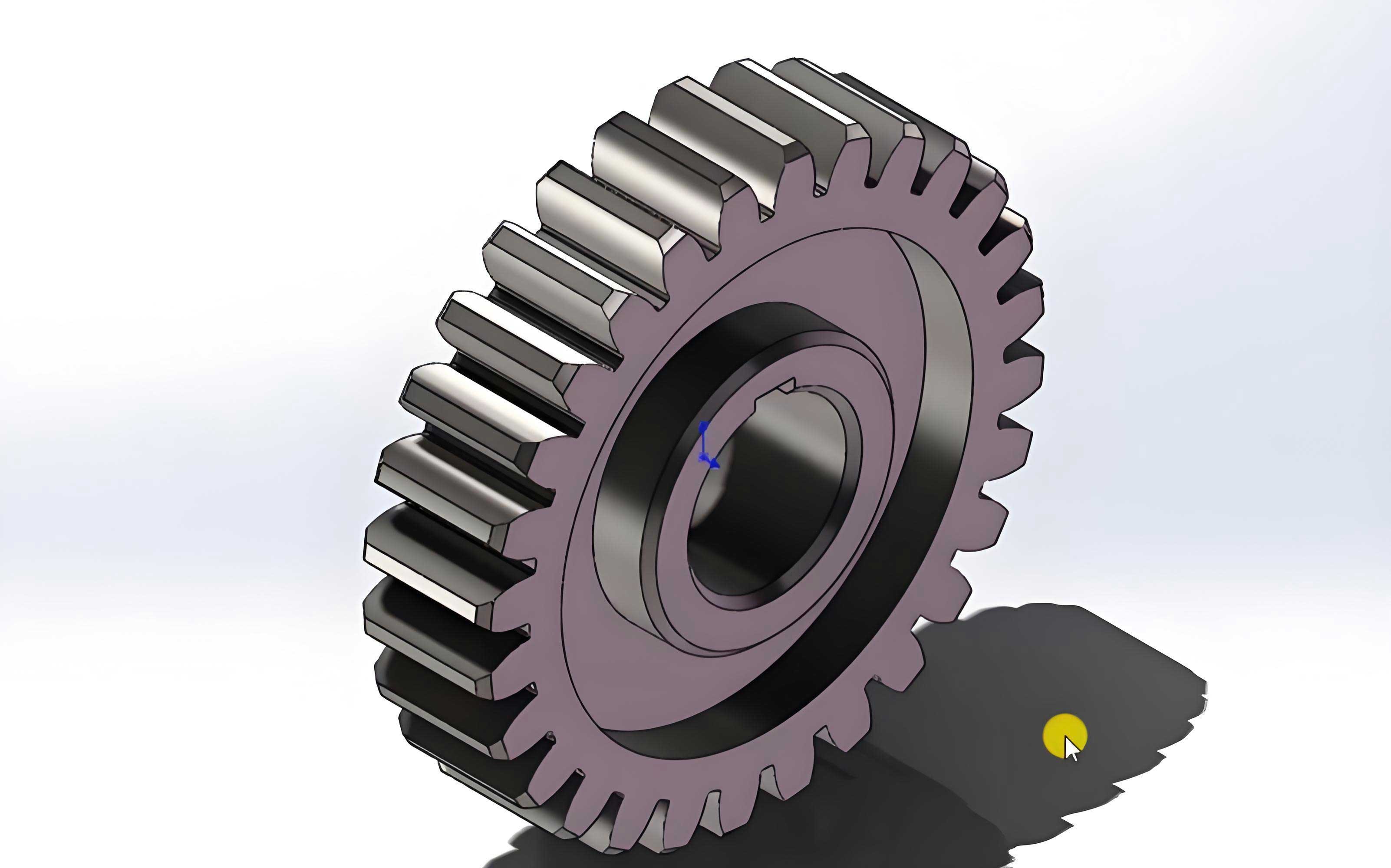
The geometry of meshing spur gears is defined in a coordinate system that follows the contact point along the line of action. The equivalent radius of curvature \( R(t) \) and the entrainment velocity \( U(t) \) at any instant are critical inputs that vary during the meshing cycle of the spur gears.
The core set of governing equations for this transient thermal mixed lubrication problem is as follows:
1. Modified Average Reynolds Equation:
The lubricant is modeled as a Ree-Eyring non-Newtonian fluid. The generalized average Reynolds equation incorporating transient and thermal effects is:
$$
\frac{\partial}{\partial x}\left(\phi_x \frac{\bar{\rho}_e h^3}{12 \eta_e^*} \frac{\partial p_h}{\partial x}\right) = \frac{\partial}{\partial x}\left( \frac{\phi_c U \bar{\rho}_e^* h}{2} \right) + \frac{\sigma}{2} \frac{\partial}{\partial x}\left( \phi_s U_s \bar{\rho}_e \right) + \phi_c \frac{\partial (\bar{\rho}_e h)}{\partial t}
$$
Here, \( p_h \) is the hydrodynamic pressure, \( h \) is the average film thickness, \( \eta_e^* \) is the equivalent non-Newtonian viscosity, and \( \bar{\rho}_e, \bar{\rho}_e^* \) are equivalent densities. \( U_s \) is the sliding velocity.
2. Film Thickness Equation:
The film thickness accounts for elastic deformation of the spur gears surfaces:
$$
h(x,t) = h_0(t) + \frac{x^2}{2R(t)} – \frac{2}{\pi E’} \int_{x_{in}}^{x_{out}} p_h(x’,t) \ln|x-x’| dx’
$$
where \( h_0(t) \) is the rigid central film thickness and \( E’ \) is the combined elastic modulus.
3. Viscosity-Pressure-Temperature Relationship:
$$
\eta(p, T) = \eta_0 \exp\left\{ (\ln \eta_0 + 9.67) \left[ -1 + (1 + 5.1 \times 10^{-9} p)^{Z_0} \left( \frac{T-138}{T_0-138} \right)^{-S_0} \right] \right\}
$$
The equivalent viscosity for the Ree-Eyring fluid is \( \eta^* = \eta \frac{\tau / \tau_0}{\sinh(\tau / \tau_0)} \), where \( \tau_0 \) is the characteristic shear stress.
4. Density-Pressure-Temperature Relationship:
$$
\rho(p, T) = \rho_0 \left[ 1 + \frac{0.6 \times 10^{-9} p}{1 + 1.7 \times 10^{-9} p} – 0.00065 (T – T_0) \right]
$$
5. Load Balance Equation:
The total load \( w(t) \) per unit face width on the spur gear tooth is shared between the fluid film and the asperities:
$$
w(t) = \int_{x_{in}}^{x_{out}} p_h(x,t) \, dx + \int_{x_{in}}^{x_{out}} p_a(x,t) \, dx
$$
where \( p_a \) is the asperity contact pressure.
6. Energy Equations:
The temperature field is solved using the energy equation for the fluid film:
$$
\rho c \left( \frac{\partial T}{\partial t} + u \frac{\partial T}{\partial x} + w \frac{\partial T}{\partial z} \right) – k \frac{\partial^2 T}{\partial z^2} = -\frac{T}{\rho} \frac{\partial \rho}{\partial T} \left( \frac{\partial p}{\partial t} + u \frac{\partial p}{\partial x} \right) + \eta^* \left( \frac{\partial u}{\partial z} \right)^2 + Q_c
$$
and the heat conduction equations for the two spur gear solids. \( Q_c \) represents heat generated by asperity contact.
7. Asperity Contact Model:
The asperity contact pressure \( p_a \) is calculated by integrating over the distribution of asperity heights, considering three deformation regimes:
$$
p_a(h) = \frac{2}{3} E’ \sqrt{\frac{\sigma_s}{\beta}} n \beta \sigma \int_{h-y_s}^{h-y_s+w_1^*} F_{1.5}(w^*) \, dw^* + \pi H_v n \beta \sigma \int_{h-y_s+w_1^*}^{h-y_s+w_2^*} C(w^*) F_2(w^*) \, dw^* + 2\pi H_v n \beta \sigma \int_{h-y_s+w_2^*}^{\infty} F_2(w^*) \, dw^*
$$
where \( F_m(w^*) = \int_{w^*}^{\infty} (s – w^*)^m \phi^*(s) \, ds \), \( \phi^* \) is the normalized asperity height distribution, \( H_v \) is the hardness, and \( C(w^*) \) is an interpolation function for the elastoplastic regime.
The numerical solution employs the multigrid method for pressure, the multigrid integration technique for film thickness, and a column-by-column scanning method for the temperature field. A full meshing cycle of the spur gears is discretized into 180 time steps. The convergence criteria for relative error in pressure, load, and temperature are set at \(10^{-3}\), \(10^{-3}\), and \(10^{-4}\), respectively. The gear and lubricant parameters used in the calculation are summarized in the following table.
| Parameter | Value |
|---|---|
| Pressure Angle, \(\alpha\) | 20° |
| Module, \(m\) (mm) | 4 |
| Number of Teeth, \(z_1, z_2\) | 35, 140 |
| Face Width, \(b\) (mm) | 20 |
| Pinion Speed, \(n_1\) (rpm) | 620 |
| Input Power, \(P\) (kW) | 40 |
| Composite Roughness, \(\sigma\) (µm) | 0.4 |
| Lubricant Viscosity at \(T_0\), \(\eta_0\) (Pa·s) | 0.075 |
| Lubricant Density at \(T_0\), \(\rho_0\) (kg/m³) | 870 |
| Pressure-Viscosity Coefficient, \(\alpha\) (Pa⁻¹) | 2.2×10⁻⁸ |
| Elastic Modulus, \(E\) (GPa) | 206 |
| Poisson’s Ratio, \(\nu\) | 0.3 |
Analysis of Results and Discussion
1. Influence of Roughness-Related Parameters
The composite surface roughness σ and the surface texture orientation γ are fundamental to mixed lubrication performance in spur gears.
Effect of Composite Roughness σ: As σ increases, the hydrodynamic pressure shows a slight decrease, while the asperity contact pressure \(p_a\) increases significantly, and its bearing zone widens slightly. This is because a larger σ implies more asperities are in contact, increasing the load share carried by solid contact. The central and minimum film thicknesses increase with σ due to the enhanced “micro-pumping” effect of the roughness, which helps entrain more lubricant. However, the film thickness ratio λ (ratio of film thickness to roughness) decreases because the rate of increase in σ outpaces the rate of increase in film thickness. Therefore, selecting an appropriate σ is critical; while a very low σ is ideal, it may be impractical to achieve, and a moderately low σ can still benefit from positive micro-pumping effects.
Effect of Roughness Texture Parameter γ: The parameter γ is defined as the ratio of the correlation lengths in the x and y directions (γ = λ_x/λ_y). A γ < 1 indicates a transverse texture (roughness ridges perpendicular to the entrainment direction), γ = 1 an isotropic texture, and γ > 1 a longitudinal texture. My analysis reveals a pronounced effect:
- Pressure: As γ increases (texture becomes more longitudinal), the secondary pressure peak in the hydrodynamic pressure distribution grows and shifts towards the contact center. The asperity contact pressure also increases with γ.
- Film Thickness: Both the central/minimum film thickness and the film thickness ratio λ decrease monotonically as γ increases. Transverse roughness (γ < 1) provides the thickest films. This is because transverse ridges create more effective barriers to lubricant side flow, promoting better lubricant entrapment within the contact of the spur gears.
- Temperature: The maximum oil film temperature rise ratio \(T_{max}/T_0\) exhibits a non-monotonic behavior. It first decreases as γ increases from a highly transverse value (e.g., 1/6) to γ = 1/3, reaching a minimum, and then increases for longitudinal textures (γ > 1). This suggests there exists an optimal texture (around γ = 1/3 in this study) that minimizes frictional heating under mixed lubrication conditions.
In summary, for spur gears operating in mixed lubrication, surfaces with a transverse roughness texture (especially with γ ≈ 1/3) generally offer superior performance in terms of maintaining thicker films and potentially lower temperatures.
2. Influence of Gear Geometric Parameters
The geometry of the spur gears themselves significantly affects the lubrication state.
Effect of Module (m): Increasing the module reduces the load per unit face width for a given transmitted torque. Consequently, the central hydrodynamic pressure decreases, while both the central and minimum film thickness increase. The maximum temperature rise also decreases. Therefore, selecting a larger module, within design constraints, is beneficial for improving the lubrication of spur gears.
Effect of Pressure Angle (α): A larger pressure angle (e.g., 25° or 30° compared to the standard 20°) also reduces the load on the tooth flank for the same transmitted load. Similar to the module effect, this leads to a decrease in central pressure and temperature rise, and an increase in film thickness. While a higher pressure angle can improve bending strength and lubrication, it must be balanced against potential increases in bearing loads and noise.
The trends for these geometric parameters are summarized in the table below:
| Parameter Increased | Central Pressure (\(p_c\)) | Central/Min Film Thickness (\(h_c\), \(h_{min}\)) | Max Temp Rise (\(T_{max}/T_0\)) | Effect on Lubrication |
|---|---|---|---|---|
| Module (\(m\)) | Decreases | Increases | Decreases | Beneficial |
| Pressure Angle (\(\alpha\)) | Decreases | Increases | Decreases | Beneficial (within limits) |
3. Influence of Operating Conditions
The operating environment of the spur gears is equally critical.
Effect of Rotational Speed (n₁): Increasing the pinion speed raises the entrainment velocity \(U\). This strongly promotes film formation, resulting in increased central and minimum film thicknesses. The central pressure decreases slightly due to the enhanced hydrodynamic effect. Importantly, the maximum temperature rise ratio decreases with increased speed, particularly in the approach and recess regions of the meshing cycle. This indicates that operating spur gears at higher speeds (within reasonable limits to avoid dynamic issues) can improve their thermal mixed lubrication status.
Effect of Input Power (P): Increasing the input power directly increases the transmitted load \(w(t)\). This leads to a significant increase in central hydrodynamic pressure and a decrease in both central and minimum film thickness. Consequently, the maximum temperature rise increases substantially due to higher shear and more asperity contact. High-power operation is therefore detrimental to maintaining a good lubrication film and should be considered carefully in the design and application of spur gears.
The trends for these operating parameters are summarized below:
| Parameter Increased | Central Pressure (\(p_c\)) | Central/Min Film Thickness (\(h_c\), \(h_{min}\)) | Max Temp Rise (\(T_{max}/T_0\)) | Effect on Lubrication |
|---|---|---|---|---|
| Rotational Speed (\(n_1\)) | Slight Decrease | Increases | Decreases | Beneficial |
| Input Power (\(P\)) | Increases | Decreases | Increases | Detrimental |
Conclusion
Through the development and application of a comprehensive transient thermal mixed lubrication model for involute spur gears under line contact conditions, I have drawn several key conclusions regarding the optimization of their lubrication performance:
- The composite surface roughness σ and the roughness texture parameter γ are dominant factors in the mixed lubrication regime of spur gears. An increase in σ raises the asperity contact pressure and load share. While film thickness may increase due to micro-pumping, the film thickness ratio decreases, highlighting the need for a carefully selected, practically achievable surface finish.
- Surface texture orientation has a profound impact. Transverse roughness textures (γ < 1) consistently promote thicker lubricant films compared to longitudinal textures. Furthermore, there exists an optimal texture parameter (found to be γ = 1/3 in this study) that minimizes the maximum contact temperature, suggesting a potential trade-off between film generation and frictional heating.
- Gear geometry can be tailored to improve lubrication. Increasing the module or the pressure angle reduces contact pressure and increases film thickness, thereby improving the lubrication state of the spur gears, provided other design constraints are satisfied.
- Operating conditions are crucial. Increasing the rotational speed improves lubrication by increasing film thickness and reducing temperatures. Conversely, increasing the input power severely degrades lubrication by increasing pressure, reducing film thickness, and raising operating temperatures significantly.
This analysis underscores the complexity of the thermal mixed lubrication state in spur gears and demonstrates that a holistic approach, considering surface topography, gear geometry, and operating parameters, is essential for effective design and performance prediction.