
Spur gears are fundamental components in mechanical power transmission systems, prized for their simplicity, efficiency, and ability to transmit motion and torque between parallel shafts. However, the dynamic behavior of spur gear pairs is inherently nonlinear, primarily due to factors such as time-varying mesh stiffness, backlash, and damping. These nonlinearities can lead to complex dynamic responses, including periodic, multi-periodic, and even chaotic motions. Such responses induce fluctuating meshing forces, which are a primary driver of contact fatigue—a predominant failure mode for spur gears characterized by pitting and spalling on the tooth flanks. Therefore, analyzing the dynamic safety of spur gear systems under the constraint of contact strength is crucial for reliable design and predictive maintenance. This article establishes a safety condition based on Hertzian contact stress and employs the safe basin theory to investigate the evolution of safe operating regions in the phase space of a spur gear pair model, considering multi-state meshing conditions.
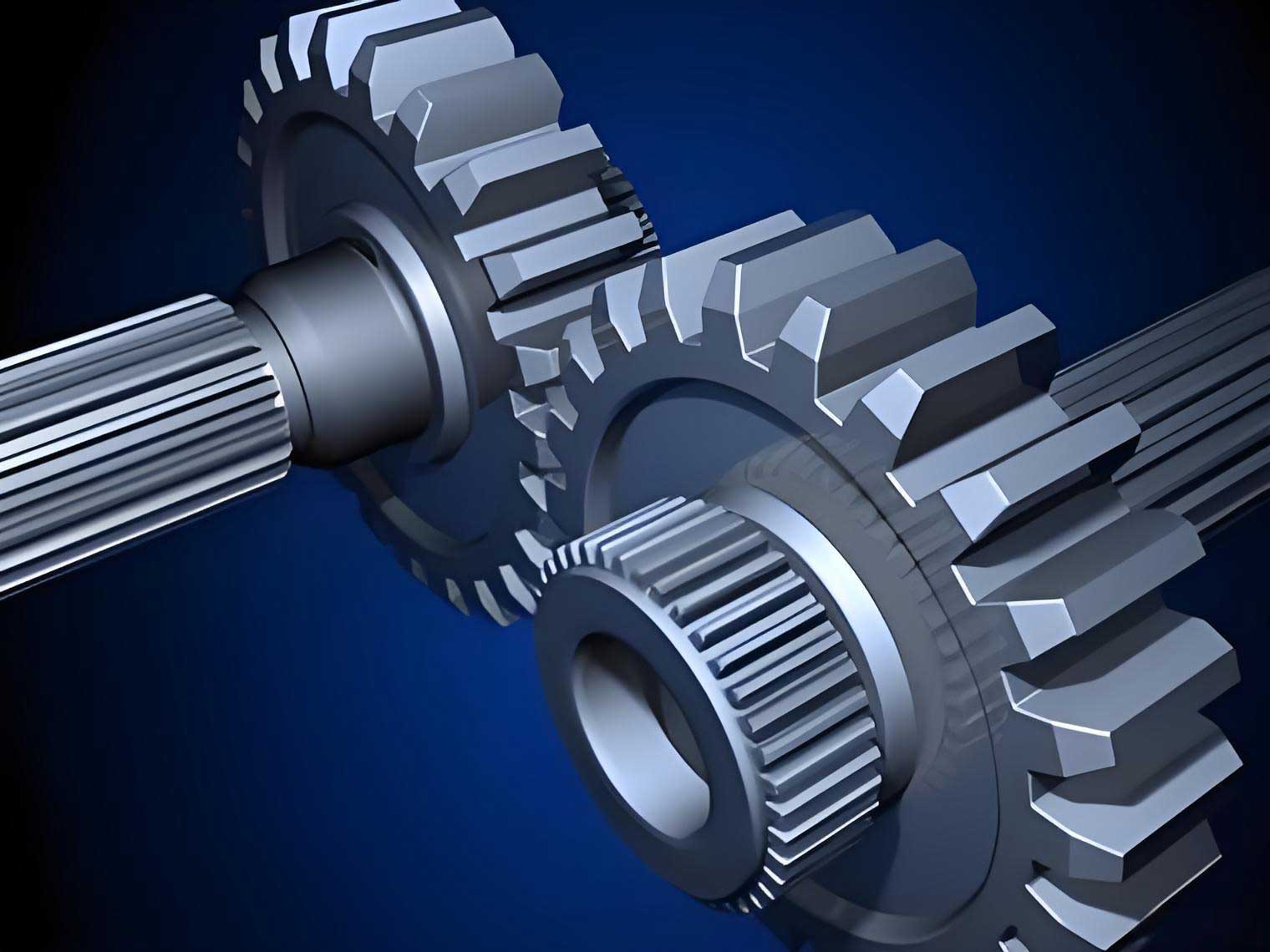
The dynamic model for a pair of spur gears is typically reduced to a single degree-of-freedom system focusing on the torsional vibration along the line of action. Key nonlinearities are incorporated: a piecewise-linear function $f(x)$ to model the backlash $2\bar{D}$, and a time-periodic function $k(t)$ to represent the meshing stiffness fluctuation which alternates between high stiffness during double-tooth contact and low stiffness during single-tooth contact. The dimensionless equation of motion is given by:
$$ \ddot{x} + 2\xi \cdot \text{sign}(\dot{x}) \dot{x} + \bar{k}(t) M(t) f(x) = F_m + F_h(t) $$
Here, $x$ and $\dot{x}$ are the dimensionless relative displacement and velocity of the gear teeth. The term $\xi$ represents the dimensionless damping ratio, $\bar{k}(t)=1 + \kappa \cos(\omega t)$ is the dimensionless time-varying mesh stiffness with fluctuation amplitude $\kappa$ and meshing frequency $\omega$, and $F_m$ is the dimensionless average force from the external load. The function $M(t)$ is critical as it models the multi-state engagement, switching between single-tooth pair contact, double-tooth pair contact, tooth separation (detachment), and back-side contact when the gears reverse their relative motion through the backlash zone. The function $f(x)$ is defined as:
$$ f(x) =
\begin{cases}
x – \bar{D}, & \text{if } x > \bar{D} \quad \text{(Driving-side contact)} \\
0, & \text{if } -\bar{D} \le x \le \bar{D} \quad \text{(Detachment)} \\
x + \bar{D}, & \text{if } x < -\bar{D} \quad \text{(Back-side contact)}
\end{cases} $$
The dynamic meshing force $F_n$ transmitted through the contacting teeth is derived from the model and serves as the input for contact stress calculation. For spur gears, the contact between mating teeth can be approximated locally as the contact of two cylinders with radii equal to the radii of curvature of the tooth profiles at the point of contact. According to Hertzian contact theory, the maximum compressive stress $\sigma_{H}$ occurring at the center of the contact line is given by:
$$ \sigma_{H} = \sqrt{ \frac{F_n E_{eq}}{\pi \rho_{eq} L} } $$
In this formula, $F_n$ is the normal load per unit face width, $E_{eq}$ is the equivalent Young’s modulus, $L$ is the length of the contact line (face width), and $\rho_{eq}$ is the equivalent radius of curvature. For a pair of spur gears, these equivalent parameters are calculated from the geometry of the specific tooth pair in contact at any given time. The allowable contact stress $\sigma_{HP}$ is determined by the gear material’s endurance limit and application-specific safety factors. A safety condition for the spur gear pair can thus be defined as:
$$ \sigma_{H}(t) \le \sigma_{HP} \quad \text{for all } t $$
Violation of this condition indicates a high risk of pitting failure. The dynamic response of the system, which dictates $F_n(t)$, determines whether this condition holds for a given set of operating parameters and initial conditions.
The concept of a safe basin is instrumental in visualizing this safety condition in the system’s phase space. The safe basin is the set of all initial conditions $(x_0, \dot{x}_0)$ that lead to a steady-state attractor (e.g., a periodic orbit) whose dynamic meshing force history $F_n(t)$ results in contact stresses that never exceed $\sigma_{HP}$. Attractors whose resulting stresses violate the condition are deemed “unsafe,” and their basins of attraction are labeled as unsafe regions. The erosion or bifurcation of the safe basin refers to the shrinkage or topological change of this safe set as a system parameter (e.g., meshing frequency $\omega$ or stiffness fluctuation $\kappa$) varies. The analysis involves numerically integrating the equations of motion for a grid of initial conditions (using the cell mapping method), identifying the resulting attractor for each, and then evaluating the safety condition by calculating the time-history of contact stress for that attractor.
The following table summarizes typical parameters used in the dimensionless spur gear dynamic model for such analyses:
| Parameter Symbol | Description | Typical Range/Value |
|---|---|---|
| $\xi$ | Dimensionless damping ratio | 0.06 – 0.1 |
| $\kappa$ | Mesh stiffness fluctuation amplitude | 0.1 – 0.3 |
| $\omega$ | Dimensionless meshing frequency | 0.2 – 2.0 |
| $F_m$ | Dimensionless mean load | 0.1 – 0.3 |
| $\bar{D}$ | Dimensionless half-backlash | 1.0 |
| $\epsilon$ | Dimensionless transmission error amplitude | 0.2 |
As the dimensionless meshing frequency $\omega$ is increased, the system undergoes a series of bifurcations. The table below illustrates how the coexistence of attractors and their safety classification can change with $\omega$:
| Frequency Range ($\omega$) | Coexisting Attractors | Safety Classification (S=Safe, U=Unsafe) |
|---|---|---|
| (0.20, 0.46) | Period-1 (P1) | P1-S |
| [0.46, 0.62) | P1, Quasi-Periodic-1 (Q1), Period-1 (R1) | P1-S, Q1-S, R1-U |
| [0.62, 0.65) | Q1, R1 | Q1-S, R1-U |
| [0.65, 0.74) | Q1, Chaotic (PN) | Q1-S, PN-U |
| [0.84, 0.95) | Period-2 (P2), Quasi-Periodic-2 (Q2) | P2-S, Q2-S |
This evolution demonstrates that different attractors co-existing in the same parameter regime can have vastly different implications for the longevity of the spur gears. For instance, while a period-1 motion might keep stresses within limits, a coexisting chaotic or even another period-1 attractor might lead to stress violations. The safe basin is constituted by the union of all basins of attraction leading to “safe” attractors. The bifurcation of attractors (e.g., period-doubling, birth of a quasi-periodic orbit, or a crisis) directly causes bifurcations in the safe basin—either through the appearance of a new unsafe region or the disappearance of a safe one. Erosion, a gradual shrinking of the safe basin, often occurs as an unsafe basin expands its domain in the phase space, “eating away” at the initial conditions that would previously lead to a safe operating state.
Another critical parameter is the stiffness fluctuation amplitude $\kappa$. As $\kappa$ decreases, the system can exhibit rich dynamics. The transition is often tracked using multi-initial bifurcation diagrams and the calculation of Lyapunov exponents. The safe basin evolution with decreasing $\kappa$ shows the emergence and disappearance of various periodic and chaotic attractors with distinct safety properties. For example, a safe period-2 basin might be suddenly invaded by an unsafe period-3 basin at a specific parameter value, representing a sudden reduction in the safety margin of the spur gear system.
The contact stress calculation for an attractor involves post-processing the steady-state time series of $x(t)$ and $\dot{x}(t)$. The dynamic meshing force $F_n(t)$ is computed first. For double-tooth contact periods, the load is shared between two pairs. The load on an individual tooth pair $i$ is $F_{ni} = F_n \cdot Y_i(t)$, where $Y_i(t)$ is the load-sharing factor. The radius of curvature for each contacting tooth $\rho_{i1}(t)$ and $\rho_{i2}(t)$ changes with the contact position along the line of action. The instantaneous maximum contact stress for tooth pair $i$ is then:
$$ \sigma_{ni}(t) = \frac{2 F_{ni}(t)}{\pi b B_i(t)} \quad \text{where} \quad B_i(t) = 1.128 \sqrt{ \frac{2 F_{ni}(t) \rho_{eq,i}(t) (1-\nu^2)}{E b} } $$
Here, $b$ is the face width, $\nu$ is Poisson’s ratio, and $\rho_{eq,i}(t) = \left( \frac{1}{\rho_{i1}(t)} + \frac{1}{\rho_{i2}(t)} \right)^{-1}$. The safety condition requires $\max_{t} \{ \sigma_{n1}(t), \sigma_{n2}(t) \} \le \sigma_{HP}$. The complex interplay between the dynamic response (governed by $\omega$, $\kappa$, etc.) and this stress condition is what shapes the safe basin. For spur gears operating near resonance or under specific parametric conditions, the dynamic amplification of $F_n(t)$ can easily push $\sigma_H(t)$ beyond the allowable limit, even if the static load is well within design specifications.
In conclusion, the nonlinear dynamics of spur gear pairs have a direct and significant impact on their susceptibility to contact fatigue failure. The methodology of combining a nonlinear dynamic model with Hertzian contact theory and safe basin analysis provides a powerful framework for assessing operational safety. Key findings are:
1. For a given set of operational parameters, multiple co-existing attractors (steady-state motions) are possible in spur gear systems, and these attractors can have fundamentally different safety characteristics regarding tooth contact stress.
2. The safe operating region in the phase space (the safe basin) can undergo sudden bifurcations and gradual erosion as parameters change. These changes are directly linked to global bifurcations in the system’s dynamics, such as the appearance, disappearance, or metamorphosis of attractors.
3. Monitoring parameters like meshing frequency and stiffness variation is critical, as their variation can trigger bifurcations that suddenly introduce unsafe operating basins, jeopardizing the spur gear system’s integrity even if the nominal load is unchanged.
This approach moves beyond traditional static stress analysis and offers a dynamic safety perspective, which is essential for the robust design and fault prognosis of high-performance spur gear transmissions operating under variable conditions.