
The dynamic behavior of spur gears is fundamentally nonlinear, primarily due to time-varying mesh stiffness, clearances, and frictional forces acting on the tooth flanks. These factors introduce complex phenomena such as bifurcations, subharmonic and superharmonic resonances, and chaotic motion, which directly impact noise, vibration, and durability. While time-varying mesh stiffness and constant backlash are commonly studied, the combined influence of time-varying tooth friction and time-varying backlash is less explored. In this analysis, I develop a comprehensive nonlinear dynamic model for a spur gear pair that explicitly incorporates these coupled time-varying effects. My goal is to isolate and understand their individual and combined contributions to the system’s bifurcation characteristics and response spectra, providing a more refined theoretical basis for gear design and parameter selection.
This discussion is based on a model derived from the principles of gear meshing dynamics. The gear system is simplified to a purely torsional model, where the relative displacement along the line of action serves as the generalized coordinate. The model integrates three key time-varying elements: the mesh stiffness, the tooth flank friction, and the gear backlash. The inclusion of time-varying friction, calculated based on the instantaneous sliding velocity and contact position, and a sinusoidally varying backlash introduces a high degree of nonlinear coupling that significantly enriches the system’s dynamic landscape.
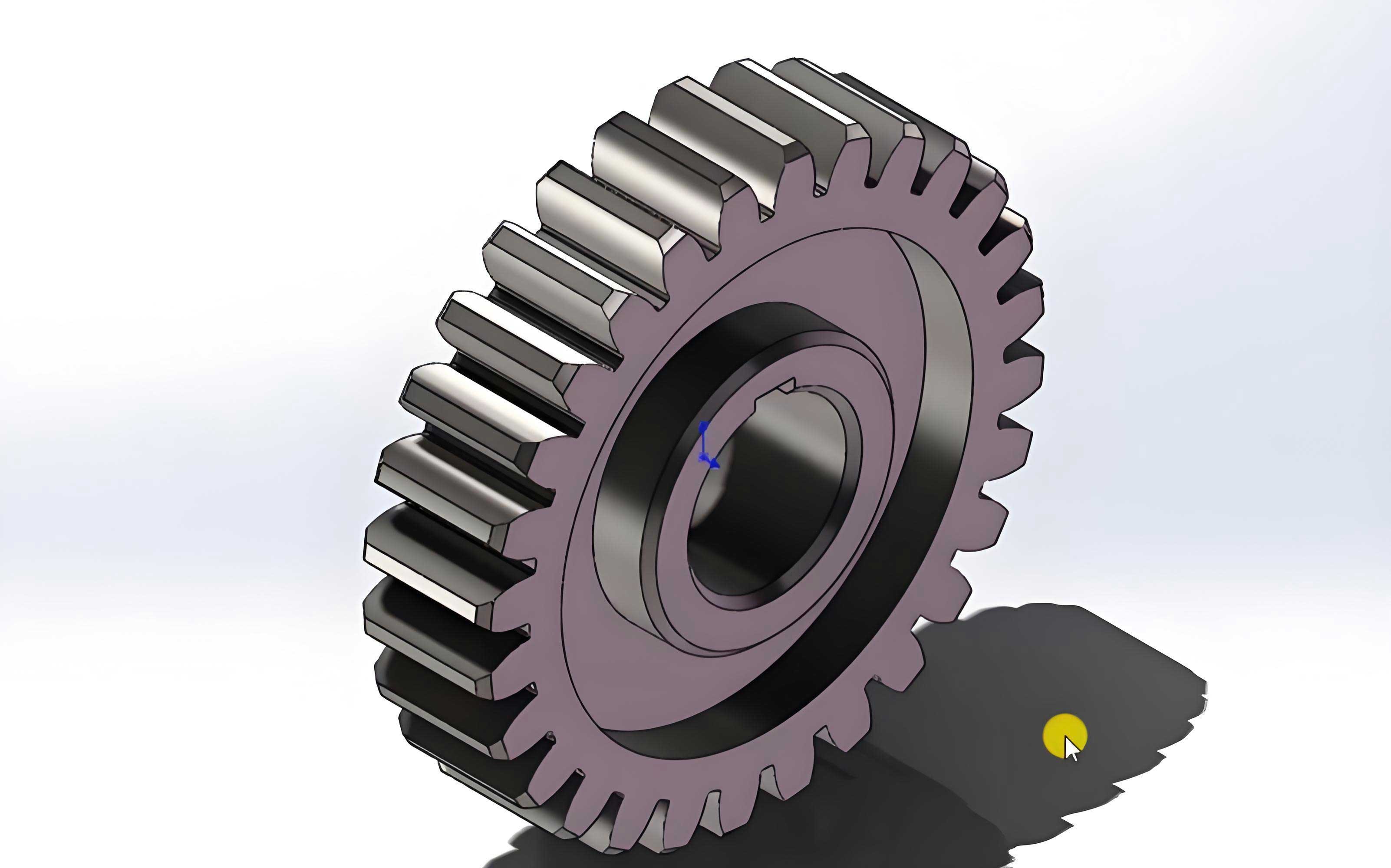
A typical meshing cycle for spur gears with a contact ratio between 1 and 2 involves double-tooth and single-tooth contact zones. This periodicity is central to modeling the time-varying parameters.
Mathematical Modeling of Time-Varying Parameters
1. Time-Varying Friction Model
The friction force on the tooth flank is not constant. It depends on the relative sliding velocity at the contact point K and the normal mesh force. For a pair of spur gears, the sliding velocity at point K is given by:
$$ V_s = \omega_1 \cdot \overline{KN_1} – \omega_2 \cdot \overline{KN_2} $$
where $\overline{KN_1}$ and $\overline{KN_2}$ are distances from the contact point to the respective gear centers, evolving with time as the contact moves along the line of action. The friction force direction reverses as the contact point passes the pitch point.
The friction coefficient itself is highly variable. I employ the Buckingham semi-empirical formula to capture its dependence on sliding velocity:
$$ \mu_K = 0.05 e^{-0.125 |V_s|} + 0.002 \sqrt{|V_s|} $$
This relation shows that $\mu_K$ is highest near the pitch point (where $V_s$ is theoretically zero but practically very small) and decreases towards the tooth tips and roots before increasing slightly again.
The friction-induced torque on a gear is $M_{f,i} = \text{sign}(V_s) \mu_K F_K \cdot \overline{KN_i}$. Due to the contact ratio, the total frictional load on the system is the sum of contributions from all concurrent contact pairs. Over one mesh period $T$, the comprehensive friction torque can be piecewise defined, accounting for single and double pair contact zones:
$$ M_{fi}(t) =
\begin{cases}
M_i(t) + M_i(t+T), & 0 \leq t < (\varepsilon – 1)T \\
M_i(t), & (\varepsilon – 1)T \leq t < T
\end{cases} $$
where $\varepsilon$ is the contact ratio.
2. Time-Varying Backlash Function
Backlash, often considered constant, can vary due to manufacturing errors, assembly misalignment, thermal expansion, and wear. I model this time-dependency with a simple harmonic function:
$$ b_n(t) = b_0 \left(1 + \alpha \sin(\omega_1 t)\right) $$
Here, $b_0$ is the nominal half-backlash, and $\alpha$ is the amplitude coefficient of its variation. The dimensionless backlash function in the dynamic equations then becomes:
$$ b(\tau) = 1 + \alpha \sin(\Omega \tau) $$
The piecewise linear displacement function $f(x, b)$, representing the gear separation, is therefore driven by this oscillating threshold.
3. Time-Varying Mesh Stiffness
The mesh stiffness $k_h(t)$ of spur gears varies periodically with tooth engagement. It is calculated using established methods (e.g., potential energy method or finite element analysis) and exhibits a similar piecewise characteristic due to the contact ratio. The comprehensive mesh stiffness $K(t)$ over a period is structured identically to the friction torque:
$$ K(t) =
\begin{cases}
k(t) + k(t+T), & 0 \leq t < (\varepsilon – 1)T \\
k(t), & (\varepsilon – 1)T \leq t < T
\end{cases} $$
This stiffness variation is a primary source of parametric excitation in the system.
Nonlinear Dynamic Model of the Spur Gear Pair
Based on Newton’s second law, the torsional dynamics of the spur gear system shown in the conceptual model can be derived. The governing equations for the pinion and gear are:
$$ I_1 \ddot{\theta}_1 + F_K r_{b1} + M_{f1} = T_1 $$
$$ I_2 \ddot{\theta}_2 – F_K r_{b2} – M_{f2} = -T_2 $$
where $I_i$, $\theta_i$, and $r_{bi}$ are the moment of inertia, angular displacement, and base radius, respectively. $T_1$ and $T_2$ are input and output torques.
The mesh force $F_K$ along the line of action is:
$$ F_K = K(t) \cdot f(X, b_n) + c_h \dot{X} $$
The relative displacement $X$ is defined as:
$$ X = r_{b1}\theta_1 – r_{b2}\theta_2 – e(t) $$
with $e(t) = e_a \sin(\omega_h t)$ representing static transmission error.
By defining the equivalent mass $m_e = \frac{I_1 I_2}{I_1 r_{b2}^2 + I_2 r_{b1}^2}$ and the average mesh stiffness $K_{av}$, a dimensionless equation is obtained. Introducing the dimensionless time $\tau = \omega_n t$, where $\omega_n = \sqrt{K_{av}/m_e}$, and the dimensionless displacement $x = X/b_0$, the final governing equation is:
$$ \ddot{x} + \left(1 + h(\tau)\right) \cdot \left[ 2\zeta_1 \dot{x} + (1 + k_a(\tau)) f(x, b(\tau)) \right] = F_{av} + F_e \Omega^2 \sin(\Omega \tau) $$
Where:
- $\zeta_1$ is the dimensionless damping ratio.
- $h(\tau) = \text{sign}(V_s(\tau)) \mu(\tau) \left( \frac{\overline{KN_1}}{m_1 r_{b1}} + \frac{\overline{KN_2}}{m_2 r_{b2}} \right) m_e$ is the dimensionless friction influence term.
- $k_a(\tau)$ represents the periodic variation of mesh stiffness around its mean.
- $f(x, b)$ is the piecewise linear function with time-varying threshold $b(\tau)=1+\alpha \sin(\Omega \tau)$.
- $F_{av}$ and $F_e$ are dimensionless constant load and error excitation amplitude.
- $\Omega = \omega_h / \omega_n$ is the dimensionless excitation frequency.
This equation encapsulates the coupled effects of time-varying friction ($h(\tau)$), time-varying stiffness ($k_a(\tau)$), and time-varying backlash ($b(\tau)$) on the dynamics of the spur gear pair.
Numerical Simulation and Analysis of Dynamics
To analyze the system, I employed a variable-step 4th-5th order Runge-Kutta numerical integration method. The parameters for the sample spur gear pair are listed in the table below. The investigation focuses on the system’s response under varying dimensionless frequency $\Omega$, which is the primary bifurcation parameter.
| Parameter | Symbol | Value |
|---|---|---|
| Pinion Teeth | $Z_1$ | 30 |
| Gear Teeth | $Z_2$ | 45 |
| Pressure Angle | $\alpha$ | 20° |
| Module | $m$ | 3 mm |
| Dimensionless Load | $F_{av}$ | 0.2 |
| Dimensionless Error Amplitude | $F_e$ | 0.5 |
| Damping Ratio | $\zeta_1$ | 0.02 |
| Moment of Inertia (Pinion & Gear) | $I_1, I_2$ | 1.0 kg·m² |
| Nominal Half-Backlash | $b_0$ | 10 µm |
1. Characterization of Time-Varying Friction
Before examining the system response, it’s instructive to visualize the friction parameters. The friction coefficient $\mu$ and the equivalent friction arm term $h(\tau)$ vary significantly within a mesh cycle.
The friction coefficient $\mu$ reaches its maximum near the pitch point due to the minimal film thickness in the boundary lubrication regime. As the contact moves towards the tooth root or tip, the sliding velocity increases, initially causing a drop in $\mu$ according to the Buckingham formula, followed by a slight rise due to the square root term. This creates a characteristic “W” shaped profile along the path of contact for a given speed.
The equivalent friction influence $h(\tau)$ is even more complex. It incorporates not only $\mu$ but also the leverage arm $\overline{KN_i}$ and its sign change at the pitch point. Furthermore, it exhibits sudden jumps at the transitions between single and double tooth contact zones because the number of active friction sources changes instantaneously. This makes $h(\tau)$ a rich source of non-smooth, multi-frequency excitation.
2. Bifurcation Analysis: The Role of Friction and Backlash Variation
I constructed global bifurcation diagrams by plotting the local maxima of the dimensionless displacement $x$ against the dimensionless frequency $\Omega$ over the range [0.5, 2.5]. Three system configurations were compared:
- System A: With time-varying friction and time-varying backlash ($\alpha=0.2, \mu \neq 0$).
- System B: With time-varying friction only ($\alpha=0, \mu \neq 0$).
- System C: Without time-varying friction and with constant backlash ($\alpha=0, \mu = 0$).
A critical observation is that the bifurcation diagrams for System A and System B are nearly indistinguishable. This indicates that the amplitude of the time-varying backlash ($\alpha$) has a negligible impact on the global bifurcation structure of this spur gear system. The primary nonlinear jump phenomena and chaos boundaries are not significantly altered by introducing a sinusoidal variation to the backlash width.
In contrast, the comparison between System B (with friction) and System C (without friction) reveals substantial differences. Friction acts as a significant modifying agent:
- Altered Chaos Boundaries: The presence of time-varying friction causes the system to enter chaotic motion at a lower $\Omega$ value and to exit chaos into periodic motion at a higher $\Omega$ value compared to the frictionless case. Essentially, friction “widens” the frequency band where chaotic behavior is observed.
- Modified Periodic Windows: Within the chaotic region, the periodic windows (narrow bands of periodic motion) are shifted and altered in size. Friction introduces additional damping and hysteresis, which suppresses some bifurcation routes while enabling others.
This demonstrates that while time-varying backlash variation may be secondary, time-varying tooth flank friction is a critical factor that must be accounted for in accurate dynamic modeling of spur gears.
3. Spectral Content of Periodic Responses
Analyzing the Fast Fourier Transform (FFT) of the displacement response under different periodic regimes reveals how friction enriches the frequency content. For the system with friction (System A/B):
- At $\Omega = 2.3263$, the response is period-1, showing a clean spectrum dominated by the mesh frequency and its harmonics from parametric excitation.
- At a lower frequency, $\Omega = 0.5169$, while still period-1, the spectrum shows prominent superharmonic components (integer multiples of the excitation frequency). This indicates a stronger nonlinear distortion of the waveform.
- At $\Omega = 1.3441$, the system exhibits a period-2 response, characterized by a strong subharmonic component at $\Omega/2$ in the FFT spectrum.
- At $\Omega = 1.5580$, a period-3 response is found, with subharmonic components at $\Omega/3$ and $2\Omega/3$.
This proliferation of subharmonic and superharmonic responses in the presence of friction is a direct consequence of the non-smooth, multi-frequency nature of the $h(\tau)$ term. The friction provides a broadband excitation that interacts with the primary parametric excitation from stiffness variation, exciting these fractional and higher-order resonances. This has direct implications for noise and vibration, as these components can fall within sensitive auditory ranges or coincide with other structural resonances.
4. Influence of Friction on Chaotic Attractors
To understand the qualitative effect of friction on chaotic motion, I compared the phase portraits and Poincaré maps at a specific frequency ($\Omega = 1.0856$) where both Systems B (with friction) and C (without friction) exhibit chaos.
The phase portraits ($x$ vs. $\dot{x}$) for both systems appear as filled, bounded regions of seemingly random trajectories, typical of chaotic attractors. Visual comparison shows subtle differences in shape but not a dramatic change.
The Poincaré map, however, provides a clearer distinction. The Poincaré section is taken once per period of the mesh stiffness variation. For the system without friction (System C), the map shows a cloud of points with a certain density distribution and boundary. For the system with friction (System B), the cloud of points is expanded, covering a larger area in the state space. This suggests that the chaotic attractor has a larger “footprint” or geometric extent when friction is included.
Interestingly, calculation of the largest Lyapunov exponent (a measure of chaos intensity) yields $\lambda \approx 0.11$ for the frictionless system and $\lambda \approx 0.09$ for the system with friction. While both positive values confirm chaos, the slightly lower exponent for the frictional system indicates a reduction in the degree of chaotic divergence. The interpretation is nuanced: friction enlarges the attractor’s basin or scope in phase space (seen in the Poincaré map) but simultaneously imposes a dissipative constraint that slightly tames the exponential divergence of nearby trajectories. The net effect is a more expansive but slightly “softer” form of chaos.
Conclusions
Through the development and numerical analysis of a nonlinear dynamic model for spur gears incorporating coupled time-varying friction, backlash, and mesh stiffness, several key conclusions can be drawn regarding their influence on system dynamics:
- Dominance of Frictional Effects: The time-varying nature of tooth flank friction, modeled via the Buckingham formula and integrated over the meshing cycle, has a profound and primary influence on the bifurcation structure and response characteristics of spur gear pairs. In contrast, the amplitude modulation of gear backlash ($\alpha$) was found to have a negligible impact on the global bifurcation diagram for the parameters studied.
- Friction Alters Bifurcation Sequences: Time-varying friction acts as a hysteresis-inducing, non-smooth excitation that causes the system to transition into chaotic motion at lower excitation frequencies and to remain chaotic over a wider frequency band compared to a frictionless model. This can lead to an unexpected expansion of operational regimes prone to severe nonlinear vibration.
- Enrichment of Frequency Spectra: The inclusion of friction significantly increases the spectral complexity of periodic responses. Subharmonic (e.g., period-2, period-3) and superharmonic vibrations become prevalent. This has direct implications for acoustic noise, as these components can excite housing and structural modes at frequencies unrelated to the fundamental mesh frequency.
- Modification of Chaotic Properties: Friction modifies the geometry and dynamics of chaotic attractors. It tends to enlarge the attractor’s extent in the state space, as evidenced by Poincaré maps, while simultaneously applying dissipative damping that slightly reduces the largest Lyapunov exponent. The result is a chaotic state that occupies a larger region but with marginally lower sensitivity to initial conditions.
These findings underscore the importance of incorporating realistic, time-varying friction models in the dynamic analysis of spur gear transmission systems. For design purposes, parameters that influence friction—such as lubrication condition, surface finish, and operating speed—should be carefully considered alongside traditional factors like stiffness and backlash. Strategies to minimize friction, such as improved lubricants, coatings, or micro-geometry modifications, may not only improve efficiency but also stabilize dynamics, suppress subharmonic vibrations, and narrow the regions of potentially damaging chaotic operation.