
In the realm of mechanical transmission systems, spur gears play a pivotal role due to their simplicity and efficiency. As a researcher focused on precision metrology, I have often encountered challenges in accurately assessing gear quality, particularly the tooth form error, which critically influences transmission smoothness and longevity. Traditional measurement methods, such as the generating method and polar coordinate method, are fraught with limitations including multiple error sources, significant probe adjustment errors, and practical constraints like finite probe diameter. This has driven me to explore and develop a new non-contact measurement technique utilizing imaging on a 19JC universal toolmaker’s microscope. This approach aims to overcome these drawbacks by offering short measurement travel, theoretically zero probe diameter, minimal human intervention, and high precision. Throughout this article, I will delve into the principles, methodology, and applications of this method, consistently emphasizing its relevance to spur gears—a fundamental component in countless machinery and instruments.
The accuracy of spur gears is paramount for optimal performance. Tooth form error, a key indicator under the second tolerance group in gear standards, directly affects noise, vibration, and wear. Precise measurement not only evaluates this error but also aids in diagnosing manufacturing issues, such as machine tool misalignment or cutter wear. Existing methods, while useful, often fall short. The generating method relies on pure rolling between a probe and the gear base circle, requiring multiple datums and introducing alignment errors. The polar coordinate method, though with shorter travel, typically uses spherical probes that deviate from the ideal point contact, leading to inaccuracies. My research focuses on leveraging imaging technology to capture the actual tooth profile of spur gears, enabling a more direct and error-resistant measurement process. The core idea is to obtain discrete coordinate points from the magnified tooth image, fit a continuous curve using spline functions, and compare it against the theoretical involute profile derived from geometric principles.
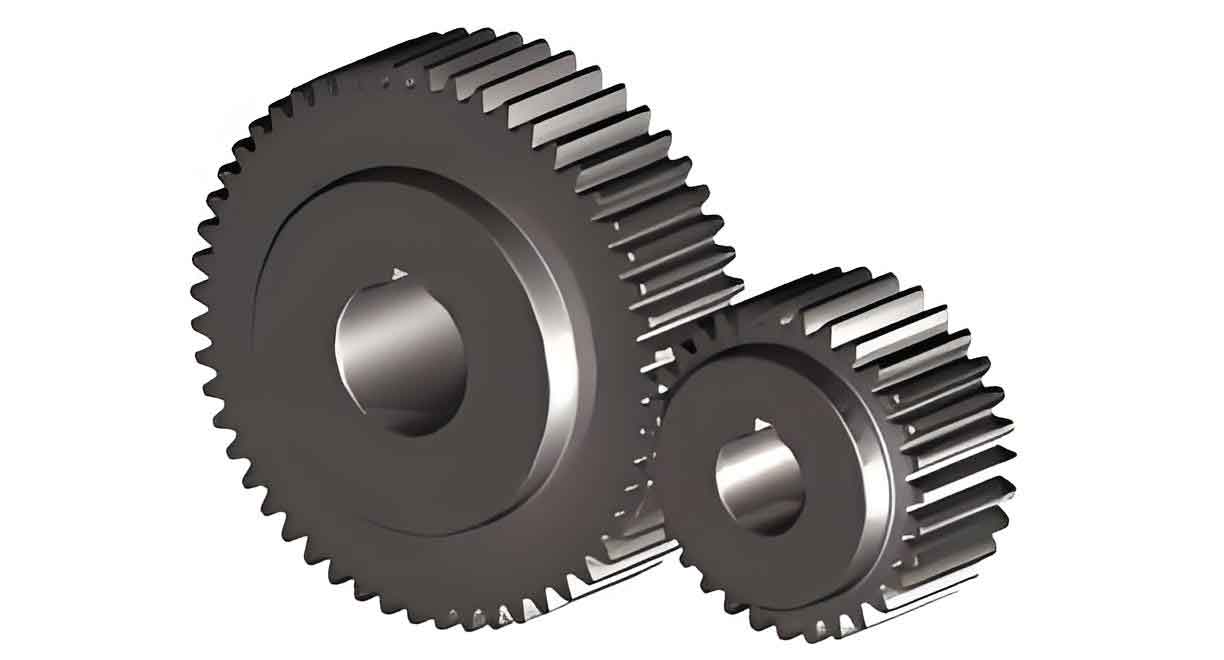
To understand the measurement principle, one must first grasp the fundamental geometry of involute spur gears. The involute curve is generated as the locus of a point on a taut string unwinding from a base circle. For a theoretical involute, the relationship between the roll angle increment $\Delta \phi$ (in degrees) and the corresponding arc length increment $\Delta g$ along the base circle is given by:
$$ \Delta g = \frac{2 \pi r_b}{360} \Delta \phi $$
where $r_b$ is the base circle radius of the spur gear. This equation forms the basis for error assessment: any deviation in the actual $\Delta g$ from this theoretical value at specified $\Delta \phi$ intervals constitutes tooth form error. In practice, for spur gears with module $m$ and pressure angle $\alpha$, the base radius is calculated as $r_b = \frac{m Z \cos \alpha}{2}$, where $Z$ is the number of teeth. This foundational relationship allows us to translate angular increments into linear displacements for comparison with measured data. The elegance of this principle lies in its simplicity, making it ideal for implementation on precision instruments like the 19JC microscope, where imaging can capture the actual tooth contour without physical contact.
The measurement method I propose involves several systematic steps. First, the spur gear specimen is cleaned and placed on the glass stage of the 19JC universal toolmaker’s microscope. A 3x objective lens is employed to magnify the tooth profile, ensuring clear imaging in the eyepiece. The microscope’s crosshair reticle (a米字刻线 in the original, but described here as a crosshair) is aligned to points on the tooth contour. Through manual adjustment of the X and Y stage movements, the center of the crosshair is brought into tangential contact with the tooth edge. A data acquisition system, connected to a computer, records the coordinates of these points. Specialized two-dimensional measurement software facilitates point capture, with care taken to sample points primarily along the active tooth flank of the spur gear, avoiding the tip relief and root regions. The distribution of points is denser near the pitch circle and sparser towards the tip and root, typically totaling under 20 points for a gear with module 5 mm to ensure accurate curve fitting. Additionally, the positioning circle of the spur gear (often the bore or a reference diameter) is measured using a three-point circle measurement function to establish a datum for subsequent analysis.
Once coordinate data is acquired, the actual tooth profile of the spur gear is reconstructed. I employ cubic spline interpolation to fit a smooth curve through the discrete points. Cubic splines ensure continuity in the first and second derivatives, which is essential for representing the functional surface of spur gears that undergo dynamic loading. The fitting process minimizes oscillations and provides a high-fidelity representation of the actual contour. Boundary conditions, such as tangent directions at the endpoints, are estimated based on the gear geometry to enhance accuracy. This numerical approach replaces the need for complex mechanical setups, reducing error sources inherent in traditional methods. The spline function $S(x)$ representing the tooth profile can be expressed piecewise over intervals $[x_i, x_{i+1}]$ as:
$$ S_i(x) = a_i + b_i(x – x_i) + c_i(x – x_i)^2 + d_i(x – x_i)^3 $$
where coefficients $a_i, b_i, c_i, d_i$ are determined from continuity and endpoint conditions. This mathematical model allows for precise calculation of coordinates at any point along the tooth, enabling detailed error evaluation against the theoretical involute.
For error assessment, the fitted curve is compared to the theoretical involute profile. Using computer-aided design software like AutoCAD, the actual profile curve is imported and analyzed. The process involves: (1) Determining the base circle radius $r_b$ from the gear parameters; (2) Selecting a roll angle increment $\Delta \phi$ (e.g., 2°); (3) Calculating the theoretical arc length increment $\Delta g_{\text{theory}}$ using the formula above; (4) Measuring the actual arc length increment $\Delta g_{\text{actual}}$ along the fitted curve corresponding to the same angular increment, with measurements taken relative to the gear’s center (established from the positioning circle); (5) Computing the tooth form error at each point as $\delta = \Delta g_{\text{actual}} – \Delta g_{\text{theory}}$. The maximum difference across the evaluated range gives the total tooth form error. This method leverages software precision, minimizing human error in reading and calculation.
To illustrate, I conducted a measurement on a spur gear from a local manufacturer (specifications: $Z=21$, $m=5$ mm, $\alpha=20°$). The base radius is $r_b = \frac{5 \times 21 \times \cos 20°}{2} \approx 49.30$ mm. With $\Delta \phi = 2°$, the theoretical $\Delta g$ is:
$$ \Delta g_{\text{theory}} = \frac{2 \pi \times 49.30}{360} \times 2 \approx 1.7221 \text{ mm} $$
Coordinate points were collected along one tooth flank, and a spline curve was fitted. In AutoCAD, the curve was arrayed circumferentially around the gear center at 2° intervals, and actual arc lengths were measured. The results are summarized in the table below, showing point-by-point errors and the overall error. For comparison, measurements from a 3004 universal gear measuring machine yielded similar results, validating the accuracy of this imaging-based method for spur gears.
| Measurement Point | Theoretical $\Delta g$ (mm) | Actual $\Delta g$ (mm) | Pointwise Error (μm) |
|---|---|---|---|
| 1 | 1.7221 | 1.7187 | -3.4 |
| 2 | 1.7221 | 1.7210 | -1.1 |
| 3 | 1.7221 | 1.7234 | 1.3 |
| 4 | 1.7221 | 1.7229 | 0.8 |
| 5 | 1.7221 | 1.7214 | -0.7 |
| 6 | 1.7221 | 1.7213 | -0.8 |
| 7 | 1.7221 | 1.7235 | 1.4 |
| 8 | 1.7221 | 1.7242 | 2.1 |
| 9 | 1.7221 | 1.7226 | 0.5 |
| 10 | 1.7221 | 1.7213 | -0.8 |
| 11 | 1.7221 | 1.7226 | 0.5 |
| 12 | 1.7221 | 1.7290 | 6.9 |
The total tooth form error, defined as the maximum range of pointwise errors, is $6.9 – (-3.4) = 10.3$ μm. This demonstrates the method’s capability to detect deviations in spur gears with high sensitivity. The process, from data acquisition to error computation, involves minimal manual intervention, primarily in point selection and curve fitting setup, thereby reducing subjective biases.
An essential aspect of any measurement technique is error analysis. For this imaging method on the 19JC microscope, the primary error sources include: (1) Imaging alignment error $\Delta_{\text{lim1}}$, typically ±0.75 μm as per instrument calibration; (2) Coordinate reading error $\Delta_{\text{lim2}}$ from the microscope scales, also ±0.75 μm; (3) Curve fitting error from spline interpolation, which I estimate to be within 2 μm given proper point distribution and boundary conditions; (4) Perpendicularity error between the gear’s reference face and its axis. For spur gears mounted directly on the stage, this can be negligible if the face is flat, but for higher accuracy, a dedicated fixture can be used to align the gear axis perpendicular to the optical axis. The combined uncertainty can be approximated by root-sum-square of these components, but in practice, the overall error is dominated by the fitting and alignment aspects. Notably, the theoretical advantage of zero probe diameter eliminates errors due to probe size compensation, which plagues contact methods for spur gears with small modules or delicate teeth.
To further elucidate the mathematical underpinnings, consider the involute function in parametric form. For a spur gear, the coordinates of a point on the theoretical involute are given by:
$$ x = r_b (\cos \theta + \theta \sin \theta) $$
$$ y = r_b (\sin \theta – \theta \cos \theta) $$
where $\theta$ is the roll angle in radians. The arc length from the start of the involute to a point corresponding to $\theta$ is $s = r_b \theta$. In measurement, we discretize $\theta$ into increments $\Delta \theta$ (converted to degrees for convenience), and the corresponding arc length increment is $\Delta s = r_b \Delta \theta$. Comparing this with the actual measured increments from the fitted curve yields the error. The spline fitting ensures that even between sampled points, the profile is accurately represented, which is crucial for spur gears where smooth transmission requires continuous tooth flanks.
In terms of practicality, this method is highly suitable for spur gears, especially those with small to medium modules. The 19JC microscope offers a versatile platform, but the technique can be adapted to other imaging systems with sufficient resolution. Key advantages include: Short measurement travel since only a single tooth flank is imaged, unlike generating methods that require full rotation; Non-contact nature preserves gear surface integrity, important for finished spur gears; Automated data processing reduces human error; High precision from imaging magnification and numerical fitting. Limitations include dependency on optical clarity—dust or oil on the gear can affect imaging—and the need for a flat reference surface for mounting. However, for most industrial spur gears, these are manageable.
Beyond basic error measurement, this approach can be extended for comprehensive gear analysis. For instance, by measuring multiple teeth on a spur gear, one can assess pitch errors and runout. The spline-fitted profiles can be used to compute modifications like tip relief or root fillets, aiding in design validation. Additionally, integrating this with software for tolerance stack analysis can help in quality control for gear assemblies. The flexibility of imaging makes it applicable to various gear types, though my focus remains on spur gears due to their widespread use.
In conclusion, the imaging-based method on a universal toolmaker’s microscope presents a robust alternative for measuring tooth form error in involute spur gears. By combining optical magnification, coordinate measurement, and spline curve fitting, it addresses the shortcomings of traditional techniques. The method’s precision, minimal manual intervention, and theoretical zero-probe diameter make it particularly valuable for quality assurance in gear manufacturing. Future work could involve automating the point selection process using image recognition algorithms, further reducing human input. As spur gears continue to be integral in machinery, advancing measurement technologies like this will contribute to higher performance and reliability. I believe this approach not only enhances metrological capabilities but also underscores the importance of innovative thinking in precision engineering.
Throughout this discussion, the significance of spur gears has been emphasized repeatedly—from their geometric properties to measurement challenges. The developed method, with its emphasis on accuracy and efficiency, is poised to become a valuable tool for engineers and metrologists working with these fundamental components. By leveraging existing microscope infrastructure, it offers a cost-effective solution for small-batch production or laboratory analysis, ensuring that spur gears meet the stringent demands of modern mechanical systems.