
As one of the most widely used transmission forms, spur gears offer numerous advantages such as accurate transmission ratio, compact structure, high efficiency, reliability, and long service life, playing a critical role in mechanical systems. However, during operation, the alternating single and double tooth meshing and changes in mesh position cause the mesh stiffness of spur gears to exhibit periodic variations. When tooth faults occur, they primarily affect the dynamic characteristics of the system by altering the time-varying mesh stiffness (TVMS). Therefore, studying changes in TVMS can reflect the severity of gear faults. Tooth pitting, as one of the most common faults in spur gear transmissions, results from local stress concentration on the tooth surface, leading to fatigue脱落 and directly impacting the TVMS of the spur gear pair, thereby changing the system’s dynamic behavior.
In this article, I present a comprehensive analysis of the effects of tooth pitting on the TVMS and vibration response of spur gears. Based on the potential energy method, I model pitting defects as part of ellipsoidal cylinders and define three damage levels—slight pitting, moderate pitting, and severe pitting—based on the distribution and number of pits. I calculate the TVMS for both healthy and pitted spur gears, discuss the influence of pitting position and size on stiffness, and investigate the dynamic response of a single-stage spur gear transmission system through simulation and experimental validation. The findings provide theoretical insights for the detection and diagnosis of tooth pitting in spur gears, emphasizing the importance of understanding stiffness variations in fault analysis.
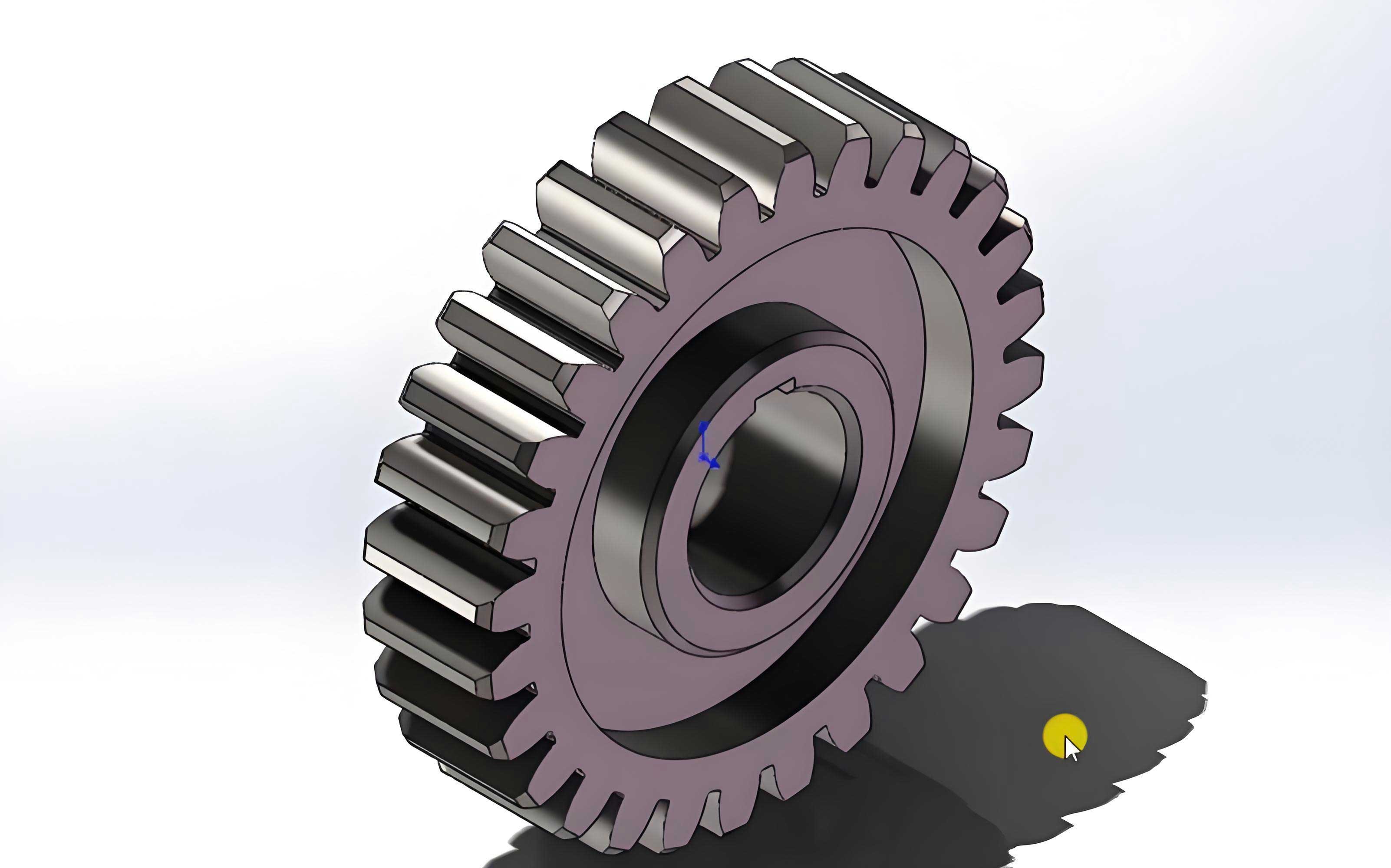
Spur gears are integral components in many mechanical systems due to their simplicity and efficiency. The meshing process in spur gears involves periodic engagement and disengagement of teeth, which inherently leads to time-varying stiffness. This stiffness is a key parameter influencing the dynamic response, including vibrations and noise. When pitting occurs on the tooth surface of spur gears, it introduces localized defects that reduce the effective contact area and alter the stiffness characteristics. Pitting typically initiates due to fatigue under cyclic loading, and its progression can significantly degrade the performance of spur gears. Understanding how pitting affects TVMS is crucial for predictive maintenance and fault diagnosis in applications involving spur gears, such as automotive transmissions, industrial machinery, and wind turbines.
To model tooth pitting in spur gears, I approximate each pit as part of an ellipsoidal cylinder. This geometry is chosen because it better matches the actual pitting morphology observed in experiments and real-world applications, compared to simpler shapes like rectangles or spheres. The pitting region is considered as a union of multiple ellipsoidal cylinders, accounting for potential overlaps between pits. Based on the position and quantity of pits on the tooth surface of spur gears, three damage levels are defined: slight pitting, moderate pitting, and severe pitting. For slight pitting, a limited number of pits are distributed near the pitch line; moderate pitting involves more pits extending toward the tooth tip; and severe pitting includes extensive pitting coverage across multiple regions. The geometric parameters of each pit include the major axis length \(2a\), minor axis length \(2b\), and depth \(\delta\), as illustrated in the model for spur gears.
The TVMS calculation for spur gears is based on the potential energy method, which considers the energy stored due to various deformation components: Hertzian contact energy, bending strain energy, shear strain energy, axial compressive strain energy, and gear body flexibility energy. Each tooth of the spur gear is treated as a cantilever beam with a variable cross-section starting from the base circle. For a healthy spur gear, the TVMS is derived from the stiffness contributions of these components. When pitting is present on a tooth of the driving spur gear—assuming other teeth and the driven gear are healthy—the effective tooth width, cross-sectional area, and moment of inertia are reduced, leading to changes in the stiffness values.
Let me define the parameters for the spur gear pair. The gear parameters are summarized in Table 1, which includes the number of teeth, modulus, pressure angle, and material properties. These parameters are essential for calculating the TVMS in spur gears.
| Parameter | Driving Gear | Driven Gear |
|---|---|---|
| Number of Teeth, \(z\) | 19 | 48 |
| Elastic Modulus, \(E\) (GPa) | 206.8 | 206.8 |
| Poisson’s Ratio, \(\nu\) | 0.3 | 0.3 |
| Module, \(m\) (mm) | 3.2 | 3.2 |
| Addendum Coefficient, \(h_a^*\) | 1 | 1 |
| Dedendum Coefficient, \(c^*\) | 0.25 | 0.25 |
| Face Width, \(L\) (mm) | 16 | 16 |
| Pressure Angle, \(\alpha_0\) (degrees) | 20 | 20 |
For a healthy spur gear, the Hertzian contact stiffness \(k_h\), bending stiffness \(k_b\), shear stiffness \(k_s\), axial compressive stiffness \(k_a\), and gear body flexibility stiffness \(k_f\) are calculated as follows. The total TVMS for a single tooth pair in mesh is given by:
$$ k_t = \left( \frac{1}{k_{h1}} + \frac{1}{k_{b1}} + \frac{1}{k_{s1}} + \frac{1}{k_{a1}} + \frac{1}{k_{f1}} + \frac{1}{k_{h2}} + \frac{1}{k_{b2}} + \frac{1}{k_{s2}} + \frac{1}{k_{a2}} + \frac{1}{k_{f2}} \right)^{-1} $$
where subscripts 1 and 2 refer to the driving and driven spur gears, respectively. For two tooth pairs in mesh, the effective TVMS is the sum of the stiffnesses of each pair.
When pitting exists on a tooth of the driving spur gear, the reductions in tooth width \(\Delta L\), cross-sectional area \(\Delta A_x\), and moment of inertia \(\Delta I_x\) are computed based on the pitting geometry. For example, for slight pitting with pits distributed symmetrically around the pitch line, the tooth width reduction is:
$$ \Delta L = 2\Delta L^- + 7\Delta L^\sim $$
where \(\Delta L^-\) and \(\Delta L^\sim\) are functions of the position \(x\) along the tooth height, defined in terms of the pitting parameters \(a\), \(b\), and the distance from the base circle \(u\). The effective cross-sectional area \(A_{x\_pit}\) and moment of inertia \(I_{x\_pit}\) are:
$$ A_{x\_pit} = A_x – \Delta A_x, \quad \Delta A_x = \Delta L \cdot \delta $$
$$ I_{x\_pit} = I_x – \Delta I_x, \quad \Delta I_x = \frac{1}{12} \Delta L \delta^3 + \frac{A_x \Delta A_x (h_x – \delta/2)^2}{A_x – \Delta A_x} $$
Here, \(h_x\) is the distance from the neutral axis. The stiffness components for the pitted tooth are then modified. For instance, the Hertzian contact stiffness for the pitted region becomes:
$$ \frac{1}{k_{h\_pit}} = \frac{4(1-\nu^2)}{\pi E (L – \Delta L)} \quad \text{for } x \in (u-b, u+b) \cup (u+b, u+3b) $$
and remains unchanged elsewhere. Similarly, the bending stiffness is adjusted by integrating over the reduced moment of inertia:
$$ \frac{1}{k_{b\_pit}} = \frac{2}{F^2} \int_0^d \frac{[F_b(d-x) – F_a h]^2}{2E I_{x\_pit}} dx $$
for the pitted regions, where \(F\) is the mesh force, \(F_b\) and \(F_a\) are force components, and \(d\) is the distance from the base circle to the load point. The shear and axial compressive stiffnesses are modified analogously based on \(A_{x\_pit}\). The gear body flexibility stiffness \(k_f\) is assumed unaffected by pitting and calculated using the standard formula for spur gears:
$$ \frac{1}{k_f} = \frac{\cos^2 \alpha_1}{EL} \left[ L^* \left( \frac{u_f}{s_f} \right)^2 + M^* \left( \frac{u_f}{s_f} \right) + P^* (1 + Q^* \tan^2 \alpha_1) \right] $$
where \(u_f\) and \(s_f\) are geometric parameters, and \(L^*, M^*, P^*, Q^*\) are coefficients dependent on the gear geometry of spur gears.
To analyze the impact of pitting on TVMS in spur gears, I consider variations in pitting position and size. The pitting position parameter \(u\) represents the distance from the base circle to the center of the pitting region. As \(u\) increases, the pitted area moves from near the base circle toward the tooth tip in spur gears. The TVMS reduction is more pronounced when pitting occurs in regions of high contact stress, such as near the pitch line. The pitting size parameters \(a\) and \(b\) affect the stiffness differently: increasing the major axis length \(a\) reduces the effective tooth width, leading to a greater decrease in TVMS, whereas increasing the minor axis length \(b\) extends the pitting area along the tooth height but does not change the stiffness reduction magnitude per angular displacement range.
I calculate the TVMS for healthy spur gears and spur gears with different pitting levels over the angular displacement \(\theta_1\) of the driving gear. The results are summarized in Table 2, which shows the percentage reduction in TVMS at key angular positions for slight, moderate, and severe pitting in spur gears.
| Angular Displacement \(\theta_1\) (degrees) | Healthy Spur Gear TVMS (N/m) | Slight Pitting Reduction (%) | Moderate Pitting Reduction (%) | Severe Pitting Reduction (%) |
|---|---|---|---|---|
| 15.64 | 2.1e8 | 5.2 | 10.3 | 10.3 |
| 17.99 | 2.3e8 | 0.1 | 0.1 | 0.1 |
| 20.05 | 2.4e8 | 2.1 | 2.1 | 15.7 |
| 31.17 | 1.9e8 | 0.0 | 0.0 | 0.0 |
The TVMS variation with angular displacement is plotted using the following equation for the pitted spur gear:
$$ k_t(\theta_1) = k_{t\_healthy} – \Delta k(\theta_1) $$
where \(\Delta k(\theta_1)\) is the stiffness reduction function dependent on pitting parameters. For severe pitting, the reduction is modeled as:
$$ \Delta k(\theta_1) = \begin{cases}
k_0 \cdot \left( \frac{\theta_1 – \theta_a}{\theta_b – \theta_a} \right) & \text{for } \theta_a \leq \theta_1 \leq \theta_b \\
k_0 \cdot \left( \frac{\theta_c – \theta_1}{\theta_c – \theta_b} \right) & \text{for } \theta_b < \theta_1 \leq \theta_c \\
0 & \text{otherwise}
\end{cases} $$
Here, \(\theta_a = 15.64^\circ\), \(\theta_b = 17.99^\circ\), \(\theta_c = 20.05^\circ\), and \(k_0\) is a constant based on pitting severity. This piecewise function captures the entry and exit of teeth into pitted regions in spur gears.
The influence of pitting position on TVMS is further analyzed by varying \(u\) from 1.5 mm to 2.3 mm. As \(u\) increases, the pitting region shifts toward the tooth tip, and the stiffness reduction occurs at larger angular displacements. The relationship can be expressed as:
$$ \Delta k_{pos}(u) = \alpha \cdot e^{-\beta (u – u_0)^2} $$
where \(\alpha\) and \(\beta\) are constants, and \(u_0\) is the reference position. This Gaussian-like decrease reflects that pitting near the pitch line has the most significant impact on TVMS in spur gears due to higher contact forces.
Regarding pitting size, the major axis length \(a\) affects the tooth width reduction linearly. The stiffness reduction due to \(a\) is:
$$ \Delta k_{size\_a}(a) = \gamma \cdot a $$
where \(\gamma\) is a proportionality constant. For the minor axis length \(b\), the reduction is independent of \(b\) over the same angular range, as it only alters the pitting extent along the tooth height without changing the effective width during meshing. However, if \(b\) increases significantly, the pitting may cover a larger portion of the tooth profile, potentially affecting multiple meshing cycles in spur gears.
To study the dynamic response, I incorporate the TVMS model into a four-degree-of-freedom dynamic model for a spur gear pair, considering torsional vibrations of the gears and vertical translational vibrations of the support system. The equations of motion are:
$$ I_1 \ddot{\theta}_1 + c_1 \dot{\theta}_1 + k_t(t) r_1^2 (\theta_1 – \theta_2) = T_1 $$
$$ I_2 \ddot{\theta}_2 + c_2 \dot{\theta}_2 + k_t(t) r_2^2 (\theta_2 – \theta_1) = -T_2 $$
$$ m_1 \ddot{y}_1 + c_{y1} \dot{y}_1 + k_{y1} y_1 = F_{y1} $$
$$ m_2 \ddot{y}_2 + c_{y2} \dot{y}_2 + k_{y2} y_2 = F_{y2} $$
where \(I_1\) and \(I_2\) are moments of inertia, \(c\) are damping coefficients, \(r\) are base radii, \(T\) are torques, \(m\) are masses, \(y\) are vertical displacements, and \(F_y\) are forces. The time-varying mesh stiffness \(k_t(t)\) is derived from the angular displacement \(\theta_1\) for both healthy and pitted spur gears.
I simulate the system with an input shaft frequency of 30 Hz and analyze the frequency spectrum of the vertical acceleration response. For healthy spur gears, the spectrum is dominated by the mesh frequency \(f_m\) and its harmonics. When pitting is present in spur gears, sidebands appear around the mesh frequency and its harmonics, spaced at the input shaft frequency. The amplitude of these sidebands increases with pitting severity. The sideband amplitude \(A_{sb}\) can be modeled as:
$$ A_{sb} = A_0 + \eta \cdot S $$
where \(A_0\) is the baseline amplitude, \(\eta\) is a constant, and \(S\) is a pitting severity index defined as \(S = n_p \cdot \bar{a} \cdot \bar{b}\), with \(n_p\) being the number of pits and \(\bar{a}, \bar{b}\) normalized size parameters.
Experimental validation is conducted using a drivetrain dynamics simulator with a single-stage spur gear reducer. Accelerometers are mounted on the bearing housings to measure vertical vibrations. The test spur gears include healthy ones and those with artificial pitting defects created by electric discharge machining. The measured frequency spectra confirm the simulation results: pitting in spur gears introduces sidebands around the mesh frequency, and their amplitudes grow with damage level. Table 3 summarizes the experimental sideband amplitudes for different pitting levels in spur gears at the mesh frequency \(f_m = 570\) Hz (calculated from gear teeth and shaft speed).
| Pitting Level | Sideband Amplitude at \(f_m \pm 30\) Hz (m/s²) | Increase Relative to Healthy Spur Gears (%) |
|---|---|---|
| Healthy | 0.05 | 0 |
| Slight | 0.12 | 140 |
| Moderate | 0.28 | 460 |
| Severe | 0.45 | 800 |
The dynamic response can also be analyzed using statistical indicators. For instance, the root mean square (RMS) of the acceleration signal increases with pitting severity in spur gears. The relationship is approximately linear:
$$ \text{RMS} = \text{RMS}_0 + \lambda \cdot S $$
where \(\text{RMS}_0\) is the RMS for healthy spur gears and \(\lambda\) is a constant. This provides a simple metric for monitoring pitting progression in spur gears.
In conclusion, tooth pitting significantly affects the time-varying mesh stiffness and vibration response of spur gears. The ellipsoidal cylinder model for pitting accurately captures the stiffness reduction, which depends on pitting position and size. As pitting severity increases, the TVMS decreases more substantially, leading to enhanced sideband activity in the frequency spectrum. These findings underscore the importance of TVMS analysis for fault diagnosis in spur gears. Future work could explore the effects of pitting on other gear types or under varying operating conditions, but for spur gears, the presented model offers a reliable tool for predicting dynamic behavior and facilitating early fault detection. The integration of simulation and experimental data validates the approach, highlighting the robustness of the stiffness-based analysis for spur gear systems.
To further elaborate, the potential energy method for calculating TVMS in spur gears can be extended to include more complex pitting patterns, such as random distributions or evolving pits. The stiffness reduction formulas can be refined by considering the exact geometry of the pits in three dimensions, but the ellipsoidal approximation suffices for most practical applications involving spur gears. Additionally, the dynamic model can be enhanced by incorporating nonlinearities like backlash or friction, which may interact with pitting effects in spur gears. However, the core insight remains: pitting directly impacts stiffness, and monitoring stiffness variations through vibration analysis is key to maintaining the health of spur gear transmissions.
In summary, this study provides a comprehensive framework for analyzing the influence of tooth pitting on spur gears, from modeling and stiffness calculation to dynamic response and experimental validation. The repeated emphasis on spur gears throughout the analysis ensures clarity on the application context, and the use of formulas and tables facilitates understanding of the quantitative relationships. As spur gears continue to be vital components in machinery, such research contributes to improved reliability and efficiency in mechanical systems.